The Medicine Bag: Personal Object of Power and Protection of the Plains Peoples
By Ralf Ittermann · last reviewed on
The medicine bag, referred to in English-language scholarship as a medicine bundle, is a personal or communal container made of leather or cloth in which the Plains peoples of North America keep objects of ritual significance. Its contents are regarded by their bearers as a source of power, orientation and protection.
The German term Medizin here translates the English word medicine, which in turn renders an Indigenous concept of spiritual potency and is not to be understood in the sense of European medical science.
From the external perspective of religious studies, the medicine bag can be described as an object that brings together individual piety, mythical narrative and social order. Much about its contents deliberately remains private and belongs solely to the respective bearers and communities.
Classification of the Medicine Bag
The medicine bag is among the most frequently mentioned and at the same time most strongly misunderstood objects of the Indigenous religions of North America. Researchers use the English expression medicine bundle because the German word Beutel renders the variety of forms only incompletely.
What is meant is a bound-together ensemble of objects wrapped or sewn into a container. The German designation Medizinbeutel has nevertheless become established and is used here as well.
The word medicine goes back to the English rendering with which travellers and traders translated an Indigenous concept. This concept denotes a spiritual potency that can dwell in persons, animals, places and objects. A translation as remedy therefore falls short. The medicine bag is not a pharmacy container but a religious object.
Geographically, the focus of the documented tradition lies in the Great Plains of North America, that is, in the area of present-day US states such as Montana, North and South Dakota, Wyoming and Nebraska, as well as in adjacent parts of Canada.
Peoples such as the Lakota, Cheyenne, Blackfoot, Crow, Arapaho and Pawnee each have their own bundling traditions.
Within these traditions a distinction must be drawn between personal and communal bundles. A personal bundle accompanies a single individual, whereas a communal bundle belongs to a group, a clan or an entire people and is kept by appointed keepers. Both forms follow their own respective rules.
The medicine bag belongs to the wider context of the protective symbols, but it differs from a mere ornamental or lucky object. Its meaning is accessible only through the narratives, songs and rules of conduct connected with it. Without this context it remains a plain leather bundle.
For a factual account it is important that many details about contents and use are deliberately not published. This text describes what is documented in the scholarly literature and has been released by Indigenous authors, and it refrains from any instructions for reproduction.
Origin and History
The practice of ritual bundling is ancient in North America, yet its precise beginnings cannot be dated. Archaeological finds of combined groups of objects and ethnographic reports from the eighteenth and nineteenth centuries suggest that the tradition existed long before contact with Europeans. Written sources begin only with the records of travellers and traders.
In the nineteenth century, Indian agents, missionaries and early ethnologists documented numerous bundles, often without grasping their religious meaning. During this period the Great Plains experienced profound upheavals through the fur trade, smallpox epidemics, the disappearance of the bison herds and forced removal to reservations. These upheavals also changed the way the bundles were handled.
With reservation policy and the prohibition of numerous ceremonies, many bundle traditions came under pressure. Some bundles were hidden, others passed on to relatives, and still others handed under coercion or through sale into the hands of collectors and museums. The history of the medicine bag is therefore inseparably bound up with the colonial past.
A well-known example of a communal bundle is the Sacred Pipe Bundle of the Lakota, linked to the narrative of the White Buffalo Calf Woman. Such bundles have a designated keeper and are passed on over generations. They are not private possessions.
In the twentieth century, the religious freedom laws of the United States and Canada led to a gradual revival of prohibited practices. The American Indian Religious Freedom Act of 1978 marks an important legal turning point here. Many communities openly took up their bundle traditions again.
In parallel, museums and communities began to negotiate over the return of bundles. The Native American Graves Protection and Repatriation Act of 1990 created a legal framework for this in the United States. Several significant bundles have since returned to the care of their peoples of origin.
Form, Material and Manufacture
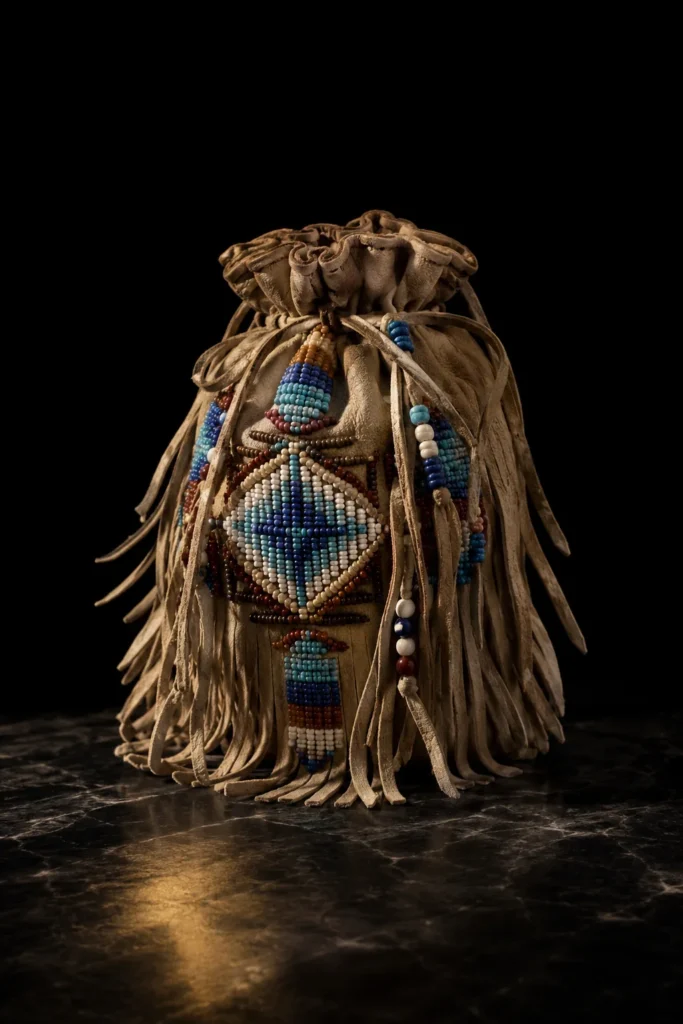
In its outer form, a medicine bag consists of a covering, frequently made of tanned leather from bison, deer or antelope, and more rarely of cloth. The covering may be a simple bag with a drawstring or a flat package laced together with thongs. The size and the elaborateness of the decoration vary considerably.
Decorations range from painting through porcupine quillwork to glass beadwork, which became widespread in the nineteenth century. Some coverings bear geometric patterns, others figurative depictions of animals or celestial signs. The design follows regional and personal conventions.
The contents of a bundle differ according to bearer and purpose and are described only with restraint in the scholarly literature. Among the items mentioned are feathers, stones, dried plant parts, animal parts, pigments and small carved figures. Each object refers to a narrative or an encounter.
The composition of a personal bundle often goes back to a dream vision or a vision quest. The instructions received in the vision determine which objects are to be included and which rules apply. A bundle therefore comes into being not through free choice but through a directive experienced as binding.
Communal bundles are opened, cleansed and rebound on appointed occasions. This procedure is itself a ritual with songs and prayers. Knowledge of the correct sequence is among the tasks of the keeper and is passed on only to successors.
This text deliberately gives no precise construction guide. The making of a bundle is bound to narratives, songs and entitlements that are not available outside the respective community. A reproduction without this foundation would be an appropriation of the outer form without its meaning.
Religious and Mythological Background
The religious basis of the medicine bag is the notion of a continuous spiritual potency that connects all areas of the world. Among the Lakota, this all-encompassing reality is addressed with the term Wakan Tanka, which can be translated only inadequately as Great Mystery. Other Plains peoples use their own terms.
The medicine bag is regarded as a place where a person stands in an ordered relationship with this potency. The objects kept within it are not symbols in a purely pictorial sense but bearers of a connection, experienced as real, to animals, natural forces and ancestors. This connection is established through the vision.
Many bundles are linked to narratives about their origin. Communal bundles often possess a detailed founding narrative that recounts how a spirit being or a mythical figure handed the bundle to the people. This narrative legitimises its use.
Animals play a prominent role in these narratives. Bison, bear, eagle, beaver and other animals appear as teachers and helpers who meet a person in the vision. An object in the bundle can recall such an encounter and keep it permanently present.
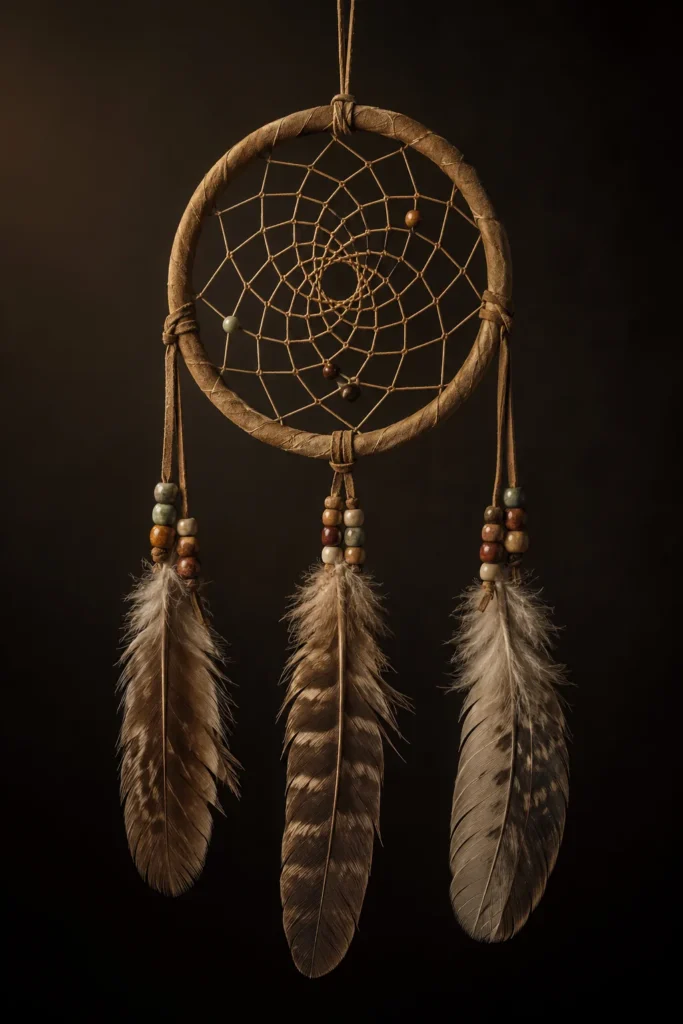
The medicine bag is thus part of a wider field of ritual objects, to which the dreamcatcher and other protected objects also belong. Contrary to what popular accounts suggest, however, these objects do not form a uniform system but each belong to particular peoples and contexts.
It is important to recognise that the religious meaning does not reside in the object itself but in the relationship between bearer, narrative and community. A bundle without this relationship loses its meaning for the culture of origin, even if it remains outwardly unchanged.
Ritual Use and Bearers
The handling of a medicine bag follows fixed rules of conduct laid down in the vision or through tradition. These include prescriptions about who may touch the bundle, when it is opened and which foods or activities are to be avoided in its vicinity. These rules are binding.
Personal bundles accompany their bearer through important phases of life. They may be drawn upon during the vision quest, before difficult tasks or in times of illness. The bearer tends the bundle through prayers, songs and smudging, for instance with sage or sweetgrass.
Communal bundles are used at annual festivals, at the Sun Dance ceremony or on special occasions such as war, the conclusion of peace or harvest. Their keeper bears great responsibility and is himself subject to strict rules of life. The office of keeper may be inherited or transferred through a ceremony.
The handing over of a bundle is a ritual procedure in its own right. It takes place not through sale but through a ceremonial transfer in which the new bearer is introduced to the duties and narratives. An unauthorised transfer is regarded as a grave breach.
Women and men can be bearers or keepers depending on the people and the type of bundle. Some bundles are expressly bound to one gender or to particular societies. Research warns against generalising here, since the rules differ from people to people.
When a bearer grows old or dies, separate prescriptions govern the fate of the bundle. It may pass to a successor, be buried with the deceased or be dissolved in a prescribed manner. The proper conclusion of a bundle is regarded as just as important as its creation.
Regional Variants and Related Forms
Within the Great Plains, the bundle traditions differ considerably. The Blackfoot have, among other things, beaver bundles and bundles connected with the weather and the cycle of the year. Among the Pawnee, bundles are closely linked to the observation of the stars and to the planting of maize.
The Lakota and Dakota connect certain communal bundles with the Sacred Pipe and with the Sun Dance ceremony. Among the Cheyenne, two great tribal bundles hold a central position, their keeping bound to particular families. Each of these traditions has its own narratives.
Comparable practices also exist outside the Great Plains. Peoples of the eastern Woodlands and of the Southwest likewise have ritual bundles, though these possess their own forms and meanings. A blanket equation of all Indigenous bundles is therefore not permissible.
In religious-studies terms, communal bundles can be compared with other safeguarded sacred objects, for instance with relics or with cult objects bound to designated keepers. Such comparisons serve to provide classification but must not obscure the distinctiveness of the Indigenous traditions.
Personal bundles stand in a line with other protective objects worn on the body worldwide. Those interested in this wider context will find a conceptual clarification in the article on amulet and talisman. The medicine bag is one example within this broad field.
Related but not identical are small sewn leather pouches that contain individual protective objects and are worn on the body. Such pouches are attested in several Plains cultures. They form, in a sense, a reduced version of the personal bundle.
Meaning as a Protective Object
From the internal view of many Plains peoples, the medicine bag is regarded as protective because it establishes an ordered relationship with spiritual powers.
The protection is not understood as a mechanical effect but as the consequence of a right relationship between human, spirit being and community. The bundle is both sign and means of this relationship.
In religious-studies terms, this conception of protection can be described as a form of coping with uncertainty. In a life world shaped by hunting, war, illness and weather, the bundle offered orientation and the sense of not acting without support. It structured the relationship to the world.
The protection is directed, depending on the bundle, toward different domains. Some bundles are associated with healing, others with success in the hunt, with the protection of the community or with the success of important undertakings. These purposes are laid down in the founding narratives.
This text expressly makes no claims about actual effects. From a scholarly standpoint, only the meaning that the bearers ascribe to the object can be described, not whether this ascription describes an effect that goes beyond belief. Promises of healing are excluded.
The social dimension of protection is also important. A communal bundle does not protect an individual but binds a group together and reminds it of its origin and its duties. The protection here also consists in the cohesion of the community.
Finally, the protection is coupled with obligations. Whoever carries a bundle must observe its rules. A breach of these rules is regarded as dangerous, because it disturbs the order on which the protection rests. In this conception, protection and responsibility are inseparable.
History of Research, Ethical Questions and Cultural Appropriation
Scholarly engagement with the medicine bag began in the nineteenth century with the records of travellers and early ethnologists. Researchers such as Clark Wissler and George Bird Grinnell collected extensive reports, yet often interpreted the bundles within their own, evolutionist assumptions.
A dark chapter of this research history is the appropriation of bundles for museums. Numerous bundles came into European and North American collections under coercion, through deception or through sales made in hardship. Many of these objects were communal sacred items whose removal was experienced as a grave loss.
Today, the principle holds in ethnology that, regarding protected contents, only what the communities of origin release is published. Some details of bundle contents and the associated songs are deliberately not intended for the public. This restriction is respected and not understood as a deficiency.
The cultural appropriation of the medicine bag by the esoteric and wellness industry is an ethical problem in its own right. Bundles sold without any connection to a community, do-it-yourself instructions and commercial seminars detach the object from its meaning and are rejected as hurtful by many Indigenous voices.
Repatriation, that is, the return of bundles to their peoples of origin, has been an important concern since the 1990s. The Native American Graves Protection and Repatriation Act created a legal framework for this in the United States. Several tribal bundles have since returned from museums.
For a serious account, this gives rise to a clear stance. The medicine bag is described here from the external perspective of religious studies, without instructions for reproduction and without any claim to disclose protected knowledge. Those who wish to explore the subject further should first read Indigenous authors.
Present-Day Reception
Within the peoples of origin, bundle traditions are today often openly practised again. After decades of prohibitions and of concealed transmission, ceremonial practice has been revived in several communities. Keepers and bearers pass their knowledge on to younger generations.
This revival is part of a broader cultural renewal that also encompasses language, songs and land rights. The medicine bag here stands for the continuity of a tradition that has not been severed despite colonial oppression. Its return from museums is understood as a symbolic act.
In popular culture outside the Indigenous communities, the term medicine bag is widely used and often distorted. Films, novels and advertising employ it as a cliché of Native American spirituality. These images mostly have little in common with actual practice.
The esoteric industry offers bags, instructions and seminars that appeal to Indigenous models. In religious-studies terms, this is a distinct, modern form of reception that is to be clearly separated from the tradition of the peoples of origin. It follows the rules of a global market of spiritual offerings.
Museums have changed their handling of bundles. Many institutions no longer display sacred bundles, consult with the communities of origin and grant their representatives access. Some bundles are kept by agreement, others returned.
For interested readers, a restrained approach to the subject is advisable. To acquire knowledge about the medicine bag is legitimate, but to imitate its practice is not. A respectful attitude begins with acknowledging the limits of what is publicly accessible. Further protective objects are presented in the protective symbols section.
Literature (Selection)
Related key terms: medicine bag medicine bundle Plains Indians Lakota Cheyenne Blackfoot vision quest Sun Dance Wakan Tanka sacred bundle Indigenous religion repatriation.
iWell Guard and Protective Traditions
iWell Guard stands in the cultural-historical line of portable protective objects, to which the medicine bag also belongs. A modern companion for people who live with protective symbols: made in Germany, 41 layers of solid gold, platinum and silver, with a 30-day right of return.
Personal experiences may vary. Not a medical device. No promise of healing.