The Mirror as a Means of Defense: Sending Evil Back
By Ralf Ittermann · last reviewed on
The mirror is among the most widespread objects to which a defensive meaning is attributed. The underlying idea is that of sending the harm back: a harmful influence is meant to be reflected at the mirroring surface and to return to its point of origin.
This article places the defensive mirror within the field of religious studies and traces its history from antiquity to its reception today. In doing so, it distinguishes between historically documented custom and modern interpretation.
The mirror as a means of defense is meant to send evil back to its sender.
Classification: What the Defensive Mirror Is
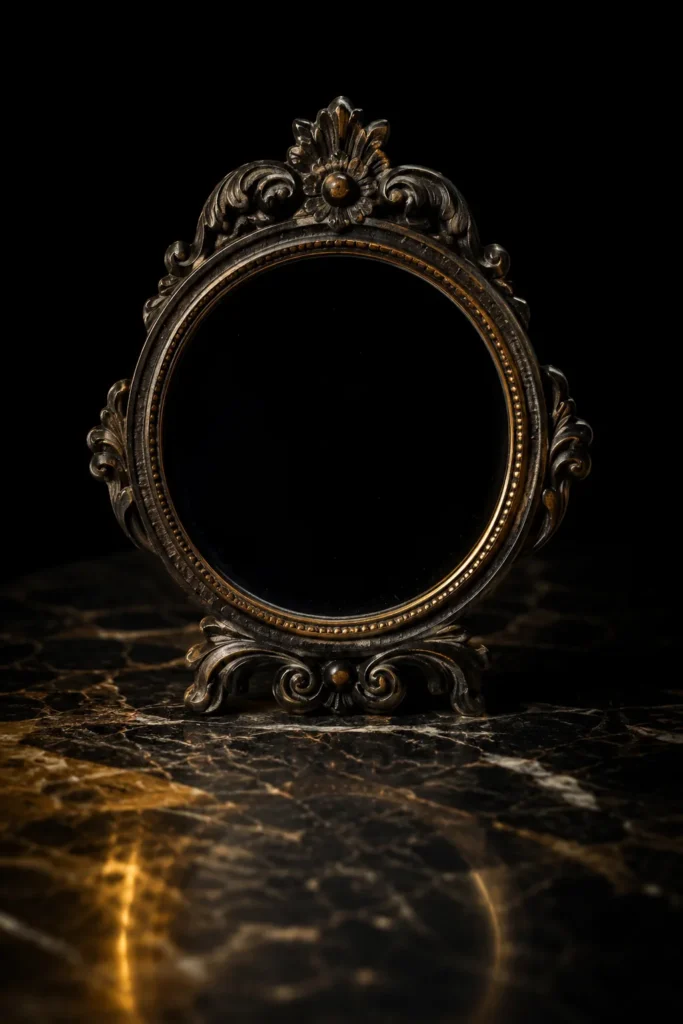
The defensive mirror is a mirror or a reflecting surface to which a protective function is attributed. It is placed on houses, on doors, on windows, or on the body, and is meant to ward off harmful influences.
The basic idea is that of throwing-back. A mirror reflects the light and the image that fall upon it. This everyday property was transferred to the notion that a harmful influence, too, could be thrown back.
Often the defensive mirror is directed against the gaze regarded as harmful, which is understood in many cultures as a source of misfortune. The mirror is meant to send this gaze back to its point of origin.
The forms range from the small mirror sewn into fabric or jewelry to the large mirror fixed to the wall of a house. Polished metal surfaces and shining objects were also used in this function.
Among the protective symbols, the mirror belongs to the group of defensive objects that are interpreted not through a pictorial motif but through a physical property. This property is reflection.
The defensive mirror thus stands between object and symbol. It is a real mirror with real reflection, to which at the same time a meaning beyond optics is attributed.
The defensive mirror is closely linked with the notion of the gaze regarded as harmful, which is widespread in many cultures. This gaze is held to be something that proceeds from a person and strikes a target. The mirror takes up precisely this notion by seeking to deflect the gaze back.
Origin and Historical Depth of the Defensive Mirror
Mirrors have been known since early prehistory, first as polished stones and metal surfaces, later as glass mirrors. From early on, a meaning was associated with the mirror that went beyond mere reflection of an image.
From the ancient Near East and from Egypt, mirrors are known as objects with cultic significance. They appear in graves and in the temple sphere, which assigns them a role beyond their everyday function.
In China the mirror has a particularly deep history. Bronze mirrors were produced from the early Bronze Age, often furnished with cosmological patterns on the back, and were regarded as significant objects.
From China also comes the best-known defensive mirror, the octagonal mirror with a frame of symbols that is placed above doors. It is treated in detail in the article on the bagua mirror.
In Europe the glass mirror spread from the late Middle Ages onward. Numerous customs and notions became associated with it, some of which take up the defensive interpretation.
On the whole it is evident that in many cultures the mirror was given a meaning that went beyond the reflection of an image. The defensive interpretation is one part of this broad field of meaning.
With the spread of the Venetian glass mirror in the early modern period, the mirror became generally accessible and drew numerous new notions to itself. The clear, even glass mirror replaced the older metal mirrors and shaped the handling of the object. Many of the transmitted mirror customs were tied to this broad change.
The Underlying Notion of Throwing-Back
The conceptual core of the defensive mirror is the notion of throwing-back. A mirror visibly reflects what strikes it. This visible property became the basis of a transferred interpretation.
In many cultures it is assumed that harmful influences proceed from a source and are directed at a target. When such an influence strikes a mirror, according to this notion it is not meant to penetrate but to turn back.
Often this notion is directed against the gaze regarded as harmful. The gaze is understood as something that is sent out. The mirror is meant to catch this gaze and deflect it back to its point of origin.
A second idea is that of distraction by the mirror image. Some traditions assume that a harmful being is halted or confused by its own reflection before it moves on.
Closely linked to this is the idea of brilliance. Shining and flashing surfaces were regarded in many cultures as a means of drawing a gaze to themselves and thereby diverting it from its actual target.
The notion described here is a cultural-historical explanation. It accounts for why the mirror was given a defensive meaning, and it documents a belief. It is not evidence of any effect. Scholarship describes the notion without confirming it.
Examples from Antiquity and the Near East
From pharaonic Egypt, mirrors are known as grave goods and as cultic objects. They were given a meaning beyond their everyday function in connection with certain deities and with notions of light.
In the Greek and Roman world, mirrors were common objects, often made of polished metal. Ancient texts mention mirrors in connection with notions of the image, the soul, and the gaze.
In the Near East, small reflecting elements are attested on jewelry and on amulets. Shining and flashing pendants were meant to draw the gaze to themselves and thereby divert it from their wearer.
From ancient magic, procedures are known in which a mirror or a shining surface plays a role. These procedures mostly concern looking and interpreting, but they touch on the wider field of the mirror’s meaning.
In general, the ancient Mediterranean world shows that the mirror held a broad field of meaning. Within it, the defensive interpretation stands alongside notions of image, soul, and divination.
These examples make clear that the mirror in antiquity was no mere everyday object. It stood within a web of notions to which the later defensive interpretation could attach itself.
From the Etruscan world, too, richly decorated bronze mirrors are attested whose backs show scenes from myth and cult.
These mirrors were used as grave goods and were regarded as objects with a meaning beyond everyday life. They take their place within the broad ancient field of meaning to which the later defensive interpretation attached itself.
Examples from European Folk Magic
In European folk magic the mirror is connected with numerous customs. Folklore collections report mirrors that were placed at sites regarded as endangered or used on particular occasions.
A widespread custom is the covering or turning of mirrors in the event of a death. Folklore sources report this from many regions. The precise interpretation of this custom is not uniform in scholarship.
Shining pendants and small reflecting elements were attached to clothing and jewelry in some regions. They were meant to draw the gaze regarded as harmful to themselves and divert it from the wearer.
Mirrors fixed to houses are attested in some areas. They were placed on windows or doors and were meant to throw back an influence coming from outside.
Reports of mirror customs document the expectations of those who practiced them and not a proven effect. They show that the mirror was understood as an object with special meaning.
With the decline of magical household custom, many of these mirror customs lost their everyday role. Individual ones, such as the covering of mirrors in the event of a death, persisted longer in some regions.
From the German-speaking area, folklore collections report that mirrors in the living room were covered or turned on certain occasions. Besides the event of a death, this is also noted for thunderstorms and for the birth of a child.
The Handwörterbuch des deutschen Aberglaubens assigns these customs to the notion that the reflecting surface requires special attention at sensitive moments.
Examples from Asia and Other Cultures
In China the defensive mirror holds a particularly firm place. The octagonal bagua mirror is placed above doors and is meant to throw back influences coming from outside. It remains in use to this day.
In the Mongolian and in the Tibetan Buddhist tradition the toli plays a role, a round mirror disc of metal. It is used, among other things, in the ritual sphere and is associated with purity and defense.
In South Asia, small mirrors are widespread in embroidery and textiles. This mirror embroidery adorns clothing and cloths and is at the same time associated with the notion of diverting the gaze regarded as harmful.
In various cultures, polished metal surfaces and shining objects were used in a similar way. Brilliance was held to be a means of drawing a gaze to itself and thereby rendering it ineffective.
Across these regions it is evident that in many cultures the mirror was given a defensive interpretation. The idea of throwing-back is not a motif of a single tradition.
The variety of examples makes clear that the defensive mirror is to be understood as a principle. It arises wherever the reflection of the mirror is transferred to harmful influences.
In parts of South and Central America, polished stone discs of obsidian are attested that held a special meaning in pre-colonial times. They were used for looking and interpreting and were associated with notions of light and reflection. These examples show that the interpretation of the reflecting surface was not confined to the Eurasian sphere.
Use in Ritual and Everyday Life
The defensive mirror was used in everyday life above all at entrances. Above doors and on windows it was meant to throw back an influence coming from outside. This use connects it with the protection of the threshold.
As a portable element, the mirror was worked into jewelry, clothing, and amulets. Small reflecting surfaces accompanied their wearer and were meant to divert the gaze regarded as harmful.
In ritual contexts the mirror sometimes played a role in acts meant to secure a place or a person. The mirror was then deliberately oriented, for instance toward the side regarded as endangered.
The orientation was often important. The defensive mirror was meant to face outward, toward the street, the neighboring property, or the open field. Facing inward, it was held in many traditions to be inappropriate.
Some customs combined the placing of a mirror with spoken words or with a particular point in time. The mirror was then part of a larger act and not merely an object that had been put up.
There is no uniform ritual order for the defensive mirror. The precise form depended on region and tradition, as folklore scholarship has repeatedly recorded.
The time of placing, too, was fixed in some traditions. A mirror was to be placed at a certain time of day or on a certain day so that the meaning attributed to it would take hold. Such requirements show that the defensive mirror could be embedded in a regulated custom.
Related Forms of Protection and Distinctions
The defensive mirror stands in close kinship with the eye motif against the harmful gaze. The Nazar Boncuğu, like the mirror, is directed against the gaze, yet it works with a pictorial motif rather than with reflection.
The mirror is closely linked with all shining protective elements. Flashing pendants, beads, and metal surfaces share with the mirror the idea that brilliance draws a gaze to itself and diverts it.
The mirror differs from the pure pictorial amulet through its physical property. A pictorial amulet bears a painted or engraved motif. The mirror, by contrast, actually reflects light, and the interpretation attaches to this real property.
A boundary exists toward the mirror as an instrument of divination. In some traditions a reflecting surface serves for looking and interpreting. This use is to be distinguished from the defensive mirror, even though both make use of the same object.
The defensive mirror is further to be distinguished from the mirror as mere decoration. A decorative mirror does not necessarily carry a protective interpretation. What is decisive is the function of throwing-back attributed to it.
Placing it within this neighborhood helps to define the defensive mirror precisely. It is an object to which, on account of its reflection, a defensive function is attributed, and it differs from pictorial amulets and from the divination mirror.
A boundary exists further toward the mirror as a means of self-examination. In this everyday use the mirror serves to check one’s own appearance and carries no defensive interpretation. Only the attributed function of throwing-back turns the everyday object into a defensive mirror.
The Defensive Mirror in Reception Today
The bagua mirror remains in use to this day and is placed above doors in environments shaped by East Asian culture. In Western countries, too, it is offered and used in connection with teachings about space.
In modern esotericism, the mirror is frequently described as a means of defense. There are instructions according to which a mirror is to be oriented for protection. Such offerings are credited with effects that are not proven.
These present-day practices should be viewed critically. The mirror is to be understood as a cultural symbol and as an object with a long history of meaning, not as a verifiable means of protection.
In popular culture the mirror frequently appears as a place of transition and of danger. Films and stories take up the old, many-layered meaning of the mirror and combine it with uncanny motifs.
For religious studies, the defensive mirror is an instructive example. It shows how a physical property, reflection, could become the basis of a defensive interpretation.
Anyone who engages today with the defensive mirror finds in it above all a topic of cultural history. A sober approach separates the documented history of the custom from modern promises of effect that do not withstand examination.
In building research and in the study of material culture, mirrors and shining elements fixed to houses are a recognized object of inquiry. They are recorded and interpreted as testimonies of past household custom. In this way the defensive mirror remains tangible even where the underlying belief is no longer alive.
Literature (Selection)
Related key terms: mirror as a means of defense, bagua mirror, toli, throwing-back, evil eye, mirror embroidery, shining pendants, reflection, apotropaic, defensive mirror.
iWell Guard and Protective Traditions
iWell Guard stands in the cultural-historical line of portable protective objects, to which the defensive mirror also belongs. A modern companion for people who live with protective symbols: made in Germany, 41 layers of genuine gold, platinum, and silver, with a 30-day right of return.
Personal experiences may vary. Not a medical device. No promise of healing.