Bells and Chimes: Noise-Making Protection Against Harmful Spirits
By Ralf Ittermann · last reviewed on
Bells and chimes are among the most widespread noise-making means of protection. The underlying idea is that of acoustic defence: loud, bright or sustained sound is meant to drive off harmful influences.
This article places noise-making protection within religious studies and traces it from antiquity to its reception today. In doing so, it distinguishes between historically documented folk custom and modern interpretation. This entry places noise-making protection Against harmful Spirits within the wider framework of religious studies.
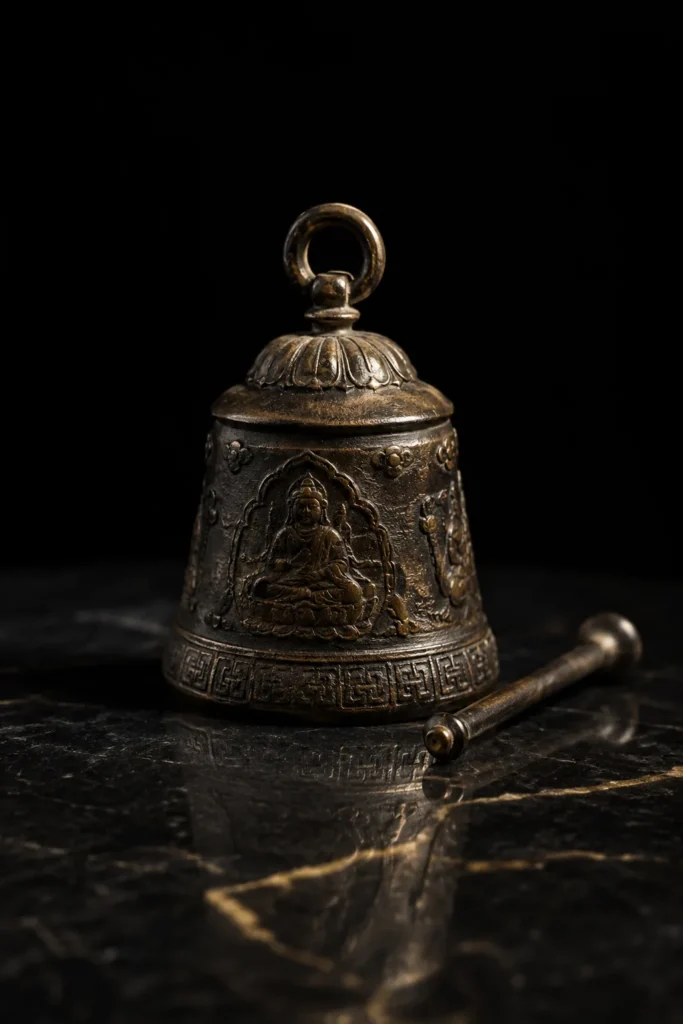
Classification: Bells and Chimes as Noise-Making Protection
Bells and chimes are sound-making devices to which many cultures ascribe a defensive meaning. The bell produces a full tone audible over a wide area, while the smaller chime produces a brighter, often repeated sound.
The basic idea is acoustic defence. In many systems of folk belief, harmful influences were thought to be driveable away by sound. Loud or bright sound was meant to keep them at bay or scare them off.
Bells and chimes are only the best-known examples of this. Rattles, drums, whistles and the loud calling of people also belong to noise-making protection and follow the same principle.
Their use ranges from the small chime fastened to clothing or to an animal to the large bell mounted on a building. Both carry the same basic idea in different sizes.
Within the protective symbols, bells and chimes belong to the group of acoustic means of protection. They work not through an image or a material, but through sound.
Noise-making protection is therefore less an object than an act. Only the ringing or the shaking turns the bell or the chime into a means of protection in the narrower sense.
Bells and chimes differ not only in size but also in their use. The large bell is bound to a fixed place and is rung deliberately, while the small chime accompanies a wearer and sounds with every movement. Both forms carry the same basic idea of acoustic defence.
Origin and Historical Depth of Noise-Making Protection
Sound-making devices are among the oldest objects made by humans. Rattles and simple little bells are known from very early contexts, often in connection with cult and ritual.
The bell in its developed form is attested since antiquity. Metal bells and chimes survive from China, the Near East and the Mediterranean region, some of which were used in cult.
In China the bell has a particularly deep history. Even in the Bronze Age, elaborate bells were made that played a significant role in music and ritual.
In the ancient Mediterranean region, chimes and little bells were known as both sound-making and protective devices. They appear on clothing, on animals and in the cultic sphere.
In medieval Europe, the church bell became a central sound-making device. Religious and popular ideas attached to it, some of which carry a defensive interpretation.
On the whole, it becomes clear that in many cultures sound was given a meaning that went beyond the merely audible. Noise-making protection extends across long periods of time and many cultures.
With the Christianisation of Europe, the bell became a fixed part of church life. Bells were consecrated and given names, and their ringing structured the day and the year. Numerous popular ideas attached themselves to this church use.
The Underlying Idea of Defensive Sound
A widespread notion is the idea that harmful beings shun noise. Loud and sudden sounds were regarded as something that drives off or scares away such beings.
A second idea concerns the purity and brightness of the sound. The bright tone of a bell was understood as clear and pure. This clarity was regarded as the counter-image to influences thought of as impure.
To this is added the reach of the sound. A bell is audible over a wide area. Its tone fills an entire room or an entire region. This reach was interpreted as an image of far-reaching protection.
With the repeated sound of a chime, continuity plays a role. A little bell fastened to an animal or to clothing sounds with every movement. It accompanies the wearer and its sound persists.
A further idea is the announcing effect. The sound of a bell signals a movement or an event. In some traditions it was also meant to interrupt the approach of a harmful influence.
The notions described here are explanations from cultural history. They describe why sound was given a defensive meaning and document a belief. They are not evidence of an effect. Scholarship describes the notion without confirming it.
To this is added the idea of the bell as a voice. In many traditions a rung bell was understood like a calling voice that fills a region. This interpretation linked the sound with the idea of an invocation that was meant to drive off harmful influences.
To this is added the idea of sudden interruption. A bright, unexpected sound was understood as something that breaks through and changes a situation. In some traditions it was precisely this sudden ringing that was meant to disrupt a harmful influence in its working.
Examples from Antiquity and the Near East
From the ancient Mediterranean region, small bronze bells and chimes survive in great numbers. They were attached to clothing, to doors and to animals and were in part associated with a defensive meaning.
In the Greek and Roman world, chimes appear on amulets and on children’s jewellery. The sound was meant to accompany the wearer and to keep harmful influences at bay.
In the Near East, little bells are recorded on festive and cultic clothing. From religious texts it is known that little bells on priests’ garments played a role.
In Mesopotamia and in neighbouring cultures, sound-making devices were used in the ritual sphere. Drums and rattles belonged to acts that were meant, among other things, to serve as defence.
Loud calling and the making of noise by people are likewise known from ancient sources. On certain occasions, collective noise was meant to drive off harmful influences.
These examples show that in the ancient Mediterranean region and the Near East, sound did not serve music alone. It stood within a web of notions to which the defensive interpretation attached.
From pharaonic Egypt, too, small metal bells survive that were fastened to jewellery and to clothing. Their sound was meant to accompany the wearer and was regarded as significant. They form part of the broad field of meaning in which sound points beyond the merely audible.
Examples from European Folk Magic
In European folk magic, noise-making protection plays a striking role. Folklore collections report noise customs by which harmful influences were meant to be driven off at certain times of the year.
Particularly well known are noise processions in the dark season. With bells, chimes, whips and loud calls, groups moved through villages. Such customs are recorded in many regions of the Alpine area.
Chimes were fastened to animals, above all to cattle on the pasture. The chime served to locate the animal and was at the same time associated with a protective meaning.
In folk magic, the church bell was ascribed a defensive meaning beyond its religious function. Folklore sources report ringing during storms and in other situations felt to be threatening.
Reports of such noise customs document the expectations of those who practised them, not a proven effect. They show that sound was understood as a means of driving off.
Some of these customs, such as the noise processions in winter, survive to this day as folk custom. Their originally defensive interpretation has often receded into the background.
Folklore sources also record chimes on horse harness and on sledges. The chimes served to signal the approaching team and were at the same time associated with a defensive meaning. The Handwörterbuch des deutschen Aberglaubens assigns this custom to the idea of accompanying sound.
Examples from Asia and Other Cultures
In East Asia, bells play a significant role in religious contexts. Bells are rung at temples, and the sound is ascribed a purifying and ordering meaning.
In the Buddhist tradition, bells and chimes belong to the ritual implements. Their sound structures acts and is linked with ideas of purity and attentiveness.
Wind chimes are widespread on East Asian buildings and sound at every breath of air. Their sound is ascribed in part a protective and in part a fortune-favouring meaning.
In South Asia, bells are used in temples and in household prayer. The sound accompanies ritual acts and marks their beginning.
Across these regions, it becomes clear that the sound of bells and chimes was given a meaning beyond music in many cultures. Noise-making protection is not a motif of a single tradition.
The diversity of the examples makes clear that noise-making protection is to be understood as a principle. It arises wherever sound is given a driving-off or purifying meaning.
In parts of Africa, bells and rattles belong to the ritual implements and accompany dance and invocation. Their sound structures the act and is linked with the idea of purifying an area. These examples show that defensive sound also had a firm place beyond Eurasia.
In Mongolia and in parts of Central Asia, little bells and chimes belong to the implements of ritual specialists and are fastened to their garments and drums. Their sound accompanies the ritual act and is linked with purification and defence. These examples too show the wide spread of acoustic protection.
Use in Ritual and Everyday Life
Noise-making protection was used in everyday life in various ways. A chime fastened to an animal or to clothing sounded with every movement and accompanied its wearer continuously.
Bells and wind chimes mounted on buildings sounded in the wind or when a door was opened. Their sound was bound to a place and rang out as soon as a movement occurred there.
Noise processions and collective noise-making were tied to particular times. Above all in the dark season and at the turning points of the year, noise was deliberately produced.
The ringing of the church bell followed a fixed order but was also tied to special occasions. During storms and in situations felt to be threatening, additional ringing took place.
In ritual contexts, above all in the religions of Asia, the ringing of bells is part of fixed sequences. The sound structures the act and marks its sections.
There is no uniform ritual order for noise-making protection. The precise form depended on region, occasion and tradition, as folklore research has noted repeatedly.
The material and the making of the bell were also regarded as significant. Casting a bell was an elaborate process, often accompanied by words of blessing. This careful making was itself among the notions that gave the bell’s sound its special meaning.
Related Forms of Protection and Distinctions
Noise-making protection is related to the means of protection worn on the body. A chime fastened to clothing is at the same time an amulet or talisman, which, however, works through the sound and not through an image.
Noise-making protection is closely linked with threshold protection. Bells on doors and entrances connect the place of the opening with defensive sound.
Noise-making protection differs clearly from the image amulet and from apotropaic material. In many notions, image and material work permanently and silently. Noise-making protection works in the moment of the sound.
Within the acoustic means of protection, bells and chimes stand alongside further sound-making devices. Rattles, drums, whistles and human calling also belong to this group.
There is a boundary to purely musical or signalling use. A bell that merely indicates the time or accompanies music does not necessarily carry a defensive interpretation.
Placing it within this neighbourhood helps to define noise-making protection precisely. It is an acoustic means of protection that works in the moment of the sound, and it differs from silent amulets and from the pure signalling function.
Within the acoustic means of protection there is also a connection to the spoken and sung word. Invocation, words of blessing and song were also used with a defensive meaning. Bell and chime thus form part of a broad field of acoustic acts.
The Reception of Noise-Making Protection Today
Some noise customs survive as living folk custom to this day. Noise processions in the dark season continue to be maintained in many regions of the Alpine area, often as a communal festival.
In these present-day customs, the communal experience is usually in the foreground. The originally defensive interpretation is known but is rarely understood as a literally intended means of protection.
In modern esotericism, sound and the tone of a bell are sometimes linked with purifying effects. Such practices are ascribed effects that are not proven. They should be viewed critically.
Wind chimes are widespread today as decoration. Their old protective or fortune-favouring interpretation has mostly receded into the background.
For religious studies, noise-making protection is an instructive example. It shows how a sensory experience, namely sound, could become the basis of a defensive interpretation.
Anyone who engages with noise-making protection today finds in it above all a topic of cultural history. A sober approach separates the documented history of the customs from modern promises of effect that do not withstand scrutiny.
In campanology, old bells are today recorded, dated and described by sound and inscription. Many bear inscriptions that invoke protection from storm and misfortune. These inscriptions directly attest that the bell’s sound was ascribed a defensive meaning beyond its religious function.
Literature (Selection)
Related key terms: bells as protection chimes sound noise acoustic defence wind chime noise procession church bell apotropaic sound protection.
iWell Guard and Protective Traditions
iWell Guard stands in the cultural-historical line of portable protective objects, to which the bell also belongs. A modern companion for people who live with protective symbols: made in Germany, 41 layers of solid gold, platinum and silver, with a 30-day right of return.
Personal experiences may vary. Not a medical device. No promise of healing.