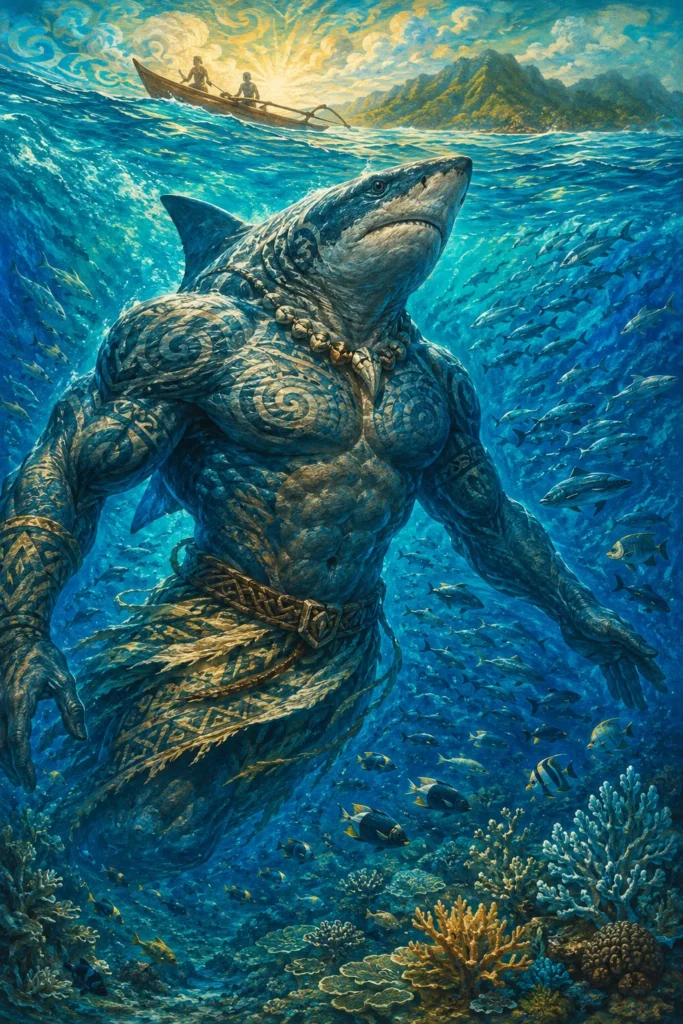
Adaro and the arrow of flying fish
By Ralf Ittermann · last reviewed on
Adaro is a demon of Melanesian tradition.
He wounds fishermen with poisonous flying fish as projectiles. The account describes the flying fish as an arrow this demon hurls to wound fishermen.
The Adaro is a malicious sea spirit of the Solomon Islands, half human, half fish, with gills and a swordfish-like head appendage. He travels on rainbows and in waterspouts and shoots fishermen with poisonous flying fish. On Makira he is regarded as the evil soul within humans, the counterpart to the good aunga.
Type: sea spirit, half human half fish
Origin: Arosi tradition, Makira Island
Texts: sparse, chiefly Fox 1924
Period: oral, early 20th century
Appearance: gills, shark horn, head appendage

Source Context
Period of the Texts
Oral tradition, ethnographically documented by Fox in the early 20th century.
Area of Diffusion
Solomon Islands, particularly Makira Island in the Arosi-speaking area.
Sources
Sparse: Fox 1924 is considered the most reliable primary source, supplemented by Codrington 1891.
Name and variants
Arosi: Adaro means corpse, spirit or soul, and at the same time the evil soul of humans as the counterpart to the good aunga.
Form and attack
Appearance
A man with gills, tail fins instead of feet, a shark-like horn and a swordfish-like head appendage.
Effect
Travels on rainbows and in waterspouts and shoots poisonous flying fish at fishermen, who may fall ill or die.
Profile: Adaro
The key characteristics of the sea spirit at a glance.
Arosi tradition of Makira Island, part of a dualistic soul concept.
Fishermen and people on the open sea of the Solomon Islands.
Gills, tail fins, shark horn, swordfish-like head appendage.
Illness and death caused by poisonous flying-fish projectiles at sea.
Concrete formulas are lacking; what is documented is avoidance and ritual handling of the spirits.
Counterpart to the protective shark gods Dakuwaqa and Kāmohoaliʻi; related to the Japanese Ningyo.
The evil soul that becomes a shark
The word adaro comes from the Arosi language of Makira Island and means, among other things, corpse, spirit and soul. On Makira, humans are believed to have two souls: the malicious adaro, which remains after death and often turns into a shark, and the good aunga, which passes away. One also speaks of the adaro of the sea and of the rainbow.
Bestiary and ethnographic evidence
In popular culture the Adaro is taken up as a creature, but for a lexicon its ethnographic grounding is what counts. In religious studies it belongs to a dualistic soul concept in which illness at sea is explained as a spirit attack; the link between the spirit of the dead, the shark and natural phenomena is typically Melanesian.
Caution rather than fixed protective formulas
The source material on protective rites is sparse: what can be documented is avoidance and ritual handling of the spirits. Fixed protective formulas are lacking; protection lies chiefly in caution at sea. Protective means: amulet, salt, protective circle.
Sea spirits between fish and human
The Adaro belongs to the type of merman-like half-human, half-fish beings, here clearly malicious, related to the Japanese Ningyo. It is the hostile counterpart to the protective shark gods Dakuwaqa and Kāmohoaliʻi, alongside the Germanic Nix and the Australian Bunyip as further dangerous water beings.
Frequently asked questions about Adaro
Is the Adaro dangerous?
Yes: it shoots fishermen with poisonous flying fish; a person struck may fall ill or die.
What does the name mean?
From the Arosi: corpse, spirit or soul, and at the same time the evil soul of humans as the counterpart to the good aunga.
Further links
Internal links:
Literature (selection)
More in the bibliography.
Adaro, Solomon Islands: The sea spirit of Makira attacks fishermen with venomous flying fish and travels across the sea on rainbows. As a sea spirit of Melanesia, he embodies the hostile side of sea and weather.