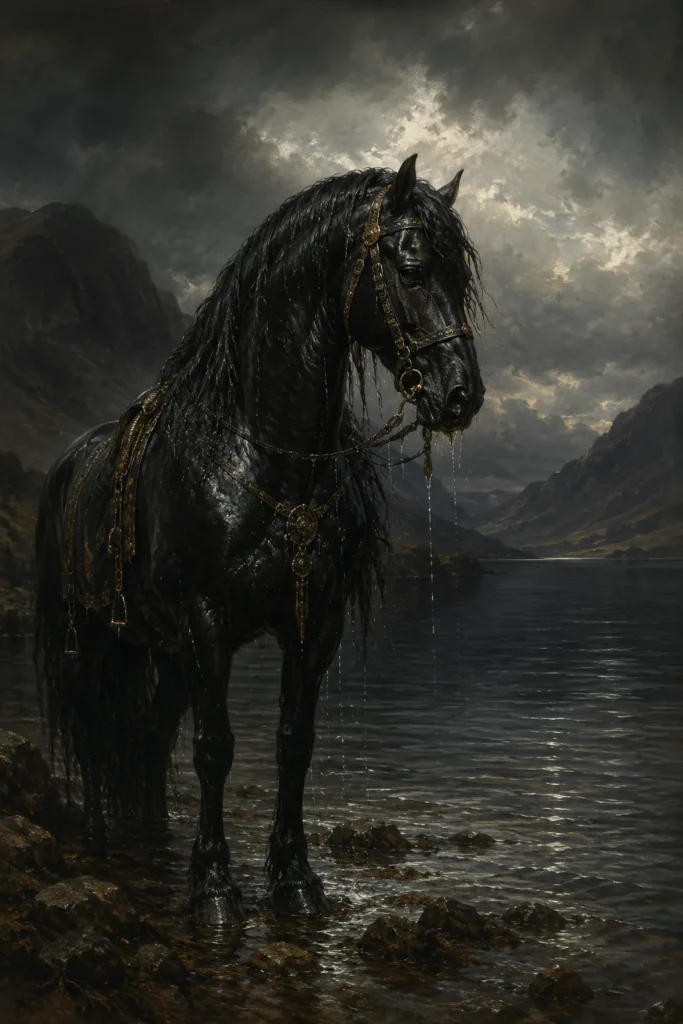
Kelpie, the sticky horse of the fords
By Ralf Ittermann · last reviewed on
Kelpie is a demon of Scottish tradition.
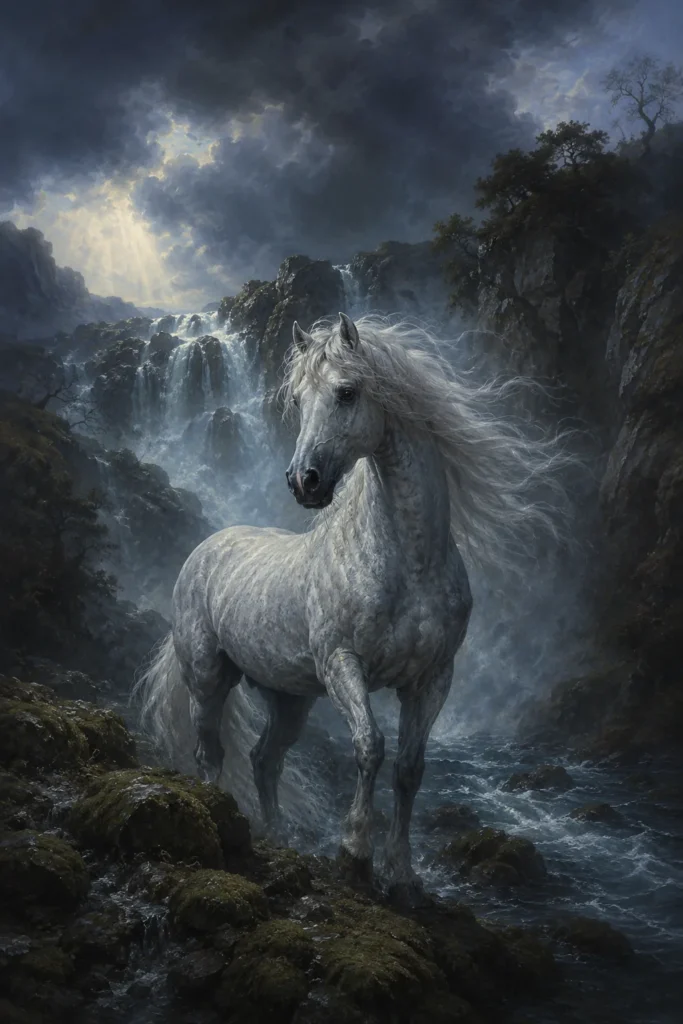
A beautiful horse by the river that pulls riders into the depths. The Kelpie is known as a shape-shifting water horse haunting the rivers of Scotland.
The Kelpie is Scotland’s best-known water spirit: a tame horse that waits at fords, lets travellers mount and then drowns them. Its hide sticks like glue; above all its own bridle can tame it. Scottish rivers swell rapidly and dangerously after rain.
Type: water horse of rivers and fords
Origin: Gaelic-Scottish legend cycle
Texts: Gregor 1881, Campbell 1900
Period: 18th century to today
Appearance: black horse, rarely a man with sand in his hair

Textual history
Period of the Texts
Attested in writing since the 18th century: Collins 1749, printed 1788, Burns 1786, collected in the 19th century by Gregor and Campbell.
Area of Diffusion
Scotland: rivers and fords of the Highlands; almost every larger river had its water horse.
Sources
Rich: the 19th-century collections of Gregor and Campbell, along with early records by Collins and Burns.
Name and variants
Gaelic: the origin of kelpie is unclear; a derivation from Gaelic calpa, heifer, or cailpeach, foal, has been suggested.
Appearance and symbolism
Appearance
Black or grey horse, tame by the water, wet mane, sticky hide. Effect: whoever mounts cannot get free again and is drowned; its back stretches to carry a whole group of children.
Profile: Kelpie
The key features at a glance.
Gaelic-Scottish legend cycle, river relative of the Each-uisge.
Travellers and children at fords, especially at dusk and during high water.
Black, more rarely grey horse of unnatural beauty, sticky hide, wet mane.
Drowns and devours riders, warns children away from fords and darkness.
Distrust of tame horses near water, the bridle as a means of binding, the silver bullet as a last resort.
Closest relative: the Gaelic Each-uisge, more dangerous than the Kelpie; the Welsh counterpart is Ceffyl Dŵr.
From the bridle motif to Graham of Morphie
Campbell distinguished the river Kelpie from the more murderous Gaelic Each-uisge of the lochs. A man-made bridle forces the Kelpie into service.
Well known: Graham of Morphie subdued a Kelpie, made it haul stones, and was cursed for it.
From Burns to the Kelpies of Falkirk
Since Burns, the Kelpie has been part of Scottish literature; the Harry Potter books interpret Loch Ness’s monster as its largest specimen; the most visible sign is the Kelpies of Falkirk, erected in 2013.
It personifies the danger of drowning at fords.
The bridle as the most important means
Tradition knows no invocation, only rules: distrust of tame horses near water, no mounting at fords at dusk. A bridle made of iron grants power over it; the horseshoe takes up the motif; Kelpie bridles were regarded as amulets with healing power.
Water horses of the Celtic and Norse world
Related: Each-uisge (lochs, more dangerous), Ceffyl Dŵr (Wales), Nuckelavee (horse-rider body), Bäckahäst (pure horse).
Frequently asked questions about the Kelpie
What is the difference between the Kelpie and the Each-uisge?
The Kelpie belongs to rivers, the Each-uisge to lochs, and is considered more dangerous.
Can a Kelpie be subdued?
Yes, with a man-made bridle, as shown by Graham of Morphie.
Further links
Further reading:
Literature (selection)
Further standard works in the bibliography.
Those searching for the Kelpie water horse will find the legendary figure that, as the Kelpie of Scotland, still shapes the imagination today: beautiful on the bank, deadly in the current, tamed above all by its own bridle.