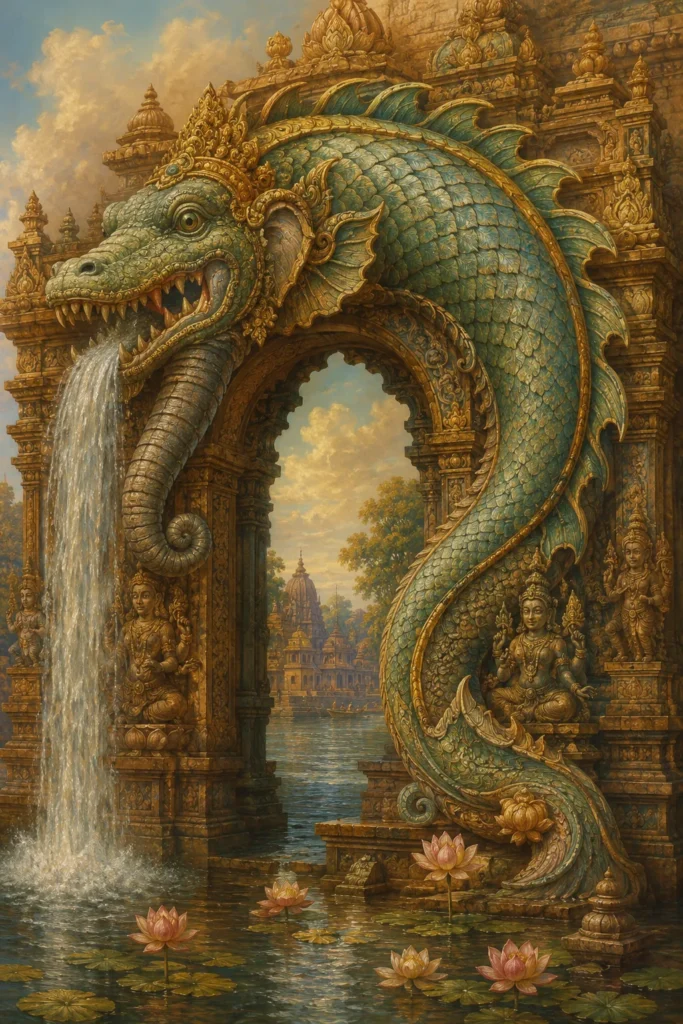
Makara, guardian of temple gates in a crocodile's body
By Ralf Ittermann · last reviewed on
Makara is a demon of the Hindu tradition.
Makara, water being in the service of Ganga and Varuna. The entry casts him as guardian of temple gates, his crocodile body serving Ganga and Varuna. Makara frequently appears as a water monster in Indian art depicting Hindu temple guardians.
Makara is a mythical water being of Hindu tradition, a composite creature with a crocodile’s head, an elephant’s trunk and a fish’s body. It serves the river goddess Ganga and the water god Varuna as a mount, and is regarded as the most recurrent being in Hindu and Buddhist temple art, from India to the Himalayas and Southeast Asia.
As a gate guardian it watches over the thresholds of temples and throne halls, as an emblem of the love god Kamadeva it stands for fertility and desire, and in astrology it gives its name to the zodiac sign Capricorn. Towards humans, the Makara is not regarded as malevolent but as a serving, protective liminal being.
Type: hybrid water monster, mount and threshold guardian
Origin: Hindu-Buddhist cultural sphere
Texts: Vedic foundation, Puranas, temple iconography
Period: Vedic to present
Appearance: composite being of crocodile, elephant and fish
Source context
Period of the Texts
Vedic in foundation, broadly elaborated in the Puranas, epics and temple art, still alive today in astrology and architecture.
Area of Diffusion
The Hindu- and Buddhist-shaped region stretching from India across Southeast Asia to the Himalayas.
Sources
Sanskrit texts, extensive temple iconography and astrology document the composite being well.
Name and variants
Sanskrit: Makara denotes at once the water monster, the mount of two deities, a protective motif of temple architecture and the zodiac sign Capricorn, named after its form.
Being and effect
Appearance
The Makara combines a crocodile head and jaws, an elephant trunk, fish scales and a fish tail, sometimes with a peacock’s tail. As an arch over images of the gods, a pair of Makaras often forms the frame, its apex crowned by the face of glory; its form also appears as ear ornaments of Vishnu and Shiva.
Effect
As a mount it carries Ganga and Varuna; as a threshold guardian it symbolically devours chaos and protects the sacred inner space. Towards humans it is not a hostile being but a serving liminal being between order and flood.
Profile: Makara
The key aspects of the water monster at a glance.
Hybrid water being of Hindu-Buddhist iconography, Vedic in foundation.
Temple thresholds, throne halls, and the water deities Ganga and Varuna, whom it carries.
Crocodile head, elephant trunk, fish body, sometimes with a peacock’s tail.
Threshold guardian and zodiac sign: it tames chaos and marks Capricorn.
No personal cult; the festival Makara Sankranti celebrates the sun’s entry into its zodiac sign.
Mount of two water gods and guardian of the threshold
Makara is the mount, the vahana, of the river goddess Ganga and of Varuna, god of the sea and waters. In Vedic times, Varuna, originally a sky and order god, became lord of the waters and rode the water monster. Iconographically, the Makara is the most frequently recurring being in Hindu and Buddhist temple art.
It is linked with several deities: as the emblem of the love god Kamadeva it refers to fertility and desire, and in astrology it marks the sign of Capricorn. Its name thus stands at once for a monster, a mount, a protective motif and a constellation.
From temple gate to zodiac sign
The Makara continues to shape astrology, temple architecture and jewellery design; the festival Makara Sankranti celebrates the sun’s annual entry into its sign. In esoteric-theosophical literature it is symbolically elevated, which is not supported by sources, and a fringe cryptozoological interpretation is not scientifically tenable.
From a religious-studies perspective, Makara is a classic liminal being that combines water, fertility and the taming of chaos. As an attribute of several deities and an astrological sign, it is less an independent cult figure than an iconographic functional being, ambivalent and non-human, but not malevolent.
Gate guardian rather than cult image
The Makara is not worshipped itself but acts protectively: as a gate-guardian motif at temple entrances, as a water spout above springs and as an arched frame around images of the gods. Its nature as guardian of the threshold is reflected in the traditional threshold protection of house and temple. A worn amulet draws on its protective gate images, and consecrated holy water on its connection to the sacred waters.
Water monster and liminal being in comparison
As a hybrid water monster, the Makara is comparable to the Mesopotamian Tiamat and the chaos dragons; as a crocodile-shaped being, it is close to the Egyptian Sobek. Within India it touches the sphere of the river goddess Sarasvati, and in the West it corresponds to the constellation Capricorn. As a mount it also remains closely bound to Ganga.
Frequently asked questions about Makara
Whose mount is the Makara?
Above all that of the river goddess Ganga and the water god Varuna. As their vahana it carries and supports the deities through the floods.
What is the Makara made of?
Of a combination of several animals: a crocodile head, an elephant trunk, a fish body and fish scales, sometimes with a peacock’s tail.
Further links
Further reading:
- Hinduism – all beings of the Hindu tradition
- Ganga – the river goddess it carries as a mount
- Varuna, Apsara – water god and water nymph of the same pantheon
- Threshold protection, amulet, holy water – traditional protective means
Literature (selection)
Further standard works in the bibliography.
As the Makara water being of Hindu temple art, it devours chaos at the threshold; as the Makara mount, it carries Ganga and Varuna through the sacred floods.