Amphitrite and the waves that bear her name
By Ralf Ittermann · last reviewed on
Amphitrite is a goddess of the Greek tradition.
Queen of the Nereids, wife of Poseidon, mother of Triton. The entry notes that the waves bear her name, honoring the queen of the Nereids.
Amphitrite is the queen of the sea in Greek legend: eldest of the Nereids, wife of Poseidon, mother of Triton. In Homer, her name stands for the sea itself.
Her myth tells of a flight from Poseidon to the outer ocean, where a dolphin persuaded her to marry him. Cultically she remained bound to Poseidon, with a sanctuary on Tenos and at the Isthmus.
Type: Queen of the sea, eldest Nereid
Origin: Greek coasts, Tenos, Isthmia
Texts: Homer, Hesiod, 8th/7th century BC
Period: archaic to imperial era
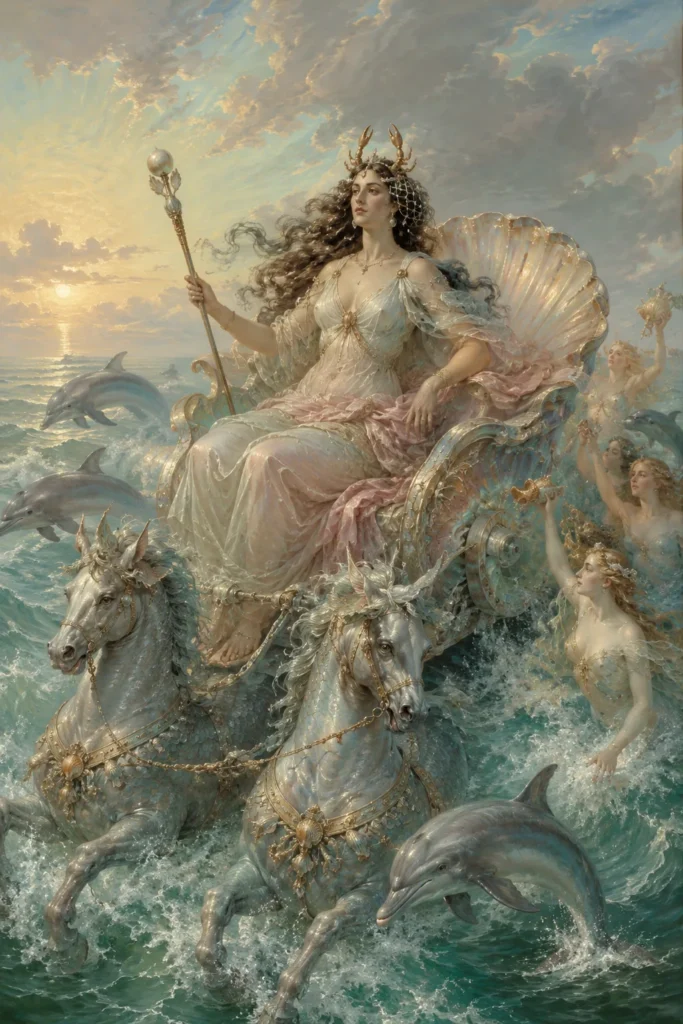
Appearance: dolphins, crab-claw crown
Source context
Period of the Texts
Homer and Hesiod attest to her in the 8th/7th century BC, venerated into the imperial era.
Area of Diffusion
Greek coasts and islands, cult sites Tenos and the Isthmus.
Sources
Well attested in literature, cultically usually alongside Poseidon.
Name and variants
Greek: Often linked in antiquity to amphi, meaning around. In Homer her name itself becomes the word for the sea.
Appearance
Appearance
She is enthroned in a shell chariot, accompanied by dolphins and Nereids, with a crab-claw crown in her hair.
Effect
With no tradition of harm, she swells the waves and nourishes all life in the water.
Profile: Amphitrite
The key aspects of the sea queen at a glance.
Eldest of the Nereids, daughter of Nereus, wife of Poseidon.
The sea itself: waves, sailing, catch and the creatures of the sea.
Enthroned queen with dolphins and a crab-claw crown.
Swells the waves, grants safe passage and good catch.
Shared sanctuary with Poseidon on Tenos and at the Isthmus.
The flight from Poseidon
Hesiod counts her among the daughters of Nereus in the Theogony and names her as Poseidon’s wife and mother of Triton. A dolphin found Amphitrite after she had fled from Poseidon and persuaded her to marry him, for which it was placed among the stars as the constellation Delphinus.
Cultically she remained bound to Poseidon, with temple and festival on Tenos and at the Isthmus.
From Baroque Fountain to Asteroid
In post-antique times Amphitrite lived on chiefly in art, for example in Poussin’s 1634 painting, and in fountains alongside Poseidon-Neptune; her name passed on to ships and an asteroid.
She shows how poetry and cult diverge: a literary figure with her own myth, but in cult mostly a consort goddess without an independent cult.
Image in the Temple and Protective Signs
Amphitrite’s image stood in the temple of Poseidon on Tenos and at the Isthmus.
Considered protective signs are amulet, salt and holy water.
Mistresses of the Sea Creatures
Mistresses of the sea are attested worldwide: Sedna decides over catch and hunger, the Japanese Ryūjin rules from the depths much like Amphitrite. Untamed powers such as Yam form the counter-type.
Frequently Asked Questions about Amphitrite
Was Amphitrite a goddess or merely a name for the sea?
Both: Homer uses her name for the sea, Hesiod gives her a lineage and marriage; an independent cult cannot be verified.
What role does the dolphin play?
It found Amphitrite after she had fled and persuaded her to marry, and in gratitude was placed among the stars as a constellation.
Further links
Further reading:
Literature (selection)
Further standard works in the bibliography.
Those searching for Amphitrite Poseidon will find the Greek sea goddess whose name, in Homer, itself stands for the sea.