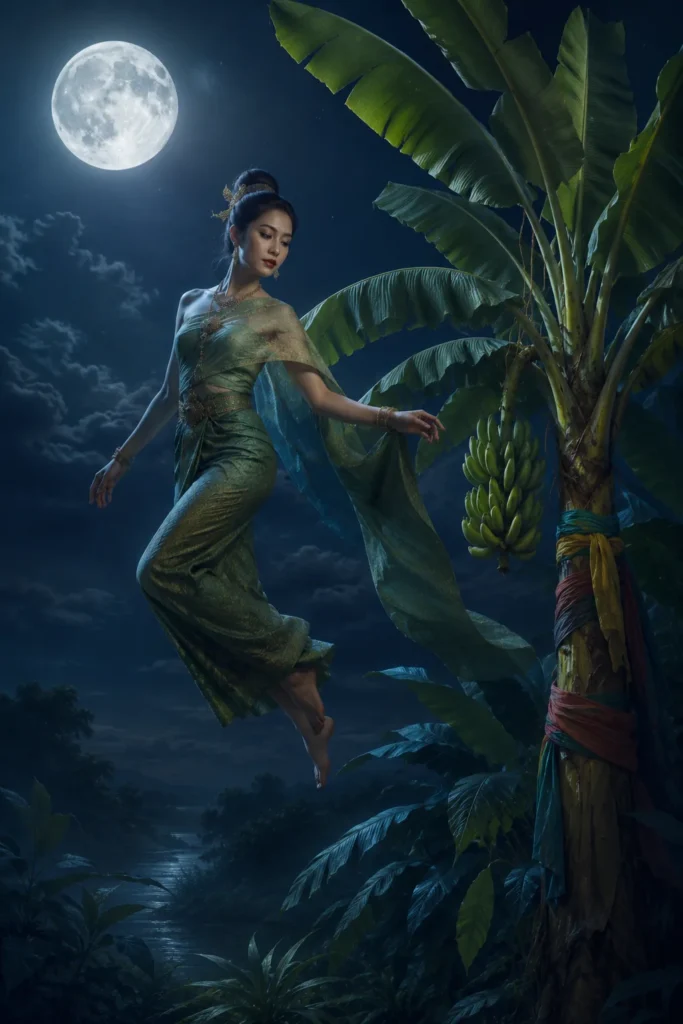
Krasue, the woman who becomes a floating head at night
By Ralf Ittermann · last reviewed on
Krasue is a demoness from Thai folklore.
At night, a head with dangling entrails on the hunt for blood. Krasue appears as a floating female head, and the text explains how this apparition has been passed down and interpreted.
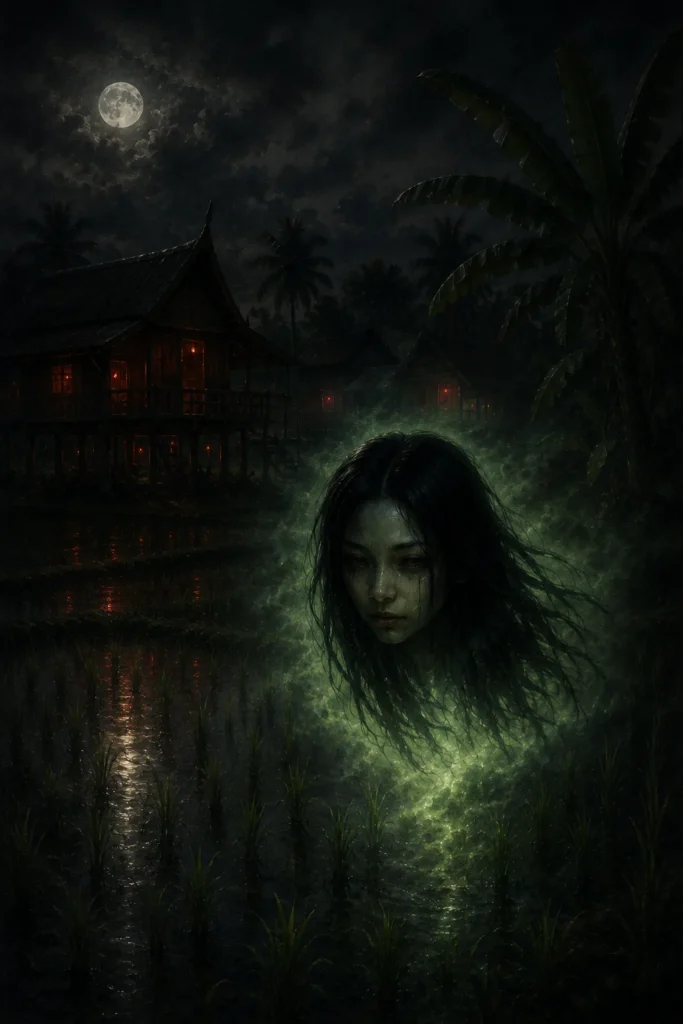
Krasue is a female demon of Thailand: by day she lives inconspicuously as a woman, but at night she appears as a floating female head with dangling entrails, surrounded by a will-o’-the-wisp-like glow. She seeks blood, carrion and the unborn, and poses a particular danger to pregnant women and newborns.
The name Krasue is Thai; related forms are the Laotian Kasue and the Cambodian Ahp. The Krasue belongs to Thailand’s mixed Buddhist-animist system, in which those who died violently or under a curse cannot properly move on.
Type: Nocturnal blood- and carrion-seeking spirit in the form of a floating female head
Origin: Buddhist-animist folk belief of Thailand
Texts: well documented ethnographically, including by Anuman Rajadhon
Period: ancient, mainland Southeast Asian tradition, still alive today
Appearance: floating female head with dangling entrails and a will-o’-the-wisp-like glow
Area of origin and sources
Period of the Texts
Ancient, mainland Southeast Asian folk tradition: belief in the Krasue is well documented ethnographically and remains alive today.
Area of Diffusion
Thailand and the rest of mainland Southeast Asia, with the Laotian Kasue and the Cambodian Ahp as regional counterparts.
Sources
Good: documented, among others, in the studies of Phraya Anuman Rajadhon on Thai folk belief.
Name and variants
Thai: The name Krasue denotes the nocturnal head spirit; related forms are the Laotian Kasue and the Cambodian Ahp, the same idea under a different name.
Nature and effect
Appearance
The severed, glowing head with its dangling digestive tract symbolises insatiable greed and the transgression of social and moral order. By day, its bearer lives inconspicuously as a woman, which makes the threat especially unsettling.
Effect
At night, the Krasue seeks blood and carrion and is regarded as a particular threat to pregnant women and newborns; her slime and glow are also said to spoil harvests. Her long, dangling intestines emphasise the voracity at the core of her nature.
Profile: Krasue
The key aspects of the head spirit at a glance.
Thailand’s mixed Buddhist-animist system, in which those who died violently or under a curse cannot properly move on.
Pregnant women and newborns as preferred targets, alongside carrion and raw meat, which attract the Krasue.
The floating head of a young woman with long hair and dangling, glowing entrails, accompanied by a will-o’-the-wisp-like glow.
Nocturnal thirst for blood and carrion, along with the threat to harvests posed by the slime and glow of the passing Krasue.
Thorny plants and bamboo thickets around the house, along with Sak Yant protective tattoos and the formulas of Buddhist monks.
Nearly identical to the Malay Penanggalan, and related to the Filipino Manananggal, which detaches the entire upper body rather than just the head.
Curse, contagion and inheritance
The name Krasue is Thai; regional names include the Lao Kasue and the Cambodian Ahp. The origin legends are not unambiguous, but they frequently interpret the transformation as punishment or curse, for instance for involvement in black magic, for abortion, or for murder committed in a previous life.
Contagion through the saliva or flesh of a Krasue, and inheritance within families of witches, are also cited. The Krasue thus belongs within Thailand’s mixed Buddhist-animist system, in which those who died violently or under a curse find no proper transition and instead remain bound to their craving.
A fixture of Thai horror cinema
The Krasue has an extremely strong presence in Thai horror cinema, comics and television, and is one of the fixed figures of Thailand’s popular ghost iconography.
From a religious-studies perspective, the Krasue embodies moral transgression, black magic and karma, and the danger to reproduction and birth. She is a classic voracious curse spirit, thought of as contagious and hereditary.
Thorns, amulets, and the watch over women in childbirth
In the Buddhist-animist tradition, an amulet or a sak yant protective tattoo is considered protection, along with holy water and the protective formulas of monks. Popularly, people plant thorny plants and herbs such as mugwort, or lay out a bamboo thicket around the house, in which the dangling entrails are meant to become entangled. Watch is kept at night especially over women in childbirth, since pregnant women and newborns are considered the Krasue’s preferred targets.
Head spirits of Southeast Asia compared
The Krasue is nearly identical to the Malay Penanggalan, the floating woman’s head with dangling organs, and related to the Philippine Manananggal, which detaches its entire upper body rather than just the head. More loosely related is the Malay Langsuir, who appears above all as a woman with long hair and becomes a floating head only in blended traditions, while in her true nature remaining the mother spirit of a woman who died in childbirth.
Frequently asked questions about the Krasue
Is the Krasue identical to the Penanggalan?
No, but the two are very closely related. The Krasue is the Thai form, the Penanggalan the Malay form of the same head spirit.
Why thorns and bamboo around the house?
The Krasue’s dangling entrails are meant to become entangled in them, preventing her from entering.
What causes someone to become a Krasue?
The legends cite a curse, black magic, serious past guilt, or also contagion and inheritance within families of witches as causes.
Further links
Further reading:
- Penanggalan – the almost identical Malay head spirit
- Manananggal – the Philippine relative with a detachable upper body
- Langsuir – the Malay mother spirit with a related head motif
- Amulet, holy water, mugwort – traditional protective means
- Protection Compass – protective means at a glance
Literature (selection)
Further standard works in the bibliography.
The Krasue is a Thai spirit who drifts through the night as a floating woman’s head with dangling entrails: by day an inconspicuous woman, by night a warning to every woman in childbirth to secure her house with thorny plants and amulets.