Gu, the divine blacksmith of Dahomey
By Ralf Ittermann · last reviewed on
Gu is a god of Fon tradition.
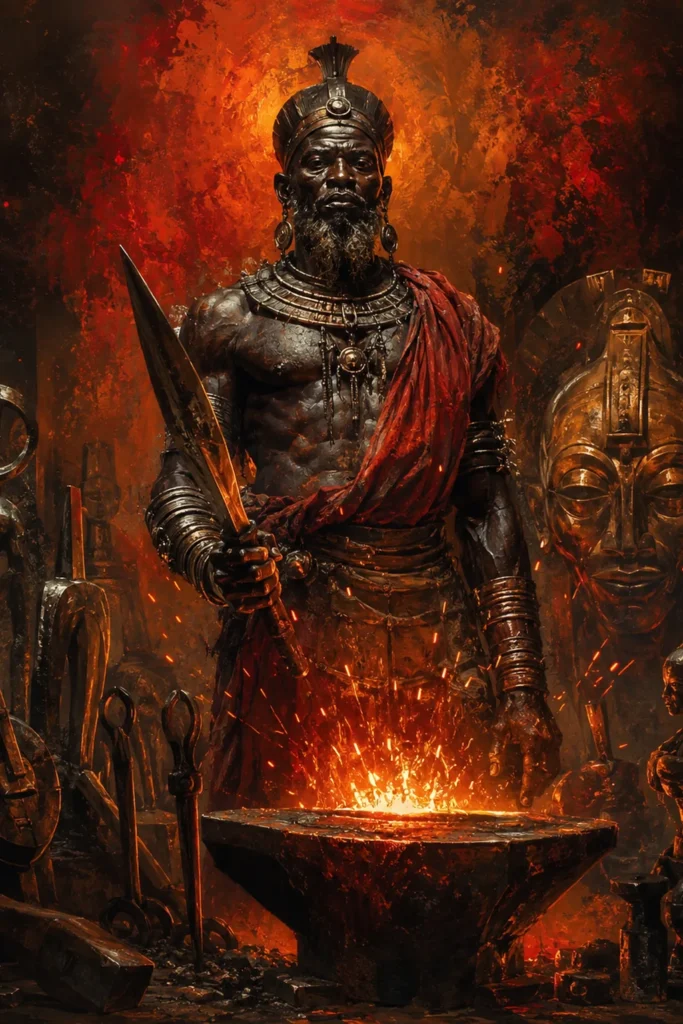
The divine blacksmith who brought iron to humankind.
Among the Fon of Dahomey, Gu is the god of iron, fire and war and the patron of blacksmiths. As a culture bringer, he gave humans iron and tools; he is closely related to the Yoruba Ogun and is among the actively venerated Vodun.
He is embodied by iron itself: blades, blacksmith’s tools and iron sculptures serve as his altars and symbols. His cult is still maintained today in Benin and in the African American diaspora.
Type: God of iron, fire, blacksmithing and war
Origin: Fon religion in Benin (Dahomey), related in the Yoruba region
Texts: oral tradition, ethnographic research
Period: living West African tradition
Appearance: god of iron and blacksmiths, often embodied in iron sculptures
Historical Classification
Period of the Texts
The tradition is oral and predominantly documented ethnographically; the cult is maintained to this day.
Area of Diffusion
The territory of the Fon in Benin, the old Dahomey; related traditions are found in the neighbouring Yoruba region and in the diaspora.
Sources
Well documented ethnographically, from Herskovits to Blier; the cultic practice remains alive as part of the Vodun religion.
Name and variants
Fon: Gu is the name of the iron Vodun of the Fon religion and the counterpart to the Ogun of the neighbouring Yoruba, who arrived through the slave trade as Ogum in Candomblé and Santería.
Appearance
Appearance
Gu is embodied by iron itself; a famous large iron sculpture of Gu from the Kingdom of Dahomey is well known. His symbols are blacksmith’s tools, blades and the fire of the forge.
Effect
Gu brought humans iron and the art of working it in fire; he made agriculture, craft and war possible. As a war god he protects warriors, as a god of smithing and tools he protects craftsmen and farmers. He stands for the transforming, ordering and defensive power of iron.
Profile: Gu
The key aspects of the blacksmith god at a glance.
Vodun of the Fon religion of Dahomey, son or tool of the creator pair Mawu-Lisa, related to the Yoruba Ogun.
Blacksmiths, warriors, craftsmen and farmers: all who work with iron stand under his protection.
Embodied in iron itself; the great iron sculpture of Gu from Dahomey is famous, along with blades and blacksmith’s tools.
Culture bringer of iron and the art of smithing; he made agriculture, craftsmanship and war possible.
Venerated through iron objects, blades and blacksmith’s tools, on which offerings are made; still alive in Benin and the diaspora.
The Ogun of the Yoruba as his immediate counterpart; as divine smiths Hephaestus, Goibniu and Wayland the Smith.
The Vodun who brought iron
Gu is a Vodun, a deity of the Fon religion, and the counterpart to the Ogun of the neighbouring Yoruba. He is regarded as the son or instrument of the creator pair Mawu-Lisa and is understood as the divine smith who brought fire and iron. The tradition is oral and rooted in a cult still maintained today.
As a culture bringer, Gu stands at the beginning of what first made agriculture, craftsmanship and war possible: the art of working iron in the fire of the forge. The material itself thereby becomes the seat of the deity; the great iron sculpture of Gu from the Kingdom of Dahomey is the best-known testimony to this idea.
Reception and classification
Gu and the related Ogun are widely known through the living Vodun religion and its influence on the African-American diaspora. The iron sculpture of Gu from Dahomey is a significant testimony to West African art.
In religious studies, Gu is a prime example of the smith and iron god as culture bringer: the fire of the forge and iron are foundations of agriculture, craftsmanship and war. His veneration through iron objects shows how the material itself becomes the seat and sign of the deity.
Iron as altar: forms of the cult
Gu is venerated through iron objects, blades and blacksmith’s tools, on which offerings are made to him. Blacksmiths, warriors and all who work with iron stand under his protection; iron objects serve as his altars and as protective symbols. The cult is alive as part of the Vodun religion in Benin and in the African-American diaspora.
Divine smiths in comparison
Gu corresponds directly to the Ogun of the Yoruba, the god of iron and smiths; through the slave trade this figure reached Candomblé and Santería as Ogum. As a divine smith, Gu stands alongside the Greek Hephaestus, the Irish Goibniu and the Germanic Wayland the Smith: everywhere the fire of the forge is bound up with the role of culture bringer.
Frequently asked questions about Gu
Who is Gu?
The god of iron, fire and war among the Fon of Dahomey and the counterpart to the Ogun of the Yoruba. He is regarded as the divine smith and culture bringer.
How is he venerated?
Through iron objects, blades and blacksmith’s tools, on which offerings are made to him. Iron objects serve as his altars and protective symbols.
Is the cult still alive?
Yes. As part of the Vodun religion, Gu is still venerated today in Benin and in the African-American diaspora.
Further links
Further reading:
- Vodou – all beings of the Vodou tradition
- Hephaestus – the Greek smith god as a parallel
- Goibniu, Wayland the Smith – further divine smiths
- Iron, Protective Candle, Amulet – traditional protective means
Literature (selection)
Further standard works in the bibliography.
As the Fon god of iron, Gu represents the fire and the art of smithing in West Africa: the metal he brought to humankind is at once his altar, his sign and the raw material of agriculture, craftsmanship and war.