Lips, who holds the ship's stern
By Ralf Ittermann · last reviewed on
Lips is a god of the Greek tradition.
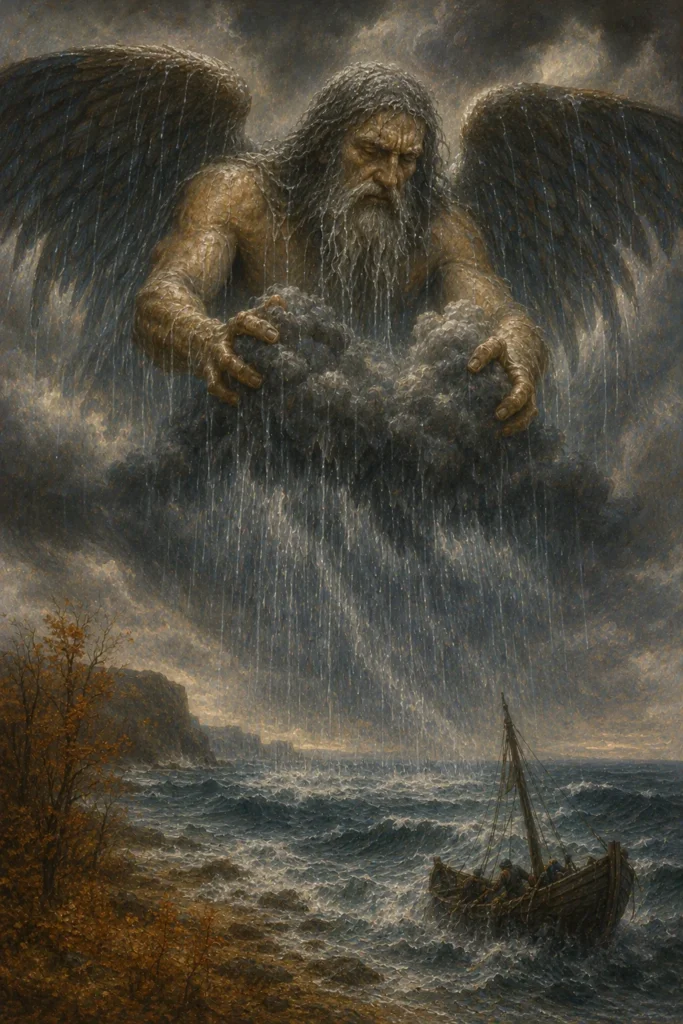
The south-wester, who quickly brings clouds and drives ships home.
Lips, Roman Africus, is the Greek god of the south-west wind. At the Tower of the Winds in Athens, he holds the stern of a ship; he quickly brings clouds and rain, but also swift clearing.
Near Methana, Lips was considered harmful to the vine buds, and it is there, exceptionally, that a concrete apotropaic rite is recorded: the ritual with the white cockerel described by Pausanias. This makes Lips better documented than most of the minor winds of the Greeks.
Type: God of the south-west wind
Origin: Greek cultural sphere, wind rose of ancient meteorology
Texts: Euenus of Paros, Aristotle (Meteorologica), Pausanias
Period: Euenus and Aristotle through to the imperial era
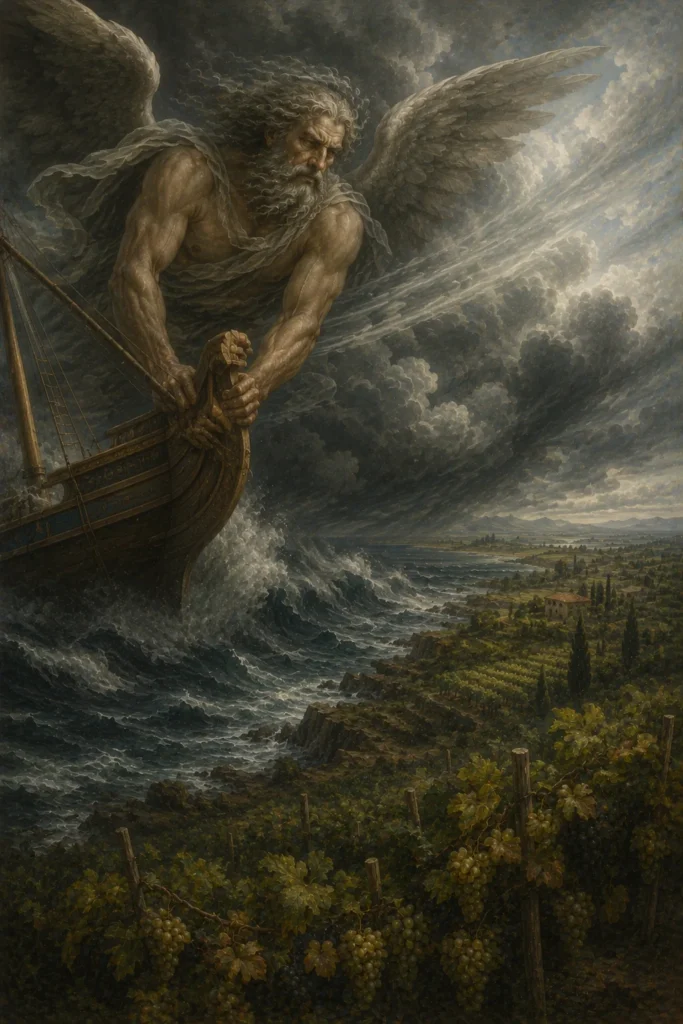
Appearance: winged man with a ship’s stern
Ancient attestation
Period of the Texts
The evidence ranges from Euenus of Paros and Aristotle through to the imperial era; Pausanias provides the local rite of Methana in the 2nd century.
Area of Diffusion
The Greek cultural sphere, with Athens and the Tower of the Winds as well as Methana, where the apotropaic rite against the vine-damaging wind was practised.
Sources
Good for a minor wind: Euenus, Aristotle and Pausanias, along with a clear attribute on the Tower and a concretely described local rite.
Name and variants
Greek: Lips is probably derived from leíbō, to pour, the wind that pours out moisture, though this remains uncertain. In Roman tradition he is called Africus, the wind from the direction of the province of Africa.
Beings and effect
Appearance
On the Tower of the Winds, Lips is a winged man holding the stern of a ship, the so-called aphlaston. The image refers to the ships that the south-west wind drives into Piraeus.
Effect
Lips brings clouds and rain quickly, but also swift clearing. According to Pausanias, he is harmful to the vine buds at Methana; for sailors, however, the same wind could aid a swift return home.
Profile: Lips
The key aspects of the south-west wind at a glance.
A minor wind of the ancient wind rose with a stable location in the south-west; better documented than most of its kind thanks to Euenos and the Methana ritual.
Sailors, whose ships he drives into Piraeus, and vintners, whose vine buds he scorches at Methana.
Winged man with the aphlaston, the stern of a ship; depicted this way on the south-west side of the Tower of the Winds.
Swiftly gathering clouds and rain, followed by equally swift clearing; at Methana he is regarded as a blight on the vine buds.
At Methana, according to Pausanias, two men cut a wholly white cockerel in half and run round the vines in opposite directions, each carrying one half.
Paralleled with Notos as a rain-bringing south wind, and related to Libonotos; his Roman equivalent is Africus, and in Italian he lives on as Libeccio.
Euenos, Aristotle and the aphlaston
Already Euenos of Paros names Lips as a bringer of clouds and clear skies: a wind with two faces. In his Meteorologica, Aristotle places him between Notos and Zephyros; on the Tower of the Winds he stands on the south-west side.
His name is probably derived from leíbō, to pour, the wind that pours out moisture, though the derivation remains uncertain. His attribute is unmistakable: the aphlaston, the stern of a ship, a sign of the vessels that the south-west wind drives into Piraeus. In Roman tradition he is called Africus, named after the direction of the province of Africa.
From Lips to Libeccio
The name lives on in the Italian Libeccio, the south-west wind, derived directly from Lips or Libs. Lips is a fixed part of the ancient wind rose.
From a religious-studies perspective: Lips is better documented, through the Methana ritual and Euenos, than most minor winds, yet he has no myth narrative of his own. His attribute is specifically the aphlaston, the ship’s stern, not an entire ship; his location is consistently south-west.
The white cockerel of Methana
For Lips, exceptionally, a concrete agricultural apotropaic rite is recorded, not a temple cult: at Methana, according to Pausanias, two men cut a wholly white cockerel in half and run round the vines in opposite directions, each carrying one half, to ward off the scorching Lips. The custom served to protect the vine buds and is one of the few wind-warding rites of Greek antiquity described in detail.
Notos, Africus and Libonotos
As a rain-bringing south wind, Lips is paralleled with Notos and related to the south-south-westerly Libonotos; his Roman equivalent is Africus. In the wind rose he borders on Zephyros, the west wind, and his dry counterpart in the north-west is Skiron. The apotropaic rite against this harmful wind recalls wind-warding customs found in other cultures.
Frequently asked questions about Lips
What kind of wind is Lips?
The south-west wind, called Africus in Roman tradition, which quickly brings clouds and rain.
What does he carry on the Tower of the Winds?
The stern of a ship, the aphlaston, a sign of the ships driven into the harbour.
How was he warded off?
At Methana, two men cut a white cockerel in half and ran round the vines in opposite directions.
Further links
Further reading:
- Greece – all beings of Greek mythology
- Notos, Zephyros, Skiron – the neighbours in the wind rose
- Amulet, Salt, Protective candle – traditional protective means
- Protection Compass – an overview of protective means
Literature (selection)
Further standard works in the bibliography.
As the Greek south-west wind, Lips unites two roles: he is the wind of the ship’s stern, driving sailors into Piraeus, and at the same time the scorching enemy of the vine buds, against whom Methana sacrificed its white cockerel.