Ha, Lord of the Western Desert
By Ralf Ittermann · last reviewed on
Ha is a god of the Egyptian tradition.
Lord of the Western Desert, protector against enemies from the west.
Ha is the ancient Egyptian god of the western desert and bears the title Lord of the West. As the personification of the desert land west of the Nile, he protected Egypt from enemies coming from the west and secured the western celestial pole for the deceased.
His characteristic sign is the three-peaked mountain-land emblem, which he wears as a standard on his head and with which his name is written. Ha was not a major temple god but a guardian of direction and boundary, appearing chiefly in the funerary texts of the Old and Middle Kingdoms.
Type: Desert and direction god, personification of the western desert
Origin: Ancient Egypt, first attested in the 3rd Dynasty
Texts: Pyramid Texts, Coffin Texts, Ptolemaic temple reliefs
Period: Old Kingdom to Ptolemaic period
Appearance: Man with the three-peaked mountain-land emblem on his head

Historical Background
Period of the Texts
The earliest evidence dates back to the 3rd Dynasty. Ha appears in the Pyramid Texts, extensively in the Coffin Texts, and remains attested up to Ptolemaic temple reliefs.
Area of Diffusion
The western desert of Egypt and the Fayum. Ha personifies the desert land west of the Nile, the edge of the ordered world.
Sources
Well documented: Pyramid Texts, Coffin Texts and temple reliefs up to the Ptolemaic period, together with the standard reference works of Egyptology.
Name and variants
Egyptian: Ha, written with the three-peaked mountain-land emblem that the god wears as a standard on his head. The literal meaning of the name is unknown; the common translation as desert is not attested. The popular epithets Lord of the Libyans and the hippopotamus motif are likewise unattested.
Form and Iconography
Appearance
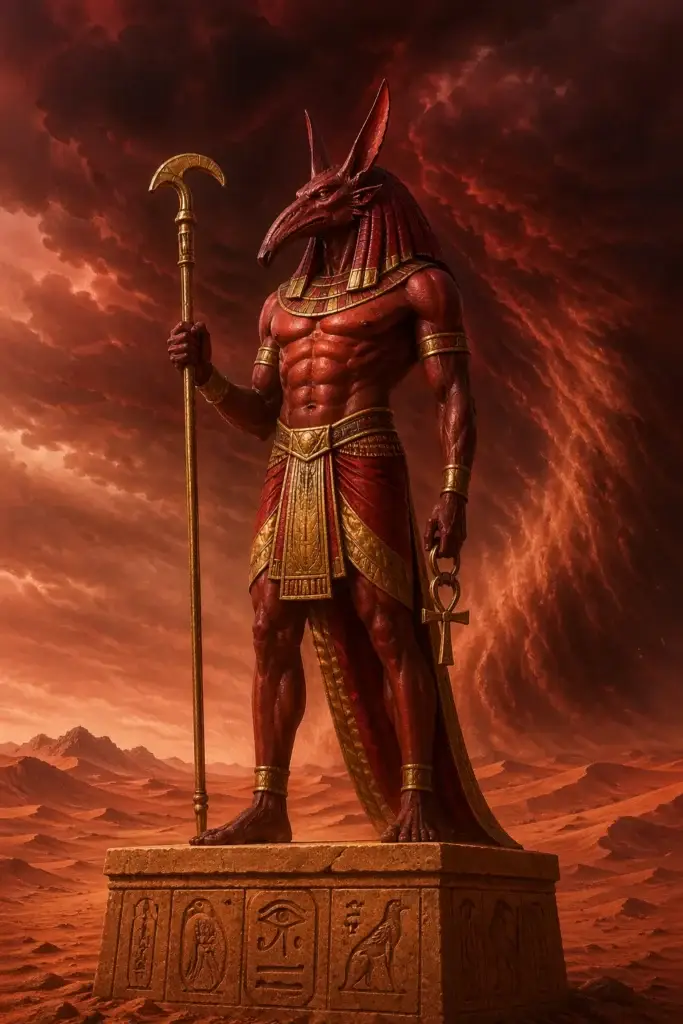
Ha is depicted in human form, usually wearing a loincloth and a wig, with the mountain-land emblem as a standard on his head, sometimes holding a knife or a bow. The weapons refer to the harshness of the desert and to his protective role.
Effect
Ha is the personification of the western desert, both geographically and symbolically: the west is the land of the setting sun and the realm of the dead. He protects against enemies from the west, against desert nomads and Libyans, and in the Coffin Texts secures the western celestial pole and the deceased.
Profile: Ha
The key aspects of the desert god at a glance.
A minor god of ancient Egypt, the personification of the western desert. Together with Sopdu for the east and Dedun for the south, he forms a triad of direction and boundary gods.
The western border of Egypt and the deceased: in the Coffin Texts, Ha secures the western celestial pole and assists the deceased on the journey into the west.
A man wearing a loincloth and a wig, with the three-peaked mountain-land emblem as a standard on his head, sometimes holding a knife or a bow as a sign of readiness to defend.
Protection of the western border: warding off enemies from the west, desert nomads and Libyans; at the same time, a guardian of the direction of the west in funerary belief.
A dedicated temple or festival is not securely attested. Ha appears chiefly in funerary texts; on coffins from the Herakleopolitan period he is placed on the western side.
Sopdu (east) and Dedun (south) as direction gods, the older oasis god Ash, and Seth as a god of the desert, to whom Ha is thematically closely related.
From the Mountain-Land Emblem to the Lord of the West
The name Ha is written with the three-peaked mountain-land emblem that he wears as a standard; its literal meaning is unknown, and the common translation desert is unattested. The earliest evidence dates back to the 3rd Dynasty; he appears in the Pyramid Texts and extensively in the Coffin Texts, remaining attested up to Ptolemaic temple reliefs.
In the divine landscape of the desert margins, Ha displaced the older oasis god Ash. Thematically he stands close to Seth as a desert god, without being identical to him: while Seth embodies the chaotic power of the desert, Ha is its benevolent guardian. In the Coffin Texts he takes on a clearly defined task for the deceased, securing the western celestial pole, the place where the dead cross into the afterlife.
Afterlife and Classification
Ha appears as a minor desert god in the standard reference works of Egyptology; a recent specialist study is devoted to the concept of the desert he embodies. As a curiosity, the dinosaur Hagryphus giganteus bears his name.
In religious studies, Ha is a benevolent protective god of the western desert. Three clarifications are important: his name does not literally mean desert, its meaning is unknown. The popular epithets Lord of the Libyans and the hippopotamus motif are unattested. And his worship is not to be dated only to a late period but can be traced back to the Old Kingdom.
Cult and Presence in the Funerary Texts
A dedicated temple or fixed festival for Ha is not securely attested; he was a minor god who appears chiefly in funerary texts and as a guardian of direction and boundary. On coffins from the Herakleopolitan period, his name is placed on the western side, the side through which the deceased entered the afterlife. Anyone in ancient Egypt who crossed the western desert or entrusted their dead to the west thereby moved within the domain of this quiet god.
Direction Gods and Lords of the Desert in Comparison
Together with Sopdu for the east and Dedun for the south, Ha forms a triad of direction and boundary gods that divinely occupies the edges of the ordered world. He displaced the older oasis god Ash, and thematically he is closely related to Seth as a desert god, without being identical to him. In funerary belief, his role touches upon that of Anubis, who as a god of the dead is likewise closely linked to the west. Separate articles cover Sopdu, Ash and Pakhet.
Frequently Asked Questions about the God Ha
Who is Ha?
The ancient Egyptian god of the western desert, Lord of the West. He protects Egypt from enemies coming from the west and secures the western celestial pole for the deceased.
Does his name mean desert?
No. The meaning of the name is unknown; it is only linked to the three-peaked mountain-land emblem with which it is written.
Did Ha have his own temple?
A dedicated temple is not securely attested. Ha was a minor god who appears chiefly in the funerary texts and as a guardian of the western border.
Further links
Further reading:
- Egypt – all beings of the Egyptian cultural sphere
- Anubis – god of the dead with a close connection to the west
- Amulet, Smoke Cleansing, Salt – traditional protective means
- Sopdu, Ash, Pakhet – other desert gods of Egypt
- Protection Compass – protective means at a glance
Literature (selection)
Further standard works in the bibliography.
As an Egyptian desert god and Lord of the West, Ha belongs to the quiet figures of the pantheon: not a temple lord, but a fixed reference point on the border between the ordered world and the desert.