Gaʼan, Powers of Blessing from the Sacred Mountains
By Ralf Ittermann · last reviewed on
The Gaʼan are spirits of Apache tradition.
Benevolent mountain spirits, embodied by the Crown Dancers.
The Gaʼan, in simple transcription Gaan, also called Gan or Mountain Spirits, are the mountain spirits of the Apache. They dwell in sacred mountains and caves of the Southwest and are regarded as benevolent powers of protection, healing and blessing.
At ceremonies they are embodied by masked dancers, the Crown Dancers. Out of respect for the living religion of the Apache, sacred details are deliberately omitted from this page: much of it is protected ceremonial knowledge not intended for outsiders.
Type: Benevolent mountain spirits, powers of protection, healing and blessing
Origin: tradition of the Mescalero, Chiricahua and White Mountain Apache
Texts: oral tradition, published ethnography from 1941
Period: oral tradition continuing into the living present
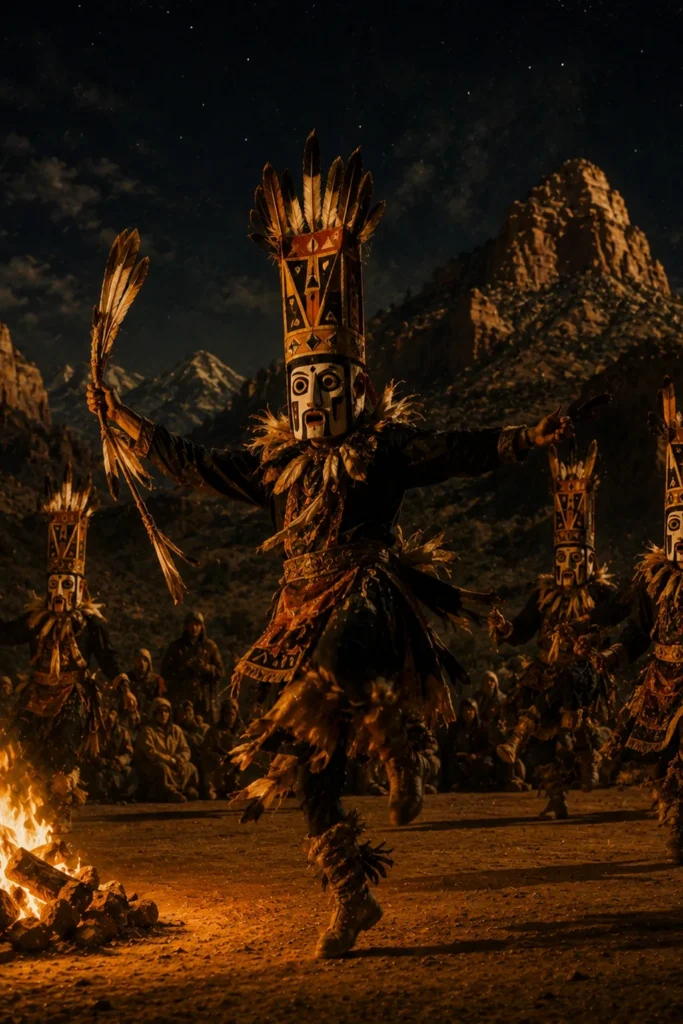
Appearance: masked dancers with head mask and crown-shaped headdress
Region of origin and sources
Period of the Texts
The tradition is oral; published ethnography has existed since 1941, when Morris E. Opler presented the classic scholarly account in An Apache Life-Way.
Area of Diffusion
The American Southwest: the Gaʼan are documented among the Mescalero, Chiricahua and Western Apache.
Sources
Solidly documented ethnographically, above all by Opler and Farrer; much, however, remains deliberately protected as it falls under ceremonial law.
Name and variants
Apache: gáan, among the Eastern Apache also gaahe, the mountain spirits. The English terms Mountain Spirits and Crown Dancers refer respectively to the spirits and to the dancers who embody them.
Appearance and Embodiment
Appearance
The Gaʼan are supernatural, benevolent mountain spirits who dwell in sacred mountains and caves. In ceremony they are embodied by masked dancers wearing a black head mask and a tall, painted wooden crown-shaped headdress, with painted bodies; they carry ceremonial staffs. Usually there are four dancers for the cardinal directions and one special figure, often a sacred clown.
Effect
The Gaʼan are powers of protection, healing and blessing who guard the people against illness and misfortune. Numerous traditions explain their particular friendship with the Apache; they are invoked for healing and blessing.
Profile: Gaʼan
The key aspects of the mountain spirits at a glance.
Mountain spirits of the Apache in the American Southwest, documented among the Mescalero, Chiricahua and Western Apache; the ceremonies are still actively maintained today.
The Apache people: the Gaʼan protect against illness and misfortune and are invoked for healing and blessing.
Masked dancers with a black head mask and a tall, painted wooden crown-shaped headdress; usually four dancers for the cardinal directions and one special figure.
Protection, healing and blessing; numerous traditions explain the Gaʼan’s particular friendship with the Apache.
Ceremonies such as the Sunrise Ceremony with nighttime dances by the fire; performance and detailed knowledge fall under ceremonial law.
Structurally related are the masked spirit embodiments of other peoples of the Southwest, such as the Katsinam of the Hopi and Pueblo, a distinct religion in its own right.
From the Sacred Mountains to the Crown Dancers
Apache gáan, among the Eastern Apache also gaahe, are the mountain spirits; the English terms Mountain Spirits and Crown Dancers refer respectively to the spirits and to the dancers who embody them. The Gaʼan are documented among the Mescalero, Chiricahua and Western Apache.
The classic scholarly account is Morris E. Opler’s An Apache Life-Way of 1941 on the Chiricahua. The level that can be publicly described remains deliberately limited: performance, masks, songs and detailed knowledge fall under ceremonial law and are not intended for outsiders.
Reception and Respectful Classification
Outside the community, the Gaʼan are often depicted photographically and folklorically in a reductive way as the Crown Dance; the Mescalero continue to maintain the ceremony as a living practice today. Commercialised or touristic depictions are sometimes viewed critically by Apache representatives.
From a religious-studies perspective, the Gaʼan are solidly documented ethnographically, yet the level that can be publicly described remains deliberately limited, as much of it is protected ceremonial knowledge. Important clarifications: ‘Devil Dancers’ is a derogatory colonial misnomer; the Gaʼan are benevolent protective spirits, not demons; they are not gods but spirit beings; and they should not be conflated with the Pueblo Katsinam.
Ceremonies and Protected Knowledge
Central is the naʼiiʼees, the Sunrise Ceremony, the four-day girls’ initiation into womanhood, above all among the Mescalero; the Gaʼan and Crown dances typically take place at night by the fire. Other occasions include healing and blessing ceremonies. Performance, masks, songs and detailed knowledge fall under ceremonial law and are not intended for outsiders; for this reason no sacred details are set out here.
Masked Mountain Spirits in Comparison
Within the Southwest, the Gaʼan are structurally reminiscent of the masked spirit embodiments of other peoples, such as the Katsinam of the Hopi and Pueblo; it is a related typology but a distinct religion, not to be equated. In general, the Gaʼan belong to the type of masked mountain spirits as protective powers. As mountain powers of other cultures, they stand alongside the Japanese Yama-no-Kami, the Tibetan mountain god Machen Pomra and the East African high god Ngai.
Frequently Asked Questions about the Gaʼan
Who are the Gaʼan?
The benevolent mountain spirits of the Apache, who dwell in sacred mountains and bring protection and healing.
What are the Crown Dancers?
Masked dancers with a crown-shaped headdress who embody the Gaʼan at ceremonies.
Is ‘Devil Dance’ a correct term?
No. This is a derogatory colonial misnomer; the Gaʼan are not demons but benevolent protective spirits.
Further links
Further reading:
- Ngai, Machen Pomra, Yama-no-Kami – mountain powers of other cultures
- Sage, Amulet, Protective Candle – traditional protective means
- Protection Compass – overview of protective means
Literature (selection)
Further standard works in the bibliography.
The Gaʼan, often simply called Apache mountain spirits, are with their Crown Dancers among the most vivid figures of indigenous North American religion; their sacred depth remains deliberately where it belongs, with the Apache themselves.