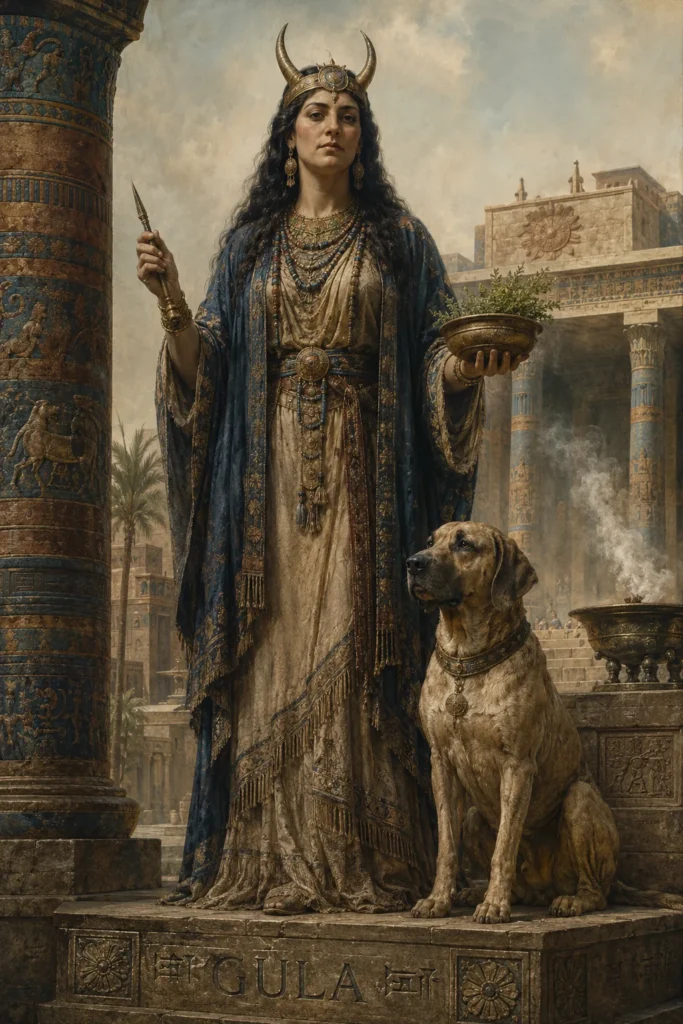
Ea, Akkadian god of wisdom and fresh water
By Ralf Ittermann · last reviewed on
Ea, in the Sumerian tradition Enki, is the ancient Mesopotamian god of wisdom, fresh water and the art of incantation. Together with Anu and Enlil, he belongs to the highest triad of the Sumerian-Akkadian pantheon and is regarded as the creator of humankind, the teacher of artisans and the shrewd counselor of the gods.
His main cult was located in Eridu, the ancient Sumerian city that, according to Mesopotamian tradition, was considered the first city in world history.

Myth and Origin
In the ancient Sumerian pantheon, Enki is one of the three highest gods. In terms of linguistic history, his Akkadian name Ea is unresolved in terms of linguistic history; the meaning “house of water” corresponds to the Sumerian É-A.
His spheres of function are fresh water, which wells up from the depths beneath the earth, as well as wisdom, which is closely bound up with water symbolism.
Enki’s dwelling is the Apsu, the ocean of the depths, which lies beneath the earth and from which springs, rivers and wells issue.
His relationship with the Apsu is not only cosmological but also theologically profound, because in the Mesopotamian world of thought water was regarded as the seat of hidden knowledge. Enki is the embodiment of this knowledge and of the practical shrewdness that applies it.
His mother is Nammu, the primeval-sea goddess; in most Sumerian sources his father is An (Akkadian Anu). His consort is Damgalnuna, a goddess of birth and nurture. In some traditions Ninhursag, the earth-mother goddess, is also associated with him.
Together they form the most important creation constellation of ancient Sumerian theology. His son with Damgalnuna is Marduk, the later imperial god of Babylon, with whom Asalluhi, a healer, is also identified.
In the myth “Enki and the World Order,” Enki is portrayed as the god who organizes the cosmic order and assigns each element its destiny.
This narrative is important for the history of religion because it presents Enki as the organizer of the world rather than its creator in the narrower sense. Creation as such is, in Sumerian thought, less a single act than a continuous process of ordering, for which Enki is responsible.
Symbols and Attributes
Ea’s most important attribute is water. On reliefs and seal impressions, a twofold stream of water flows from his shoulders, in which small fish often swim.
This image combines his function as a giver of water and of knowledge in a single composition. The streams of water represent the two great rivers of Mesopotamia, the Euphrates and the Tigris, whose sources were attributed to Ea.
His symbolic animal is a mixture of goat and fish, the Suhurmash, an ancient Mesopotamian creation figure that became the constellation Capricorn in later astronomy.
This animal links the high and the deep spheres, that is, mountain and water, and is thus a distinct emblem of Ea’s cosmic knowledge. In the Kassite period the Suhurmash became the generally understood identifying sign of Ea on kudurru stones.
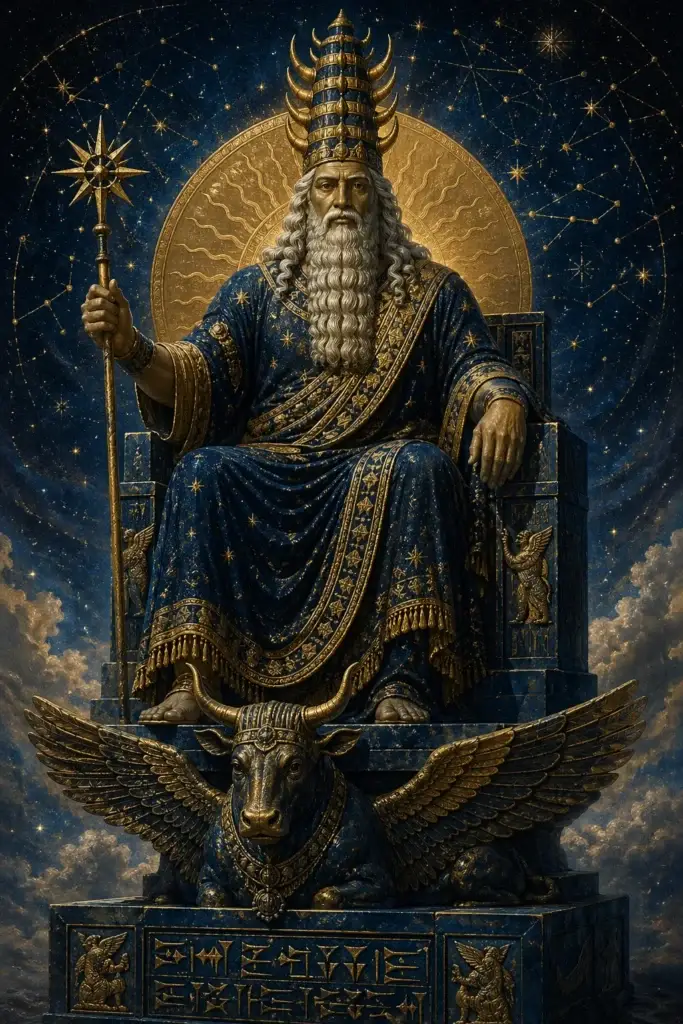
In visual art Ea is depicted as a bearded man with a long robe and a horned crown, often with a river between his shoulders.
In some reliefs he sits on a throne in the Apsu, surrounded by fish and water beings. On the kudurru stones his symbol appears in the upper row, since he belongs to the highest assembly of the gods.
Cult and Veneration
Eridu, the ancient Sumerian city in southern Mesopotamia, was the main cult site of Enki. According to Mesopotamian tradition, Eridu was the first city in the world, and the sanctuary E-abzu, the “house of the depths,” was his most important temple.
Archaeological excavations have uncovered in Eridu a long sequence of strata of temple buildings, reaching back into the Ubaid period of the 5th millennium BC.
The sanctuary was famous for its cultic water rites. Priests connected with the Apsu performed purification rites at a large water basin in front of the temple. This practice was preserved throughout Mesopotamian temple culture and also influenced the late Babylonian temple practice in Babylon, where Marduk’s temple likewise possessed an Apsu basin.
In Babylon, Borsippa, Nippur and Sippar, Ea was acknowledged as the father of Marduk and was venerated together with the imperial god of the Babylonian capital. Incantation texts, healing texts and divination texts invoke him as the source of knowledge, without whose counsel no magical act can succeed.
Ea’s cult ran through the whole of Mesopotamian history. In the Neo-Assyrian and Neo-Babylonian periods too he was one of the most important deities.
Ashurbanipal had his texts collected in the library of Nineveh; Nabopolassar and Nebuchadnezzar II had the Apsu basin in Babylon renewed. In the Seleucid period he remained present in incantation practices, until Mesopotamian written culture died out in the 1st century AD.
In popular religion Ea was held in particular esteem among physicians, incantation priests, well builders and scribes. These professional groups invoked him before every important undertaking. Writing tablets used in schools often begin with a brief invocation of Ea, because writing itself was considered one of his inventions.
Important Myths
In the “Enuma Elish,” the Babylonian creation epic, Ea plays a central role. He defeats Apsu, the male fresh-water primal father, who wishes to destroy the younger gods. Ea puts Apsu to sleep, cuts off his band of life and sets up his dwelling upon his body.
On this dwelling place his consort Damgalnuna gives birth to Marduk, the later imperial god of Babylon. This narrative is exceptional in the history of religion, because it theologically grounds the father-son rivalry and the shift of the supreme divine weight onto Marduk.
In “Enki and the World Order,” the myth describes how Enki organizes the cosmic order. He assigns each land, each element, each profession its own function. In the course of the text his daughter Inanna complains that she is not sufficiently equipped with functions of her own.
Enki reassures her and additionally grants her power over war and love. This narrative is one of the most important self-reflections of ancient Sumerian theology and shows how Mesopotamian religion mythically developed the division of the world.
“Enki and Ninhursag,” the myth already mentioned in the entry on Ninhursag, is another important text. It depicts the creative work of both gods on Dilmun and ends with the birth of the eight healing deities. This narrative is a creation text that links sickness, guilt and healing in a single mythical movement.
The “Atrahasis Epic,” the Old Babylonian forerunner of the flood story, describes how Ea warns the pious Atrahasis of the great flood and instructs him to build a ship.
Enlil, who had decreed the flood, is enraged at Ea’s high-handedness, but Ea defends his action with shrewd argumentation. The narrative is one of the most important pieces of evidence for Ea’s function as a shrewd, at times subversive, counselor of the gods.
Relationships within the Pantheon
Ea, together with Anu and Enlil, belongs to the highest triad of the pantheon. Anu is the sky god, Enlil the god of air and earth, Ea the god of fresh water and wisdom.
This threefold division reflects a cosmological apportioning of the spheres and is of great significance for the history of religion, because it forms the spiritual framework of the ancient Mesopotamian pantheon.
With Marduk, his son, Ea has a theologically profound relationship. In the “Enuma Elish,” Marduk takes the place of the highest god, yet Ea remains his father and teacher.
In incantation texts the priest often invokes Ea as the one who transmits the guilt of patients to Marduk. This function of a mediator between humans and the highest god is a particular feature of Ea.
With Ninhursag, Ea shares creative and healing functions; with Inanna, a parental relationship; with Damgalnuna, a marital bond. With Gula, the healing goddess, Ea is often invoked jointly in the incantation texts. This relationship shows how closely the Mesopotamian pantheon was interlocked in its functions.
Ea forms, together with Anu, the sky god, and Enlil, the storm and earth god, the highest triad of the Mesopotamian pantheon. These three gods divide among themselves the realms of heaven (Anu), atmosphere and earth (Enlil), and fresh water beneath the earth (Ea).
The triad is documented from the ancient Sumerian period onward and remains constant across the entire Mesopotamian religious system into the late period. This constancy distinguishes it from many other constellations of gods that vary regionally.
With Asalluhi, a younger god who played an important role in the cult of Eridu, Ea was connected through a father-son relationship. Asalluhi was later identified with Marduk, which made possible the merging of Eridu theology and Babylon theology. Wilfred G. Lambert reconstructed the text-historical line of this identification in “Babylonian Creation Myths.”
Reception and Influence
Ea remained present as an incantation deity in the manuscripts of Babylon and Uruk in the Hellenistic and Parthian periods. The Greek and Arabic traditions too know reflexes of his figure. In Gnostic late antiquity he was associated with demiurge conceptions; in medieval astrology his constellation Suhurmash was firmly established as Capricorn.
In modern history of religion Ea is one of the most frequently cited ancient Mesopotamian gods, above all because of his role in the flood story. The discussion about the relationship between the Atrahasis Epic and the biblical Deluge has placed his figure at the center of comparative religious research.
In popular culture Ea rarely appears today under his own name, yet his legacy lives on in numerous adaptations of the Babylonian flood myth. Astronomy has erected a monument to him in the constellation Capricorn. The name Ea is used in some modern role-playing games and computer games as an allusion to Mesopotamian mythology.
In Hellenistic history of religion, Ea was carried forward under the name Oannes, a Hellenized form used by Berossos in his “Babyloniaka.” Berossos describes Oannes as a fish-man who comes to humans out of the Persian Gulf, teaches them the arts and sciences, and returns to the sea again in the evening.
This narrative shaped the Hellenistic conception of a Mesopotamian bringer of culture and was interpreted by Eusebius and later Christian authors as a pagan distortion of the Genesis creation.
In modern phenomenological discourse on religion, Ea is regarded as the ideal type of the “trickster” god who mediates between gods and humans and influences the course of history through cunning.
This phenomenological classification has co-shaped the reception of Ea in religious studies in the 20th century.
Religious-Studies Classification
Thorkild Jacobsen sees in Ea one of the most multilayered gods of ancient Mesopotamian religion. He interprets his relationship with the Apsu as an image of the hidden knowledge that rises from the depths, and sees in his shrewd diplomacy an early form of later mediation theologies.
Jean Bottéro emphasizes the theological-philosophical significance of Ea. In his view, Ea is the god through whose figure ancient Mesopotamian religion develops a kind of philosophical reflection on the world.
Stefan Maul has shown in his studies on the art of incantation how central Ea was for the asipu, the incantation priest. Without Ea’s knowledge no magical act could succeed.
Andrew George, Wilfred Lambert and Stephanie Dalley have edited and commented on the texts. Walther Sallaberger and Marc van de Mieroop have analyzed the cult in Eridu and the connection to ancient Sumerian urban culture.
Modern scholarship sees in Ea one of the most important keys to understanding the ancient Mesopotamian history of science and religion.
The Adapa Myth and Atrahasis
The Adapa myth is one of the most important narratives concerning the theology of Ea. Adapa, a human priest from the city of Eridu and a son of Ea, is fishing one day on the Persian Gulf when the south wind overturns his boat.
In his anger Adapa curses the south wind and symbolically breaks its wings.
The gods in heaven learn of this, and Anu, the lord of heaven, summons Adapa before his throne.
Before the journey, Ea advises his son to refuse the food and drink offered to him, because they are “food of death” and “water of death.” Adapa follows the advice and declines the offer, without knowing that Anu in truth wished to present him with “food of life” and “water of life.” With this, humankind forfeits immortality.
This episode is read in scholarship as a reflexive narrative on the relationship between knowledge and mortality. Stefan Maul has advanced, in several essays, the thesis that Ea’s advice is a pseudo-paternalistic trap: by denying his son immortality, he secures the human scribal and priestly culture, whose succession of generations is possible only in mortality.
Other scholars such as Shlomo Izre’el and Karen Radner see in the narrative the theological grounding of human finitude. The tablet edition by Izre’el (“Adapa and the South Wind,” 2001) has clarified the text-historical details and laid open the range of interpretations.
The Atrahasis Epic, in the edition by Wilfred G. Lambert and A. R. Millard, “Atra-Hasis: The Babylonian Story of the Flood” (1969), reports on the creation of humans from clay and divine blood, on the overgrowth of the human population and its suppression through sickness, famine and finally the Deluge.
Ea is the central figure of resistance against Enlil’s wrath in this epic. He warns Atrahasis, the “exceedingly wise one,” of the impending flood and gives him the building instructions for the ark. This mediating role between the gods and humankind is constitutive of Ea’s profile and recurs in numerous further texts.
Apsu, Fresh Water and Creator Theology
Ea dwells in the Apsu, the subterranean sea of fresh water, which according to Mesopotamian conception lies beneath the earth’s surface and feeds all wells, springs and rivers. The Apsu is at the same time the seat of his workshop, in which he forms clay figures and magical implements.
This conception connects Ea with the archaic craft religion of Mesopotamia, in which fresh water and the potter’s craft are closely interrelated. Walther Sallaberger reconstructed in detail the religious dimension of pottery in “The Babylonian Potter” (1996).
In the Enuma Elish, the great Babylonian creation epic in seven tablets, the Apsu is personified as Ea’s father or grandfather, whose killing initiates the beginning of the world. In Tablet I the primeval divine pair Apsu and Tiamat ask for rest from the noisy younger gods. Apsu plans to destroy them.
Ea sees through the plan, puts Apsu to sleep by means of an incantation, and kills him. Upon the dead Apsu, Ea builds his dwelling place, which he names after the slain predecessor Apsu. This pathos etymology is one of the most important examples of Babylonian narrative reflection.
From the union of Ea with Damkina, Marduk is born, who later defeats Tiamat and creates the cosmos from her body. Ea is thus not the final creator but the preparer, who creates the preconditions.
This function as a mediator of creation can also be found, in terms of the history of religion, in the Genesis narrative, where the divine spirit hovers over the waters before the words of creation go forth.
A direct dependence is not compelling, but the structural similarity has been discussed in detail by John Day in “God’s Conflict with the Dragon and the Sea” (1985).
Incantation, Magic and the Scribal Craft
Ea was the patron god of the Mesopotamian incantation priests, the ashipu.
The most important incantation collections, first and foremost the “Maqlu” (the “Burning,” an anti-witchcraft collection), the “Shurpu” (the “Searing,” a rite of atonement) and the “Namburbi” (rites of release against unfavorable omens), often contain an invocation of Ea. The standard formula “incantation, not mine, but that of Ea” is a topos that derives the authority of the human incantation from the divine one.
Tzvi Abusch reconstructed in detail the theology of the Ea invocations in his studies on Maqlu and Shurpu.
Ea plays a special role as the patron god of the scribal art. The Mesopotamian scribal schools, the Edubba, had Ea as their chief patron, together with Nidaba (or Nisaba), the goddess of writing and surveying.
Scribal colophons often end with the formula “Nidaba, sister of Ea, be praised,” which attests to the close interweaving of scribal culture with the fresh-water god. In the scribal hymns Ea is invoked as “lord of the tablets” and “opener of understanding.”
In the field of medicine Ea is the patron of the ashipu, the magical-ritual healers, in competition with the asu, the more practical-pharmaceutical physicians.
The diagnostic handbooks compiled under Esagil-kin-apli trace themselves back to Ea. In every diagnosis Ea appears as the distant teacher whose knowledge is passed on through the human scribe. Stefan Maul presented this connection of scribal craft, medicine and incantation in detail in “The Art of Divination in the Ancient Orient” (2013).
Sources and Further Reading
Ancient sources: “Enuma Elish,” “Atrahasis Epic,” “Enki and Ninhursag,” “Enki and the World Order,” inscriptions from Eridu, incantation texts and healing texts from Babylon and Nippur, hymns to Ea and Marduk.
Research literature: Thorkild Jacobsen, “The Treasures of Darkness,” New Haven 1976. Jean Bottéro, “Mesopotamia: Writing, Reasoning, and the Gods,” Chicago 1992. Stefan Maul, “Die Wahrsagekunst im Alten Orient,” Munich 2013. Walther Sallaberger, “Der kultische Kalender der Ur III-Zeit,” Berlin 1993. Andrew George, “The Babylonian Gilgamesh Epic,” Oxford 2003. Wilfred Lambert, “Babylonian Creation Myths,” Winona Lake 2013. Stephanie Dalley, “Myths from Mesopotamia,” Oxford 1989. Marc van de Mieroop, “A History of the Ancient Near East,” Oxford 2004.