Omamori: the Japanese protective pouch from shrine and temple
By Ralf Ittermann · last reviewed on
The Omamori is the Japanese protective pouch obtained at shrines and temples. It is a small pouch of brocade fabric that conceals a blessed core, and it accompanies its bearer through a year before it is returned and replaced by a new one.
Classification
The Omamori is a Japanese protective object that is dispensed at the shrines of the Shinto religion and at the Buddhist temples of Japan. It is among the most widespread religious objects in the country and is familiar both to locals and to travelers.
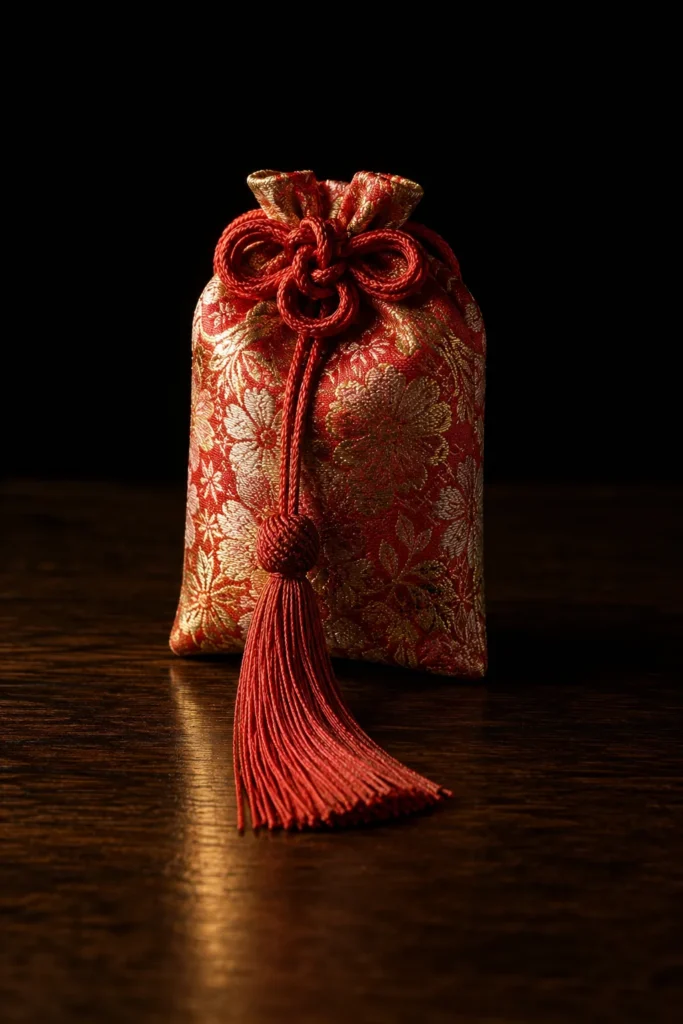
Outwardly, the Omamori is a small, usually rectangular pouch of colored brocade fabric. It is closed with a cord and decorated with embroidery. Its small size makes it easy to carry, so that it can be taken along without effort in a bag, on a school satchel or in a vehicle.
What is distinctive about the Omamori lies within. The pouch encloses a blessed core that constitutes the actual protective object. This core remains hidden, for according to a widely held view the Omamori is not meant to be opened.
In religious studies the Omamori is a good example of a protective object that is firmly embedded in a religious institution. It does not arise through commerce but at the shrine or temple, and at the end of its use it returns there as well.
In everyday Japanese culture the Omamori belongs to a larger group of objects meant to bring good fortune and protection. These lucky objects accompany many areas of life, from school through work to travel.
Within this group the Omamori is probably the best known and most widespread representative, and scarcely a household in Japan manages entirely without such a protective object.
Origin and name
The name Omamori is composed of a polite prefix and a word derived from the Japanese verb for protecting or preserving. Taken literally, the Omamori therefore simply denotes that which protects, protection in tangible form.
The roots of the Omamori reach far back. It stands in the tradition of older Japanese protective practices in which blessed objects and inscribed strips played a part. From these forms the small, portable pouch gradually developed into the form common today.
Both the Shinto religion with its shrines and Buddhism with its temples took the Omamori into their practice. Both traditions dispense it to this day, and for many people in Japan the distinction is of little importance in everyday life.
Over time the Omamori became a fixed part of religious life. Today it is not a rare or special object but a familiar companion that many people carry with them as a matter of course.
The roots of the Omamori reach back to the time when pilgrims brought small blessed objects home from their pilgrimages.
In the Edo period, when travel within the country increased and great sanctuaries were visited by many people, portable protective objects spread widely. Out of this culture of pilgrimage and travel the generally accessible form of the protective pouch common today gradually developed.
Form and the hidden core
The outer pouch of the Omamori is usually made of brocade in strong colors. Red, gold, violet and green are common, and the fabric often bears the name of the shrine or temple as well as the purpose for which the Omamori is intended.
Within the pouch lies the blessed core. It is a small strip of paper or wood that has been consecrated in a ritual. On this strip there may be the name of a deity or a protective formula.
This core is regarded as the actual sacred element of the Omamori. A widely held notion holds that the pouch should not be opened, because otherwise the protection escapes or is lost. The Omamori therefore generally remains closed throughout its entire period of use.
This construction reveals a recurring pattern in the study of amulets. The element that is actually effective is hidden and protected by an outer covering. Similar arrangements are known from amulet capsules and inscribed protective objects of other cultures.
Those who are nonetheless curious and open an Omamori often find inside only a plain inscribed strip. For many believers the essential thing is not the material but the blessing and the connection to the sanctuary.
The artfully woven brocade pouches are nonetheless carefully made, and their design belongs to the appearance of the respective shrine or temple.
Shrine and temple as source
An Omamori is not obtained in ordinary commerce but at a shrine or temple. There it is dispensed in exchange for an offering that is understood not as a purchase price but as a donation and contribution. This origin is important for understanding the object.
The bond to the religious institution gives the Omamori its meaning. The blessed core was consecrated at this place and in its ritual, and the protection is connected to the deity or the Buddha that is venerated there.
Many shrines and temples are known for particular purposes. A shrine associated with learning and education dispenses above all Omamori for success in examinations. A temple connected with health keeps corresponding protective pouches at hand.
Thus the acquisition of an Omamori is often linked to a visit. Those who have a particular purpose seek out the appropriate shrine or temple. The Omamori thereby becomes a tangible reminder of this visit and of the blessing received there.
Telling is the language in which the acquisition is spoken of. One does not speak of buying but rather of receiving an Omamori.
The offering paid for it is regarded as a contribution to the upkeep of the shrine or temple. This choice of words underscores that the Omamori is understood as a consecrated object and not as ordinary merchandise of the market.
The variety of purposes
Omamori exist for a wide range of purposes. Very common is the Omamori for safety in road traffic, which many people attach in the car. Equally well known is the Omamori for success in examinations, which is carried especially by pupils and students.
Further Omamori are directed at health, at a safe birth, at finding a partner and at the success of a marriage. Separate protective pouches are also dispensed for business success and for the general warding off of misfortune.
This variety shows that the Omamori is not a general, undefined protective object. As a rule it is directed at a concrete purpose, and this purpose is named on the outside of the pouch.
Many people therefore possess several Omamori at the same time, each for a different area of life. This specific orientation distinguishes the Omamori from protective signs meant to act quite generally against any misfortune.
The modern variety of Omamori is considerable. There are protective pouches for success in sporting competitions, for safety when traveling by airplane or for the well-being of pets.
Many people deliberately choose their Omamori according to their own situation in life, so that the small pouch becomes a personal expression of their own cares and hopes.
The yearly cycle: renewal and return
An Omamori is not intended to last forever. According to a widely held notion it loses effectiveness over the course of a year, because it takes into itself, as it were, the misfortune that it keeps away from the bearer.
For this reason the Omamori is as a rule renewed after about a year. Many people do this at the start of the year, in connection with the first shrine visit of the new year, which is an important custom for numerous Japanese.
The old Omamori is not simply thrown away. It is brought back to the shrine or temple, where it is collected and burned in a ritual. This reverent disposal is firmly part of how the protective pouch is handled.
In this yearly cycle of receiving, carrying, returning and renewing a distinctive conception of protection appears. The Omamori is an object for a time, whose power is consumed and which therefore must be renewed regularly.
Behind the annual exchange there is also a religious idea. The notion that nothing remains permanent and unchanged is deeply anchored in Japanese religiosity.
The burning of the old Omamori respectfully returns the object to its origin and at the same time makes room for a new beginning. Renewal thus belongs to the very nature of the protective pouch.
Omamori and Ofuda
Closely related to the Omamori is the Ofuda. The Ofuda too is a blessed protective object from shrine or temple, yet it differs markedly from the small pouch in form and use.
The Ofuda is as a rule a longer strip or a small tablet of paper or wood. It is not intended to be carried on the body but is placed in the home, often at the house altar or in a protected spot.
While the Ofuda thus protects the living space and the family, the Omamori is the personal protection of the individual, carried on the body. Both belong together and complement each other, for they cover the domestic and the personal sphere.
The relationship of Omamori and Ofuda corresponds to a pattern that is encountered in many cultures. Elsewhere too a protective sign attached to the house stands alongside a worn, personal amulet.
The Ofuda often has its place at the kamidana, the small house altar found in many Japanese homes. There it is kept and venerated in an elevated, clean spot. Omamori and Ofuda thus complement each other in the household, the one as worn personal protection, the other as resting protection of the shared living space.
Religious background
The Omamori stands at the meeting point of the two great religious traditions of Japan. The Shinto religion venerates the kami, the divine powers present in nature and at special places. A shrine Omamori connects its bearer with the kami of the respective shrine.
Buddhism brought its own conceptions and in turn dispenses protective objects. A temple Omamori is connected with a Buddha or a Bodhisattva figure that is venerated at this temple.
In the everyday life of many people in Japan, Shinto and Buddhism stand side by side without this being seen as a contradiction. It is customary to acquire Omamori at shrines as well as at temples, depending on occasion and purpose.
The Omamori thus reflects a religious practice that is oriented not toward strict demarcation but toward the concrete purpose. The protective pouch connects the individual with the sacred power held to be responsible for that person’s purpose.
That Shinto and Buddhism work together so closely in practice has a long history. For centuries both traditions were closely intertwined. Only state interventions in the nineteenth century separated them organizationally.
In the religious sentiment of many people, however, the connection remained, and the Omamori is a vivid example of this side-by-side existence that is taken for granted to this day.
Reception today
The Omamori is exceptionally vibrant in Japan to this day. It belongs to the great shrine visits as well as to small occasions, and it is often given as a gift in order to pass on protection and a good wish to another person.
In more recent times the design has expanded. Some shrines and temples dispense Omamori with modern motifs, and there are pouches tailored to particular target groups. This development has kept the Omamori attractive to younger people as well.
At the same time the Omamori has become a popular souvenir among travelers. With this, the meaning shifts for a portion of the pieces, from religious protective object toward a keepsake of a journey.
For many people in Japan, however, the original sense remains unbroken. There the Omamori continues to be a protective pouch that was blessed in a ritual and that accompanies and preserves a concrete area of life.
The Omamori is moreover firmly embedded in the Japanese culture of gift-giving. Those who know that someone close faces an examination, a journey or an operation gladly give that person a suitable Omamori. The protective pouch thus becomes the bearer of a good wish and makes the concern for another’s circumstances visible and tangible.
Literature (selection)
Related key terms: Omamori Ofuda shrine temple Shinto protective pouch brocade kami Japan.
iWell Guard and protective traditions
iWell Guard stands in the cultural-historical line of portable protective objects to which the Omamori also belongs. A modern companion for people who live with protective symbols: made in Germany, 41 layers of solid gold, platinum and silver, with a 30-day right of return.
Personal experiences may vary. Not a medical device. No healing promise.