Zombi, spirit of the Haitian tradition
By Ralf Ittermann · last reviewed on
Zombi is a spirit of the Haitian tradition.
The body without a soul, the living grave.
The Zombi is a soulless person in Haitian folklore.
Overview: Zombi
Type: Vodou horror figure: the soulless living person, controlled by a Bokor
Pantheon: Vodou (Haiti); not a Loa, but a victim of black-magic practice
Function: will-less servant of the Bokor (in the traditional conception); a warning against social enslavement
Main attributes: empty eyes, mechanical movements, upright posture, expressionless
Main cult sites: none; the Zombi is a folk-tradition horror figure, not a cult object
Western pop adaptation: heavily distorted (Hollywood „Zombie“ from 1968 onward)
Classification
Period of Sources
The Zombi concept in Haiti has West African roots (Kongo and Kongo-Yoruba traditions). In its developed form it emerged in colonial Saint-Domingue as a response to slavery: the Zombi represents the ultimate form of the enslaved person, one whose will has been taken.
Ethnographic documentation began in the 19th century; scholarly attention increased from the 1980s onward, driven above all by Wade Davis’s controversial study The Serpent and the Rainbow (1985), which popularized the tetrodotoxin hypothesis.
Geographic Distribution
Zombi narratives are present throughout rural Haitian regions, functioning as cautionary tales about Bokors (black-magic Vodou practitioners) and as a social warning.
First-hand accounts of Zombi experiences are rare and difficult to verify; individual documented cases (Clairvius Narcisse, 1962) have received academic attention. The figure is widely distributed in popular culture worldwide, but is barely connected any longer to its Haitian origin.
State of Sources
Key sources: Maya Deren’s Divine Horsemen (reference), Wade Davis’s The Serpent and the Rainbow (1985, populist in tone, academically contested), Davis’s subsequent Passage of Darkness (1988, more critically reflective). From a history-of-religions perspective: Métraux’s Le Vaudou haïtien; Hurbon, Voodoo: Search for the Spirit.
Name and Variants
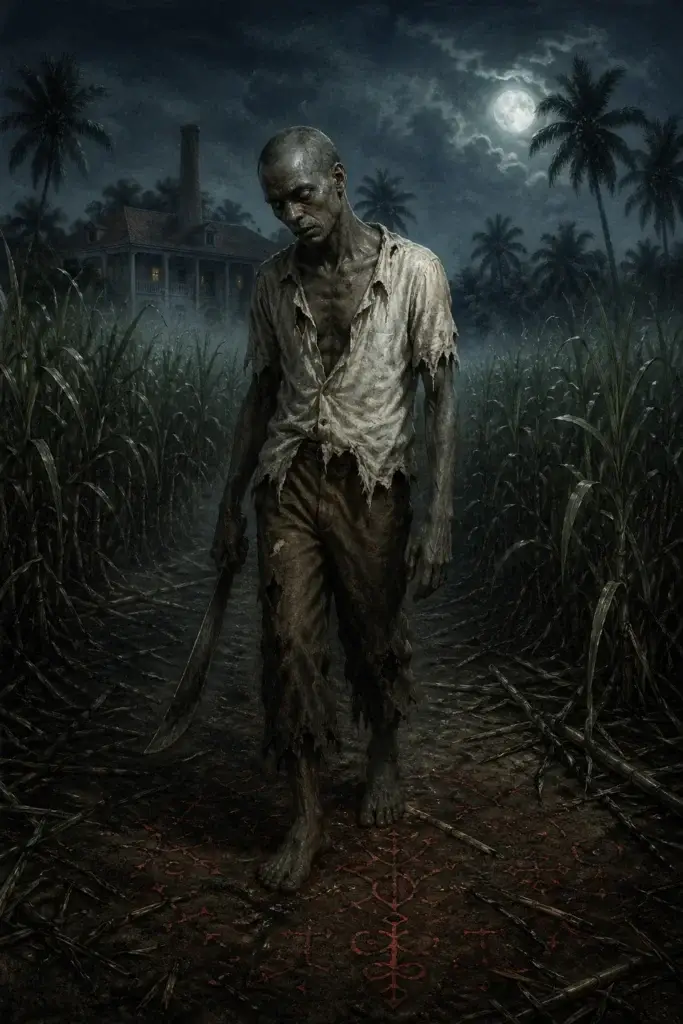
A Zombi is depicted as living yet withered, slow, with a vacant gaze and a monotone voice. The movements are stiff, the skin ashen-gray. In popular cinema the Zombi is a flesh-eating monster; in folklore, however, it is usually a silently obedient slave who carries out orders without any will.
No magic, no supernatural power, only physical existence without inner presence. The Zombi is the counterpart to the living person, the punishment for moral transgressions or enmity during life.
Description
The Zombi (Haitian Creole zonbi, from Kongo nzambi, meaning “spirit” or “god”) is, in Haitian Vodou, a person put into a will-less state by the practice of a Bokor (sorcerer).
Anthropologically, research distinguishes two types: the Zombi cadavre (body zombie, placed in a death-like state by a tetrodotoxin/Datura mixture and then “revived” as a slave) and the Zombi astral (soul zombie, in which the ti bon ange soul is separated from the body and imprisoned in a clay jar).
Wade Davis documented the pharmacological practice in The Serpent and the Rainbow (1985), although his conclusions remained disputed (cf. also Métraux, Voodoo in Haiti; Hurbon).
Profile: Zombi
The most important aspects of the Zombi at a glance. The following fields summarize origin, function, appearance, “veneration” (in practice: avoidance), symbols, and parallels.
In the traditional Haitian conception, the Zombi is created by a Bokor (black-magic Vodou practitioner): the victim is placed in a death-like state by a powder (in Davis’s theory containing tetrodotoxin from puffer-fish bile), buried, then exhumed after several days and kept as a will-less servant.
The soul, the ti bon ange (little good angel), is separated from the body and kept by the Bokor in a bottle.
Functionally, the Zombi is a will-less laborer, the ultimate intensification of slavery. A Bokor keeps several Zombis and puts them to work in his fields.
In social-philosophical terms, the Zombi is a warning: the fate after death can be worse than death itself if one falls under the power of a Bokor. In modern discussion, the figure is often read as an allegory for a soulless consumerist existence.
A gaunt, expressionless male figure with empty eyes (frequently white and glazed), slowed mechanical movements, an upright gait, and dirty, tattered clothing. Skin color often pale and grayish. Cannot speak, or only mumbles.
Responds only to direct commands from the Bokor. In the Hollywood zombie from 1968 onward (Night of the Living Dead), this image was radically altered: bloody, flesh-eating, infectious undead with little relation to the Haitian tradition.
Domain: The Zombi is not venerated but feared and avoided. Protective practices: salt placed in the mouth of the deceased (prevents reanimation, because the Zombi responds to salt with the return of memory), heavy stones placed on the grave (so the Bokor cannot open it), and guarded burial through the first nights.
If there is suspicion that a relative has been zombified, it constitutes a family scandal and a commission to a Houngan to retrieve the soul.
Empty eyes, mechanical movements, pallid skin, a powder (Bokor powder), a bottle containing the captured soul, salt (which breaks the spell), grave earth, the Bokor’s assistants, shovel and spade. Sacred number: none.
Bokor (Vodou, the creator), Houngan (Vodou, the redemption priest in Zombi cases). Global undead parallels: Draugr (Germanic, an activated corpse but conscious), Kuei/Jiangshi (China, the hopping undead), Edimmu (Mesopotamia, restless dead), Wiederganger (Germanic folk tradition). Functionally distinct: the Haitian Zombi is de-souled, not inhabited by a soul.
Protective Practice
Rituals of Protection
According to widespread belief, a zombi that had already been raised could be released if given salt to eat, since this made him recognize his fate and return to his grave or to freedom. Also central was the safeguarding of the ti bon ange, the portion of the soul that the bokor is said to keep captive in a vessel: if this vessel is destroyed or the soul freed, the bokor’s power over the victim ends. Such motifs show that protection in Vodou always targets the soul, not the body alone.
Invocations
In Haitian Vodou, protective practice is directed not against the zombi itself but against zombification as an act carried out by a bokor. Traditionally, concern focused above all on protecting the recently deceased: families guarded graves, weighed them down with stones, or buried their dead close to the house. In the 1980s, ethnobotanist Wade Davis documented accounts describing zombification as a form of punishment within the community, which made proper social conduct the true means of prevention.
Amulets and Protective Symbols
From the perspective of the history of religion, belief in zombis in Haiti also served as a form of social control: anyone who violated community rules had to fear zombification as a sanction. Haiti’s Code Pénal of 1864 even made it a criminal offense under Article 246 to place a person in a death-like state, treating it legally as attempted murder. This linked the ritual notion of protection with a state-imposed norm.
Cult and Veneration
Zombi is not venerated but understood as a warning against the abuse of power. Protective rituals are meant to guard against transformation into a zombi. Bokors, who create zombis, are regarded as powerful but morally condemned. Zombi concepts are invoked in protective charms and in ethical discussions.
Zombi: Parallels in Other Cultures
West African Roots
The concept of the Zombi traces back to Bantu terms around nzambi (god, ancestor, spirit), which arrived in Haiti through the slave trade of the 17th to 19th centuries.
In the Kongo tradition, nzambi a mpungu designates the supreme god. The Haitian semantic shift to “the living dead” is a Creole-Haitian innovation not found in any direct West African source.
Caribbean Parallels
Related concepts appear in Jamaican Obeah (duppy as the spirit of a deceased person), in Cuban Palo Mayombe (nfumbe as a spirit-bound corpse in the nganga pot), and in Trinidadian Spiritism. The slave economy and syncretism with Catholic veneration of the dead produced a shared Caribbean concept of the deceased.
Modern Reception
The Haitian Zombi developed in North American popular culture, beginning with William Seabrook’s travel account The Magic Island (1929) and Victor Halperin’s film White Zombie (1932), into an independent cinematic figure.
George A. Romero’s Night of the Living Dead (1968) created the modern violent Zombi-apocalypse myth, which now has little in common with the Haitian original (cf. Bishop, American Zombie Gothic; Boluk/Lenz, Generation Zombie).
Origin of the Term and Religious Background
The term Zombi comes from Haitian Creole and most likely has West African and Central African roots. Frequent reference is made to words from Kongo languages relating to spirit, soul, or the deceased. The precise etymology has not been conclusively established by research, though the African origin is considered confirmed.
In Haitian Vodou, the Zombi is embedded in a conception of the soul as consisting of multiple parts. According to widespread teaching, a person possesses several soul components, including one referred to as gwo bon anj.
Zombification is interpreted as the extraction of such a component from a person and its subjection to external control. The body remains, but the person’s own will is absent.
In this respect the Haitian Zombi differs fundamentally from later popular representations. It is not a reanimated corpse and not a contagious monster, but a living person in a condition understood as unfree.
From the perspective of religious studies, the concept belongs to the realm of soul doctrine, death, and social control within Vodou and is inseparable from the functions of the Bokor.
The Davis Thesis and Its Discussion
The topic received international attention through the work of ethnobotanist Wade Davis. In The Serpent and the Rainbow (1985) and the academic version Passage of Darkness (1988), Davis argued that some documented cases of zombification involved a powder containing the nerve toxin tetrodotoxin.
This substance, found among other sources in puffer fish, can induce a death-like state.
The thesis was widely discussed and criticized on several points. Toxicologists noted that the concentrations found in examined samples varied considerably and were in some cases too low to produce the claimed effect.
Other specialists emphasized methodological weaknesses in case selection. Davis himself has consistently stressed that the pharmacological component is only one element and that the decisive factor lies in social and religious interpretation.
Well known in this context is the case of Clairvius Narcisse, a man who reportedly reappeared years after an official death declaration. This case too is contested on source-critical grounds.
What can be stated is that science has identified no confirmed mechanism of zombification. iWell Guard presents the Davis thesis as a historically important but contested research position, not as established fact.
From the Haitian Zombi to the Film Monster
The figure of the zombie as a decaying, flesh-eating undead, now widespread worldwide, separated itself from the Haitian concept only gradually during the 20th century.
Early American films such as White Zombie (1932) still depicted the Zombi with clear reference to Haiti, though strongly shaped by colonial stereotypes. The will-less laborer under external control was at the center.
The decisive break was marked by George A. Romero’s film Night of the Living Dead (1968). Romero detached the figure from the Vodou context, transformed it into an anonymous mass of reanimated corpses, and associated it with contagion. The individual, Bokor-controlled person became a faceless threat. Later films, series, and games expanded this model.
In cultural studies, this development is described as an example of a religious motif becoming detached from its origin. The popular-culture zombie today serves as a projection surface for very different fears, including those around epidemics, mass society, or loss of control.
The Haitian Zombi should be kept distinct from this. Those interested in the religious source figure should consider it separately from the film monster and read it in connection with the Bokor and Vodou.
Further Links
Research Literature
Further standard works in the literature index.
Frequently Asked Questions about Zombi
What is a Zombi in the Vodou tradition?
The Zombi (Vodou spelling, anglicized as Zombie) is a central figure of Haitian Vodou, not a walking corpse in the sense of modern popular culture, but a person revived by a Bokor (sorcerer) from whom the soul has been taken.
The historical Zombi belief has real-world grounding: the puffer-fish powder theory of Wade Davis (1985) describes a mixture of tetrodotoxin and psychotropic substances that can induce a death-like state followed by a condition of captive will.
How does the Haitian Zombi differ from the Hollywood zombie?
The Haitian Zombi is a single individual enslaved by a Bokor, typically forced to labor in sugarcane fields. It is not contagious, not aggressive, and not flesh-eating. The Hollywood zombie of the George Romero tradition (Night of the Living Dead, 1968) is a secondary invention that shares only the name with the Vodou concept.
The central Vodou teaching: anyone who wants to free a Zombi must give it salt to eat, at which point it recognizes that it has died and can then die.