Morrigan, Goddess of Celtic Tradition
By Ralf Ittermann · last reviewed on
Morrigan is the goddess of Celtic tradition, mistress of war, fate, sexuality and death, often depicted as a war spirit or shape-shifter. In terms of the history of religion she represents the Indo-European type of the »goddess of fate« and is central to understanding Celtic warrior religion and demonological ambivalence.
Morrigan (also Morrígu, Mór-Ríghan) is depicted as a goddess and spirit of war, death and fate. She appears as a crow or raven, flies over battlefields and influences the outcome of war through supernatural power. She encounters several heroes (Dagda, Cú Chulainn) and brings them blessing or ruin.
In the Cath Maige Tuired she proclaims the outcome of the battle. She is sometimes transmitted as a triad (Mór-Ríghan, Macha, Badb) and sometimes as a single figure. She is not »evil«, but amoral and governed by war.
The evidence comes from the Cath Maige Tuired, the Togail Bruidne Dá Derga, the Oidheadh Chloinne Usnig and other Irish saga complexes (recorded in the 8th to 12th centuries).
Morrigan is also mentioned in genealogies and place-name etymologies (Rath Maeve = »hill of the queen«, possibly connected to Morrigan). Modern scholarship (Maier, Mac Cana, Green) debates whether Morrigan is an original goddess or a syncretism of several figures. Folkloric transmission in Ireland and Scotland preserved war-spirit traditions.
Historical Classification
The continuity of the transmission across these long spans of time is remarkable and shows a deep, stable cultural rootedness. Even in modern times the memory, and sometimes also active veneration, remains alive: sometimes transformed, but in its essential features still recognisable.
Morrigan was known and venerated, or respectfully feared, throughout Ireland.
Whether in large urban centres or in peripheral rural regions, whether among the social elite or among ordinary people, the spiritual or cultural significance of this entity was consistently recognised and universal.
The Morrígan was no locally confined cult; she was firmly anchored in the Irish narrative cycles that were recited across the whole island. Place names such as Dá Chích na Morrigna, the hills in the plain of Meath known as the Breasts of the Morrígan, show that the goddess was also located in the landscape. Her partly threefold form, together with Badb and Macha, further linked her to other battle goddesses known well beyond any single region.
Primary sources: Cath Maige Tuired (recensions A and B, recorded ca. 9th to 12th centuries), Togail Bruidne Dá Derga (destruction saga), Oidheadh Chloinne Usnig (the fate of the children of Usnech), as well as the Tochmarc Eímhain (»the wooing of Eimain«). Period: oral traditions older (possibly Iron Age or early medieval), written fixation from the 8th century onward. Researchers: Proinsias Mac Cana (Celtic Mythology, The Mabinogion), Bernhard Maier (Die Religion der Kelten), Miranda Green (The Gods of the Celts), Birkhan (Kelten) treat Morrigan as a central figure of war religion.
Name and Variants
Morrigan is depicted in the various sources and artistic traditions with certain recurring iconographic elements that remain relatively constant across decades and across different geographical regions.
These elements are not purely decorative or chosen at random, but are deeply symbolically encoded and carry great meaning. They convey the central functions, sources of power, areas of responsibility and cosmic role of the being.
The overall system is like a sacred script or an encoded image: it allows initiates or the culturally educated to grasp the essential, deeper meaning and to understand it correctly. Colours, sacred objects or weapons, physical attributes, specific accessories: everything is significant and traditionally handed down.
Description
Morrigan was central to the religious practice, the everyday rituals and the daily understanding of the Celts. People turned to this entity in critical or specific life situations or at particular ritual times of the year.
Knowledge of the Morrígan was carried in Ireland by the learned classes: the poets and scholars of the pre-Christian era preserved the tales of the war goddess, and the monks of the medieval monasteries eventually recorded them in manuscripts such as the Book of Leinster. What has come down to us about her therefore follows fixed narrative and scribal traditions, not spontaneous invention.
The continuity of these practices across many generations clearly shows that the practice was regarded as effective and necessary. Functions were manifold: some were preventive (warding off potential harm), some healing (alleviation of illness or suffering), some transformative (accompaniment through transitions between stages of life).
The profile captures Morrigan in six main aspects: her mythological origin and ambivalent position in the Celtic pantheon, her function as a war spirit and determiner of fate, her iconography as a crow and shape-shifter, her demonically powerful effects, spiritual precautions, and cultural parallels in other religious traditions.
The following cards bring together the most important key points in condensed form; more detailed descriptions can be found in the preceding chapters on name, description and protective practice.
Origin
Morrigan belongs to the oldest strata of the Celtic goddess traditions, possibly of pre-Celtic origin. She is transmitted in many variants as a single goddess or as a triad (Mór-Ríghan, Macha, Badb).
Geographically she is centred on Ireland, with Scottish and Welsh variants. Her first literary attestation lies in texts of the 9th to 10th centuries, but the tradition is older. Etymologies are disputed (»great queen«, »sea goddess«, »fates«).
Recipients
Morrigan was invoked by warriors and kings to obtain victory or to bring about defeat. Women turned to her in matters of birth and fertility.
She was not a goddess of the »organised cult«, but of war fate and wild femininity.
Appearance
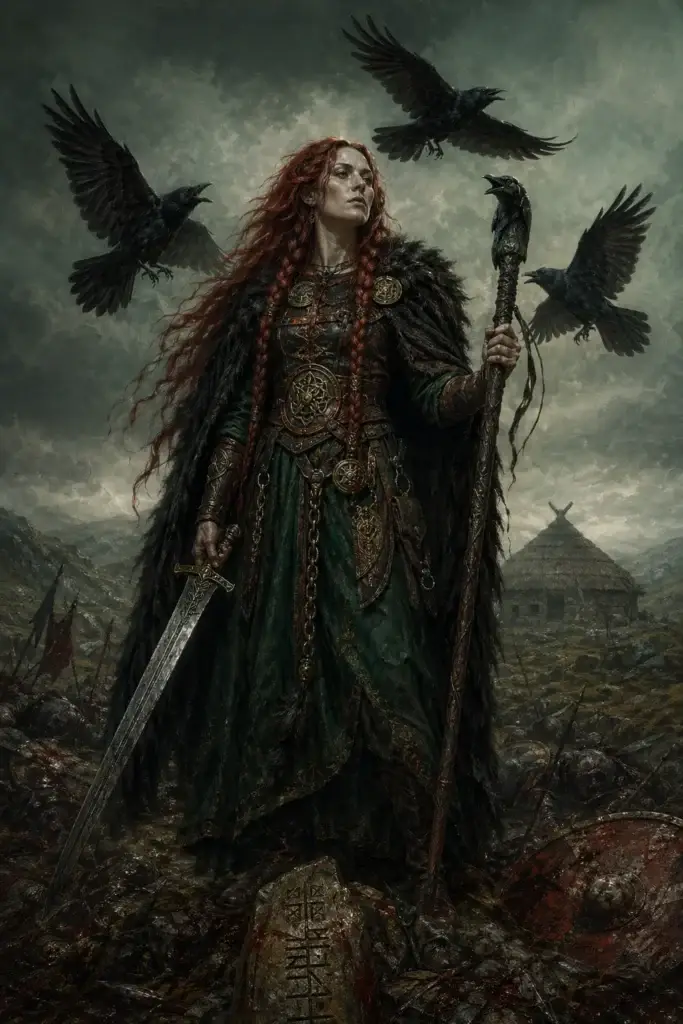
Morrigan is iconographically often depicted as a crow or raven, sometimes with human features or as a shape-shifting woman. She sometimes wears armour or warlike attributes.
In literary descriptions she is wild, beautiful and dangerous at once. She stands on battlefields or flies over them. Colours: black, red (blood), sometimes silver. She radiates a supernatural presence.
Morrigan's Effect
Morrigan is credited with power over the outcome of war, the determination of fate, fertility and sexuality, as well as shape-shifting abilities. She can inspire heroes or paralyse their opponents. She embodies destructive and creative femininity. Her supernatural power is amoral: it follows the logic of war, not ethics.
She can bring ruin, but also blessing. In the Táin Bó Cúailnge this dual nature appears especially clearly: first she offers Cú Chulainn her favour, then she turns against him, an ambivalence that cannot be resolved morally but is to be understood as a cosmic power of fate.
Forms of Defence
Morrigan is not evil, but dangerous and unpredictable. She is a mistress of battle fate, not a demoness. Protective practices consist in respecting and honouring her, not fearing her.
War-magic traditions teach invocations and sacrifice in order to win her favour or to avoid her enmity. Modern esoteric practice sees Morrigan as a force of transformation and authenticity, not as destructive.
Counterparts
Comparable are the Erinyes/Furies (Greek) as deities of fate and vengeance, the Norns (Germanic) as weavers of fate, who like the Morrígan are similarly tripartite, the Roman Bellona as a war goddess, and the Indian Kali as goddess of destruction and transformation.
The “goddess of fate” type is widespread across the Indo-European world. The Slavic Mokosh, the Old Norse Skuld and the Phrygian Cybele also share aspects of the triad of war, earth and mortality; in a feminist history-of-religion reading the Morrígan is additionally compared with the Anatolian mother goddesses of the late Bronze Age.
Morrigan, Parallels in Other Cultures
The comparison shows that Morrigan represents a universal religious type: the ambivalent, feminine force of destruction and transformation, which is neither good nor evil, but amoral and necessary. This figure appears in numerous cultures as a reflection of deep psychological and cosmological truths about change, violence and femininity.
Jewish tradition: No direct equivalent in the form of a deity. Distantly related are Lilith as a wild, uncontrollable feminine force, or the aspects of the Shekhinah as presence and terror. In Kabbalah: Binah as a destructive-creative force.
Greco-Roman world: Erinyes/Furies as supernatural embodiments of fate and spirits of vengeance. Ares/Mars in their warlike aspect. Hecate as goddess of thresholds and magic. Bellona as the Roman war goddess. Also Nemesis as goddess of retribution and cosmic balance.
Mesopotamia: Ereshkigal as mistress of the underworld and determiner of death. Ishtar/Inanna in their destructive and warlike aspect. Also Lilitu (the primitive Lilith) as a wild, uncontrollable feminine force.
India/Asia: Kali as goddess of destruction, time, war and transformation. She resembles Morrigan: amoral, wild, necessary. Also Durga as war goddess and protector. In Tibet: Mahakali as a dark, protective force. These show deep structural parallels to the Celtic war-spirit goddess.
The Morrígan in the Táin Bó Cúailnge
The most detailed narratives about the Morrígan are found in the saga cycle surrounding the hero Cú Chulainn, above all in the Táin Bó Cúailnge, the cattle raid of Cooley, the central heroic narrative of the so-called Ulster Cycle.
There the Morrígan confronts the hero in several episodes, and her relationship to him is ambivalent.
In one scene she appears to him as a young woman and offers him her love. Cú Chulainn, in the midst of battle and dismissive, refuses the offer. Thereupon the Morrígan announces that she will hinder him in combat.
She does this in animal form: she attacks him as an eel that winds around his legs, as a she-wolf that drives the cattle against him, and as a heifer that leads a herd.
Cú Chulainn wounds her in each of these forms. Later she meets him as an old woman milking a cow, and asks him for a drink.
He gives her something to drink and blesses her three times in doing so, without recognising her, and with each blessing the wounds he had previously inflicted on her heal.
This sequence of episodes shows the Morrígan as a power that is not simply an opponent or a helper. She can press the hero hard and yet be healed by him; she changes form and role.
Scholarship has seen various layers in this: remnants of older notions of a goddess of the land and of sovereignty, but also narrative shaping by medieval Christian scribes who transmitted the material. A simple fixing on a single original meaning is therefore not possible.
The Battlefield Form: Crow, Prophecy and the Death of the Hero
Closely connected with the Morrígan is the image of the raven or the crow, the carrion birds of the battlefield. In the narratives the Morrígan announces battle and death, she can confuse armies through fear and appears where blood is shed.
Her name is interpreted in the texts partly as phantom queen, partly as great queen, yet the precise etymology is disputed in scholarship.
In the death of Cú Chulainn she plays a clear role. Before his last battle the Morrígan, according to one transmission, breaks his chariot in order to hold him back, for his death is near.
When he nevertheless goes into battle and is mortally wounded, he binds himself to a stone in order to die standing upright.
Only when a crow settles on his shoulder do his enemies dare to approach him. This crow is associated in the tradition with the Morrígan. The image of the bird that confirms the hero’s death is among the best known scenes of Irish saga literature.
The battlefield form of the Morrígan stands in a larger context. In the texts she often appears together with other female battle figures, such as the Badb and the Nemain, so that some sources speak of a triad or a group.
The boundaries between these figures are blurred, and scholarship debates whether they are independent figures or aspects of a single power. This blurring is not a defect of the transmission, but corresponds to the way these figures were conceived in the early Irish texts.
The Morrígan among the Túatha Dé Danann
Besides the Ulster Cycle, the Morrígan also appears in the so-called mythological cycle, which deals with the Túatha Dé Danann, the race of gods of Irish transmission. In the Cath Maige Tuired, the battle of Mag Tuired, in which the Túatha Dé Danann fight against the Fomori, the Morrígan appears in several places.
Before the battle she has an encounter with the god Dagda, the powerful father god of the Túatha Dé Danann. The two meet at a river, and the Morrígan promises the Dagda to use her powers against the Fomori.
During the battle itself she speaks and urges the Túatha Dé Danann on. After the victory she delivers, according to the text, a kind of proclamation of peace or victory, to which a dark prophecy about future misfortune and the decay of order is attached.
This prophecy, couched in dark, hard-to-translate language, is among the most impressive and at the same time most enigmatic passages of the text.
In this context, then, the Morrígan appears not only as a battle fury, but as a figure who, beyond war and peace, also speaks about the course of time and the fate of the world.
Scholarship has seen in this indications of an older function as a goddess of sovereignty or fate, yet, as with many figures of Irish mythology, such reconstructions are to be treated with caution, since the texts were written down only centuries after Christianisation.
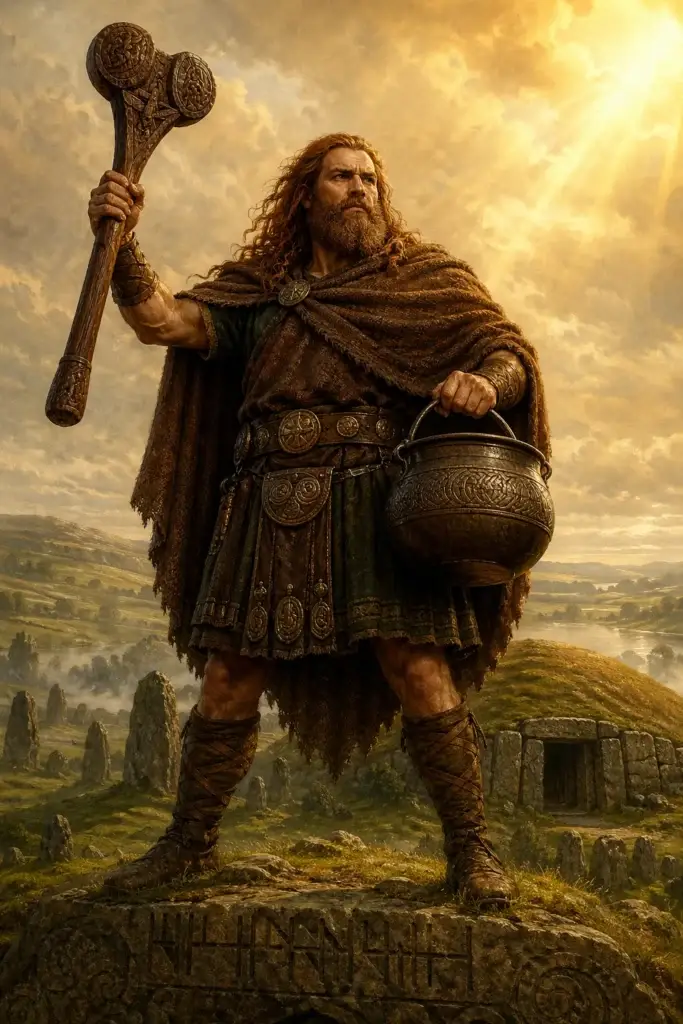
Related figures of the Irish saga material are found, for example, in Dagda.
Reception: the Morrígan in Modern Culture
Since the late nineteenth century, with the growing interest in Irish transmission in the course of the so-called Celtic Revival, the Morrígan has received a broad reception.
Translations and adaptations of the Táin made her figure accessible to a larger public. Poets and writers of the Irish literary movement took up motifs of the old sagas, even if the Morrígan was usually not at the centre.
In the twentieth and twenty-first centuries the Morrígan was taken up above all in two areas. In modern pagan and neopagan currents she is venerated as a goddess, often in the role of a goddess of war, fate or sovereignty.
This appropriation draws on the medieval texts, but in its systematic theology goes clearly beyond what the sources offer.
In addition, the Morrígan has become a fixture of popular fantasy and gaming culture, where she appears as a figure in novels, comics, video games and role-playing games, frequently as a dark, powerful female figure connected with crows, war and death.
For scholarly study it is important to separate this modern layer from the medieval sources. The popular Morrígan is an independent cultural entity that feeds on the transmission but also develops it freely.
Anyone who wishes to pursue the historical figure is referred to the editions and translations of the Irish saga texts, which have been worked out in Celtic studies since the late nineteenth century and repeatedly commented upon anew.
Further Links
- Dagda, father god, ruler of the Tuatha Dé Danann, cauldron of abundance
- Lugh, master of all arts, warrior and artist, festival of Lughnasadh
- Celtic culture, hub for all Celtic gods and spirits
- Leanan Sidhe, fairy lover, ambivalent inspirer
- Cernunnos, forest god, lord of animals and of animal fertility
Research Literature
As a deity of the Irish-Celtic tradition, Morrigan appears in battle, prophecy and sovereignty, and figures in the texts of the Ulster Cycle as a crow, she-wolf or queen.
Frequently Asked Questions about Morrigan
Who is the Morrigan in Irish mythology?
The Morrigan (also Morrígan, Old Irish Mor-Ríoghain, great queen or phantom queen) is a central goddess of Irish-Celtic mythology, a mistress of war, fate and the dead. She often appears as a crow or raven and prophesies the outcome of battles.
In the tradition she appears as a threefold figure (trinity): Morrigan, Badb and Macha, sometimes also with Nemain as a fourth. Her most famous appearance is the one before the hero Cú Chulainn prior to his death.
What is the connection between Morrigan and Cú Chulainn?
Cú Chulainn is the greatest hero of the Irish saga (Ulster Cycle). The Morrigan desired him; he rejected her. Thereupon she swore to hinder him in combat. She tried to kill him in animal forms (eel, she-wolf, heifer) and was finally wounded by him herself.
Before his death the Morrigan appeared to him as a washer at the ford, washing his bloody armour, a classic Celtic death omen. Cú Chulainn, dying, bound himself to a stone so that he died standing.