Metatron, Being of Light
By Ralf Ittermann · last reviewed on
Highest angel of the Jewish mystical tradition. The biblical Enoch, taken up alive into heaven and transformed into an angel.
Quick Overview: Metatron
Type: Highest archangel, scribe, keeper of order Tradition: Jewish Merkabah mysticism (Sefer Hechalot), Kabbalah, Western esoteric schools Function: guarding the divine order, geometry of creation, highest mediation Main attributes/symbols: violet-golden flame, the Metatron cube, flaming sword, writing tablet Distribution: central in Jewish mysticism, Western theosophy, modern new spirituality
Classification
Tradition
Metatron (Metattron, possibly “the one who sits beside the throne”) appears in the texts of Merkabah mysticism, especially in the Sefer Hechalot (3rd to 6th century). He is often identified as the angel who became the mortal man Enoch, transcended into a heavenly being.
In the Kabbalah, Metatron is depicted in the highest Sephirah Keter (Crown) or as the oversoul of creation. He is regarded as the most direct mediator between God and creation.
Western theosophy and modern esoteric schools have reinterpreted Metatron as the archangel of geometry, of sacred codes, and of the quantum structure of the universe.
Source Situation
Primary sources: Sefer Hechalot, the Zohar, and kabbalistic commentaries. The Talmud (Sanhedrin 38b) names Metatron (Mattatron) as the bearer of a name “like the name of his Lord”. Modern esoteric authors such as Doreen Virtue and others have popularized Metatron’s role. The geometry of the Metatron cube is central to modern spiritual teachings.
Hekhalot Literature as Principal Corpus
Metatron is among the most intensively elaborated angelic figures of Jewish mysticism.
His principal source is the so-called Third Book of Enoch (also called Sefer Hekhalot), a writing of the Hekhalot literature from the 5th to 6th century CE. In this tradition, Enoch, after his ascension (Genesis 5:24), is transformed into the archangel Metatron and receives the position of “lesser YHWH” with his own throne in the immediate vicinity of God.
This position is provocative in terms of the history of religion, because it pushes the strict unity theology of rabbinic Judaism to its limit. The tradition is further developed in medieval Jewish mysticism (Zohar, 13th century) and in Lurianic Kabbalah (16th century).
Appearance and Symbols
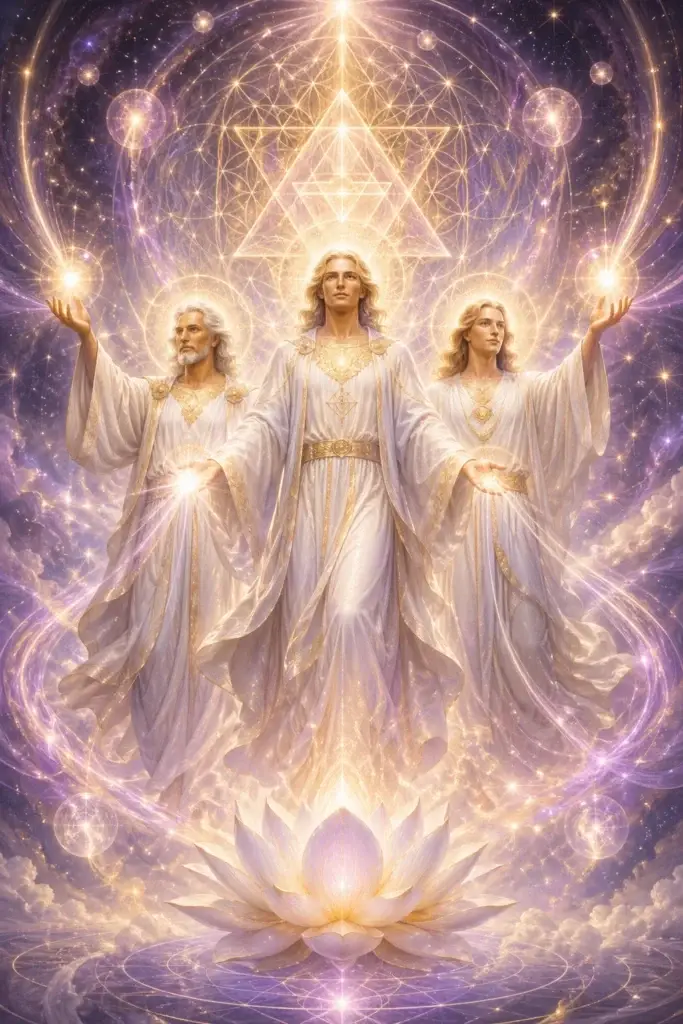
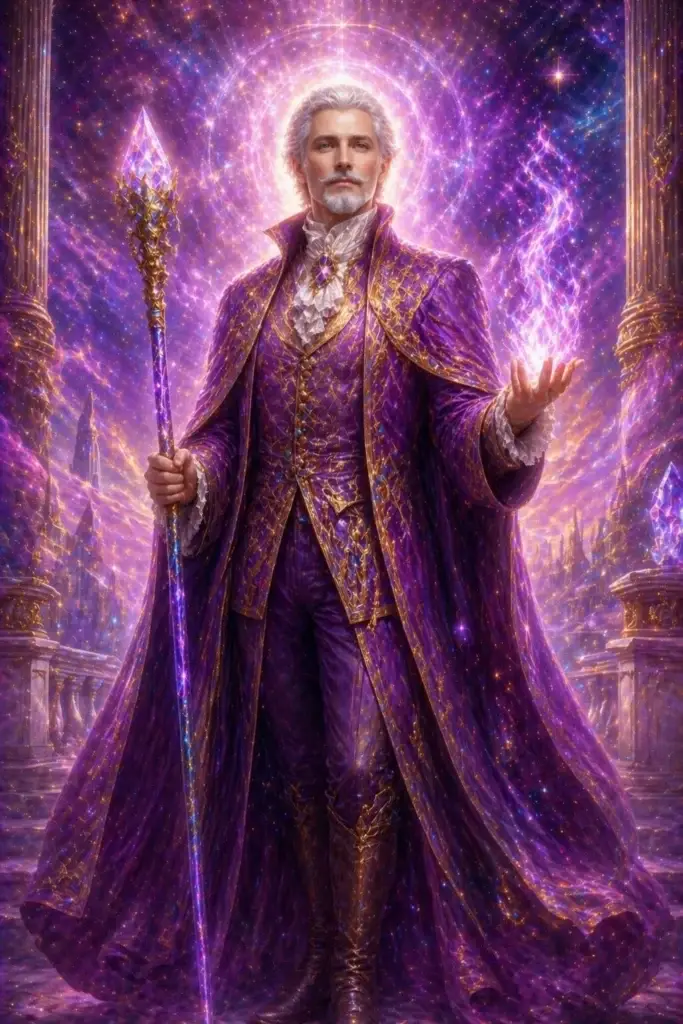
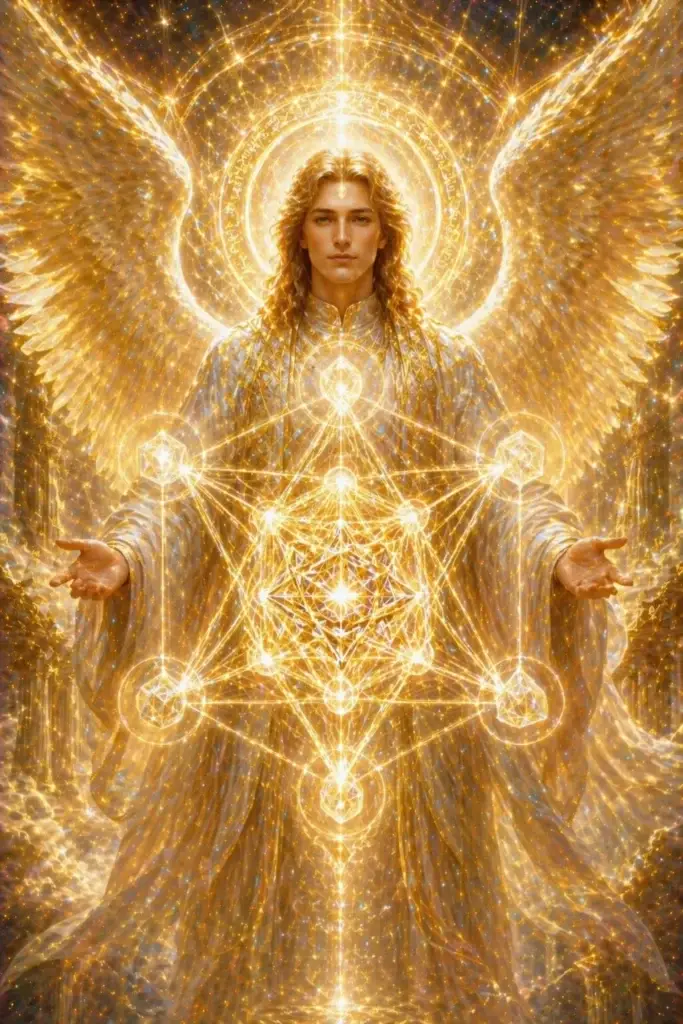
Metatron is depicted as a radiant, geometrically precise being of light in violet-golden or crystalline robes. His color is deep violet interwoven with gold, sometimes with clear white. His seal is the Metatron cube, all five Platonic solids in a lattice of light.
He often carries a writing tablet or the Book of Creation (Sefer Yetzirah). Wings of geometric, prismatic light surround him. Energetically, Metatron acts crystalline, precise, and infinitely intelligent, like a living code or a sacred geometry. His presence orders chaos and makes hidden patterns visible.
Function and Significance
Metatron is the administrator of creation and the keeper of the cosmic laws. He embodies not only power like Michael, not only healing like Raphael, but the highest intelligence itself, the mathematics and geometry behind all manifestation.
Metatron is the connection between the Absolute (Ein Sof) and the world. In psychological terms, Metatron embodies access to transpersonal wisdom and to the structure of consciousness itself. His violet-golden energy opens access to quantum, higher-dimensional levels.
Metatron Cube and Modern esotericism
In contemporary New Age esotericism, Metatron appears primarily in the form of the Metatron cube, a geometric figure that can be derived from the Flower of Life and that contains the five Platonic solids.
This connection was popularized by Drunvalo Melchizedek (The Ancient Secret of the Flower of Life, 1999) and is standard in the current sacred-geometry tradition.
In terms of the history of religion, this connection is recent and is not attested in the Jewish source tradition; it stands in the theosophical-anthroposophical line of modern esotericism. The Hekhalot tradition itself knows Metatron primarily as a personal angel, not as a geometric symbol.
Practice / Invocation / Significance in the iWell-Guard Context
In iWell Guard, Metatron is invoked to harmonize and stabilize the entire architecture of the protective field. One practice is to visualize the Metatron cube or to work with a violet candle and to ask Metatron for clear, geometrically perfect structures.
His power is used to correct miscalibrations in the field and to open access to a higher order. Metatron is also the angel who helps in understanding the quantum structure of consciousness. His working makes iWell Guard protective, and at the same time transformative and consciousness-expanding.
iWell-Guard Position
Within the iWell-Guard protective field, Metatron is classified as a being of light of the highest angel hierarchy. His function in the mantra system is not explicit, but is implicitly given through the class of beings of light (point 8 of the mantra).
Those who wish to work with Metatron in protective practice can integrate him as a bridging figure between Creator and creature into a contemplative practice, with the note that the Hekhalot tradition provided for the invocation of Metatron as a practice only under strict ritual conditions.
The modern lightworker tradition has abandoned these conditions, which is debatable in terms of the history of religion.
Parallels
Connection within iWell Guard
In the iWell-Guard cosmology, the archangel Metatron takes on functions of the violet flame and the transformation of foreign energy. Functional level 3.
Directions of effect are described in purely functional terms. Not a medical device. No promise of healing.
Metatron in the Enoch Tradition and in the Book of 3 Enoch
Metatron is among the most peculiar figures of Jewish religious tradition. He is not named in the Hebrew Bible and appears only in post-biblical literature, but there with extraordinary significance.
The most important source is the so-called Third Book of Enoch, a Hebrew text of the Hekhalot literature that probably originated in late antiquity or the early Middle Ages.
This work tells that the biblical Enoch, of whom the Book of Genesis briefly reports that he walked with God and then was no more, because God took him away, was raised into heaven and transformed into the angel Metatron.
This transformation of a human being into an angel is remarkable in terms of the history of religion and not undisputed within the Jewish tradition.
In this tradition, Metatron receives the epithet that designates him as the lesser YHWH, that is, with a form of the divine name.
He sits upon a throne, keeps the heavenly books, and is regarded as Prince of the Divine Countenance and as scribe. This high standing led to theological tensions, because it seemed to touch upon the uniqueness of God.
A famous text of the Babylonian Talmud, in the tractate Chagigah, reports of the scholar Elisha ben Abuya, who saw Metatron seated in heaven and arrived at the erroneous conclusion that there might be two powers in heaven.
Metatron is thereupon chastised, in order to make clear that he too is a creature and subordinate to God. Scholarship, especially Gershom Scholem and later Daniel Boyarin, has interpreted this episode as a reaction to the danger that such an exalted angelic figure posed for Jewish monotheism.
The Unresolved Etymology of the Name Metatron
The name Metatron is among the most discussed and least clarified names of the entire Jewish doctrine of angels. Unlike names such as Michael, Gabriel, or Raphael, which are transparent Hebrew formations, Metatron cannot be readily derived from Hebrew.
Scholarship has made a number of proposals. A widespread hypothesis derives the name from Greek and considers a connection with a word for throne, which would fit the notion that Metatron stands beside or behind the divine throne. Other proposals consider Greek terms for measure or for a messenger or companion.
A further hypothesis sees the name as an artificial formation motivated by letter mysticism and numerical values, a procedure that was widespread in Jewish esotericism. There are also attempts to establish a connection with the Latin sphere. None of these explanations has prevailed.
It is also characteristic that the name is written differently in the manuscripts, sometimes with a different number of letters. The Jewish tradition itself developed various explanations and connected Metatron with further angelic names, for instance with Yahoel.
The assessment in religious studies is that the obscurity of the name is not a side issue, but points to Metatron’s special status: he is a figure who eludes clear classification, and his very name reflects this.
Metatron in the Medieval Kabbalah
The medieval Kabbalah, the Jewish mysticism that had its heyday from the 12th and 13th centuries, took up Metatron and gave him a firm place in its complex systems.
In this tradition, Metatron is often associated with the tenth and lowest of the Sephirot, or understood as the angelic figure that stands closest to the world of the divine emanations.
Metatron plays an important role in connection with the notion of the heavenly sanctuary. In some kabbalistic texts, Metatron serves as high priest of the upper temple and there offers a sacrificial service that corresponds to the earthly temple service. This notion connects with late antique traditions of the heavenly sanctuary.
The connection of Metatron with the Torah and with divine wisdom is also elaborated in the Kabbalah. Metatron appears as a teacher who instructs the deceased or the righteous, and as mediator between the inaccessible deity and the created world.
Scholarship, especially Gershom Scholem in his foundational works on Jewish mysticism, has emphasized that Metatron fulfills a bridging function in the Kabbalah. He stands at the boundary between the divine and the created and thereby makes it conceivable how the absolute, inaccessible God can enter into relation with the world at all.
This function explains why such a problematic figure, despite all theological misgivings, did not disappear but remained for centuries a central object of Jewish esotericism.
Metatron in Modern Reception
From Jewish esotericism, Metatron migrated in recent centuries into very different areas of culture. Already in the Christian Hebraism of the early modern period, Metatron was taken note of, as Christian scholars engaged with the Kabbalah.
In the Western esotericism of the 19th and 20th centuries, Metatron received a firm place in the angelic systems, often detached from his original Jewish context.
In modern angelic literature, which since the late 20th century has served a broad market, Metatron is a prominent figure. There he is ascribed qualities that are not to be found as such in the historical sources.
Geometric notions that circulate under the name of Metatron’s cube are likewise modern esoteric constructions without basis in the ancient or medieval texts.
In popular culture, Metatron appears in novels, films, television series, and computer games, mostly as the voice or spokesman of God, a role that loosely connects with the old notion of the Prince of the Divine Countenance, but strongly simplifies it.
In terms of religious studies, this broad reception is interesting, because it shows how an originally highly specialized figure of Jewish mysticism could become free cultural material. At the same time, it is important to distinguish the historical figure from its modern appropriations.
Those who wish to understand Metatron must return to the Hekhalot literature and to the Kabbalah, not to the contemporary angelic advice literature. Related angelic figures are found with Michael and Archangel Gabriel.
Frequently Asked Questions about Metatron
Who is the archangel Metatron?
In Jewish mysticism and the Hekhalot literature, Metatron is one of the highest angels, often described as the arch-chancellor of the divine court. Some traditions identify him with the patriarch Enoch, who was taken up into heaven. Metatron is regarded as the scribe of God, teacher of the Mosaic Torah, and mediator between the divine and human spheres.
What is the Metatron cube?
The Metatron cube is a geometric symbol of modern esotericism that unites all five Platonic solids within itself. It consists of 13 circles connected by lines and is regarded as a blueprint of creation. The connection to the biblical-Jewish archangel Metatron, however, was constructed only later; it is not historically attested in the classical sources.