Magic Squares: Number Grids as Protective Signs and Amulet Motifs
By Ralf Ittermann · last reviewed on
Magic squares are square grids of numbers or letters whose rows, columns and often also diagonals add up to the same sum. This mathematical property has made them, in several cultures, carriers of an order understood as protective.
The following classifies the square as a protective sign from a religious studies perspective, from its historical transmission to its reception today. In doing so, a distinction is made between documented custom and modern esoteric interpretation.
Magic squares are a number grid handed down as a protective sign and amulet motif.
Classification: What a magic square as a protective sign is
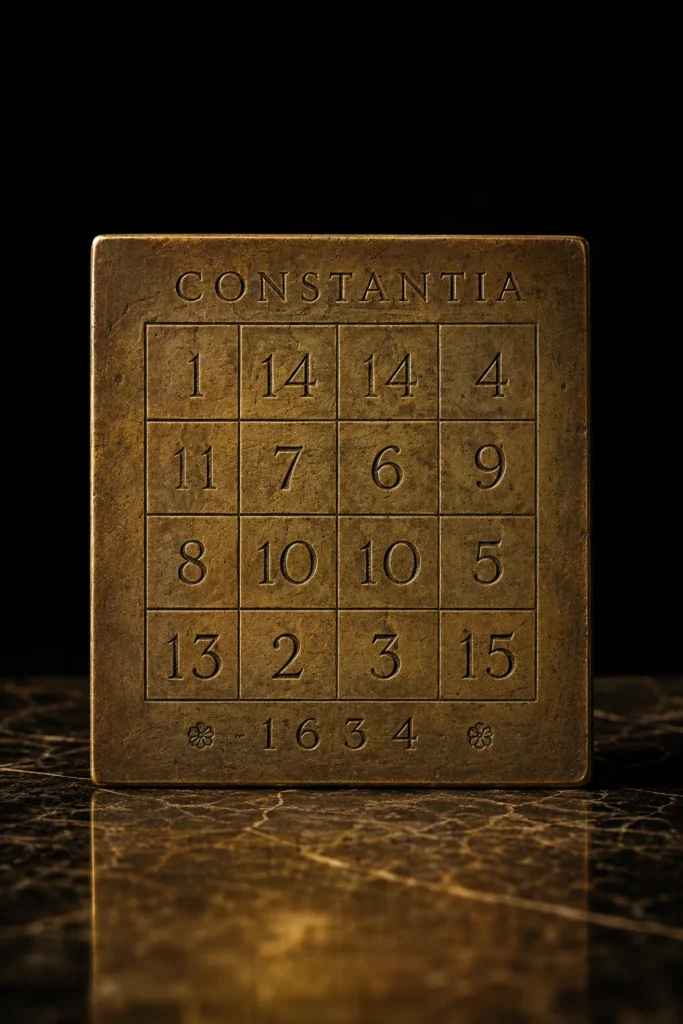
A magic square consists of an even arrangement of cells into which numbers are entered so that every row, every column and usually also the two diagonals add up to the same sum.
In scholarship this sum is called the magic constant. The term magic here at first means only the unusual completeness of the arrangement and says nothing about an assumed effect.
The square appears as a protective sign when, beyond its arithmetical property, a warding meaning is attributed to it. In this use the finished grid is transferred onto amulets, bowls, strips of paper or house walls. The wearer expects the inscribed order to provide protection against harmful influences.
Related to it are letter squares, in which words rather than numbers are interlocked so that they can be read horizontally and vertically. The best known example is the SATOR square, whose five words repeat in every reading direction. It is among the most widely transmitted letter grids of the European area.
In the Islamic world the number square is closely connected with the Buduh, a formula made up of four consonants that goes back to a three by three square. The name Buduh arose from the corner numbers of the square and was later used itself as a protective word.
Within the study of protective symbols the magic square holds a special position, because it does not rely on a pictorial motif but on an abstract arithmetical structure. In this it differs from figurative amulets such as eye or animal motifs.
The range extends from the simple three by three grid to larger squares with five, six or more cells per side. Larger squares were considered more difficult to produce and were in part placed under particular planetary associations, which a later section addresses.
Origin and historical depth of the number squares
The earliest securely datable trace of a magic square leads to China. The so called Luoshu, a three by three square with the numbers one to nine, is linked in Chinese transmission with legends about a turtle and is attested in mathematical as well as cosmological texts of the early imperial period.
Through trade and scholarly contacts the knowledge of such grids reached the Islamic cultural sphere. Arab mathematicians of the Middle Ages studied the construction of larger squares systematically and at the same time placed them in magical and astrological contexts.
From there the subject travelled to Europe in the high and late Middle Ages. Latin translations of Arabic works conveyed the construction rules, and scholarly collections assigned planets to the squares. These planetary squares were carried on in the magic literature of the early modern period.
The letter square follows a line of its own. The SATOR square is already attested in the ruins of Pompeii and is therefore securely documented at the latest for the first century. It subsequently spread across large parts of Europe and can be traced on walls, vessels and manuscripts.
The Buduh appears in Arabic sources from the Middle Ages onward and is often attributed to the scholar al-Ghazali, without this attribution being secure. It spread across North Africa and the Near East and is attested on numerous amulets.
Overall, an exchange spanning centuries between China, the Islamic world and Europe becomes apparent. The magic square is thus an example of a motif that was passed on over long distances and reinterpreted each time.
The underlying notion of protective order
The conceptual core of the square as a protective sign is the notion of a perfect order. When every row and column carries the same sum, the grid appears as self contained and balanced. This completeness was interpreted as an image of an undisturbed world.
In many folk belief systems, harmful influences were regarded as something that disturbs order and brings irregularity. A sign that is itself perfectly ordered could therefore be understood as a counter image to disturbance. It was meant to affirm what is ordered and to stand against what is disordered.
Added to this is the role of the number. In many cultures particular meanings were attributed to certain numbers, and a square joined several such numbers into a structure. The grid thereby acted like a condensed collection of meaningful values.
With the letter square the linguistic form is added. A text that reads the same in every direction appeared as linguistic perfection. Such palindromes were felt to be especially firm and immovable, which reinforced the notion of protection.
The readability from above, below, left and right was at the same time interpreted as an orientation on all sides. A sign that works in all directions matched the expectation of a protection that leaves no gap. This idea connects the square with other self contained protective forms.
The interpretation described here is a cultural historical explanation of why people gave the square a protective meaning. It describes notions, not a proven effect. Scholarship documents the belief; it does not confirm it.
Examples from antiquity and the Near East
The SATOR square is the most important ancient example. Its finds in Pompeii show that the letter grid was already known in Roman everyday life. Later finds from several provinces show that it spread across the entire empire.
The five words SATOR, AREPO, TENET, OPERA and ROTAS can be read horizontally and vertically. As to the exact meaning of the saying there is still no secure interpretation, which cautions scholarship. Only the formal completeness is certain.
In the Near East the Buduh stands at the forefront. It was formed from the corner numbers of a three by three square and condensed into a pronounceable word. On amulets, bowls and strips of paper it is attested many times over.
The Buduh was often used in connection with the protection of travellers, pregnant women and houses. It appears both as a pure word and together with the complete number square. Both forms are found on objects from several centuries.
In Jewish transmission too, arrangements of numbers and letters with a protective interpretation are known. There they combine with techniques of letter calculation, in which words and their numerical values are related to one another.
These examples show that the square was in use in the Mediterranean and the Near East over long periods. It was not carried by a single religion but taken up by several traditions.
Examples from European folk magic
In European folk magic the SATOR square is the most widespread number or letter grid. It is found on house walls, door beams, baking moulds and in handwritten collections of sayings and recipes.
Folklore sources report a use of the square against fire, against illness of humans and livestock, and against various influences perceived as harmful. Such reports document the expectations of the users; they are not evidence of an effect.
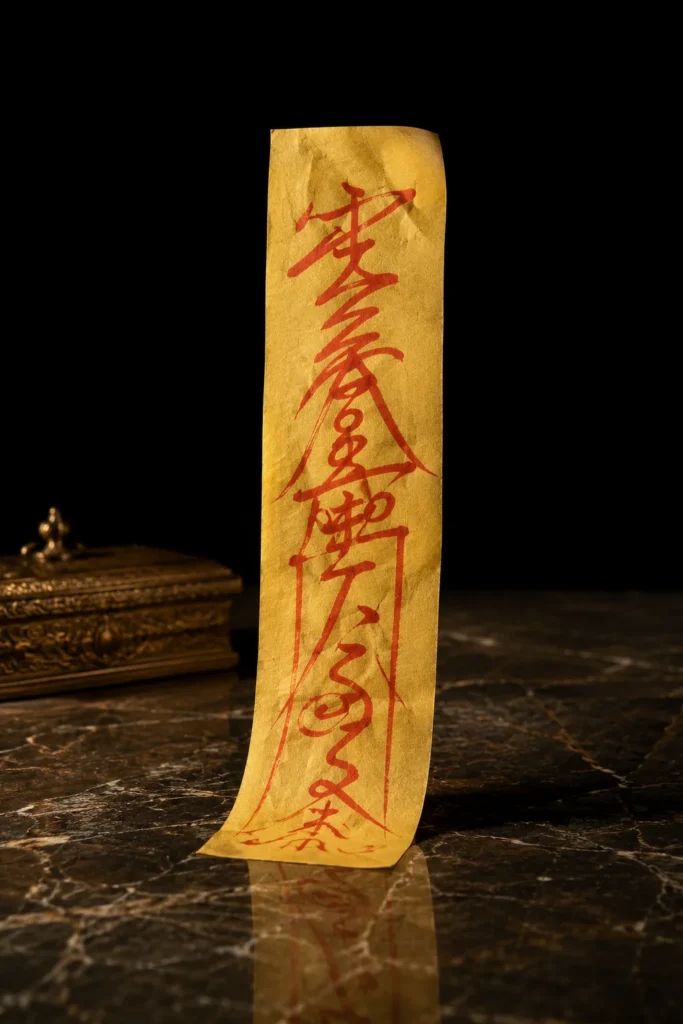
Frequently the square was written on a small slip of paper and attached to doors, stables or carried on the body. In some regions it was scratched onto bread or an apple, which were then to be eaten. These practices are transmitted very differently from region to region.
In early modern books of magic, alongside the SATOR square, number squares with planetary associations also appear. They were engraved on small metal plates that were worn as amulets. This scholarly line differs from the orally transmitted household custom.
In folk magic the square stands alongside other written amulets such as inscribed blessing formulas and letter sequences. It thus belongs to a broad group of amulets and talismans that rely on writing rather than on image.
With the decline of magical household custom in the nineteenth and twentieth centuries, practical use largely disappeared. The squares survived above all as finds on old buildings and in folklore collections.
Examples from Asia and further cultures
In China the Luoshu is the starting point of the tradition. The three by three square was integrated into cosmological schemes and linked with the cardinal directions as well as with notions of order in natural philosophy. It served not only for calculation but also for the interpretation of the world.
In the Islamic world scholars developed larger squares from the three by three grid and assigned planets and properties to them. These squares appear on amulets, in manuscripts and on bowls intended for protective purposes.
In India number squares are likewise known and were in part connected with astrological associations. Certain squares were attributed to individual planets and engraved on metal plates that were worn as protective objects.
In North Africa the Buduh spread together with further written amulets. There it appears on paper, leather and metal and was frequently arranged together with blessing words and geometric patterns.
Across these areas a common pattern becomes apparent. The number or letter grid is understood as an ordered sign that was reinterpreted in different religious settings and connected with local notions.
The variety of examples makes clear that the magic square is not a closed motif of a single culture. It is a travelling scheme that fitted in wherever number and writing were considered meaningful.
In the Jewish tradition, alongside letter calculations, number squares with a religious interpretation are also known. On amulets and in handwritten collections small grids appear whose values were related to names of God and words of blessing. This line shows that the square was also taken up where writing and number were already closely connected.
Application in ritual and everyday life
The use of a magic square usually began with its production. The grid was drawn, scratched or engraved by hand, and in some traditions the order of the entries was prescribed. The careful production was itself regarded as part of the custom.
The finished square was placed at locations considered vulnerable. Doors, windows, stables and storerooms were among them. This connection with entrances ties the square to notions of threshold protection, which are treated in a separate encyclopedia article.
As a portable amulet the square was placed on small plates, strips of paper or pieces of cloth and worn on the body or kept in the clothing. In this form it was meant to accompany its wearer in changing places.
In some traditions the square was embedded in larger rituals, for instance in blessing acts for house and farm or in procedures for the protection of travellers. It then appeared alongside spoken formulas and other signs.
Everyday use was often plain. A square written once remained permanently in its place and was not continually renewed. Other applications provided for repeated writing on particular occasions.
The exact form of application depended strongly on region and tradition. There is no uniform ritual order for the magic square, which folklore scholarship has emphasized several times.
Related protective forms and demarcation
The magic square stands in a line with other written amulets. Inscribed blessing formulas, letter sequences and individual protective words rest, like the square, on the notion that writing itself can carry a protective meaning.
Closely connected with the square is the Buduh, which emerged from a square and at the same time detached itself from it. The Buduh shows how an independent protective word could arise from a number arrangement. Both forms are treated in more detail in the article on the Buduh.
From the figurative amulet the square differs clearly. Eye, hand or animal motifs work through a recognizable image, the square by contrast through an abstract structure. It thus belongs to the writing oriented and not to the image oriented group of protective symbols.
A boundary also exists toward purely mathematical squares. Not every magic square was used as a protective sign. Many arose solely from an interest in their construction and carry no protective interpretation.
The square is further to be distinguished from geometric protective patterns such as the protective circle. While the circle draws a line and encloses a space, the square works with an inner structure of numbers or letters.
Placing it within this neighbourhood helps to define the square precisely. It is a written amulet of particular structural completeness that can be distinguished from image amulets, line symbols and purely mathematical squares.
The reception of magic squares today
In mathematics, magic squares remain a subject of interest to this day. They are treated in recreational mathematics and in the history of number theory, without a protective meaning playing any role.
In modern esotericism magic squares reappear above all as planetary squares. They are at times offered as amulet motifs and connected with properties that have their origin in the magic literature of the early modern period.
Such present day offerings should be viewed critically. The effects attributed to them are not proven, and the connection between a square and a particular planet is a historical attribution, not a verifiable fact.
The SATOR square appears today often as a historical motif in museums, in building research and in popular accounts of antiquity. In this role it is shown as evidence of past custom and not as an effective means of protection.
For religious studies the magic square is an instructive example. It shows how a mathematical property could become the basis of a religious or magical interpretation and how such interpretations travelled across cultural boundaries.
Those interested in magic squares today will find in them above all a cultural historical subject. The factual approach separates the documented history of the motif from modern promises of effect that do not withstand scrutiny.
Literature (selection)
Related key terms: magic square number square SATOR square Buduh Luoshu letter square planetary squares written amulet magic constant apotropaic.
iWell Guard and protective traditions
iWell Guard stands in the cultural historical line of portable protective objects, to which the magic square also belongs. A modern companion for people who live with protective symbols: made in Germany, 41 layers of solid gold, platinum and silver, with a 30 day right of return.
Personal experiences may vary. Not a medical device. No promise of healing.