Protective Substances and Plants
By Ralf Ittermann · last reviewed on
Alongside spoken formulas, worn amulets, and ritual acts, natural substances and plants form a pillar of their own in folk protective thinking.
This refers to materials such as salt, iron, and silver, as well as plants such as garlic, rowan, St. John’s wort, and mugwort: things that in many cultures were regarded not only as food or useful plants, but to which tradition ascribed an independent warding power.
What is special about this group of means of protection lies in its immediacy. No craft, no elaborate ceremony, no priestly knowledge is strictly necessary: the housewife scatters salt across the threshold, the smith drives an iron nail into the doorframe, the farmer hangs a bunch of St. John’s wort at the window.
Protective substances and plants are, to summarize the folkloric tradition, the most democratic form of defense. They were available to everyone, in kitchen, garden, and field.
This page offers an overview of the seven protective substances and plants linked with the corresponding beings in the Protection Compass of iwell-guard.com.
Shared Characteristics and Operating Principle
What connects such different things as the mineral, metal, and plant worlds under the term means of protection? Tradition describes similar operating principles in various cultures, without any direct mutual influence being demonstrable.
First, many traditions ascribe a cleansing property to these substances. They are meant to ward off what threatens from outside, and beyond that to drive out or neutralize what has already entered. Salt cleanses in both household rituals and baptismal rites; mugwort serves to fumigate rooms regarded as burdened.
Second, in folklore studies boundary marking counts as a central operating principle: substances are placed at thresholds, doorposts, windowsills, and the edges of rooms in order to create a barrier there. Harmful beings are not supposed to be able to cross these boundaries, because the nature of the substance stands against them.
Third, tradition often contains a cosmological justification: salt, as a gift of the sea, carries cleansing power; iron, as a product of fire, breaks magical bonds; silver, as the metal of the moon, resists the dark. These associations link the substance with a principle in the cosmic information field that lends its protective effect permanence.
In practice, protective substances and plants are frequently combined: a protective pouch may contain salt, a pinch of dried mugwort, and a piece of iron. Their effects add together in the logic of tradition.
A Cross-Cultural Overview
The seven protective substances and plants recorded in the Protection Compass stand for different traditions and operating principles. Here is a brief introduction:
Salt: In European, Near Eastern, and East Asian tradition alike, the mineral counts as both a cleansing agent and a threshold protection.
Whether as a line before the door, a pinch in baptismal water, or a component of cleansing rituals: salt is the most widespread protective substance of all. Used against demonic threshold spirits, witches, and impurity.
Iron: The metal of the forge and of war counts, especially in Northern European and Celtic tradition, as a means of banishment against fairies, wights, and other non-human beings.
Iron nails in doorframes, horseshoes over entrances, and gripping an iron blade are among the best-known applications. The term “cold iron” describes the unworked metal with a particularly strong protective effect.
Garlic: The bulb with its characteristic smell appears in protective tradition from Eastern Europe to East Asia. Garlic is especially closely associated with protection against vampires and the evil eye. Dried braids over doors, crushed cloves in cracks, or garlic juice on thresholds: the forms of application are varied.
Rowan: The tree with the bright red berries, also called mountain ash, counts in Germanic, Celtic, and Scandinavian tradition as the protective tree par excellence.
Branches over stable doors, twigs in the beams of cattle sheds, or rods of rowan wood protect, according to folk belief, against witches, harmful magic, and the bewitching of cattle.
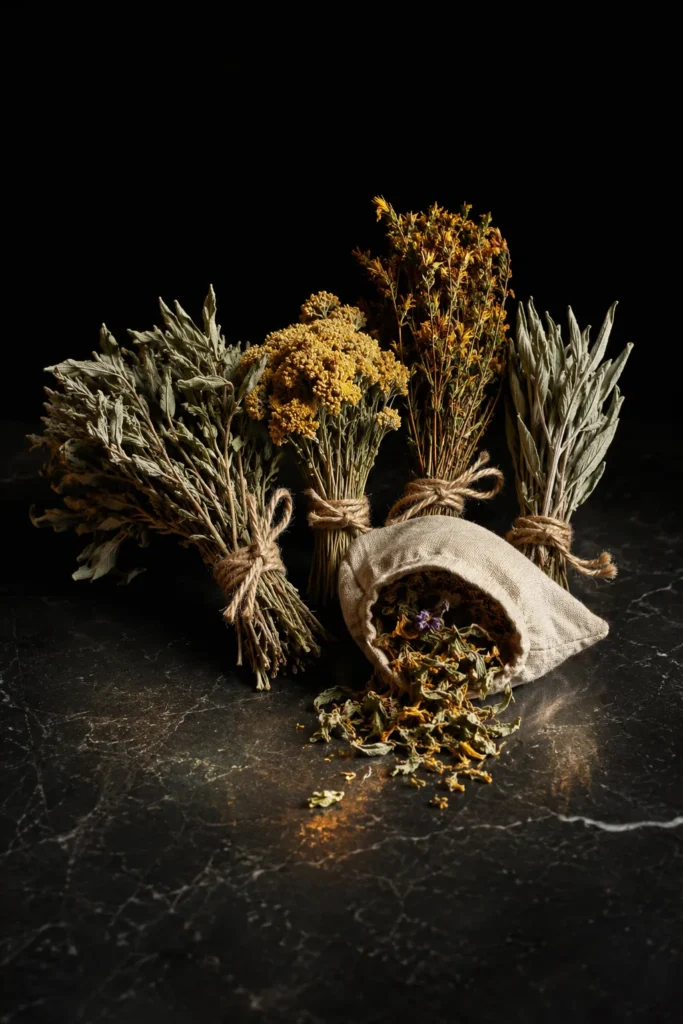
St. John’s wort: The herb, said to be at its strongest around St. John’s Day, bears in Latin the name Fuga daemonum, the flight of demons. Dried bunches placed over entrances, in window frames, or in thresholds protect, in Central European folklore studies, against demons, night-mares, and nocturnal influence.
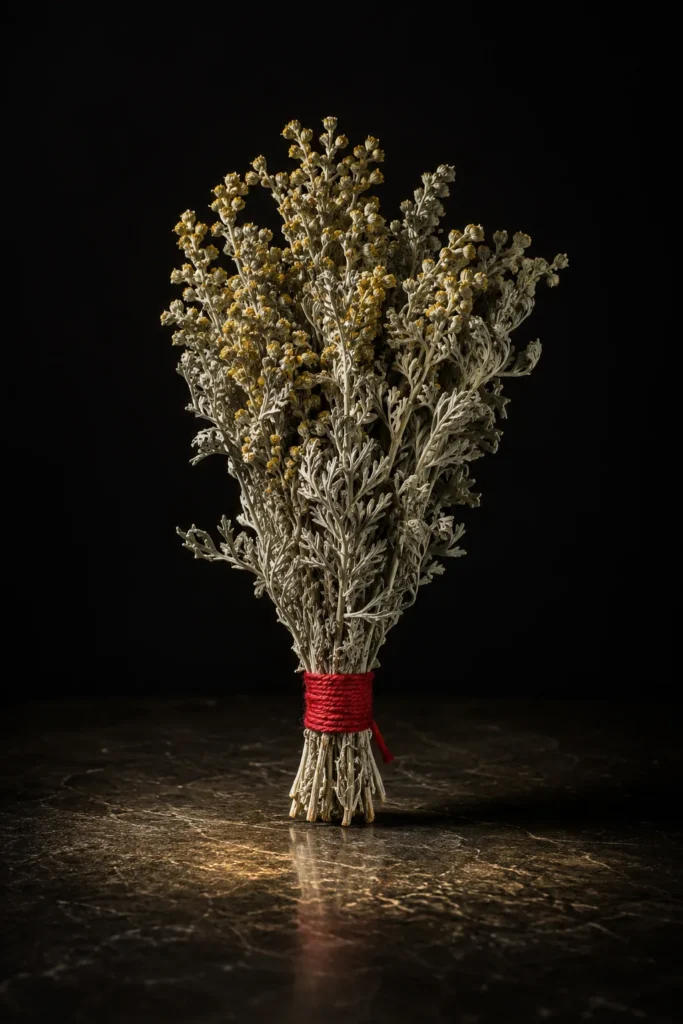
Mugwort: Mugwort, also called girdle herb, counts as a protection for travel and thresholds. Sewn into a belt, it protects wanderers; as an incense plant, it cleanses rooms; and hung as a bundle over the door, it keeps harmful influence away. The tradition reaches from Germanic Midsummer rituals to East Asian incense traditions.
Silver: The bright precious metal holds a special position: unlike iron or salt, silver counts as more than a barrier layer; it is an active means of defense that works directly against harmful beings.
Werewolves, vampires, and other shapeshifters are said to be unable to bear silver. As the metal of the moon, it carries in many cultures the connotation of purity and cosmic order.
Application and Limits
Tradition describes protective substances and plants as effective, but sets conditions. Some traditions stress the quality of the substance: salt must be pure and unprocessed, iron must be “cold,” that is, unhardened and untreated.
Some folk beliefs require that the plant be harvested at a particular time, especially on St. John’s Day or on Walpurgis Night.
Other traditions place value on correct placement: threshold, windowsill, or doorpost count as places of effect, not the open room. Boundary marking is the decisive principle.
Folklore studies describes limits to the protective effect where the substance was not applied completely or without interruption. A salt line with gaps does not protect, according to many traditions, because the being finds and uses the gap. The same applies to iron: rust or mechanical damage is said to diminish the protective effect.
None of the traditional applications constitutes a guarantee. Folklore studies documents belief systems and their cultural context, not verifiable claims of efficacy.
In the Protection Compass
The seven protective substances in this category are linked in the Protection Compass with the beings against which, according to tradition, they were particularly used. Anyone seeking protection against a specific class of being will find there an overview of the traditional means, ordered by level of threat and cultural sphere.
Literature (Selection)
Related key terms: protective substances protective plants warding herbs salt protection iron.
iWell Guard and Protective Traditions
The breadth of tradition is remarkable: cultures that had no contact with one another independently developed the same basic idea, namely that certain substances and plants carry a warding power within themselves.
The iWell Guard takes up this idea and brings together the protective traditions of various cultures in a wearable protective object, uniting within itself the symbolic condensation of several of these strands of tradition.
Personal experiences may vary. Not a medical device. No promise of healing.