Palo Santo: the holy incense wood of South America
By Ralf Ittermann · last reviewed on
Palo Santo means “holy wood” in Spanish. The name refers to the position this incense wood holds in the folk tradition of the Andean region and tropical South America: more than an incense substance like many others, it is a tool of the shaman and healer, regarded as especially powerful because of its rarity and its characteristic scent.
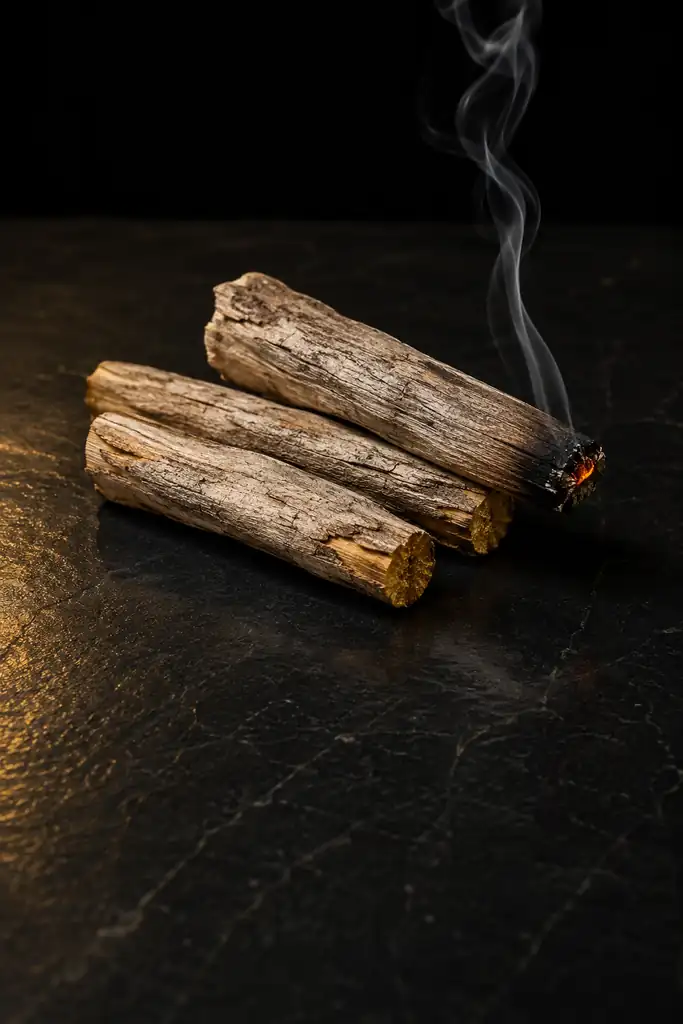
Unlike frankincense or myrrh, which are burned as resins, with Palo Santo the wood itself is burned; shavings, pieces or sticks from the trunk of the Bursera graveolens tree give off a sweet, resinous smoke with a faint scent of citrus and mint when lit.
On the overview page on burning incense and cleansing, Palo Santo represents the South American line of the ritual incense tradition.
Quick Overview
Palo Santo (Bursera graveolens) grows in the dry forests of Ecuador, Peru and other South American countries. The wood develops its characteristic scent only after the natural death of the tree or a branch: the essential oils form in the dead wood over several years.
In the tradition of indigenous peoples and in Latin American folk belief, Palo Santo is regarded as a means against evil spirits, as a companion to shamanic rituals and as protection from negative influences. Its smoke is said to drive away harmful powers while at the same time attracting healing and good energies.
Origin and Tradition
The use of Palo Santo reaches far back in the oral tradition of the indigenous peoples of Ecuador and Peru. Shamans and healers of the Andean cultures, including representatives of the Curanderismo tradition, used the wood in healing rituals, cleansing ceremonies and as an accompanying means for communication with the realm of spirits.
According to various traditions, the Incas used the wood on ceremonial occasions; secure written evidence from the pre-colonial period is, however, difficult due to the absence of written sources.
With the colonization of South America and the influence of Spanish Catholicism, indigenous use blended with Christian elements. The name “holy wood” itself is a product of this blending: it reflects the Christian reshaping through which the incense wood became linked to the concept of the holy.
In the syncretic folk belief of Latin America, which combines indigenous, African and European elements, Palo Santo remained an established means of protection.
In more recent times, Palo Santo reached the Western world via the wellness and New Age movements, where it is marketed, much like white sage, as a universal cleansing agent. In the process, the specific ritual contexts in which the wood was originally used are often lost.
Principle of Action According to Tradition
In the Andean and curanderista tradition, Palo Santo works on two levels at the same time. On the one hand, its smoke is regarded as repellent to harmful spirits and negative influences (susto, daño, mal aire, that is, soul fright, harmful magic and bad air in the traditional sense).
On the other hand, the scent is regarded as attractive to healing, protective spirits and powers. The shaman or healer therefore uses Palo Santo not only to drive away, but also to invite: it creates a cleansed space into which the healing can enter.
This double aspect, driving away and inviting, distinguishes Palo Santo in its traditional function from purely defensive means such as juniper, to which a more repellent, restraining effect is attributed. The idea that protection goes beyond defense and includes the attracting of the good is characteristic of the Andean tradition.
For its effectiveness, according to this tradition, it is decisive that the wood died naturally. Wood that has been felled is said not to possess the same ritual power as wood that died on its own and lay on the ground for several years before it was gathered.
The time the wood needs to develop its scent is, in the tradition, not accidental: it is the price of effectiveness.
Cross-Cultural Distribution
Palo Santo is, in its original form, confined to South America, since the Bursera graveolens tree occurs only there. Similar concepts, namely burning incense made from naturally dead or especially aged wood, exist in other cultures as well, however.
In Tibetan incense, certain types of wood and resins are used that require a long maturing period. In Japan, the burning of agarwood (oud/eaglewood) as incense is likewise tied to the rarity and slow maturing of the wood; the ritual logic of the preciousness and effectiveness of the matured wood is structurally related.
In Ecuador and Peru, Palo Santo today is at once a national symbol and an economic product. The export of the wood is regulated by law, because uncontrolled use has led to threats to its populations. This makes Palo Santo one of the few incense substances whose traditional status also has an ecological protective dimension.
What It Is Used Against
In the curanderista and shamanic tradition, Palo Santo is used against the following categories of harmful influences:
- Mal aire, literally “bad air”: influences that cling through certain places, times or encounters and cause illness
- Mal de ojo, the evil eye: deliberate or unintentional influence through envy or intense attention
- Susto, fright: a condition in which, according to tradition, a part of the soul leaves the body through being frightened, and protective spirits are meant to bring it back
- Influence of spirits that are bound to a place and cause disturbances
- General malicious magic (daño) that has been directed at a person by third parties
These categories correspond to a specifically Andean worldview, but can be compared structurally with similar categories from other cultures. The Protection Compass assigns Palo Santo to the types of beings with which it is traditionally linked.
Application and Limits
Palo Santo is usually lit as a piece or shaving of wood and then blown out, so that it smolders like an incense stick.
The smoke is guided through the room or over the person. According to tradition, the act takes place with a clear intention; merely burning it without concentration is considered less effective.
An important limit of the practice is the question of origin. Sustainable, legally harvested Palo Santo from natural deadwood differs, in tradition as in ecological assessment, from industrially produced products.
Anyone who wants to use Palo Santo in the sense of the tradition should look for certified products that come from Ecuador or Peru with appropriate documentation.
Like all incense substances, Palo Santo, according to tradition, is no cure-all and no substitute for other protective measures. Its strength lies in the combination of cleansing and the inviting of the healing; for specific harmful beings, the tradition recommends complementary means, which are documented in the Protection Compass.
Literature (Selection)
Related key terms: palo santo holy wood effect incense wood.
iWell Guard and Protective Traditions
Palo Santo embodies the principle that protection means more than defense; it includes the active care of a well-tended space in which the healing has room.
The iWell Guard carries this idea within it: it unites elements from the traditions of various cultures, all of which assume that a person can actively shape their personal protective space.
The South American principle of double incense burning, driving away and inviting, is reflected in the approach of the iWell Guard, which goes beyond defense and aims at a strengthening connection with one’s own protective intention.
Personal experiences may vary. Not a medical device. No promise of healing.