The Cross as a Protective Sign
By Ralf Ittermann · last reviewed on
Crossing oneself, marking a door, tracing the sign over bread: in everyday practice the cross has long served as an apotropaic means, a gesture of defense against harmful influence, and in this use it is far older than Christianity.
At the same time, it received through the Christian tradition such a deep symbolic charge that in the European context it is inseparably linked with this tradition. What remains is a gesture and mark of extraordinary cultural reach.
This page describes the folk belief and the tradition surrounding the cross as a protective sign. It relates to the apotropaic dimension, not to theology.
The folkloric framing is decisive: what did people attribute to the cross, where did they place it, against whom did they direct it? A comparison with other protective signs is offered by protective symbols; the Protection Compass shows against which kinds of beings the cross was used according to tradition.
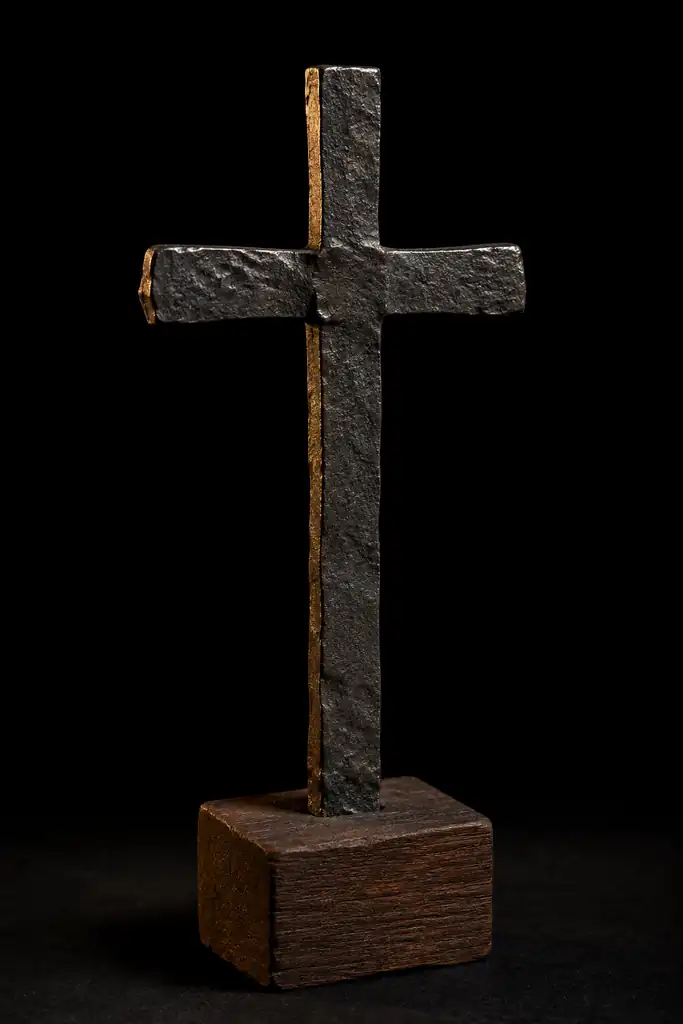
Quick overview
In the Christian-influenced European tradition, the sign of the cross is considered one of the most powerful means of defense against demons, the devil, vampires, spirits and the evil eye.
It is struck as a gesture upon one’s own forehead or chest, carved as a sign into door posts, painted onto grain and cattle, onto loaves and barrels, and held over the dying.
Long before Christianity, cross forms appear on grave goods, on pottery and on house walls in many cultures, which attributed to the cross as a basic geometric form an ordering or defending power.
The Christian sign of the cross reinforced and overwrote these older layers, but retained their practical function: a quick gesture of protection available at any time.
Origin and tradition
Cross-shaped signs are found in human cultural history reaching back so far that no single origin can be named.
The simple equal-armed cross, a vertical and a horizontal stroke, is one of the simplest geometric forms; it arose independently on all continents. The apotropaic use of the cross in pre-Christian Europe is attested for the Bronze Age sphere through grave finds.
The sign of the cross gains particular significance in the ancient context through the solar symbol: the wheel cross with four equal arms within a circle appears on Bronze Age cult implements and on wagons of the Noric region.
Its connection with the sun, the ordering and life-creating power, makes it a sign of cosmic order against chaos.
The Christian cross adds a historical and theological dimension: it stands for the overcoming of death and of evil through the suffering and resurrection of Christ.
In early Christian and medieval tradition, this theological meaning is transferred directly into defensive practice: the cross drives off the devil and his helpers because it is the sign of his defeat. Church Fathers and folk belief share this basic conviction, though at very different theological depths.
In the folk belief of the Middle Ages and the early modern period, the sign of the cross is ubiquitous.
Craftsmen carved it into roof beams, bakers stamped it into bread dough, midwives drew it on a newborn’s forehead, farmers cut it into the soil of the freshly sown field. This practice ran parallel to official church teaching and was often scarcely separable from it.
Principle of effect according to tradition
The tradition knows several explanations for the effect of the cross, depending on context and tradition.
In Christian folk belief, the notion dominates that the cross reminds the devil and demonic beings of their origin: they were overcome by Christ, the cross is the sign of this defeat, and at the sight of the sign they must yield.
An older layer explains the effect geometrically: the cross divides space into four equal parts and thereby marks all four cardinal directions. It symbolically closes off space, just as a fully secured square leaves no gap. This notion is independent of the Christian meaning; it is found in pre-Christian contexts and in non-Christian cultures.
Added to this is the notion of the point of intersection: in the cross two lines meet, and intersection points have a special power in many folk traditions, both protective and perilous. The threshold, the crossroads and the cross beam share this character: they are points of transition where forces meet.
The cross gesture, the crossing of one’s own person or of an object, transfers this power directly onto the bearer or the object.
The gesture is quick to perform, requires no material and is available at any time, which makes it one of the most widely spread protective acts in the history of European folk belief.
Cross-cultural distribution
The apotropaic use of the cross is dominantly shaped in Europe by Christianity, but is found in structural variants far beyond it. In the Hindu context, the swastika is a sign of welfare and protection with millennia of continuity; the basic form is the equal-armed cross with bent ends.
In Buddhism the sign appears on temples as a sign of fortune and protection.
In the indigenous cultures of North America, the equal-armed cross is widespread as a sign of the cardinal directions: it orders space according to the four directions and stands for cosmic completeness. There is no direct connection to European folk belief; these are parallel developments.
In the Ethiopian Orthodox tradition, the cross is the dominant protective symbol and appears on amulets, processional crosses and at house entrances in an abundance of forms that go far beyond the European variety of forms.
The apotropaic use is alive there to this day and is not confined to private folk belief, but is anchored in the church.
In the Islamic cultural sphere, the cross as such plays no protective role, yet structurally related signs that order space into four parts are found in Arabic amulet inscriptions.
What it is used against
In European folk tradition, the cross as a protective sign was directed against the following kinds of beings and threats:
- The devil and demons in the Christian sense, that is, beings from the realm of evil to which Christian theology attributed an existence of their own.
- Vampires and revenants: in Eastern European folk tradition, especially in the South Slavic, Romanian and Hungarian sphere, the cross is among the most important means against the revenant (vampire), together with garlic and stake.
- Witches and harmful sorcerers: the cross over the doorstep, carved into the door posts or placed on foodstuffs, was meant to bar witches’ entry or to avert their harmful effect.
- The evil eye and envy-driven harmful magic: the quick crossing of oneself upon encountering a person or situation regarded as ill-boding served as immediate protection.
- Spirits and the souls of the deceased who remained restless and could harm the living: signs of the cross on graves and at house openings were meant to hold such souls in their place.
Application and limits
The forms of application of the cross as a protective sign are extraordinarily varied. Permanently engraved or painted, it appears on beams, door frames, window sills, stable walls, chests and on agricultural implements.
As a threshold sign it serves to secure the entrance. Placed on edible objects such as bread and butter, it protects food against bewitchment.
As a situational gesture, the crossing of oneself protects the person in a particular moment: upon entering a suspicious place, upon waking from a nightmare, upon hearing uncanny sounds. This use is alive to this day in devout households and is regarded not as superstitious but as a gesture of prayer.
In folk belief that went beyond what was theologically sanctioned, more specific forms were also used: the threefold cross on a child’s forehead, the cross of palm fronds, the blessed cross of Ash Wednesday. Such combinations of cross form and ecclesiastical blessing were considered especially effective.
The tradition itself knows limits: a sign of the cross made without faith or with bad intent was considered, in folk-pious thinking, less or not at all effective.
Signs of the cross scratched or painted into wood also lost their effect according to tradition when they were damaged, faded or weathered. In some regional traditions the cross had to be renewed annually, for instance at certain church festivals.
Literature (selection)
Related key terms: cross protective sign sign of the cross apotropaic demon defense.
iWell Guard and protective traditions
The cross as a protective sign stands for the principle of the form that orders space and sets boundaries: it divides, closes off and marks. What the Christian tradition placed in the foreground, namely the sign of overcoming, was already present in an older layer as the sign of complete order.
The iWell Guard connects this notion with elements from other strands of protective tradition. It is not a religious symbol, but a synthesis: a sign that takes up the common basic conviction of many cultures that a worn sign with clear intent maintains the connection to the protective tradition.
More on how various signs and cultures are brought together in the Protection Compass can be found there.
Personal experiences may vary. Not a medical device. No promise of healing.