Thor, god of the Germanic tradition
By Ralf Ittermann · last reviewed on
Thor is the god of thunder, lightning and protection in the Germanic tradition. As the son of Odin and protector of humankind and the gods, he stands for strength, courage and order against chaos.
In the study of religion, Thor is an example of the central role of the weather god in Indo-European pantheons and of his subsequent reshaping into a protector deity of farmers and warriors.
Thor
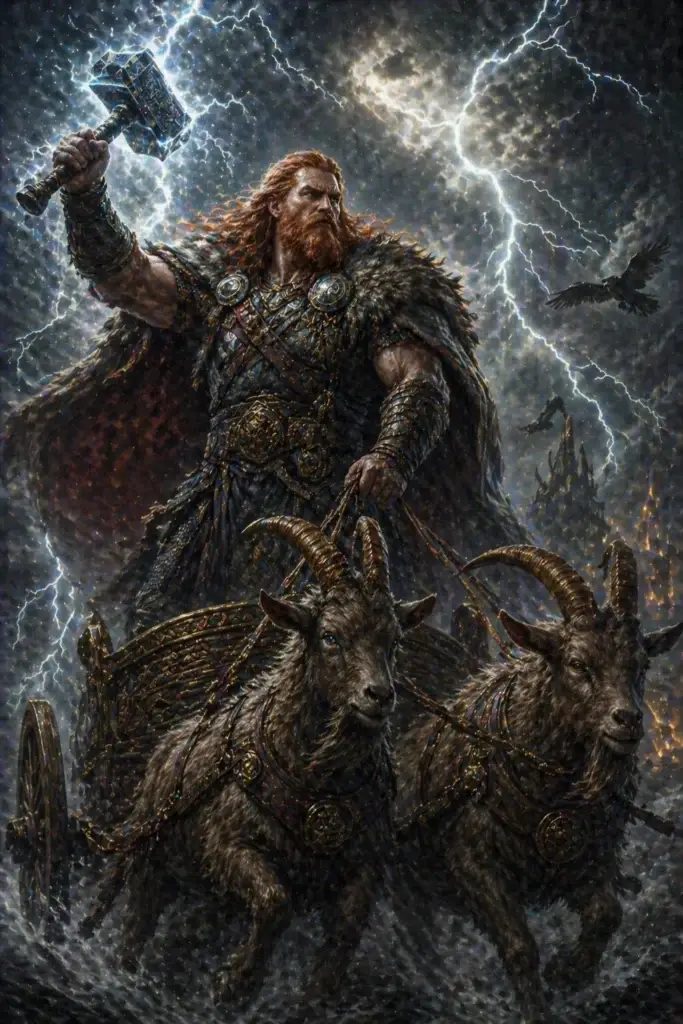
Thor embodies strength, wrath, thunder and the protection of Midgard. His central qualities are power, endurance, loyalty and a direct, straightforward nature. In myth Thor fights giants, drives his goat-drawn chariot across the sky and wields the hammer Mjölnir.
His adventures fill large parts of the Prose Edda and the Poetic Edda. The central myths are Thor’s fishing trip against the Midgard Serpent, the theft of the hammer and his contest with the giant king Thrym.
The sources are Snorri Sturluson‘s Prose Edda, the Poetic Edda (especially Þrymskviða and Hárbarðsljóð), Tacitus’s Germania, archaeological finds (Thor amulets, runestones) and Nordic place names.
Secondary works include Rudolf Simek (Lexikon der germanischen Mythologie), Jan de Vries (Altgermanische Religionsgeschichte), Georges Dumézil and Britt-Mari Näsström. Veneration of Thor was widespread in Scandinavia and in Northern and Central Europe and is still attested today in the weekday name Thursday.
Context
The continuity of the tradition across these long spans is striking and indicates a deep, stable cultural anchoring. Even in modern times the memory and at times active veneration remain alive, sometimes transformed, but still recognisable in their basic outlines.
Thor was not confined to particular regions or localities, but was known and either venerated or respectfully feared throughout the Germanic world. Whether in larger urban centres or in peripheral rural areas, whether among social elites or among ordinary people, the spiritual and cultural significance of this figure was consistently recognised.
This points to a central role in the self-understanding of the entire population. Trade, migration and cultural exchange contributed to the geographical spread and to the relative uniformity of veneration.
Primary sources: Snorri Sturluson‘s Prose Edda (especially Gylfaginning and Skáldskaparmál), the Poetic Edda (Þrymskviða, Hárbarðsljóð, Hymiskviða), Tacitus’s Germania (chapter 9: mention of the cult under the Roman name Hercules), late Roman inscriptions from Germania (IOM = Iovi Optimo Maximo, often understood as Thor syncretism) and runic inscriptions. Time span: 1st century BCE to 13th century CE. Researchers: Rudolf Simek, Jan de Vries, Folke Ström, Britt-Mari Näsström, Jens Peter Schjødt. Archaeological evidence includes Mjölnir amulets, offering finds and temples at Uppsala and Lade.
Names and spellings
Thor is depicted across the various sources and artistic traditions with certain recurring iconographic elements that remain relatively constant over decades and across different geographical regions.
These elements are not merely decorative or arbitrary, but are deeply symbolic and carry substantial meaning. They convey the figure’s central functions, sources of power, areas of responsibility and cosmic role.
The system as a whole functions like a sacred script or a coded image; it allows the initiated or culturally educated viewer to grasp the essential underlying meaning. Colours, sacred objects or weapons, bodily attributes and specific accessories are all significant and traditionally transmitted.
Characteristics
Thor stood at the centre of religious practice, everyday ritual and ordinary understanding among the Germanic peoples. People turned to this figure in critical or specific life situations or at particular ritual seasons of the year, with structured, often elaborate rites, prayers or offerings.
This practice was not arbitrary or ad hoc, but precisely transmitted and frequently led by trained priests (goðar, heathen priests) or other specialists.
The continuity of these practices over many generations shows clearly that the practice was regarded as effective and necessary. Functions were varied: some were preventive (warding off potential misfortune), some healing (relieving illness or suffering), some transformative (accompanying transitions between life stages).
Profile: Thor
This profile sets out Thor’s nature along six dimensions: his mythical and genealogical origin, the practice of his veneration among warriors and farmers, his characteristic iconography as a god of strength with hammer, the significance of invocation and divine protection, comparable figures in other Indo-European and neighbouring cultures, and a concluding synthesis of his role in the cosmic struggle against chaos.
Thor derives from Indo-European thunder and weather gods (Indra, Zeus, Iuppiter). Within Germanic mythology he is set in the early pre-Christian Iron Age (roughly 500 BCE to 1000 CE).
Tacitus mentions his cult under the Roman name Hercules (interpretatio Romana) among the Chatti and the Batavi. The Scandinavian sources (the Edda) were written down around 1200 CE, but preserve older oral traditions. The triad of Wodan, Donar/Thor and Tiwaz was widespread in Germania.
Thor was invoked by warriors before battle, by farmers at the harvest, by seafarers and by craftsmen. In Scandinavia in particular, the veneration of Thor was broadly based: kings and free farmers alike made offerings to him. Thursday (Þórsdagr) was his sacred day.
Rune amulets bearing Mjölnir were carried by warriors. In Iceland, the oath sworn on Thor’s altar was held more binding than that sworn on other gods. The berserkir (frenzied warriors) are regarded in the sources as warriors of Odin, not of Thor.
Thor was depicted as a tall, bearded man with red hair and beard, muscular and powerful. His central attributes are the hammer Mjölnir (symbol of the lightning strike and of strength), his belt Megingjörð (the belt of strength) and his iron gloves.
In runic contexts he was represented by the Thor’s hammer sign. Archaeological finds include Mjölnir amulets of silver and bronze. In iconography he drives a goat-drawn chariot across the sky, generating thunder as he travels.
Thor was credited with the power to hurl lightning, to bring rain and to crush his enemies. His strength was extraordinary: he could slay giants and even wound the Midgard Serpent (though not kill it, since it survives until Ragnarök).
Through his hammer Mjölnir, Thor could defend himself and drive off his enemies. His blessing was held to make harvests abundant and wars victorious. Curses against Thor were regarded as particularly grave and required strong counter-measures.
Thor was the object of invocation and reverent veneration, as a protector as much as a feared power. Offerings included bulls, sheep, horses and bread. Before battle, warriors swore on Thor’s altar. Mjölnir amulets were hung in houses to ward off harmful forces.
During thunderstorms people prayed to Thor for protection from lightning. During the Christianisation of Scandinavia, heathens held fast to the veneration of Thor because it felt more immediate and tangible than the more abstract Odin religion.
Zeus and Iuppiter are the Greek and Roman parallels with similar attributes (lightning, strength). Yet Zeus is primarily a king, while Thor is primarily a fighter and protector.
Indra in Hinduism is a close structural parallel: warrior god, hurler of lightning, fighter against demons. The Celtic Taranis shows similar functions. In the Slavic pantheon, Perun corresponds to Thor.
Thor: parallels in other cultures
Thunder, storm and war gods bearing the hammer as their insignia recur in many Indo-European mythologies; comparable figures include the Hittite Tarhunna, the Vedic Indra and the Baltic Perkūnas, each culturally distinctive but functionally related.
Jewish tradition: Jewish theology does not include a thunder or weather god comparable to Thor. YHWH manifests in storm phenomena (the theophany at Sinai), but Thor is more specifically concerned with warfare and protection. There is no direct parallel, but a structural similarity in the manifestation of power.
Greco-Roman world: Zeus and his Roman counterpart Iuppiter are the closest comparisons: hurlers of lightning, holders of royal power.
Yet Zeus stands higher in the hierarchy and is primarily a king, whereas Thor ranks below several gods and takes the role of protector. Ares shares the warlike aspects with Thor, but without the function of a weather god.
Mesopotamia: Adad/Hadad is a weather god with a similar lightning function, though less personal and dramatic than Thor. Ninurta is a war god with a comparable combat narrative, but without the thunder aspect.
India and Asia: Indra is the closest parallel: warrior king, hurler of lightning (vajra), fighter against demons (Vritra). Later displaced by Vishnu and Shiva, he remains structurally identical. In Buddhism, Shakra/Indra holds a minor position but does not lose his attributes.
Thor's fishing trip against the Midgard Serpent
One of the best-known individual narratives about Thor is his fishing trip, in which he hauls the world serpent Jörmungandr out of the sea.
The myth is transmitted several times over: in the Eddic poem Hymiskviða, in Snorri Sturluson’s Prose Edda and in allusions in several skaldic poems, such as the Húsdrápa of Úlfr Uggason.
Thor goes to the giant Hymir to set out to sea with him. As bait, he tears the head from one of the giant’s oxen.
Once at sea, Thor rows far beyond the familiar fishing grounds until Hymir becomes afraid. Thor casts his line baited with the ox head, and the Midgard Serpent takes the bait.
A tremendous struggle ensues. Thor braces himself so powerfully against the bottom of the boat that his feet break through the planks and find purchase on the sea floor. He pulls the serpent up until its head rises above the gunwale and raises his hammer to strike.
At this point the versions diverge. According to Snorri, the terrified Hymir cuts the fishing line, so that the serpent sinks back into the sea; Thor strikes in vain or merely grazes it. In other allusions Thor seems actually to deliver the blow.
Scholarship sees in this episode a pictorial anticipation of the final confrontation at the end of the world. Several picture stones, including finds from Sweden, England and Denmark, show a scene most often interpreted as this fishing trip, attesting to the wide currency of the material already in the Viking Age.
Mjölnir: forging myth, function and archaeological evidence
Thor’s hammer Mjölnir is his most important attribute. In the Prose Edda, Snorri recounts how the hammer came into being. Loki had precious objects forged by the dwarfs, the sons of Ivaldi and the brothers Brokk and Eitri.
In a contest over the best work, Brokk and Eitri produced the hammer, but because Loki, in the form of a fly, harassed the dwarf working the bellows, the haft turned out too short.
Despite this flaw, Mjölnir was judged the most valuable work, because it never missed its target and returned to the hand after being thrown.
Mjölnir is not only a weapon against the giants but also an instrument of consecration. In Þrymskviða the hammer is used to bless a bride, and elsewhere too it appears as a sanctifying implement, for instance in the revival of Thor’s goats.
This dual function as a destroying and a consecrating power is central to an understanding of Thor.
Archaeologically, Mjölnir is attested by numerous hammer pendants, small amulets of silver, bronze or iron, found across Scandinavia and the Viking sphere of influence. Their distribution increased in the 10th century, precisely during the onset of Christianisation.
Scholars interpret this in part as a conscious heathen statement set off against the Christian cross. A mould find from Denmark, in which cross and hammer shapes could be cast side by side, illustrates the religious coexistence of the period with particular clarity.
Thor in the religious practice of the Viking Age
Thor was not a distant god, but a deity widely venerated in everyday life, possibly the most popular among farmers and ordinary free people. Several lines of evidence point in this direction.
First, personal names: names formed with the element Thor, such as Þorsteinn, Þorgeirr or Þorgerðr, are among the most frequent in the Old Norse tradition. Second, place names: in Norway, Sweden, Denmark and in the areas settled by Northmen, numerous places bear names that refer to a Thor cult.
The Icelandic sagas, especially the Eyrbyggja saga and the Landnámabók, describe settlers who were particularly devoted to Thor, who dedicated a temple to him or threw his wooden high-seat pillars into the sea in order to find the place of settlement determined by him.
These reports, however, are later, shaped by Christian editing, and must be read with caution.
In the 11th century, Adam of Bremen describes the temple at Uppsala and places Thor at its centre between Wodan and Fricco; Thor rules over thunder, wind, rain, fair weather and the crops.
Even though Adam’s account comes from a Christian outside perspective and is not reliable in every detail, it confirms Thor’s importance for weather and harvest, that is, for the livelihood of the farming population.
From the perspective of the study of religion, the picture that emerges is that of a god connected less with rulership and war than with protection, order and fertility, a god of the homestead and of the community.
The thunder god in Indo-European comparison
Thor can be placed within a broad group of thunder deities of the Indo-European language family, a comparison that has occupied the comparative study of religion since the 19th century. Related figures include the Baltic Perkūnas, the Slavic Perun, the Vedic Indra and, in part, the Greek Zeus, where he appears as a storm god.
Several scholars, including Georges Dumézil in the framework of his theory of the three social functions, have located Thor in the warrior or protective function.
Others emphasise more strongly the shared motif of the dragon or serpent combat, which in many Indo-European traditions is linked with the storm god. Thor’s opposition to the Midgard Serpent fits this pattern.
There are also linguistic indications. The name Thor, Old Norse Þórr, Old High German Donar, Old English Þunor, goes back to a common Germanic word for thunder.
The translation of the Latin weekday name dies Iovis, the day of Jupiter, as Thursday, English Thursday, shows that ancient and medieval scholars equated Thor with Jupiter, that is, with the highest Roman god and lord of the storm.
For all the plausibility of these comparisons, more recent scholarship urges caution. Shared motifs may go back to common origin, but also to later exchange or to independent parallel development. The reconstruction of a unified Proto-Indo-European thunder god therefore remains a hypothesis that explains individual correspondences but not all of Thor’s particular features.
From heathen god to popular culture: the history of reception
After the Christianisation of Scandinavia the cult of Thor disappeared, yet the narratives were preserved through the Icelandic literary tradition. Snorri Sturluson wrote his Prose Edda in the 13th century as a Christian scholar concerned to preserve the old material for the art of poetry.
Without this work and the manuscript tradition of the Poetic Edda, the greater part of the Thor myths would have been lost.
A broad rediscovery set in with the Romanticism of the late 18th and the 19th centuries. In Scandinavia and Germany, poets and scholars took up Nordic mythology.
The Danish poet Adam Oehlenschläger devoted verses to Thor, and in Germany Jacob Grimm in his Deutsche Mythologie, among others, dealt extensively with Donar. This reception was not free of nationalist and ideological loading, which in parts of the 20th century turned dangerous when völkisch and National Socialist circles appropriated Germanic symbols.
In the 20th and 21st centuries, Thor became known worldwide primarily through the comic-book adaptation of the US publisher Marvel from 1962 onwards and through its later film adaptations. This popular version departs sharply from the medieval sources; it turns the red-bearded farmer’s god into a blond, youthful hero and invents numerous storylines anew.
From the perspective of the study of religion, this strand is to be treated less as tradition than as an independent body of modern mythical material.
At the same time, since the late 20th century there have been neo-heathen movements that again venerate Thor in religious terms. For further reading on this pantheon, see the entries on Odin and on Loki.
Further reading and links
Further reading:
- Germanic (parent culture page)
- Odin (chief god of the Æsir pantheon)
- Freyja (Vanir goddess and sister figure within the pantheon)
- High Deities (class overview)
Research literature
Further standard works in the literature index.