Mishipeshu, the underwater panther of Agawa Rock
By Ralf Ittermann · last reviewed on
Mishipeshu is a demon of the Anishinaabe tradition of North America.
Feline-shaped guardian of the copper at Lake Superior.
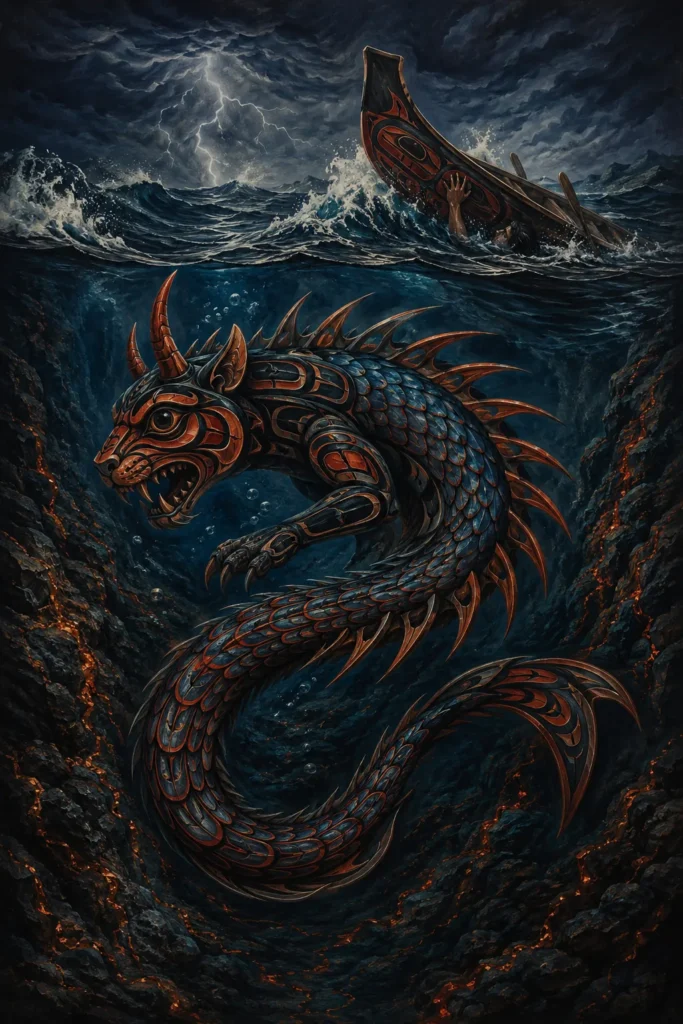
Mishipeshu, also Mishibizhiw, is regarded among the Algonquian peoples as the most powerful being of the underworld. The name means Great Wildcat. He watches over the copper at Lake Superior, captured in the rock painting of Agawa Rock.
Type: horned underwater panther
Origin: pre-colonial Algonquian tradition
Texts: Jesuit account, rock paintings at Agawa Rock
Period: 17th century to present
Appearance: feline head, scaled body, horns, long tail
Historical Classification
Period of the Texts
Pre-colonial tradition, recorded ethnographically from the 19th century onward; the earliest trace comes from the Jesuit Claude Dablon.
Area of Diffusion
Great Lakes region, concentrated around Lake Superior and Michipicoten Island.
Sources
Documented ethnographically from the 19th century onward, supported by the rock paintings of Agawa Rock.
Name and variants
Ojibwe: Mishipeshu, also Mishibizhiw, means Great Wildcat or Great Lynx.
Amalgam of big cat and serpent
Appearance
Amalgam of many animals: the body of a big cat, horns, spines along the back, a long serpent-like tail.
Effect
It drowns people, capsizes canoes, raises storms, but also grants healing power.
Profile: Mishipeshu
The most important aspects of the underwater panther at a glance.
The most powerful underworld being of Algonquian cosmology, lord of all water animals.
The depths of the Great Lakes and the copper of Lake Superior around Michipicoten.
Cat head with horns, scaled body, dagger-like spines along the back, a very long tail.
Capsizes canoes, drowns people and lashes the lake into storms with its tail.
An offering of tobacco with the left hand and a plea for safe passage, a tradition still practised today.
Originally distinct from the horned serpent Mishiginebig, though often merged with it.
Guardian of the copper at Lake Superior
Mishipeshu, Great Wildcat, watches over the copper of Lake Superior; taking it was considered theft. Claude Dablon reports of four Ojibwe who died after doing so. At Agawa Rock, a pictograph in red ochre shows Mishipeshu as its largest motif.
From rock art to museum emblem
Norval Morrisseau painted the underwater panther drawing on tradition and rock art; Agawa Rock is today a landmark in Lake Superior Provincial Park. As a manitou, it is regarded as ambivalent.
Tobacco with the left hand
Tradition tells of appeasement for a safe crossing; in the 1950s the Prairie Band of the Potawatomi held a ceremony. At Agawa Rock, tobacco is still offered into the water with the left hand today.
Underwater panthers and related water beings
Mishipeshu belongs to the type of horned water serpents of North America, such as the Uktena; its counterpart is the Thunderbird. Related is Mishiginebig, and comparable is the Scottish Kelpie.
Frequently asked questions about Mishipeshu
Is Mishipeshu male or female?
Accounts vary: stories refer to it as she, but its gender remains open.
Why not take the copper?
It was considered its property; taking it brought misfortune and death.
Further links
Further reading:
Literature (selection)
More in the bibliography.
The Mishipeshu underwater panther is regarded by the Anishinaabe as a water being of the Great Lakes: a guardian of the copper, who capsizes canoes if not shown due respect.