Abzu, the sleeping primordial water beneath the earth
By Ralf Ittermann · last reviewed on
Abzu is a god of Mesopotamian tradition.
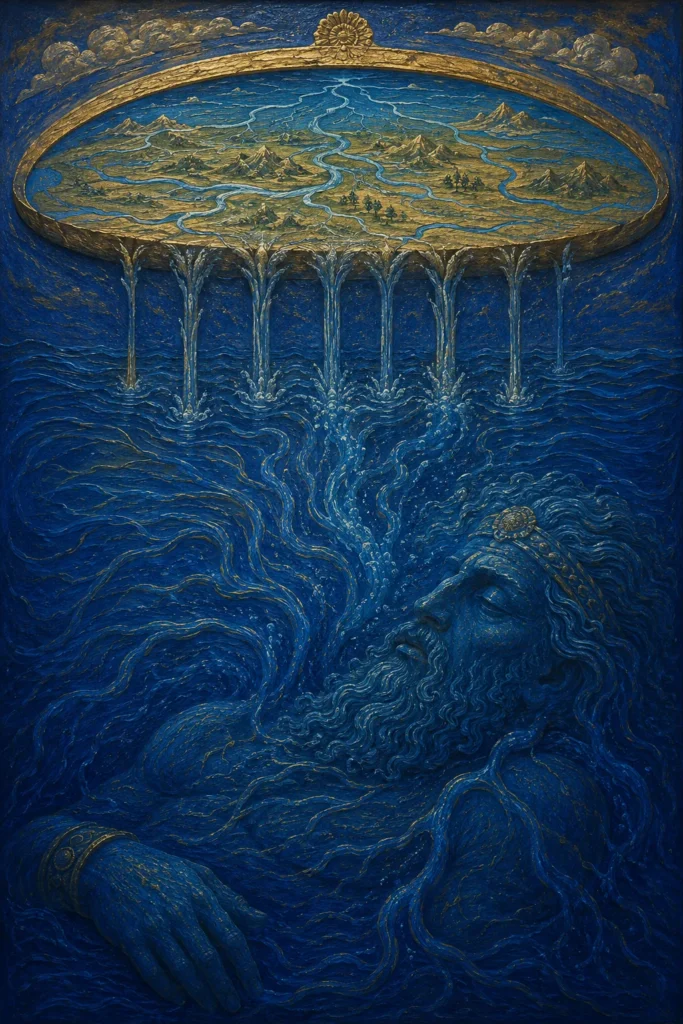
The primordial freshwater sea from which all springs arise. The tradition envisions a sleeping primordial water beneath the earth, the source from which all springs arise. Abzu was revered by the Sumerians as the primordial freshwater sea beneath the earth. Abzu denotes the Sumerians’ primordial freshwater sea, and the text below explains the place of this notion in their picture of the world.
Abzu, in Akkadian Apsu, is the cosmic primordial freshwater sea from which all springs and rivers are fed, personified as a male primordial god and consort of Tiamat, and seat of the god Enki, also called Ea.
Type: Primordial freshwater sea, personified as a primordial god
Origin: Sumerian cosmogony, from the 3rd millennium BC
Texts: Enuma Elish
Period: Sumerian to Babylonian
Appearance: subterranean water, male primordial god
Textual history
Period of the Texts
Sumerian texts from the 3rd millennium BC onwards; as a god, above all attested in the Enuma Elish.
Area of Diffusion
Southern Mesopotamia, with the cult centre of Eridu, seat of the god Enki and his temple E-abzu.
Sources
Good: the Enuma Elish, the Enki myths and temple inscriptions form a broad source base.
Name and variants
Sumerian: Abzu means deep water, the subterranean freshwater as opposed to the salt sea; Apsu is the Akkadian form.
Being and effect
Appearance
Resting, sweet primordial water beneath the earth; Apsu the male, Tiamat the female saltwater principle.
Effect
Origin of all freshwater; his plan of destruction leads to the creation of heaven and earth.
Profile: Abzu
The primordial water at a glance.
Sumerian-Babylonian cosmogony, central to the Enuma Elish and to the Enki cult of Eridu.
The subterranean freshwater of all wells, springs and rivers.
As a place, the resting primordial sea beneath the earth; personified, a primordial god alongside Tiamat.
Origin of all freshwater; in the myth, at the same time the trigger for the plan to destroy the gods.
The Apsu holy-water basin in the temple as an image of the primordial water, venerated through the Enki cult.
The battle in the Enuma Elish
In the Enuma Elish, the waters of Apsu and Tiamat mingle to produce the first generation of gods; when their noise disturbs him, Apsu plans their destruction. Ea forestalls him, plunges him into a deep sleep and kills him, builds the temple E-abzu upon his body, and there fathers the god Marduk with Damkina.
Between scholarly literature and popular culture
Abzu appears frequently in fantasy, popular culture and video games, and gave its name to a diving game; in esotericism the term is freely reinterpreted. In religious studies it links a natural aspect with a primordial deity following the pattern of chaoskampf cosmogony.
The Apsu basin in the temple
Central was the temple E-abzu in Eridu with the Apsu as a holy-water basin for purification rites; a personal cult of its own is not attested; as an equivalent, holy water, salt and amulet.
Primordial waters compared
Frequently asked questions about Abzu
Is Abzu male or female?
As a primordial god in the Enuma Elish, Apsu is male, consort of Tiamat; as a concept it is gender-neutral.
Is Apsu the same as Abzu?
Yes: Sumerian Abzu, Akkadian Apsu, the same primordial water.
Further links
Further reading:
Literature (selection)
More in the bibliography.
Called Apsu as Abzu, he remains the Sumerian primordial water: the silent origin from which all the springs of the Mesopotamian world flow.