Pyrausta, the insect from the flame
By Ralf Ittermann · last reviewed on
The Pyrausta is a spirit of the Greek tradition.
The fire creature that dies outside the flame.
In ancient natural history, Pyrausta is a small winged insect that lives in fire and dies as soon as it moves away from the flame. It is a literary fire creature without a cult of its own.
The idea belongs to the ancient doctrine of spontaneous generation: Aristotle mentions creatures said to arise in fire, and later authors often placed the fire insect in the copper furnaces of Cyprus. The Pyrausta also gave antiquity a proverb about self-destructive closeness to danger.
Type: Small winged insect that lives in fire
Origin: Ancient natural history and the doctrine of spontaneous generation
Texts: Aristotle, Aelian, Pliny
Period: Greek-Roman antiquity
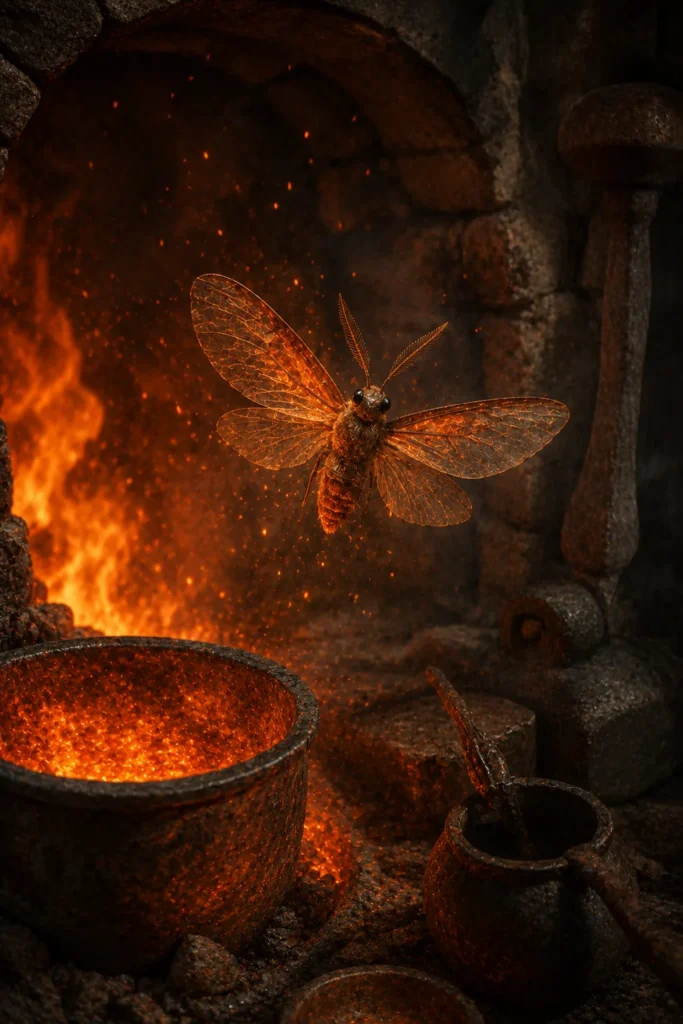
Appearance: moth-like fire creature in the glow of furnaces
Source context
Period of the Texts
Greek-Roman antiquity: the evidence is found in Aristotle, Aelian and Pliny.
Area of Diffusion
Mediterranean region, transmitted purely in literature; the fire insect was often attributed to Cyprus and its copper furnaces.
Sources
Moderate: only scattered ancient natural-history passages; no dedicated monograph on Pyrausta exists.
Name and variants
Greek: pyraustes, from pyr, fire. The word denotes a being that arises from fire. The idea is part of the ancient doctrine of spontaneous generation, according to which living creatures can arise directly from the elements.
Description
Appearance
Pyrausta is imagined as a small, moth-like winged insect flying about in the glow of furnaces. Its defining feature is complete dependence on fire: it cannot survive outside the flame.
Effect
The being lives in the flame, and its fate became proverbial: whoever, like the Pyrausta, strays too far from their fire perishes. The phrase served as an image for people who, through recklessness, leave their own protective element.
Profile: Pyrausta
The key aspects of the fire creature at a glance.
A motif of ancient natural history and the doctrine of spontaneous generation, passed down from Aristotle to Pliny.
Ancient natural history and proverbial wisdom: the Pyrausta is both an explanatory figure and a cautionary image.
Small, moth-like winged insect that flies about in the glow of smelting furnaces and can survive only there.
Lives in the flame and dies outside it; a proverbial image for self-destructive closeness to danger.
No cult: the Pyrausta belongs solely to the natural history and proverbial literature of antiquity.
The Salamander as an ancient fire-dwelling creature; the moth flying into the flame as a related motif, and the Phoenix as a fire bird.
Born from smelting furnaces: Pyrausta and spontaneous generation
Greek pyraustes, from pyr, fire, denotes a being that arises from fire. In his zoology, Aristotle mentions creatures said to arise in fire, for instance in smelting furnaces; later authors such as Aelian and Pliny take this up and often place the fire insect in the copper furnaces of Cyprus.
The idea is part of the ancient doctrine of spontaneous generation, according to which living creatures arise directly from the elements. Fire, the most dangerous of the elements, gained its own creature in the Pyrausta: an animal for which the flame is not death but habitat.
Afterlife in zoology and proverb
Today, Pyrausta is known mainly to specialists in ancient natural history. The name survives in zoology as the genus name of a group of moths, and it occasionally appears in fantasy as a fire being.
From a religious-studies perspective, the Pyrausta is not a religious being but an explanatory and proverbial motif of ancient natural philosophy. It shows how the doctrine of spontaneous generation attributed living creatures to fire itself, and how such a motif could become a moral metaphor.
Not a cult, but a proverb
Pyrausta has no cult. It belongs solely to ancient natural history and to proverbial literature. From the motif developed the proverbial saying about the fate of the Pyrausta, handed down as a warning: whoever, out of arrogance, leaves the element that protects them perishes like the fire insect that strays too far from its flame.
Salamander, moth and phoenix
The Pyrausta stands alongside the Salamander as an ancient fire creature; both share the idea of an animal that can survive in fire. Related in motif are also the moth, which flies into the flame, and the Phoenix as a fire bird. While the Phoenix is renewed in fire, the motif is reversed with the Pyrausta: it is not the fire that proves fatal, but leaving it.
Frequently asked questions about the Pyrausta
What is a Pyrausta?
A small insect described in ancient natural history, said to live in fire and to die outside the flame.
Was there a cult around it?
No. Pyrausta is a natural-history and proverbial motif, not a cult being.
Where does the proverb come from?
From the idea that the fire insect perishes if it leaves its fire; this was used as an image for self-destructive arrogance.
Further links
Further reading:
- Greece – all beings of the ancient Greek cultural sphere
- Salamander – the other fire creature of ancient natural history
- Protective candle, Amulet, Salt – traditional protective means
- Protection Compass – protective means at a glance
Literature (selection)
Further standard works in the bibliography.
As a fire insect of ancient natural history and a being living in fire without a cult, the Pyrausta remains a borderline case in the study of beings: not a spirit in the strict sense, but a thought-creature that antiquity let rise from the glow of its smelting furnaces.