The Djed Pillar: the Egyptian Protective Sign of Stability
By Ralf Ittermann · last reviewed on
The Djed pillar is the Egyptian sign for stability and permanence. As a column with four crossbars, it stood for constancy, was closely associated with the god Osiris, and was worn as an amulet intended to secure the wearer steadiness and firmness.
Classification
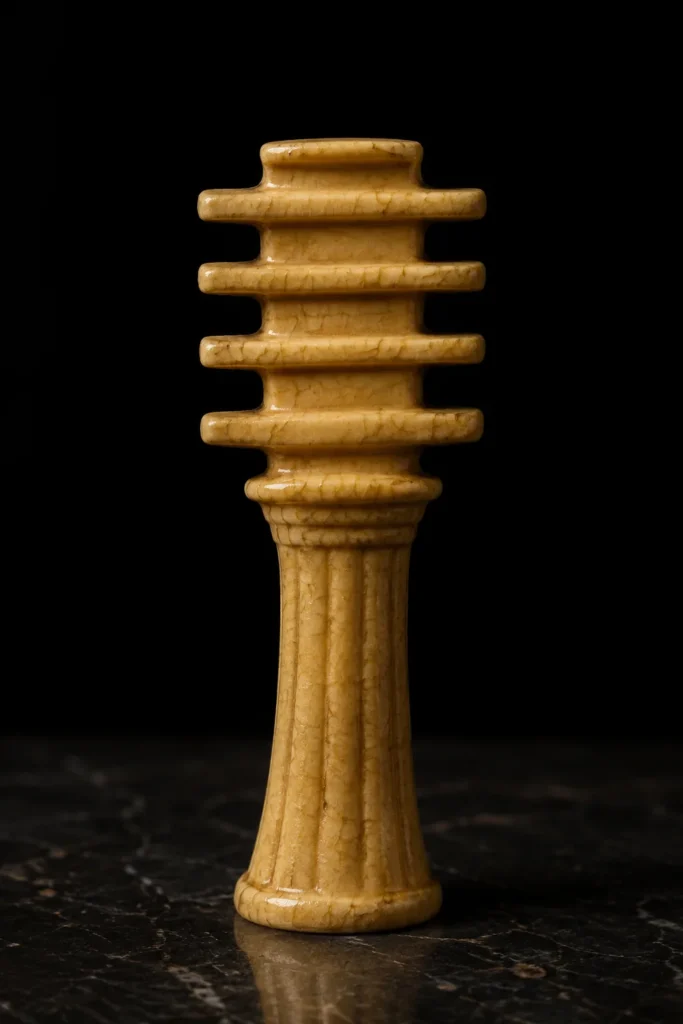
The Djed pillar is an ancient Egyptian sign in the shape of a column. Its upper part bears four horizontal crossbars arranged one above the other. This clear form makes the Djed unmistakable.
It appears in the art of ancient Egypt throughout its entire history. As a written character, as an image, and as an amulet, it belonged firmly to the Egyptian world of symbols.
The meaning of the Djed can be summed up in a single concept, that of stability. The pillar stood for firmness, for permanence, and for the constancy of order.
Whatever endured and did not begin to falter could be designated with the Djed. Its protective function derived from this meaning. Stability was a protection against decay and dissolution.
In religious studies, the Djed pillar is a good example of an abstract protective sign. Unlike the Eye of Horus or the scarab, it does not depict a living being.
It represents a form whose meaning lies in the concept of firmness. The Djed shows that the Egyptian world of symbols also knew purely objectual signs.
As an amulet, the Djed belongs among the apotropaia. It was worn and was placed with the dead.
It was especially closely connected with the god Osiris and with the idea of living on. Across many centuries its form remained unchanged. The Djed pillar thus belongs among the most constant signs of a culture that itself held constancy in high regard.
The Sign of Stability
At the center of the Djed’s meaning stands stability. The corresponding Egyptian word denoted standing firm, enduring, and remaining in being. When a text wished for permanence and firmness, it could use the Djed sign. The pillar was thus a written character for one of the fundamental wishes of Egyptian culture.
Stability held a high value for the Egyptians. Their religion and their state order were oriented toward permanence. The change of the seasons, the return of the Nile flood, and the steady course of the sun were regarded as a reliable order.
The Djed pillar stood for precisely this reliability. It was the sign that the world did not fall back into chaos.
The protective character of the Djed is explained by this meaning. What stands firm cannot easily be overturned. What endures is protected from decay. The Djed pillar transferred this firmness to the one who wore it. It was meant to lend the wearer steadiness and to preserve him from collapse.
The Djed thus complemented the other great protective signs of Egypt. The ankh secured life, the scarab renewal, the Djed stability. These signs designated different sides of the same concern, namely secure existence. For this reason they were frequently depicted together. Only together did they yield a complete picture of the hoped-for well-being.
Form and Interpretation of the Shape
The Djed pillar shows a vertical column whose upper region is crossed by four crossbars. The bars are arranged one above the other and usually increase somewhat in width toward the top.
The lower part of the column remains plain. This division into a calm shaft and a multiply articulated head is the hallmark of the sign.
Regarding the origin of the form, scholarship offers various proposals. One interpretation sees in the pillar a bundled reed or a tree from which the branches were stripped. Another interpretation thinks of a device for raising sheaves. A definite decision is not possible. The sources allow no unambiguous conclusion.
Regardless of its origin, the interpretation of the Djed in Egyptian times was clear. It denoted firmness and permanence. This meaning is attested from the earliest evidence onward. The question of the original object is therefore less important than the question of its meaning. And this meaning remained stable throughout the whole of Egyptian history.
Remarkable is the constancy of the form itself. Over more than three millennia the Djed scarcely changed. This unchangeability fits its meaning. A sign for permanence and firmness itself remained lasting and firm. The form and content of the Djed thus matched in an unusually precise way.
The Djed and Osiris
In Egyptian religion the Djed pillar was closely connected with the god Osiris. Osiris was the lord of the realm of the dead and at the same time the god who had overcome death.
According to the myth, he was killed, yet he returned to a form of life. The Djed became the sign of this re-erection.
A widespread interpretation understood the Djed pillar as the backbone of Osiris. In this view, the four crossbars were regarded as the segments of his spinal column.
The backbone is what holds the body upright. As the backbone of Osiris, the Djed thus stood for the restoration of the god. It designated the moment in which the slain Osiris regained his support.
In earlier times the Djed was also connected with other gods, such as Ptah and Sokar, who were venerated in the region of Memphis. In the course of religious history, however, the connection with Osiris came to the fore. This shift shows how Egyptian signs could change their association with the development of religion.
Through its binding to Osiris the Djed acquired a twofold meaning. It stood for stability in general and for the particular stability that had overcome death.
Whoever wore the Djed thought of firmness and at the same time of the hope of Osiris. This connection made the Djed a central sign of the belief concerning the dead.
The Raising of the Djed Pillar
The Djed was not only a sign but also the object of an important ritual. At certain festivals a Djed pillar was raised. This raising was a solemn act in which the king took part. The pillar, previously lying or inclined, was drawn into the upright position with ropes.
The meaning of this act was rich. The raising of the Djed was regarded as an image of the re-erection of Osiris. The fallen god was, as it were, set back on his feet.
At the same time it was a sign for the strengthening of order and of the land. With the raised pillar the world too stood securely once more.
The ritual was often connected with great festivals, such as celebrations for the renewal of royal rule. The king who raised the Djed thereby confirmed his role as guarantor of order. The act combined religious conception and political meaning. It showed visibly that the world stood under secure leadership.
This ritual makes a particular feature of the Djed clear. It was a sign that one did not merely contemplate but with which one acted.
The raising gave the meaning of the pillar a bodily form. From firmness as a concept came a visible movement from lying to standing. The Djed thus joined sign and action in an impressive way.
Material and Use as an Amulet
As an amulet, the Djed pillar was made from various materials. Faience in green and blue was widespread; alongside it there were pieces of gold, of carnelian, and of further stones.
The Djed frequently appears together with the Tit, the Isis knot. The two signs complemented each other and were often worn as a pair.
The sizes of the Djed amulets varied. Small pieces served as pendants and were incorporated into jewelry. Larger specimens had their place in the grave goods. The simple, clear form could be reproduced well at any scale. The Djed was thus as suitable as an amulet as it was as a large pictorial sign.
The Djed was worn by the living as protection and as a wish for firmness. Whoever wore it asked for steadiness in their own life and for the permanence of their own well-being.
The Djed was a sign that promised a calm, firm footing. In a world that knew many uncertainties, this was an understandable wish.
The Djed, however, had a special significance in the cult of the dead. There it was used not arbitrarily but in a particular place. This deliberate use in burial gave the Djed amulet its most important role. It connected the pillar directly with the body of the deceased.
The Djed in the Cult of the Dead
In the cult of the dead the Djed pillar had a fixed place. A Djed amulet was laid on the mummy’s neck, in the area of the nape and the spinal column. This place was not chosen by chance. It corresponded to the interpretation of the Djed as the backbone of Osiris.
The Egyptian Book of the Dead contains a spell of its own that belongs to the Djed amulet. This spell connects the pillar with raising up and with the strengthening of the deceased.
The amulet was meant to give the dead person support and to raise him up, just as Osiris was raised up. The Djed was thus a protection at a decisive place.
The idea behind it is clear. Just as the Djed gave Osiris firmness, it was to give the deceased firmness. The dead person was not to sink into nothingness but to enter the afterlife upright and constant. The Djed transferred the re-erection of the god to the individual human being.
In this use the Djed shows itself as a sign of hope. It designated not the end but the firm footing after the transition.
Together with the ankh, which secured life, and the scarab, which promised renewal, it formed the equipment of the deceased. These signs were meant to give the dead everything he needed for living on.
Djed, Ankh, and Was: the Group of Signs
The Djed pillar rarely stands alone. In Egyptian art it frequently appears in a fixed series with the ankh and the was scepter. The ankh denoted life, the was scepter power, and the Djed stability. Together these three signs formed a comprehensive formula of blessing.
This group of signs adorns temple walls, thrones, coffins, and pieces of equipment. It expresses a complete wish, namely a long life, secured power, and lasting existence. Each of the three signs contributes a part of this wish. Only together do they yield the whole picture.
In this series the Djed supplies the idea of permanence. Life and power alone are not sufficient if they are not of lasting kind. The Djed ensures that the good does not pass away. It is, as it were, the anchor of the whole formula. Without it the blessing would remain incomplete.
This fixed connection of the signs shows that the Egyptian world of symbols was ordered. The individual signs did not stand side by side without relation but formed a system. They could be combined and complemented one another. The Djed pillar had its fixed place in this system as the sign of constancy.
Reception Today
The Djed pillar is today less well known than the ankh or the scarab. Its abstract form is less memorable than an eye or a beetle.
Nevertheless it belongs to the firm stock of the Egyptian world of symbols and is familiar to all who concern themselves with ancient Egypt. In the scholarly world it is a well-known sign.
As a piece of jewelry the Djed is occasionally worn, mostly by people with a particular interest in Egypt. In currents that appeal to ancient Egyptian religion, it has a firm place. There it is deliberately used as a sign of stability. Its original meaning thus remains alive.
In museums the Djed pillar is well represented. The Egyptian collections preserve numerous Djed amulets, especially of faience. They show how widespread the sign was in the grave goods. Whoever views these pieces recognizes the simple, constant form that remained the same over millennia.
The Djed pillar is thus an instructive example. It shows that not only pictorial signs but also abstract forms can become protective symbols. Its meaning, stability and permanence, belongs to the basic wishes of humankind. The Djed gave this wish a clear, calm form that endured throughout the whole of Egyptian history.
Literature (Selection)
Related key terms: Djed pillar, stability, Osiris, backbone, apotropaion, faience, Book of the Dead, was scepter, ancient Egypt.
iWell Guard and Protective Traditions
iWell Guard stands in the cultural-historical line of portable protective objects to which the Djed pillar also belongs. A modern companion for people who live with protective symbols: made in Germany, 41 layers of solid gold, platinum, and silver, with a 30-day right of return.
Personal experiences may vary. Not a medical device. No healing promise.