Cornicello: the red horn amulet against the evil eye
By Ralf Ittermann · last reviewed on
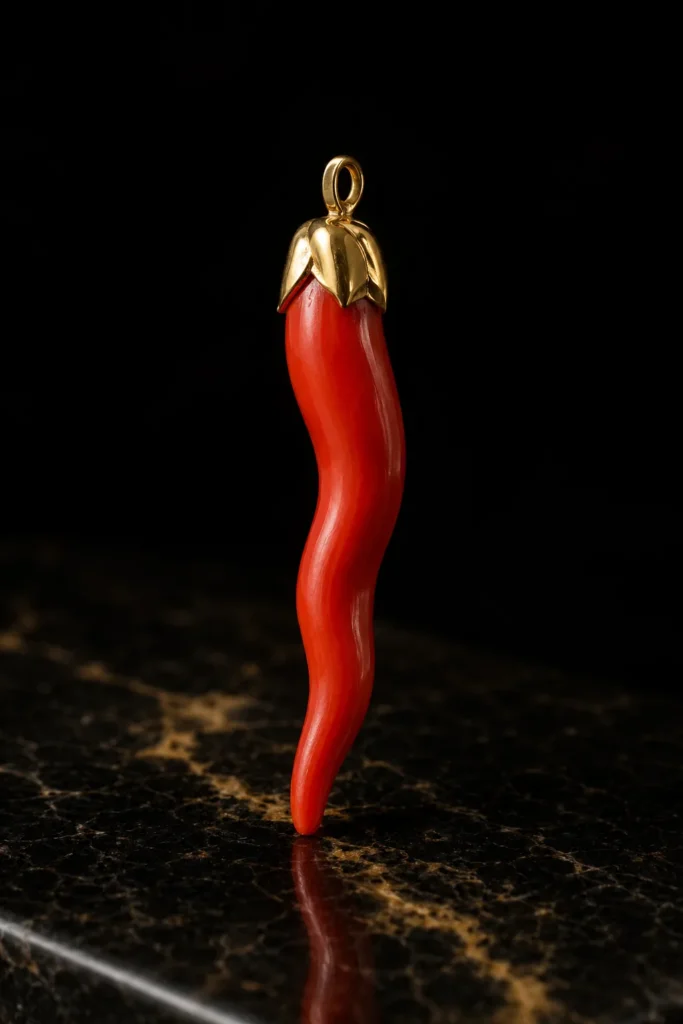
The cornicello is a small horn-shaped amulet from the Italian region. In its best-known form it is red, slightly curved and tapering to a point. It is regarded as a means against the evil eye and as a bringer of good fortune.
Classification
The cornicello is a protective amulet from the Italian region, especially from the south of the peninsula and from Naples. The name means little horn and describes directly the shape of the object. It is among the best-known protective symbols of the Mediterranean region.
In its most widespread form, the cornicello is red, slender, slightly curved and tapered at one end. It resembles a narrow, twisted animal horn or also a chili pepper. This shape has remained the same across generations.
The cornicello is worn as a pendant on a chain, as a lucky charm on a key ring, or as a small object in the home and in the vehicle. In all of these forms it accompanies its owner through daily life.
Its main task is to ward off the evil eye, which in Italy is known as malocchio. In addition, the cornicello is generally regarded as a sign of good fortune and of a favorable turn of events.
In religious studies and in folklore studies, the cornicello is a well-researched example of an averting amulet that derives from an ancient animal motif and has remained alive into the present day.
This page presents the cornicello from the perspective of protection. It describes its form, its origin, its use against the evil eye, as well as its place alongside related amulets of the Mediterranean region.
Form and shape
The shape of the cornicello is clearly defined. It is a slender, elongated form that tapers from a broader base to a fine point while describing a slight curvature.
The characteristic color is a strong red. This color is itself regarded as protective and is associated in many cultures with averting harm and with vital force. The red cornicello is the best-known, but not the only, version.
The cornicello is made from various materials. Common ones are coral, red-colored glass, plastic, as well as precious metals such as silver and gold. Red coral was long regarded as a particularly effective material.
The size varies considerably. There are very small pendants of a few centimeters in length, as well as larger pieces that are hung up in the home. The basic form remains the same across all sizes.
The upper end often carries a small loop or a cap through which the amulet can be fastened to a chain. Sometimes this mount is artfully worked and provided with further signs.
The form of the cornicello is thus simple and memorable. It is precisely this plainness that has helped the amulet remain recognizable over long periods and easy to produce.
Origin of the horn motif
The form of the cornicello goes back to the horn of animals. The horn is an ancient motif of the Mediterranean region, which was associated with strength, with fertility and with the averting of harm.
Horns belonged in many ancient cultures to the furnishings of sanctuaries and of protective customs. They stood for the strength of the animal from which they came and were regarded as a sign of a defensive vital force.
Scholarship connects the cornicello with this long tradition of the horn motif. In which exact step the small worn amulet emerged from the animal horn cannot be documented without gaps. The great age of the motif itself, however, is regarded as established.
In the Italian region, today’s shape developed from this background. The slender, red, curved horn became the fixed form of the amulet as it is known today.
Honestly, the history of the cornicello is obscure in many details. What is certain is that the horn motif is ancient. The unbroken line from antiquity to today’s pendant, however, cannot be traced in every step.
The cornicello is thus an amulet with ancient roots and a more recent fixed shape. A factual account names both, the old motif and the not fully documented line of development up to the present.
The evil eye and its averting
The main task of the cornicello is to ward off the evil eye. In the Italian region this is known under the name malocchio, which literally means evil eye.
According to this idea, a gaze can cause harm. The evil eye is often associated with envy. Whoever regards another with resentment can, according to this tradition, harm them unintentionally.
The belief in the evil eye is widespread throughout the Mediterranean region. It is presented in detailed form on the page about the evil eye and forms the background of many protective amulets of this region.
The cornicello opposes this belief as a means of averting harm. Whoever wears it is, according to the tradition, protected against the malocchio, whether it proceeds from envy or from thoughtless admiration.
The amulet was used above all where people felt at risk, for example children, pregnant women, or persons who had good fortune and could thereby arouse envy.
The cornicello is thus firmly embedded in the belief in the evil eye. Without this background its meaning cannot be understood. It is a means that gives a widespread fear a visible answer.
The operating principle of the cornicello
The cornicello follows its own operating principle. It does not catch the evil eye like an eye amulet, but wards it off through its form and its color.
The pointed, horn-like shape is itself regarded as averting. A point, a horn or a sharp end draws the harmful gaze toward itself, according to folk belief, and diverts it away from the wearer.
The red color reinforces this effect. Red was regarded in the Mediterranean region as a strong, vital and averting color. A red amulet bound attention and was meant to divert the harm.
In addition there is the ancient connection of the horn with strength and fertility. The cornicello carries this idea within it and, as it were, places the strength of the animal at the side of its wearer.
The cornicello is thus an averting amulet that works through form and color. It is neither a frightening image nor a mirror, but a sign that redirects the gaze through its own striking shape.
This operating principle places the cornicello in a row with other point and horn amulets. In all of them the underlying idea is that a sharp or horn-like form diverts the harm and leaves the wearer free.
The cornicello and related amulets
The cornicello does not stand alone. It belongs to a whole family of means of protection that were used in the Italian region against the evil eye.
Closely related is the horned hand gesture, the mano cornuta. In it, the index and little fingers are extended, so that the hand itself becomes a horn sign. Cornicello and mano cornuta rest on the same horn motif.
Equally related is the fig hand, the mano fico, a fist with the thumb thrust through. It too served to ward off the evil eye and was often worn together with the cornicello.
A distinctive Neapolitan amulet is the cimaruta, a silver sprig of rue with small signs attached. It too belongs to the warding off of the malocchio and is sometimes combined with the cornicello.
Beyond Italy, the cornicello can be compared with the blue eye amulet and with the hamsa. These work with different means, but serve the same purpose, the warding off of the evil eye.
The cornicello is thus part of a rich stock of means of protection of the Mediterranean region. They all answer the same fear and complement one another in daily protective practice.
The cornicello in custom
The cornicello was and is deeply anchored in the customary tradition of the Italian south. It was not only worn, but woven in manifold ways into daily life.
It was often placed on children, who were regarded as especially at risk from the evil eye. The little horn was meant to accompany the child through the first vulnerable years of life.
The cornicello also played a role on special occasions. It was given as a gift, for example at a birth, and was regarded as a present that expressed both protection and good wishes.
In the home and in the shop, the cornicello was hung up to preserve the place and those living or working there. In vehicles it accompanies the traveler as a small pendant.
A folk tradition holds that a cornicello received as a gift is more effective than one bought oneself. Such customs show how precisely the ideas surrounding the amulet were worked out.
The cornicello is thus not only an object, but part of a living customary tradition. Giving, wearing and hanging up were fixed actions in which the amulet was embedded.
Luck and protection
The cornicello unites two closely related meanings. It is at once an averting protective amulet and a bringer of good fortune.
The averting side is directed against the evil eye. The cornicello wards off the malocchio and preserves its wearer from the harm that an envious or thoughtless gaze can cause.
The second side is the well-disposed one. The cornicello is generally regarded as a sign of a favorable turn of events, of success and of good fortune. In this sense it is today often simply called a lucky charm.
Both meanings belong together. Whoever is preserved from harm may have the good befall them. Averting harm and good fortune are two sides of the same wish for an unharmed life.
Over time, the averting meaning has receded into the background compared with the general meaning of luck. Many people today wear the cornicello as a lucky sign, without sharing the belief in the evil eye.
The cornicello is thus a good example of how a protective amulet can change its meaning. From the strict means of averting harm, a familiar lucky charm has emerged over the centuries.
Reception today
The cornicello is to this day extraordinarily present in Italy and especially in the south of the peninsula. It is worn as a pendant, fastened to a key ring and hung up in homes.
In Naples the cornicello belongs to the familiar cityscape. In the alleys the red horns are offered in many sizes, from small pendants to large pieces for the home.
Beyond Italy, the cornicello has reached many countries through emigration. In the Italian communities worldwide it continues to be worn and there preserves the connection to its origin.
In its use today, the general meaning of luck is mostly in the foreground. The cornicello has become a well-known sign of luck and recognition that is worn even without the old belief in the malocchio.
For folklore studies and religious studies, the cornicello remains an instructive object. It shows how an ancient averting motif remains recognizable over long periods and adapts to new uses.
The cornicello is thus a living example of a protective amulet of the Mediterranean region. In it the ancient horn motif, the warding off of the evil eye and the wish, present to this day, for good fortune all come together.
Literature (selection)
Related key terms: cornicello horn amulet evil eye malocchio Naples lucky charm coral apotropaion Mediterranean region mano cornuta.
iWell Guard and protective traditions
iWell Guard stands in the cultural-historical line of portable protective objects, to which the cornicello also belongs. A modern companion for people who live with protective symbols: made in Germany, 41 layers of solid gold, platinum and silver, with a 30-day right of return.
Personal experiences may vary. Not a medical device. No promise of healing.