Archangel Raphael, being of light
By Ralf Ittermann · last reviewed on
Healing angel and patron saint of travelers in Jewish, Christian, and Islamic tradition. Known from the Book of Tobit.
This page classifies Archangel Raphael as a being of light concept.
Raphael’s Distinctive Role: Healer and Travel Companion
Raphael’s principal scene is the Book of Tobit (Tob 3:17; 5:4-22; 12:15). There he accompanies the young Tobias on the journey to Ecbatana, helps with the catch of fish at the Tigris, gives the therapeutic gall remedy against the Sara demon Asmodeus, and ultimately drives him out.
His name rāphāʾēl means “God heals.” In rabbinic literature he is counted among the four archangels of the throne, and in Christian liturgy as the patron saint of travelers, apothecaries, and healers.
His attributes are the staff and fish, his feast day the 29th of September. In Renaissance iconography (Botticelli, Verrocchio) he appears as a youthful wanderer with Tobias at his side. Therapeutic invocation in cases of illness is his best known devotional function.

Profile: Raphael
Raphael: the most important aspects at a glance. The following fields summarise origin, function, appearance, veneration, symbols and parallels.
In Jewish and Christian tradition Raphael is regarded as an archangel. His main source is the deuterocanonical Book of Tobit, which probably originated in the third or second century BCE. His name means God heals. In the First Book of Enoch he appears as the angel over the spirits of human beings.
In the Book of Tobit, Raphael accompanies the young Tobias on his journey, helps him catch a fish, drives out the demon Asmodeus and heals Tobit’s blindness. This explains his role as angel of healing, of travellers and of protection on the road.
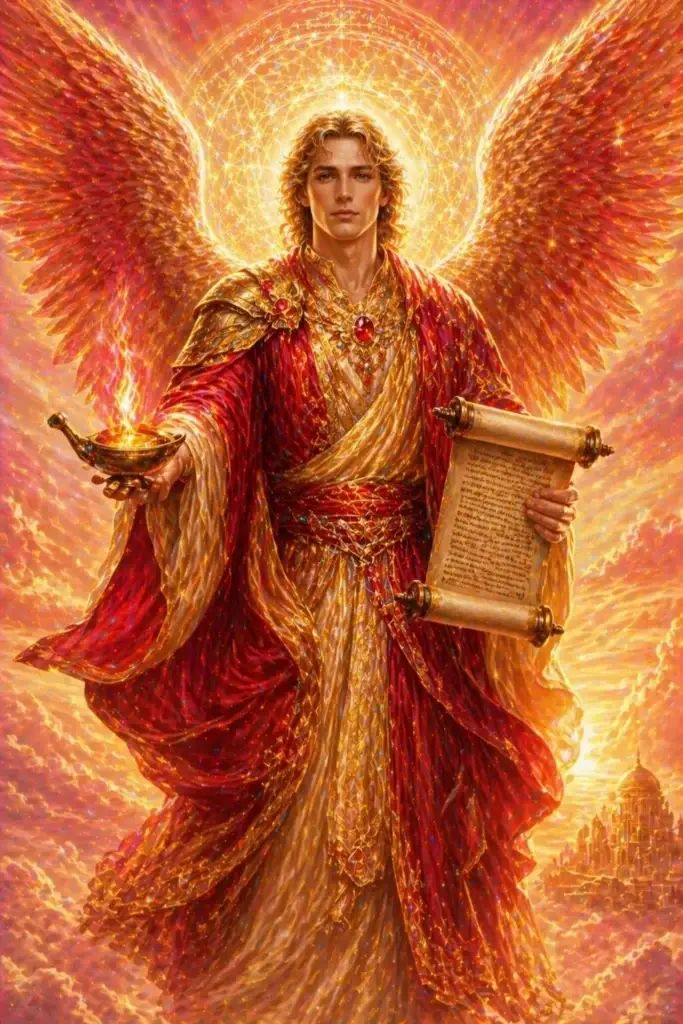
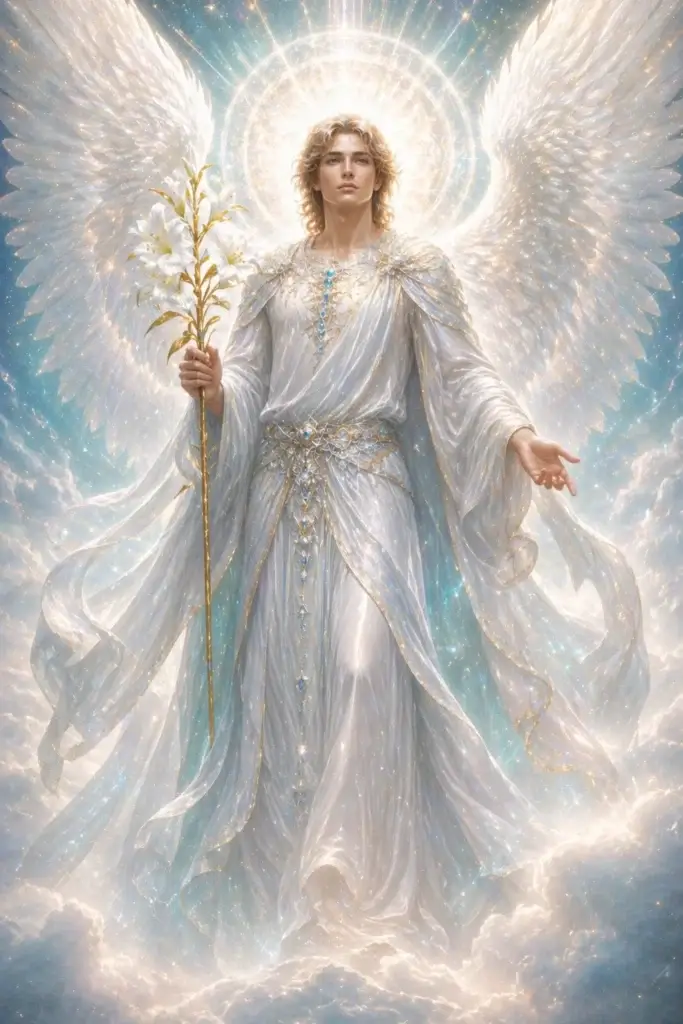
Art usually shows Raphael as a youthful wanderer leading the young Tobias by the hand, often with a fish and a dog. He carries a pilgrim’s staff, a medicine vessel or a healing jug. Esoterically he appears as a youthful being of light in a green robe.
According to Catholic tradition Raphael is the patron saint of travellers, the sick, physicians and pharmacists. His feast day was 24 October and since 1969 has been moved to 29 September together with Michael and Gabriel. In iWell Guard one asks him for healing with a green candle.
His symbols are the pilgrim’s staff, the medicine vessel, the healing jug and the fish, as well as the staff of Asclepius, around which a serpent winds. His colour is emerald to jade green, partly interwoven with gold. Esoterically a green flame belongs to him.
Healer figures are Asclepius in Greek mythology, Imhotep in Egypt, Dhanvantari in Hinduism and White Buffalo Calf Woman in Indigenous North American spirituality. Within angelology Raphael stands alongside Michael and Gabriel.
Quick Overview: Archangel Raphael
Type: Archangel, healer, travel companion, and guide Tradition: Judaism (Book of Tobit), Christianity (angelology), Western esoteric traditions Function: healing, recovery, protection on journeys and spiritual paths Main attributes/symbols: green and jade-green flame, staff of Asclepius, pitcher, healing herbs Distribution: Jewish-Christian tradition, esoteric and shamanic healing practices
Classification
Tradition
Raphael (Rephael, “God heals”) appears prominently in the apocryphal Book of Tobit, where he heals the blind Tobias and protects him on a dangerous journey. He is named only in later biblical and apocryphal texts, but is a recognized archangel in the Jewish-Christian tradition.
The Kabbalah assigns Raphael to the Sephira Tiferet (sun/heart), the place of healing and wholeness. Western angelology venerated Raphael as a healer and guide, especially of the traveler and the seeker. In Theosophy, Raphael is connected with the solar plexus region and emotional healing.
State of the Sources
The principal source is the Book of Tobit (Old Testament, apocryphal), chapters 3-13. The Talmud and medieval kabbalistic writings expand Raphael’s role. Christian artistic tradition often depicted Raphael with a staff or healing pitcher.
Modern esoteric literature emphasizes Raphael’s role in holistic healing and spiritual guidance. Shamanic and natural healing practices integrate Raphael as the patron of the healing arts.
The Book of Tobit as Principal Source
Archangel Raphael is the only archangel figure whose principal biblical source is an independent narrative work: the deuterocanonical Book of Tobit (probably 3rd to 2nd century BC).
Raphael accompanies the young Tobias on a journey from Nineveh to Ecbatana, protects him from the demon Asmodeus, and in the end heals the blind father Tobit. The name Refa’el means literally God heals.
In 1 Enoch (20:3) he is described as the angel over the spirits of humankind; in later rabbinic and Christian tradition he becomes the archangel of healing and of travelers. Liturgical veneration knows his feast day on the 24th of October, since 1969 placed together with Michael and Gabriel on the 29th of September.
Appearance and Symbols
Raphael is depicted as a well-proportioned, youthful being of light in green or jade-green robes. His color is deep emerald green or delicate healing green, sometimes interwoven with gold. He carries the staff of Asclepius (the serpent around the staff), a healing pitcher, or restorative water.
Wings of gentle green light surround him. In Renaissance painting he is often shown as a youthful angel with a traveling staff and a companion. Energetically, Raphael acts warm, calming, and regenerating, like the scent of healing herbs or warm green light on wounds. His presence creates trust and security.
Function and Meaning
Raphael heals on all levels: physical, emotional, mental, and spiritual. He is a physician and at the same time a guide; he protects the seeker on dangerous or unknown paths.
Raphael symbolizes the inner wisdom that knows how to heal and activates the inner physician. In psychological terms, Raphael embodies the healing self and the capacity for regeneration. His green energy opens the heart chakra and connects with the nature intelligence that guides all healing.
Healing Function in Esotericism
In Jewish angel magic, Raphael is the angel of the eastern direction and of the sphere Tiphareth (in some kabbalistic schools) or Hod (in others). In the ritual-magical tradition of the Golden Dawn he is the archangel of the East and of air.
In modern New Age angel teaching (Doreen Virtue, Diana Cooper) he is the central figure of invocation for health concerns, often associated with a green ray. This variability of assignment is characteristic in the history of religion: angel assignments to the four cardinal directions vary according to tradition and source.
Practice / Invocation / Meaning in the iWell Guard Context
In iWell Guard, Raphael is invoked to heal physical and energetic wounds and to promote inner recovery. One practice is to light a green candle and ask Raphael to bring healing on all levels.
Raphael’s green energy is visualized in order to repair damaged energetic structures and to regenerate the field of protection. Raphael is especially important for people who experience trauma or energetic injuries. His power eases pain without suppressing it and brings about true recovery. He also protects on inner spiritual journeys and transitions.
iWell Guard Position
In the iWell Guard field of protection, Raphael is not explicitly named in any single mantra clause, but is implicitly present as one of the four archangels. The light-cross geometry and the invocation of the positive beings (point 8 of the mantra) include Raphael as the healer archangel.
Whoever wishes to work actively with Raphael in the protection practice can integrate him as an eastern protective power into an expanded light-cross visualization (Michael south, Gabriel west, Raphael east, Uriel north). This four-archangel constellation has been a standard of Western ritual magic since the Golden Dawn tradition.
Parallels
The Book of Tobit: Raphael as the Hidden Companion
Raphael is connected in biblical tradition almost exclusively with a single book, the Book of Tobit. This book belongs in the Catholic and Orthodox tradition to the biblical canon, while in the Jewish and Protestant tradition it counts among the apocrypha, or the deuterocanonical writings.
It probably originated in the third or second century before our era and tells an artfully constructed family story.
At the center stand the pious, blinded Tobit and his kinswoman Sara, who is afflicted by a demon named Asmodeus, who causes each of her husbands to perish on the wedding night. Tobit’s son Tobias sets out on a journey to collect money and takes on a companion who passes himself off as a relative.
In truth this companion is the angel Raphael, who long conceals his true nature. He guides Tobias, helps him to catch a fish whose entrails become remedies, makes possible the marriage with Sara, and drives away the demon. In the end, the remedy from the fish also heals Tobit’s eyes.
Only toward the close does Raphael make himself known. He explains that he is one of the angels who stand before God and was sent to bring the prayers of the pious before God.
Thus Raphael is the only angel whose name appears as an acting figure across several chapters in a continuous narrative text of biblical tradition. The Book of Tobit is therefore of decisive importance for understanding this figure.
The Name as a Program: Raphael, the Healer
The name Raphael is of Hebrew origin and contains the root for to heal as well as the divine element el. It can be rendered as God heals or God has healed.
In the Book of Tobit this meaning of the name is no coincidence, but is fulfilled through the course of the action: Raphael is the one through whose working both Sara’s affliction by the demon and Tobit’s blindness are ended.
Later Jewish and Christian tradition firmly developed this connection of name and function. In Jewish texts of the post-biblical period, for example in the Enoch writings, Raphael appears among the leading angels, and responsibility for healing is repeatedly attributed to him.
In Christian tradition, Raphael became the angel of healing, of travelers, and of the encounter of illness and recovery. This assignment rests entirely on the Book of Tobit, in which all three themes, healing, journey, and protection on the way, are closely interwoven.
It is notable that the Book of Tobit does not present healing as a magical act, but places it within a framework of prayer, piety, and divine mission. Raphael acts on commission and brings, as he himself says, the prayers before God.
The remedies from the fish are means in his hand, not independent magical agents. Religious studies sees in this an example of how popular notions of healing and theological reflection are brought together in one text.
Raphael in Art, Patronage, and Popular Piety
From the narrative of the Book of Tobit a distinct pictorial theme developed, which appears above all frequently in the painting of the Renaissance and the Baroque.
Usually depicted is Raphael leading the young Tobias by the hand, often with a fish and a dog that the text mentions. These depictions, known in Italian art as Tobias and the angel, were especially popular and were in part commissioned as protective images for young people traveling.
In the Catholic tradition, Raphael is regarded as the patron saint of travelers, of the sick, and of physicians, and besides these also of apothecaries and in some regions of emigrants.
These patronages follow logically from his role in the Book of Tobit. A distinct memorial day united him liturgically with the other archangels known by name, Michael and Gabriel.
In popular piety, Raphael long remained less prominent than Michael, who possessed a strong pictorial tradition as dragon-slayer and weigher of souls, or Gabriel, who was firmly anchored in art through the Annunciation to Mary.
Nonetheless, Raphael has retained a fixed place through the connection with healing, protection on journeys, and the familiar narrative of Tobias.
In modern reception he appears occasionally in literature and the visual arts, yet the emphasis still lies on the biblical narrative, which shaped the entire later image of this figure. Within angel teaching, Raphael stands alongside Michael and Archangel Gabriel.
Frequently Asked Questions about Archangel Raphael
Who is Archangel Raphael?
Raphael (Hebrew Rafa-el, God heals) is the healer archangel of the Jewish-Christian tradition. In the deuterocanonical Book of Tobit he accompanies the young Tobias on the journey and heals his blind father.
Raphael is regarded as the patron of travelers, apothecaries, physicians, nurses, and pilgrims. In the Christian angelic hierarchy he is one of the three archangels named by name.
What are Raphael’s symbols and correspondences?
Classic Raphael symbols are the pilgrim‘s staff, the fish (from the Tobit story), the apothecary’s jar with healing herbs, and the traveling cloak. In modern esoteric angel teaching, Raphael is associated with the color green, the element air, the East, and the healing ray. Healing invocations of Raphael are found in many Christian-mystical prayer books.