Apotropaic Incised Marks: Protective Marks on Buildings in Folk Magic
By Ralf Ittermann · last reviewed on
Apotropaic incised marks are signs cut into wood or stone that were placed on buildings to ward off harm. They include the pentagram (Drudenfuss), the sun wheel and interlocking line patterns, which scholars refer to as ritual marks.
They are found especially on door beams, window lintels and near hearths. In folklore terms they belong to the building protection of early modern folk magic. This article presents the forms, distribution and interpretation of these protective marks.
Classification
Apotropaic incised marks are a subgroup of the building-bound protective symbols. The term apotropaic derives from the Greek word for warding off and denotes anything meant to keep harm at a distance. Unlike painted signs, the incised marks were cut into the material and are thus firmly bound to the structure.
In English-language research, the terms apotropaic marks and ritual protection marks have become established for these signs. In the German-speaking world people speak of protective marks, banishing marks or witch marks. A uniform terminology is lacking, since research has only become systematic in recent times.
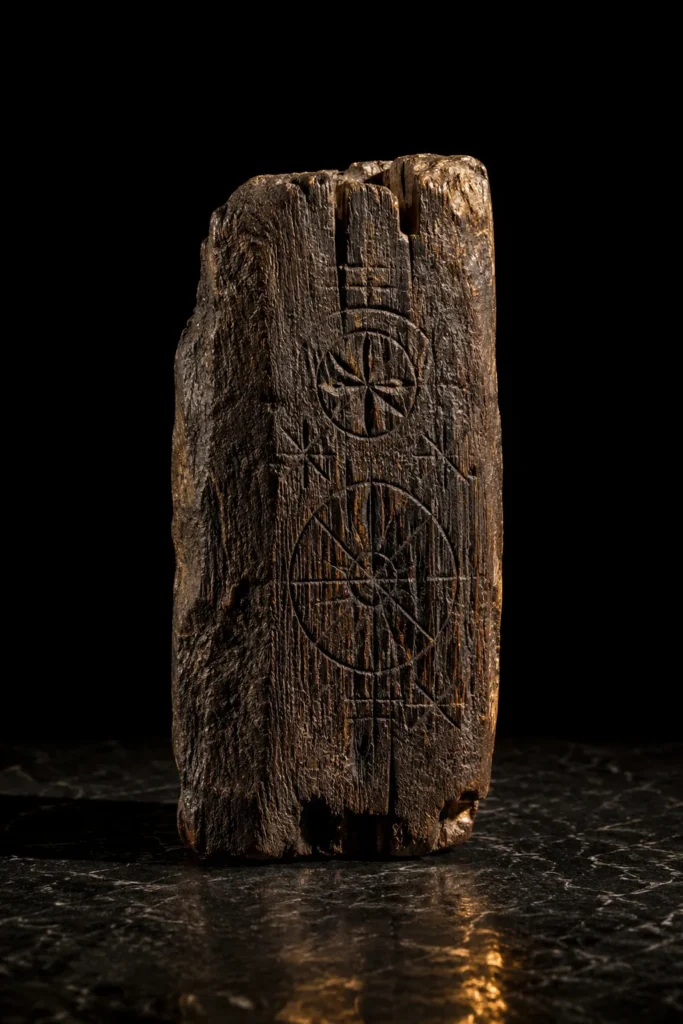
Among the most common forms are the five-pointed pentagram, six-rayed star rosettes, the sun wheel and interlaced line patterns. To these are added individual letters, above all the interlocked VV as a Marian mark, as well as crosses and grid-like patterns.
The signs are preferably placed at vulnerable points of the building. These include doors, windows, hearths and roof beams, that is, all the openings through which, according to folk belief, harmful things could enter. This placement is a central feature of building protection.
Incised marks are more durable than painted symbols and often become part of the very fabric of the building. Some were applied while the building was being erected, others were added later as needed.
It should be emphasized that the protective effect of these signs describes a historical belief. The incised marks are cultural-historical testimonies, not effective protective devices in the scientific sense.
Origin and History
The roots of apotropaic sign-making reach far back. Even ancient and medieval buildings bear signs to which a warding function is attributed. Research is cautious here, however, since not every old sign can be reliably interpreted as a protective mark.
A dense tradition begins in the late Middle Ages and especially in the early modern period. From the 15th to the 18th century, belief in harmful magic and witchcraft was widespread in Europe. During this time, building protection marks gained a firm place in popular piety.
English research projects have recorded numerous datable incised marks in churches, farmhouses and barns. The findings cluster in the 16th and 17th centuries, that is, the main period of the witch trials. This chronological connection is considered revealing.
In the German-speaking world, incised marks are known from Alpine farmhouse construction, from Franconia, the Black Forest and northern Germany. They are found on door beams, posts and stable doors. Here too the emphasis lies in the early modern period.
With the Enlightenment and the decline of witch belief, the incised marks lost their function. In the 19th century they were still occasionally applied out of habit, but the original understanding faded. Many signs remained preserved in the building, unnoticed.
The history of the incised marks is thus closely bound up with the history of fear and the need for explanation. They had their heyday when misfortune seemed to have an identifiable author.
Dated signs, into which the builder also carved a year, are especially informative. Such inscriptions allow research to assign individual signs to a particular construction phase and to narrow down the spread of the custom in time.
In English churches such as the one at Bradford-on-Avon, double-V signs have survived alongside dates from the 16th century, confirming the emphasis on the early modern period.
Form, Material and Manufacture
Incised marks were cut predominantly into wood, more rarely into stone, plaster or clay. The material depended on the building style of the respective region. In timber construction, incised beams predominate; in stone construction, signs carved into door lintels and window reveals.
The pentagram (Drudenfuss) is one of the best-known signs. It consists of a five-pointed star drawn in a single continuous line. Related is the pentagram, which in folk magic also served as a banishing sign and was in part equated with the Drudenfuss.
Six-rayed star rosettes, constructed with a compass, are common. They arise from a circle into which six equal arcs are struck, producing a flower-shaped pattern. These rosettes are at the same time regarded as sun signs.
The interlocked double-V was regarded as an abbreviation of the Latin Marian invocation Virgo Virginum, that is, Virgin of Virgins. It combines Christian piety with the folk-magical idea of protection and is especially common in English churches.
A group of their own is formed by the labyrinth-like line patterns, which research interprets as witch traps. According to this interpretation, the interlaced lines were meant to hold the harmful power and prevent it from entering.
The signs were made with a knife, a chisel or a compass. The execution ranges from hasty scribbles to carefully constructed patterns. Effort and quality, however, say nothing about the effect attributed to them.
Folklore Background and Beliefs
The incised marks are based on the idea that harm was conceived of as an acting power. Witches, night-hags and evil spirits were regarded as beings that could enter the house and cause damage. The signs were meant to deny them entry.
A widespread belief held that harmful beings had to follow a continuous line. The pentagram, drawn in a single stroke, was meant to force them onto an endless path or to prevent them from crossing the threshold. Here lies the origin of the German term Drudenfuss as protection against the Drude, a female nightmare spirit.
The labyrinth-like patterns follow a similar logic. It was believed that a witch had to trace each line and each point of a pattern individually. Complicated patterns were thus meant to detain her until morning broke and she lost her power.
The sun wheel and star rosette were regarded as light signs. In folk belief, the light of the sun was the natural opposite of nocturnal haunting and harmful magic. A sun sign on the house was meant to bind this bright power permanently to the threshold.
The Christian signs such as the cross and the Marian abbreviation show the close interweaving of religion and folk magic. For the people of the early modern period, this connection was no contradiction. Names of saints and magical patterns complemented one another in the idea of protection.
Overall, the incised marks reflect a worldview in which the house was a permeable boundary against a threatening outside world. The signs symbolically marked and secured this boundary.
A special position was held by the signs on the cradle and the bed of the lying-in chamber. Mother and newborn child were regarded as especially endangered, because according to belief the nightmare spirit and the witch threatened precisely the unbaptized child.
Incised pentagrams on bedposts and cradle rockers were meant to bridge this vulnerable phase until baptism established lasting protection.
Use and Custom
Incised marks were placed at precisely determined spots. Door frames, door lintels and thresholds were the most important locations, since the door was regarded as the main passage between the protected interior and the dangerous outside world.
Windows too received signs, above all on the lintel and reveal. Windows were openings through which, according to belief, the nightmare spirit or the witch could enter. The area around the hearth was secured with particular care, since the smoke outlet was a further possible point of entry.
In rural areas, stables and barns were also provided with incised marks. The protection of livestock was of great importance, since cattle diseases were frequently interpreted as the result of harmful magic. Stable doors and feeding troughs therefore often bear corresponding signs.
The application took place partly during construction, partly on a specific occasion. When illness, misfortune or a suspicious event occurred, signs could be added afterwards. Signs incised one over another on a beam point to such repeated measures.
The execution usually lay in the hands of the inhabitants themselves or of a carpenter. No special consecration was required. The knowledge of the right signs was passed on orally and through imitation.
Accompanying sayings or prayers are recorded, but not attested for every case. In many regions the mere application of the sign sufficed. The custom was thus low-threshold and feasible for any household.
Striking is the concentration of incised marks around chimneys and fireplaces. English researchers have observed that the signs often sit precisely where the chimney created an open connection to the outside.
The chimney was regarded as an entry route for harmful powers, which is why the lintel and cheeks of the fireplace were provided especially densely with fire-protection and warding signs. This observation supports the interpretation of the signs as deliberate threshold protection.
Regional Variants and Related Forms
The character of the incised marks differs greatly according to region and building tradition. In England, churches and timber-framed buildings are richly provided with incised signs, especially with double-V and witch-trap patterns. English research projects have documented a dense tradition here.
In the Alpine region, farmhouses bear carved sun wheels and rosettes on door beams and gables. These combine the warding idea with decorative woodcarving. The transition between ornament and protective sign is fluid here.
In northern Germany and Scandinavia, incised signs are found on stable doors and house beams, often in combination with rune-like forms. The interpretation of such signs is disputed in research, since not every line counts reliably as a protective mark.
Closely related are the painted protective signs, such as the hex signs of the Pennsylvania Dutch. They take up the same star rosettes but render them in color rather than as an incision. With this, the incised mark connects to a broader family of building protection symbols.
Related, too, are the objects placed in walls and thresholds, such as concealed shoes or the witch bottle. They pursue the same purpose by other means and often supplemented the incised signs on the same structure.
Despite regional diversity, a common pattern emerges. Everywhere the signs sit at openings, everywhere they combine light, star and line motifs, and everywhere Christian and magical ideas are interwoven.
In Scandinavia, incised signs survive on stave churches and old farmsteads, partly combined with runes and partly with crosses. Norwegian and Swedish building researchers document such marks on door frames and storehouses.
The combination of rune-like forms and Christian signs points to the same interweaving of older and ecclesiastical tradition that can also be observed in the rest of Europe.
Significance as a Means of Protection
The protective significance of the incised marks lies in their function as a boundary marker. They marked the threshold of the house as a secured area and were meant to signal to harmful powers that no entry would be granted here.
The individual types of sign had differently conceived effects. The sun wheel bound the bright power of light to the house, the pentagram blocked the continuous line, the labyrinth pattern bound the witch in its windings.
Durability played an important role. Since the signs were cut into the material, according to belief they worked constantly and independently of the presence of the inhabitants. They were a lasting, building-bound protection.
The Christian signs combined magical protection with divine assistance. The Marian abbreviation and the cross invoked holy powers whose support was meant to secure the house additionally. This double safeguard increased confidence in the signs.
For the inhabitants, the protective function also had a reassuring effect. The visible sign on the door gave the feeling of having done something against the invisible threat. Research has highlighted this function of providing certainty.
Once again it should be noted that this protective significance reflects historical beliefs. No real warding of harm is associated with the incised marks. Their value lies in their cultural-historical significance.
Sources and History of Research
The most important source for the incised marks is the physical evidence itself, that is, the signs preserved on buildings. They are scattered across Europe and have only been systematically recorded and documented in recent times.
For a long time, incised signs were misinterpreted as meaningless scribbles, craftsmen’s marks or masons’ marks. Only the connection with folklore research on witch belief made it possible to classify them as protective marks.
In England, a large-scale research project has recorded numerous incised marks in churches and historic buildings and made them accessible to the public. This undertaking has markedly raised attention to the subject.
For the German-speaking world, the Concise Dictionary of German Superstition offers entries on the pentagram (Drudenfuss), banishing marks and house marks. It places the incised signs in the larger context of warding magic.
A methodological difficulty lies in the distinction. Not every sign on an old building is a protective mark. Craftsmen’s marks, measuring marks and pure ornament must be carefully distinguished, which presents research with considerable challenges.
The history of research shows a clear change. From an overlooked detail, the incised marks have become a recognized object of building research and folklore studies, allowing statements about the everyday life and worldview of past centuries.
Reception Today
In heritage conservation, apotropaic incised marks are gaining increasing attention. In the restoration of historic buildings they are now deliberately sought out, documented and preserved, rather than reworked unnoticed.
For museums and historic sites, the signs are a vivid means of conveying the everyday life and worldview of the early modern period. Guided tours point visitors specifically to incised signs on beams and door lintels.
In modern esotericism, the pentagram, sun wheel and star rosette are taken up as protective signs. They appear on pendants, door signs and decorative objects. This modern use is to be separated from historical practice.
In local heritage care and regional customs, too, the signs live on. Carved sun wheels on new houses deliberately tie in with the old tradition, though mostly as ornament and an avowal of regional identity.
Those interested in the historical background will find reliable information in folklore accounts and in the topic overview of the protective symbols. Esoteric guides often render the historical context only in abbreviated form.
Reception today thus shows two strands. Research opens up the signs as historical testimonies, while popular culture reuses them as ornamental and symbolic motifs.
Literature (Selection)
Related key terms: pentagram (Drudenfuss) sun wheel protective mark witch mark banishing mark star rosette building protection apotropaic Marian mark witch trap door beam.
iWell Guard and Protective Traditions
iWell Guard stands in the cultural-historical line of portable protective objects to which the incised marks also belong. A modern companion for people who live with protective symbols: made in Germany, 41 layers of solid gold, platinum and silver, with a 30-day right of return.
Personal experiences may vary. Not a medical device. No healing promise.