Ammit, demoness of the Egyptian tradition
By Ralf Ittermann · last reviewed on
The Devourer, guardian of the judgment of the dead.
Ammit is a demoness of the Egyptian tradition and the devourer of hearts that fail the judgment of the dead.
Ammit
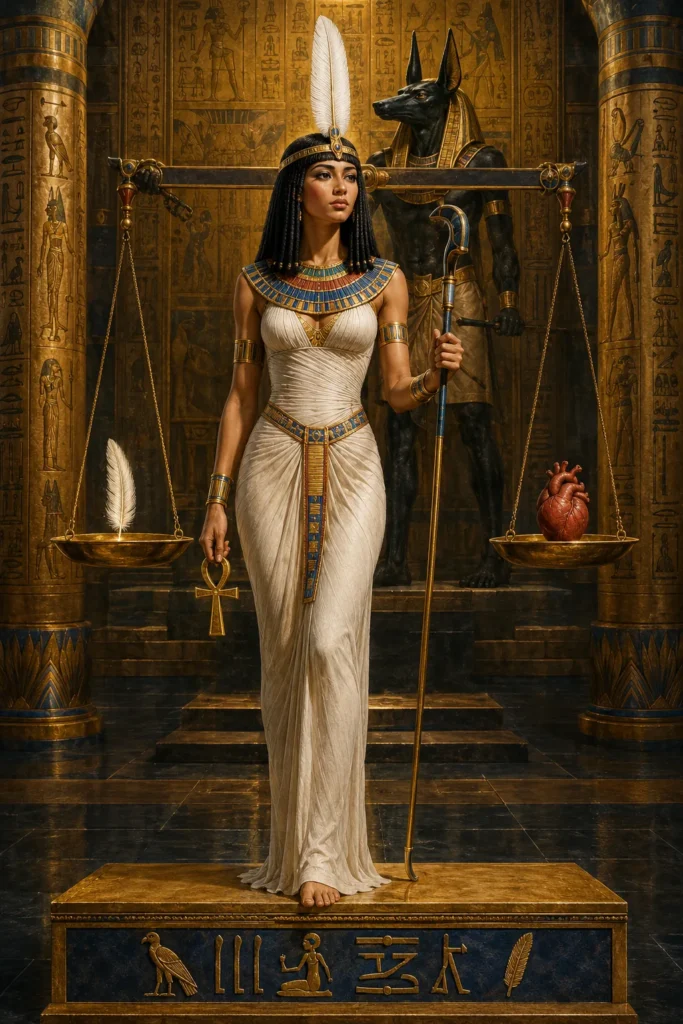
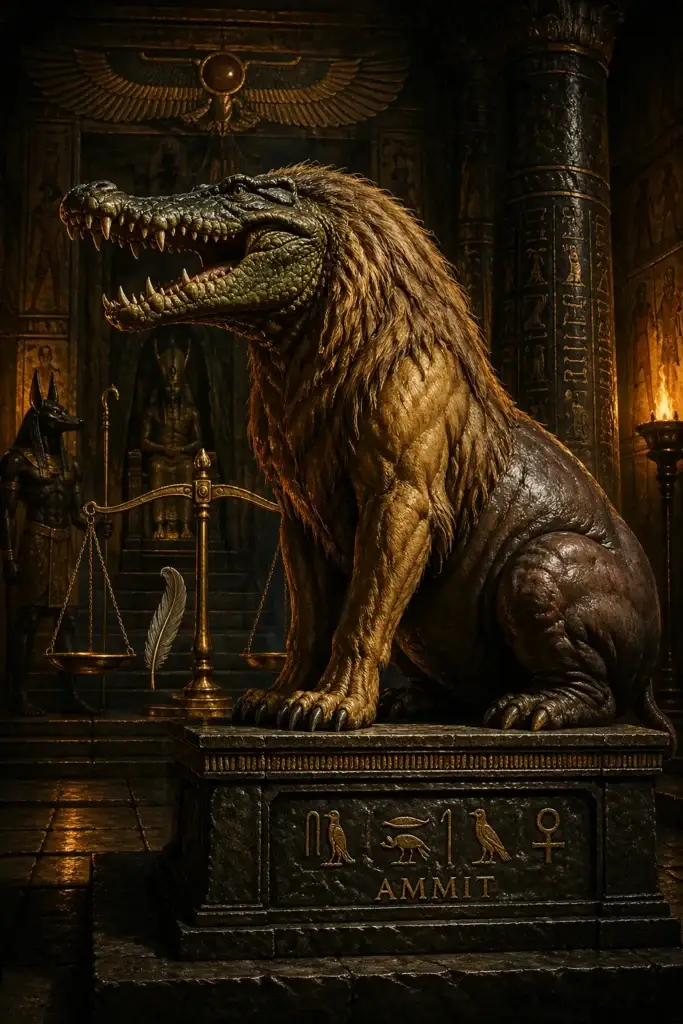
Ammit, “the Devourer,” is one of the most distinctive figures in Egyptian concepts of the afterlife. She sits in the Hall of Two Truths beside the scales on which the heart of the deceased is weighed against the feather of Maat.
If the heart is heavier, meaning it has committed wrongdoing, Ammit devours it. The result is not eternal suffering but annihilation: the dead person ceases to exist.
Her form as a composite creature made up of the three most dangerous animals of Egypt, the crocodile, the lion, and the hippopotamus, is conceptually deliberate. Each of these animals is formidable on its own; together they embody the absolute end of life after death.
At a Glance: Ammit
Type: Judgment-of-the-dead demoness, devourer
Origin: Underworld, near Osiris and Anubis
Texts: Book of the Dead (especially Chapter 125), iconographic scenes of the heart scales
Period: New Kingdom to Late Antiquity
Distribution: The entire Egyptian cultural sphere
Warding off: 42 negative confessions (Maat declaration), heart amulets
Historical Context
Period of the Texts
Ammit appears in fully developed form in the sources of the New Kingdom, especially in the richly illustrated Books of the Dead.
In the Late Period and Ptolemaic era, her image becomes a standard element of afterlife iconography. Earlier precursors can be reconstructed from the Coffin Texts, though she does not yet appear there by name in her full form.
Area of Distribution
The heart-scales scene featuring Ammit belongs to the standard decorative program of private burials throughout the entire Nile Valley. It appears on papyri, coffins, tomb walls, and mummy wrappings. In the Greco-Roman period the motif also spread to expatriate communities, but remained essentially Egyptian in character.
State of the Sources
The central source is the Book of the Dead, in particular Chapter 125 with its judgment-of-the-dead scene. The most detailed iconographic tradition comes from the 18th to 21st Dynasties. Temple reliefs and late-period papyri add further variants of the motif.
Name
Egyptian: Ꜥmm.t (“the Devourer”); the name is programmatic: it describes not her appearance but her function.
Alternative spellings: Ammut, Amemet.
Greek: no separate term; usually adopted as Ammit.
Ammit is not a goddess in the strict sense; she has no cult, no temple, and no worshippers. She appears exclusively in the context of the judgment of the dead. Her role is strictly functional: she is the instrument of Maat, not a negotiating figure in her own right.
Characteristics
Appearance
Ammit is a hybrid being composed of the three most dangerous animals of Egypt: the head of a crocodile, the forequarters of a lion (mane, paws), and the hindquarters of a hippopotamus. The combination is not coincidental; each of these animals kills humans along the Nile. Together they form an image of total annihilation.
Behaviour
She sits or crouches beside the scales while Thoth records the verdict and Anubis operates the balance. She waits passively, but lunges the moment the heart is heavier than the feather. There is no pleading, no appeal; the verdict is carried out.
Sphere of Influence
Exclusively the judgment of the dead in the Hall of Two Truths. She has no access to the living and no agency outside the hall. Her action is bound to the ritual moment of the heart scales.
Mythological Origin
Ammit emerges with the rise of the Osirian belief in the afterlife and the systematised heart scales. Her function, the annihilation of the unworthy dead, is not an add-on invention but the logical consequence of an afterlife theology in which continued existence is tied to a moral examination.
Profile: Ammit
The most important aspects of Ammit at a glance. Detailed discussion of her name, description, means of protection, and parallels can be found in the following sections.
From the afterlife theology of the New Kingdom; no independent cult. She stands beside Osiris and Anubis as their executrix.
Exclusively the dead undergoing the judgment. She has no access to the living and exerts no influence outside the Hall of Two Truths.
Composite creature: crocodile head, lion forequarters with mane and paws, hippopotamus hindquarters. Three predators that kill humans along the Nile, combined in one form.
Devours the hearts of the unworthy dead. There is no suffering; annihilation follows: the dead person no longer continues to exist.
Not a matter of warding off Ammit, but of living rightly before death. The ritual centrepiece: the 42 negative confessions in Book of the Dead Chapter 125. In addition, heart amulets that stabilise the organ.
Hell-beings as soul-devourers (Christian and Islamic iconography), Hindu Yamadutas, Aztec Tzitzimimeh; the concept of the “hellmouth” in the European Middle Ages.
Everyday Protective Measures
Protective Rituals
Ammit herself is not warded off; she acts as Maat dictates. The “protection” consists in proper preparation for the judgment of the dead: burial rites, embalming, inclusion of the Book of the Dead, and the symbolic purification of the body.
Incantations
Central is the so-called Maat Declaration in Chapter 125 of the Book of the Dead: 42 negative confessions in which the deceased declares which wrongdoings he or she has not committed. Each statement is addressed to one of the 42 judges. Only after passing this examination does the heart-scales scene with Ammit come into play.
Amulets and Protective Symbols
The most important amulet is the heart amulet (ib) and the heart scarab bearing Book of the Dead Spell 30B, which instructs the heart not to testify against its owner. Both were placed with the corpse and are attested in many burial assemblages.
Ammit: Parallels in Other Cultures
Mediterranean world and afterlife: The heart-scales scene and its executrix migrate thematically into Gnostic-Christian thought. The Christian motif of “soul-weighing” (Michael with the scales, the devil as challenger) follows the Egyptian scheme structurally, even though Ammit herself is not adopted.
Hellmouth motif: In the European Middle Ages the motif of the “hellmouth” devours the damned. Visually it strongly recalls Ammit; a direct historical line has not been established, yet the underlying pattern is identical: the annihilation of the unworthy through devouring.
Outside Europe: Yamadutas in Hindu-Buddhist concepts of the afterlife and Tzitzimimeh in Aztec mythology are functionally related as executors of judgment, without Ammit’s specific composite-animal iconography.
The Judgment-of-the-Dead Scene in the Egyptian Book of the Dead
Ammit (also Ammut, Egyptian roughly am-mut, devourer of the dead) is inseparably linked to a single, clearly defined scene: the judgment of the dead as transmitted above all in the so-called Book of the Dead of the New Kingdom.
The central text is Spell 125 of this Book of the Dead, which describes the trial in the Hall of Two Truths.
In this scene the heart of the deceased is placed on a balance. On the other pan lies the feather of Maat, the goddess of truth and the just world order. The god Anubis conducts the weighing, the ibis-headed Thoth records the result, and Osiris presides as judge over the proceedings.
Ammit sits or crouches beside the scales and waits. If the heart does not correspond to the feather, meaning the deceased is not worthy of the declarations of purity, the heart is thrown to Ammit to devour.
The consequence of this devouring was, in Egyptian thought, the gravest imaginable punishment: complete and final death, the cessation of all existence, the so-called second death. Since continued life in the hereafter was the central goal of Egyptian religion, the loss of one’s heart to Ammit meant the destruction of the person.
Ammit is therefore not a punishing deity who torments but the instrument of obliteration. She embodies the threat that gave the entire system of funerary rituals, burial preparation, and moral conduct its meaning.
The Composite Being: Crocodile, Lion, and Hippopotamus
Ammit is depicted in the vignettes of the Book of the Dead as a composite creature made up of three animals, and this combination is not coincidental.
The head is that of a crocodile, the front part of the body that of a lion or leopard, and the rear that of a hippopotamus. All three animals were regarded in ancient Egypt as dangerous, as embodiments of a threat to human life.
This choice is illuminating from a history-of-religions perspective. The crocodile of the Nile, the lion of the desert margins, and the hippopotamus of the river were the three great predators that Egyptians feared. Ammit concentrates this fear in a single figure.
She is therefore an example of a deliberately constructed composite creature whose meaning derives from the sum of its components. Unlike some Egyptian gods who bear a fixed animal head, Ammit is entirely a composite that does not continue any single animal deity.
Ammit’s size in depictions is usually small. She is not a vast monster but often appears as a relatively small, crouching figure at the edge of the judgment scene.
This visual modesty stands in tension with her existential significance and points to the fact that her power lies not in physical size but in her function.
In some sources she is associated with a sphere of fire or a fiery lake in which the condemned perish. Her appearance is transmitted with remarkable consistency across the many surviving Book-of-the-Dead papyri and tomb paintings of the New Kingdom.
Ammit between Goddess and Demon: A Problem of Classification
Religious-studies scholarship has difficulty classifying Ammit, and for good reason. She does not fit neatly into any of the usual categories.
On the one hand, she has no independent cult: no temple, no priesthood, no festivals, and no prayers addressed to Ammit are known. No one venerated her; no one sought her favour. This argues against calling her a goddess in the full sense.
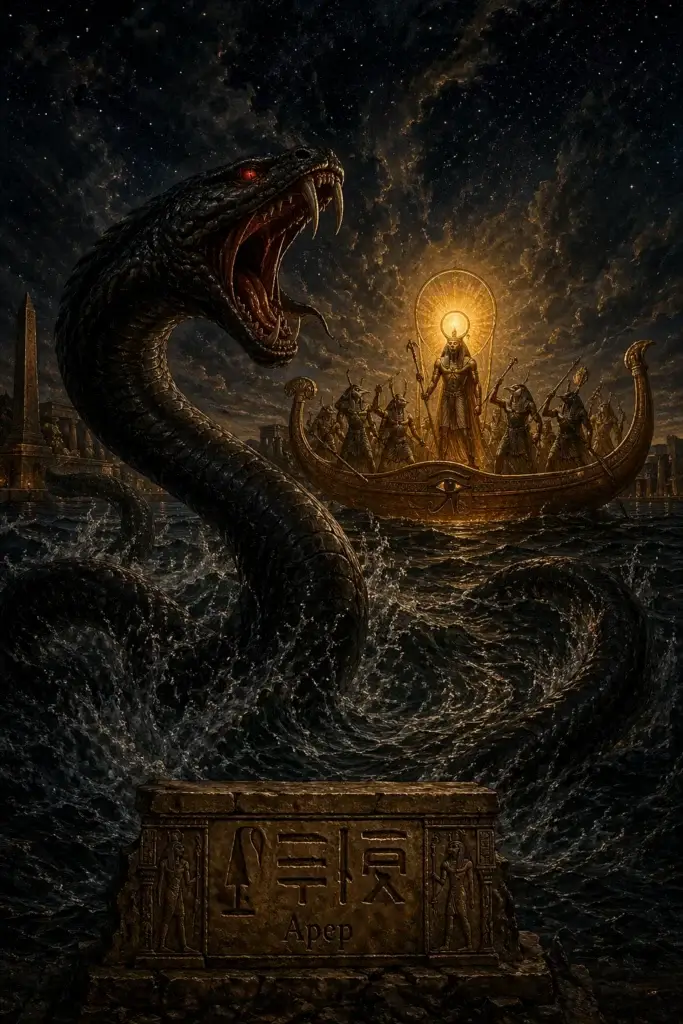
On the other hand, she is not a chaotic adversary of the divine order, as the serpent Apophis was, against whom the gods fought night after night. Ammit, on the contrary, stands on the side of order.
She is part of the tribunal of Maat and carries out its verdict. Without her the threat of the judgment of the dead would be empty. She functions within the system, not against it.
Scholarship therefore describes Ammit mostly as a kind of functional being or as a demonic figure in the service of order.
She belongs to those beings of the Egyptian imaginative world that have a clearly defined task and are wholly absorbed by it. Some Egyptologists point out that the sharp modern distinction between god and demon was in any case foreign to Egyptian thought, and that Ammit is evidence of this ambiguity.
Her existence also sheds light on the Egyptian understanding of punishment: the concern was not eternal torment but obliteration. This idea differs fundamentally from later concepts of hell and makes Ammit an important point of comparison for the religious history of the afterlife.
Further Links
Further reading:
- Egypt (parent culture page)
- Apophis (cosmic counterpart)
- The 42 Judges of Maat
- Osiris and the afterlife
Sources and Literature
Further standard works in the literature index.
The protective practice described here represents a religious-studies classification of historical traditions. iWell Guard draws on this cultural-historical line of wearable protective objects and offers a contemporary form of it. More about iWell Guard →
Frequently Asked Questions about Ammit
Who was Ammit in Egyptian mythology?
Ammit (also Ammut, “the Devourer”) was an Egyptian demoness who played a central role in the judgment of the dead. She was a composite creature with the head of a crocodile, the body of a lion, and the hindquarters of a hippopotamus, the three most dangerous animals of the Nile Valley.
After death, the heart of the deceased was weighed against the feather of Maat (truth, cosmic order). If the heart was heavier than the feather (that is, burdened with guilt), it was devoured by Ammit, which meant the final death of the soul.
What does the judgment of the dead mean in the Book of the Dead?
The judgment of the dead (psychostasia) is a central scene in the Egyptian Book of the Dead (Spell 125). The deceased appears before a tribunal of 42 judges with Osiris presiding. He or she must deliver the “negative confession,” listing the 42 transgressions that were not committed.
The heart is then weighed on the scales of Maat. If the examination was passed, the soul was admitted to the Field of Aaru (the Egyptian paradise); if not, Ammit devoured the heart and the soul was annihilated forever.