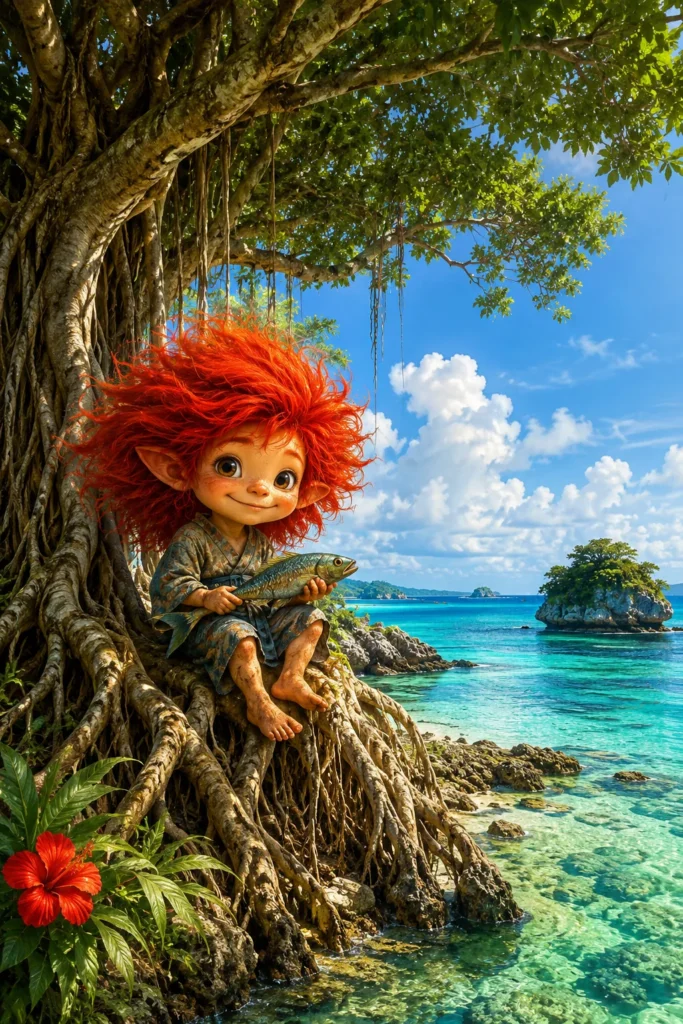
Household spirits such as Hob and Boggart, Black Dogs and will-o-the-wisps form the core stock of this English county folklore.
These Black Dogs and household spirits are still recorded today in regional collections from English counties.
This collecting work is the source of what is known about household and hearth spirits such as Hob and Boggart, as well as the numerous Black Dogs of England.
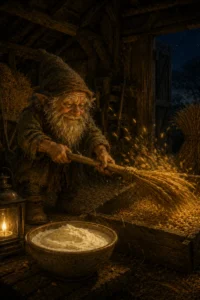
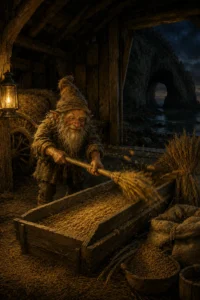
The Hob is a helper spirit bound to a house or farm that carries out tasks at night, provided it is treated with respect; according to tradition, if it is given clothing, it regards this as an insult and disappears. The closely related Hobgoblin and the Lob-lie-by-the-Fire, who lies by the hearth, share this motif of the invisible but well-meaning household spirit.
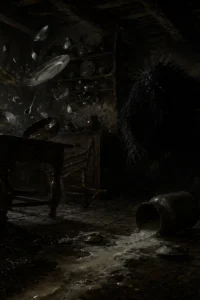
If such a spirit is disrespected or mocked, it can, according to the story, turn into the Boggart, an unpredictable, poltergeist-like apparition that moves furniture and causes noise; some Boggarts are also tied to particular places, such as the valley near Manchester known as Boggart Hole Clough.
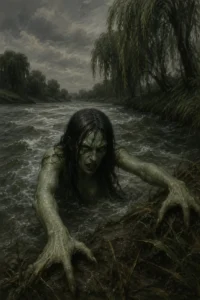
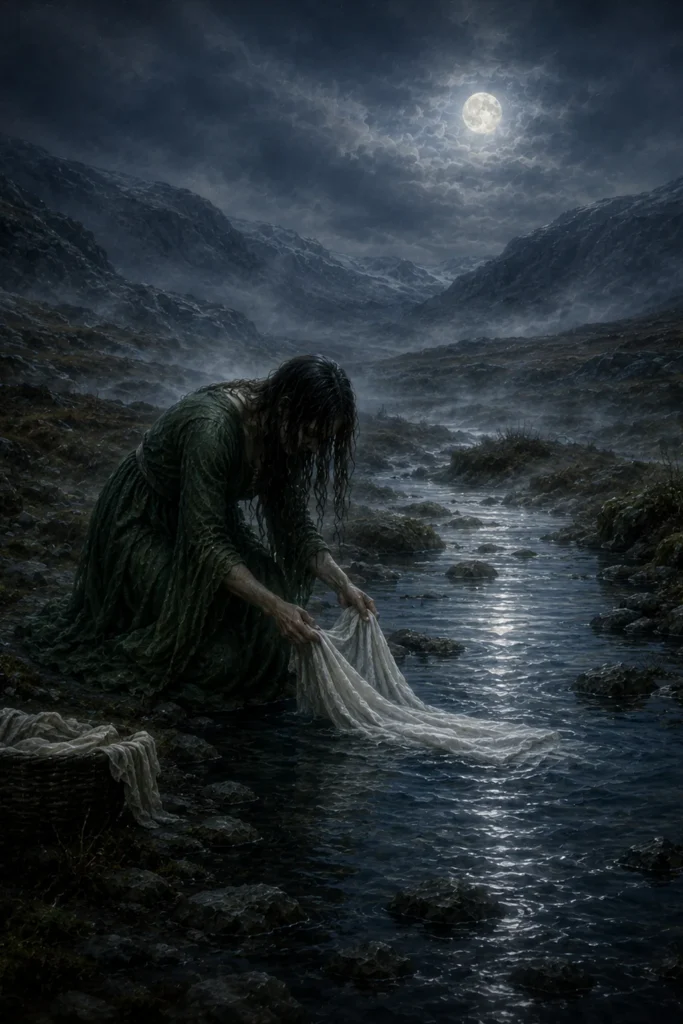
In many northern English counties, adults used water beings to warn children away from dangerous ponds and rivers. Jenny Greenteeth, named after the green duckweed cover of stagnant waters, and the similar Grindylow from Yorkshire and Lancashire, were said to pull careless children under the water.
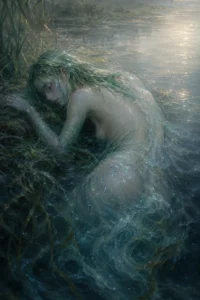
On the River Tees in County Durham, people told of Peg Powler, whose greenish river foam was known as ‘Peg Powler’s soap suds’. Gentler by nature is the Asrai, a shy water being that, according to Ruth Tongue’s tradition, dissolves in moonlight as soon as it is caught.
The folklorist Katharine Briggs distinguished in her standard works between solitary, lone beings such as the Hob and the Boggart, and the more group-orientated fairies of the neighbouring Scottish and Irish traditions, a distinction that can only be applied to a limited extent to English tradition, which is shaped more strongly by individual figures.
Within these individual figures, three functional types can be roughly distinguished: helper and household spirits such as Hob and the Lob-lie-by-the-Fire, warning figures such as the Black Dogs and will-o-the-wisps, and water spirits such as Jenny Greenteeth and Peg Powler, whose stories served above all to warn people away from dangerous places. This system is a later folkloristic ordering, not a category used by the storytellers themselves.
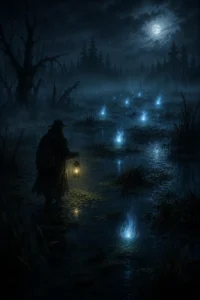
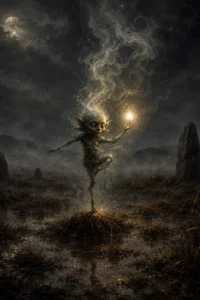
English counties have reported will-o’-the-wisps over moors and wetlands for centuries, lights said to lead travellers astray. The overarching name Will-o-the-Wisp stands alongside regional names such as the Hinkypunk known in Somerset and Devon, the Lantern Man of the East Anglian Fens, and the related Hobby Lantern from Suffolk and Norfolk.
In Cornwall, the motif merged with the figure of Joan the Wad, a being of light told of as a piskie queen who became a popular good-luck motif in the 20th century. Some regional collections also record further light names, such as Pyne, attested in a few sources.
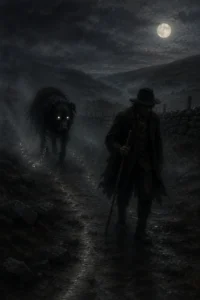
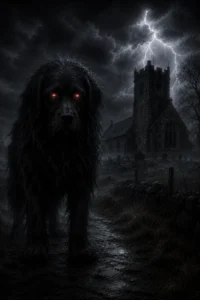
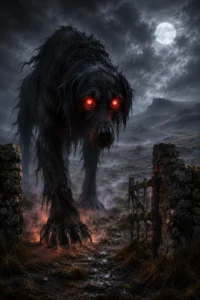
The best known black dog is probably Black Shuck of East Anglia, whose appearance was recorded in writing by Abraham Fleming in 1577 at the churches of Bungay and Blythburgh. In Yorkshire, the comparable being is called Barghest, and in Leeds Padfoot, whose name derives from its softly padding footsteps.
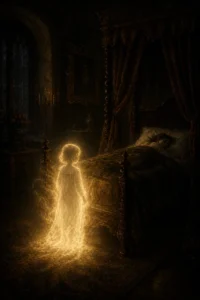
Related to this motif are the Gabriel Hounds, a pack of hounds heard in the night sky whose barking was regarded in northern English tradition as an omen of misfortune, and the glowing child figure known as the Radiant Boy from Cumbria, associated with Corby Castle.
Alongside household and water spirits, English folklore also includes place-bound spirit figures such as the Silkie of Black Heddon in Northumberland, a rustling, silk-clad apparition that shifts between spirit and fairy being. Such figures show how permeable the boundaries between household spirit, warning spirit and apparition of the dead were in oral tradition.
With the industrialisation and rural depopulation of the 19th century, many of these local narratives lost their practical frame of reference. The collections of Henderson, Briggs and Tongue preserved them before they disappeared entirely from oral transmission.
Unlike Norse or Greek mythology, England has no coherent, written-down pantheon. English folk tradition instead consisted of a multitude of local narratives that varied from county to county, sometimes even from village to village.
A household spirit called Hob in Yorkshire may appear under a different name in another county, with slightly different traits. The same holds for black dogs and will-o’-the-wisps, whose names and details change by region while the underlying narrative pattern remains constant.
This diversity makes any systematisation difficult. From a religious-studies and folkloristic perspective, it is more useful to describe recurring types of beings that were shaped differently by region than to search for a unified ‘English pantheon’.
Collectors of the 19th century faced exactly this challenge: they had to decide whether and how to order the countless local variants into overarching categories.
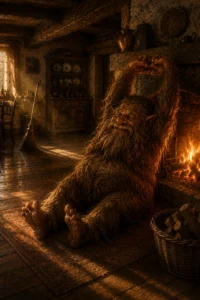
Among the most widespread figures in English folklore are household and hearth spirits bound to a particular place, usually a farm. The Hob was regarded as a diligent but shy helper who mucked out stables or threshed grain at night, provided the household treated him with respect and left a small offering, often milk or porridge, for him.
A recurring motif is the rule never to give the Hob clothing: anyone who did so lost their helper forever, according to the tale, since the Hob took the gift as notice terminating his service. This narrative structure appears, with variations, in numerous English counties.
If a household spirit was insulted or ignored, or if the household’s occupants changed, tradition holds that it could change character and become a troublesome or even threatening Boggart, smashing crockery, slamming doors, frightening animals. Some families are said to have left their homes to escape a Boggart, a motif repeated in several northern English legends.
From a religious-studies perspective, these narratives can be read as an expression of a household-spirit belief that symbolically negotiated order, diligence and mutual respect between humans and an invisible co-resident.

English folk tradition was passed on almost exclusively by word of mouth for centuries, often from older family members to children, in spinning rooms or by the fireside. Written records began comparatively late and remained scattered for a long time, appearing for instance in sermons that warned against ‘superstitious’ practices.
An early exception is the account of Black Shuck’s appearance at the churches of Bungay and Blythburgh, recorded in writing by the clergyman Abraham Fleming as early as 1577. The tradition was only recorded more systematically in the 19th century, when William Henderson presented one of the first major regional collections with his Notes on the Folk-Lore of the Northern Counties of England in 1866.
The Folklore Society, founded in 1878, further professionalised this collecting activity. In the 20th century, Katharine Briggs continued this work with her four-volume A Dictionary of British Folk-Tales and her A Dictionary of Fairies, as did Ruth Tongue with her Forgotten Folk-Tales of the English Counties, preserving numerous narratives that would otherwise have been lost.
These collections are themselves already interpretations: the collectors selected, arranged and smoothed out oral variants, which is why present-day research always distinguishes between the original oral diversity and its written fixation.
English folk tradition was closely tied to a rural, agrarian way of life: household spirits watched over farms, water spirits warned of dangerous ponds, will-o’-the-wisps warned of moors. With the industrialisation of the 18th and 19th centuries and the accompanying rural depopulation, this way of life lost its former significance.
Urban life, the railway and later electric light caused many of the old cautionary tales to lose their practical purpose, a process to which the spread of schooling and scientific explanation also contributed. In many regions, the narratives were consequently forgotten, just in time before the collectors of the 19th century recorded them.
In the 20th century, folklorists such as Katharine Briggs and Ruth Tongue devoted themselves specifically to rescuing oral traditions that were still alive but endangered, often speaking with the last remaining bearers of this knowledge in remote areas.
Today, these figures survive mainly in written form, in collected works, place names and touristic marketing, as in the case of Joan the Wad. One can no longer speak of a lived religious practice in the original sense, but rather of a preserved cultural memory.


The English tradition of household and hearth spirits links Hob, Boggart and Lob-lie-by-the-Fire in a distinct protective practice centred on hearth and farm, while the beings known as England’s black dogs, such as Black Shuck and Barghest, are regarded in county folklore as figures warning of misfortune.
Related key terms: Hob, Boggart, Black Shuck, Barghest, Padfoot, Will-o-the-Wisp, county, folklore, fen, moor.
English folklore knows iron as a traditional means of warding off boggarts and other spirit beings, horseshoes above the threshold, as well as bells and noise to drive away unwanted appearances; milk and bread offerings, conversely, served to placate benevolent household spirits such as the Hob. Such customs are documented in cultural history, not to be understood as a proven protective effect. An overview of protective forms across various cultures is offered by the Protection Compass.
iWell Guard fits into this cultural-historical line of portable protective objects, in contemporary material architecture, crafted in Germany. 41 layers, real gold, platinum, silver. 30-day right of return.
Personal experiences may vary. Not a medical device. No promise of healing.