Cross and Crucifix: the Central Protective Sign of Christianity
By Ralf Ittermann · last reviewed on
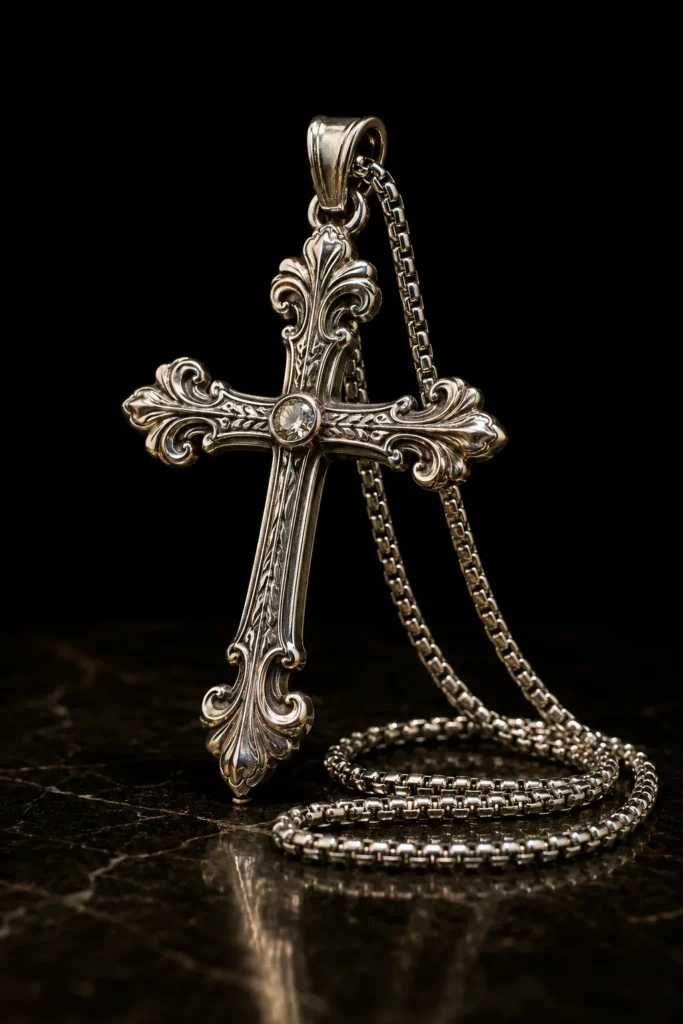
Cross and crucifix are the central objects of Christianity and among the most widely worn devotional items in the world. As a pendant and as a mark above the door, the cross has accompanied believers for many centuries. Yet cross and crucifix are not the same thing: the one is the bare form, the other bears the figure of Christ.
Classification
The cross is the most important emblem of Christianity. It points to the death of Jesus Christ on the cross and to the Christian conviction that this death was overcome. From this core derives the entire meaning of the object, including its protective role.
As a protective sign, the cross appears in many forms. It is worn on the body as a pendant, performed as a gesture, placed above doors and on walls, and used in numerous acts of blessing. In all these forms it stands for turning toward Christ and for trust in his support.
From the perspective of religious studies, the cross is an example of a sign whose protective meaning arises from a content of faith.
According to the Christian understanding it does not protect as an object, but because it points to an event of salvation. It thus belongs to those protective signs that are closely bound to a doctrine.
The cross is at the same time the uniting and the distinguishing sign of the Christian denominations. All the major churches know and venerate it, yet they emphasize it differently.
The Catholic and the Orthodox tradition often depict the crucified one, while the churches that emerged from the Reformation mostly prefer the empty cross. This choice alone reveals which aspect of the salvation event is placed in the foreground in each case.
Cross and Crucifix: the Difference
In everyday usage the terms cross and crucifix are often used as if they meant the same thing, yet they denote different things. A cross is the pure form made of two intersecting beams. It remains empty and emphasizes the sign as such.
A crucifix, by contrast, shows the body of Christ on the cross, the so-called corpus. It depicts the event of the crucifixion pictorially and places the suffering and death of Jesus at the center. The crucifix is thus a devotional image, whereas the empty cross is a sign.
Both forms carry different emphases. The empty cross is often associated with the resurrection and the victory over death, since the crucified one has left the cross. The crucifix directs the gaze toward the sacrifice and the suffering shared with Christ. For the protective meaning, both forms are in use.
The Eastern churches know their own forms of the cross, such as the cross with two additional crossbeams, the lower of which is set at a slant.
The churches that emerged from the Reformation, in turn, prefer the empty cross, because they wish to emphasize the risen Christ who no longer hangs on the cross. The difference between cross and crucifix is therefore not only a question of depiction, but also an indication of differing theological accents.
From a Hidden Sign to a Public Symbol
In the first centuries the Christians used the cross with restraint. In a time of persecution, an openly worn sign was dangerous. Instead, early, coded forms appear, such as the Christ monogram made from the Greek initial letters of the name of Christ, or the so-called staurogram letter.
With the turning point under Emperor Constantine in the fourth century this changed fundamentally. Christianity was tolerated and later became the state religion, and the cross could now be shown publicly. From the hidden mark of recognition of a persecuted minority arose the visible symbol of a great religion.
From then on the cross spread into all areas of life. It appeared on churches, on coins, on implements and on garments. This public presence was the precondition for the cross also becoming a sign of personal and domestic protection.
Two famous traditions are connected with the turning point under Constantine. One reports a vision of the emperor before a battle, joined with the promise that under this sign he would conquer.
The other tells of the finding of the cross of Christ by Helena, the mother of the emperor. Both narratives contributed substantially to the cross becoming, from a hidden mark of recognition, the publicly celebrated sign of an entire epoch.
The Sign of the Cross as a Gesture
The cross is not only an object, but also a gesture. In making the sign of the cross, the believer moves the hand to the forehead, the chest and the shoulders, and so traces the cross over the body. This action is among the oldest and most widespread forms of Christian piety.
The sign of the cross accompanies prayer, worship and many moments of everyday life. It is performed on rising and on going to sleep, before a journey, in danger and in acts of blessing. In all these cases the person places himself under the sign of the cross.
It is precisely in this gesture that the protective meaning of the cross shows itself with particular clarity.
Making the sign of the cross is a brief action, possible at any moment, by which a person places himself and others under the protection of Christ. It connects the protective sign directly with the body and with the present moment.
The sign of the cross is very old. As early as around the year 200, the church writer Tertullian reports that the Christians marked themselves with the cross on many occasions of everyday life. The manner of execution later developed differently.
In the Latin church one moves the hand to the left and then to the right shoulder, in the Orthodox tradition the reverse, and the position of the fingers also carries a meaning of its own.
The Cross as a Protective Sign
From early on, a protective effect was attributed to the cross. It was placed above doors and on walls, set up along paths and hung over the cradle. In all these cases it marked a place or a person as placed under the protection of Christ.
In popular belief the cross was regarded as a means against harmful powers. It was meant to preserve the house, the livestock and the fields and to keep evil spirits at bay. These notions belonged to a broad popular piety that bound the cross into everyday life and into the care for farm and family.
Church teaching accompanied this use and at the same time admonished believers not to misunderstand the cross as a magical means. According to the Christian understanding the cross protects because it points to Christ, not because it possessed a power of its own, detached from him. Protection and faith belong together.
In the landscape of many regions shaped by Christianity the cross is omnipresent. Wayside and field crosses, shrines and summit crosses place whole stretches of land under the sign of Christ.
Such crosses marked paths, recalled events and were meant to protect fields and travelers. They show that the protective meaning of the cross was not limited to the worn pendant, but encompassed the entire living space.
The Crucifix and Its History as an Image
The depiction of the crucified one developed only gradually. In the first centuries Christ was scarcely shown on the cross itself. Only from the early Middle Ages did the crucifix with the corpus become a widespread pictorial form.
Over the course of the centuries the depiction changed. The early and high Middle Ages often showed Christ as calm and upright, as the victor over death. Later epochs emphasized the suffering more strongly and depicted the crucified one in his pain. This history of the image reflects changing emphases of piety.
As a protective sign the crucifix is widespread above all in the domestic sphere. The Lord’s corner, the corner of the room marked by a crucifix, was for a long time a fixed part of many homes. The crucifix visibly placed the living space and its inhabitants under the sign of Christ.
Among the earliest surviving monumental crucifixes is the Gero Cross in Cologne Cathedral, created in the tenth century. It shows impressively how early the depiction of the suffering Christ was worked out in large format.
In the Baroque period numerous artful devotional crucifixes were created for churches and homes. The household crucifix in the Lord’s corner thus became a fixed part of domestic piety over many centuries.
Forms of the Cross
The cross appears in many forms. The best known is the Latin cross with an extended lower beam. Alongside it stands the Greek cross with four arms of equal length, which is widespread above all in the Eastern church.
Further forms have acquired meanings of their own. The Tau cross in the shape of the letter T is associated with Saint Anthony and with Francis of Assisi.
The cross of Saint Peter, the Latin cross turned upside down, points to the tradition of the death of the apostle Peter. Regional forms such as the Celtic ring cross combine the cross with further signs.
This diversity shows that the cross is not a rigid sign. It was able to adapt to different traditions and in doing so took on additional meanings in each case. For the protective function most of these forms are in use, for what remains decisive is the reference to Christ.
Beyond religious use, the cross appears in countless further contexts, such as in heraldry, in the signs of religious orders and in the design of decorations. These manifold forms each have their own histories.
For the protective meaning, however, it remains decisive that all variants go back to the same basic sign and thus carry the same reference to Christ, however differently they may be designed in detail.
Theological Meaning: Victory, Not Magic
The Christian interpretation of the cross as a protective sign is grounded in a theological idea. The cross is the place of the death of Jesus, but in the Christian faith this death is not the last word. The resurrection reinterprets the cross, from a sign of defeat to a sign of victory over death.
From this reinterpretation the protective meaning arises. Whoever places himself under the cross places himself under the sign of the one who, according to Christian conviction, has overcome death. The protection that is hoped for is therefore not a magical effect, but an expression of faith in this overcoming.
The church has therefore always understood the cross as a sign of faith, not as an amulet. According to church teaching a cross does not work of itself.
It is effective as a sign that orients the person toward Christ and orders his trust. This view distinguishes the cross from the magical object of protection.
The early church fathers liked to interpret the cross as a tropaion, a sign of victory such as victorious armies erected after a battle won. In this interpretation the cross is the sign of a victory achieved, not of a defeat.
At the same time church teaching always warned against treating the cross like an object that works mechanically. Its protection is bound to faith and cannot be separated from it.
The Cross in Popular Belief and Today
In popular belief the cross has played a rich role beyond church teaching. Tales and customs attributed to it the power to ward off evil spirits, witches and harmful powers. In many legends and in popular culture the cross appears as a means against evil.
This popular layer is to be distinguished from church teaching proper, even though the two existed closely side by side. It shows how deeply the cross was rooted in everyday thinking and how self-evidently it was regarded as a protective sign, far beyond the walls of the church.
To this day the cross as a pendant is one of the most widespread pieces of jewelry of all. For many wearers it is an expression of faith, for others a cultural sign or a keepsake.
In all cases it connects to a very long history in which the cross meant protection, confession and hope at the same time.
In popular belief and in the narrative tradition the cross appears many times as a means against witches, ghosts and other harmful powers. Such notions have remained alive into modern entertainment culture, for instance in the stories about vampires.
To be distinguished from this is the present-day use of the cross pendant as a widespread piece of jewelry, which, depending on the wearer, can be a sign of faith, a cultural confession or simply fashionable ornament.
Literature (Selection)
Related key terms: cross crucifix sign of the cross making the sign of the cross Christ monogram corpus Lord’s corner protective sign Christianity.
iWell Guard and Protective Traditions
iWell Guard stands in the cultural-historical line of portable objects of protection, to which the cross also belongs. A modern companion for people who live with protective symbols: made in Germany, 41 layers of solid gold, platinum and silver, with a 30-day right of return.
Personal experiences may vary. Not a medical device. No healing promise.