The Menat: the Egyptian Neck Amulet in the Sign of Hathor
By Ralf Ittermann · last reviewed on
The Menat is an Egyptian neck amulet closely associated with the goddess Hathor. It consisted of a beaded necklace and a heavy counterpoise, and was regarded as a bearer of protection, life, and renewal.
Classification
The Menat is an ornamental and protective object from ancient Egypt. It consists of a necklace made from numerous rows of small beads and a heavy, shaped counterpoise.
The Menat was closely associated with the goddess Hathor. Hathor was one of the great and versatile goddesses of Egypt. The Menat was among her symbols and part of her cult.
Unlike a small amulet, the Menat is a larger object. It could be worn, but its primary role was in the ritual, where it was held in the hand and moved.
The significance of the Menat reaches beyond mere ornament. It was regarded as a bearer of protection, of vital force, and of renewal. These meanings are closely bound up with the nature of Hathor.
In the study of religion, the Menat is a fine example of an object that is simultaneously jewelry, ritual implement, and protective sign. These three aspects cannot be strictly separated in the Menat.
The Menat thus shows that the boundaries between categories of objects in Egypt were fluid. A single object could at once be jewelry, serve in ritual, and convey protection.
Form: Necklace and Counterpoise
The Menat has a distinctive, two-part form. One part consists of a broad necklace made of many rows of small beads. The other part is a heavy counterpoise.
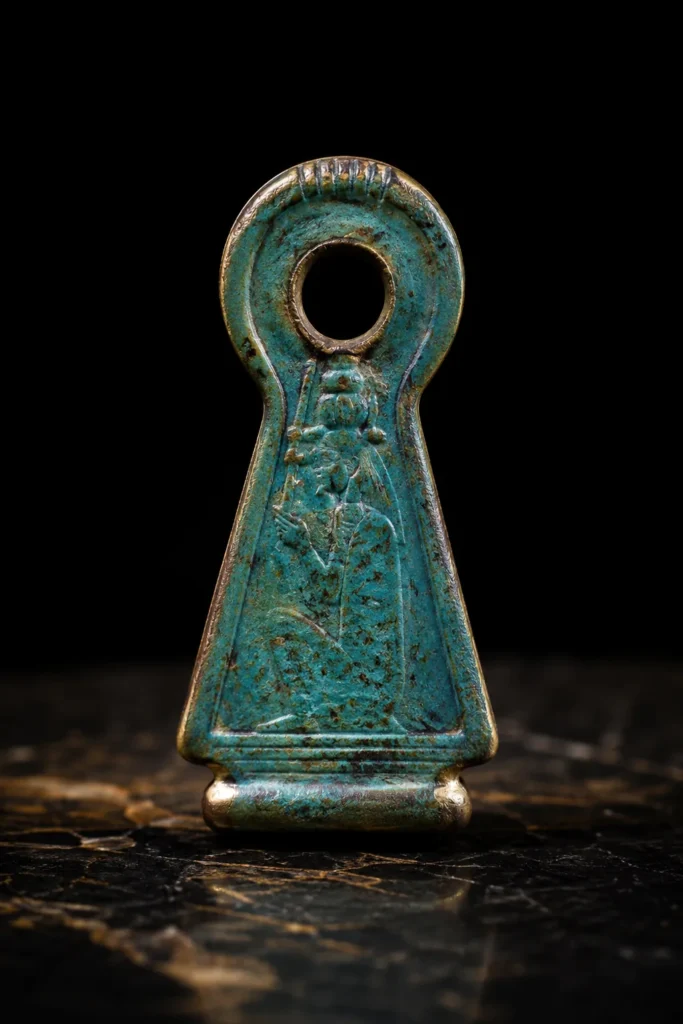
The counterpoise has a characteristic shape. It is usually designed in a keyhole form, with a narrow upper section and a broader, rounded lower portion. This shape is the most recognizable feature of the Menat.
Necklace and counterpoise belong together functionally. When the Menat was worn around the neck, the beaded necklace rested across the front of the chest. The counterpoise hung down at the back of the neck and kept the necklace balanced.
This is the origin of the name “counterpoise.” The heavy piece at the back of the neck ensured that the broad collar sat neatly at the front and did not slip. It originally served a purely practical purpose.
The counterpoise could, however, also be used on its own as an amulet. In this form, detached from the necklace collar, it was an independent protective object.
The Menat thus combines jewelry and amulet. It is a neck ornament with a heavy counterpoise, and that counterpoise simultaneously carries the significance of a protective sign.
Hathor, the Mistress of the Menat
The Menat can only be understood if one knows the goddess Hathor. Hathor was one of the most important and versatile goddesses of ancient Egypt.
Hathor was associated with many domains. She was regarded as the goddess of love, joy, dance, and music. She was at the same time a sky goddess and mother goddess, and was connected with the renewal of life.
Hathor was also a protective goddess. She watched over women, over birth, and over the deceased, easing their passage into the afterlife. Her nature united joy and protection.
The Menat was a sign of Hathor. The goddess herself is depicted in art with the Menat, and in her sanctuaries the Menat had an important role. It belonged to her cult.
Whoever used the Menat entered into a connection with Hathor and with everything she represented. The object brought the closeness of the goddess and her manifold, life-promoting power.
The close association with Hathor gives the Menat its significance. It is not an arbitrary neck ornament, but the sign of a great goddess and a bearer of her power.
The Menat in Ritual
The Menat was not merely a worn ornament. It played an important role in ritual, above all in the cult of Hathor. This ritual use was one of its primary meanings.
In the ritual, the Menat was held in the hand and moved. It could be shaken, so that the many beads of the necklace produced a soft, ringing sound.
In this respect the Menat resembles another cult implement of Hathor, the sistrum. The sistrum is a type of rattle that was shaken during the ritual. Menat and sistrum both belonged to the cult of Hathor.
The Menat was also presented during the ritual. It could be held out toward a person, an image of the goddess, or a deceased individual. Through this gesture, the power of the Menat was transferred.
This ritual presentation was an act of blessing. Whoever received the Menat or encountered it was to receive a share of its power: protection, life, and renewal.
The Menat was thus a movable ritual implement. Unlike a fixed sign, it was held, moved, and presented. This mobility is part of its nature.
Protection, Life, and Renewal
Several interconnected meanings were attributed to the Menat. All of them derive from the nature of Hathor, to whom the Menat was assigned.
The first meaning is protection. The Menat was to preserve whoever wore it or to whom it was presented. It placed that person under the protective power of Hathor.
The second meaning is life and vital force. Hathor was a goddess who promoted and renewed life. The Menat carried this life-promoting power within it.
The third meaning is renewal, especially in connection with death. The Menat was to help the deceased enter a new existence. It was therefore also a sign of rebirth.
These meanings are closely connected. Protection, life, and renewal are not separate things, but aspects of the same concern: the preservation and promotion of life.
The Menat was thus a comprehensive sign of blessing. It did not ward off a single specific danger, but stood for the full, life-promoting power of Hathor.
The Counterpoise as Amulet
The heavy counterpoise of the Menat could be detached from the necklace collar and used on its own. In this form it was an independent amulet.
The counterpoise carried within it the full significance of the Menat. Even without the beaded necklace, it stood for Hathor and her power: protection, life, and renewal.
As an independent amulet, the counterpoise could be worn or carried. It was more compact than the complete Menat and thus well suited as a personal protective object.
The counterpoise was frequently crafted with care. It could be adorned with representations of Hathor, with images, and with inscriptions. This craftsmanship reinforced its significance as a sign of the goddess.
The counterpoise was also used in funerary practice. It was placed with the deceased so that the power of Hathor might accompany them on their journey into the afterlife.
The counterpoise thus shows that a part of the Menat could stand for the whole. Just as the head of Pazuzu can represent the full figure of Pazuzu, so the counterpoise could stand for the entire Menat and its significance.
The Menat in Funerary Practice
Like many Egyptian protective objects, the Menat also had a role in funerary practice. It accompanied the deceased and placed them under the protection of Hathor.
Hathor was closely associated with the afterlife. She was regarded as the goddess who received the deceased among the dead and eased their passage. In this role she is called Mistress of the West, for the west was the land of the dead.
The Menat, as the sign of Hathor, was meant to secure for the deceased the presence and protection of the goddess. It was placed among the grave goods or shown in tomb imagery.
In tomb paintings, the Menat frequently appears in the hands of figures who present it to a deceased person or to a deity. This gesture of presentation transferred protection and vital force.
The Menat in funerary practice thus follows the same underlying idea as the Ankh, the Djed pillar, and the Isis knot. All these signs were intended to give the deceased what was needed for a good continuing existence.
In the case of the Menat, it was the power of Hathor that was directed toward the dead. Protection, life, and renewal, which the Menat carried, were to enable the deceased to enter a renewed existence.
Menat, Sistrum, and the Hathor Cult
The Menat is best understood in the context of the Hathor cult. Within this cult, it did not stand alone, but alongside other cult objects.
The most important related object is the sistrum, the ritual rattle of Hathor. Menat and sistrum belong together. Both were shaken in the ritual, both produced a soundscape, and both were signs of the goddess.
Sound played a special role in the cult of Hathor. Hathor was a goddess of music and joy. The soft chiming of the Menat beads and the rattling of the sistrum belonged to her cult.
The priestesses of Hathor wore the Menat and wielded the sistrum. These objects identified them as servants of the goddess and bearers of her cult.
The Menat was thus embedded in a whole network of objects, actions, and sounds. It should not be understood as an isolated amulet, but as part of the living cult of a great goddess.
This embeddedness in the Hathor cult gives the Menat its full meaning. It is jewelry, ritual implement, and protective sign in one, and all three aspects belong to the veneration of Hathor.
Modern Reception
Today the Menat is known primarily to those familiar with Egyptian culture. It is not among the widely recognized Egyptian symbols, but in Egyptology it is a well-researched object.
Museum collections focused on Egypt preserve Menat counterpoises, many of them finely crafted and adorned with representations of Hathor. They attest to the significance of the object in the Hathor cult.
For the study of Egyptian religion, the Menat is instructive. It shows how closely jewelry, ritual, and protection were intertwined in Egypt, and how a single object could fulfill several roles at once.
The Menat also illustrates the importance of sound in Egyptian religion. In the cult of Hathor, music, dance, and the chiming of cult implements were essential components of veneration.
The Menat is thus a compelling example of a multifaceted protective object. It was a neck ornament and ritual implement, and its counterpoise was an independent amulet.
In it, the joy and the protection that defined the nature of Hathor are united. The Menat carried the power of a goddess who stood for life, for renewal, and for the loving preservation of humanity.
Selected Bibliography
Related key terms: Menat Hathor counterpoise neck collar sistrum apotropaic object renewal funerary practice ancient Egypt.
iWell Guard and Protective Traditions
iWell Guard stands in the cultural-historical lineage of wearable protective objects, a lineage to which the Menat also belongs. A modern companion for people who live with protective symbols: made in Germany, 41 layers of genuine gold, platinum, and silver, with a 30-day right of return.
Individual experiences may vary. Not a medical device. No therapeutic claims.