


Erzulie, goddess of the Haitian tradition
By Ralf Ittermann · last reviewed on
Erzulie is a goddess of the Haitian tradition.
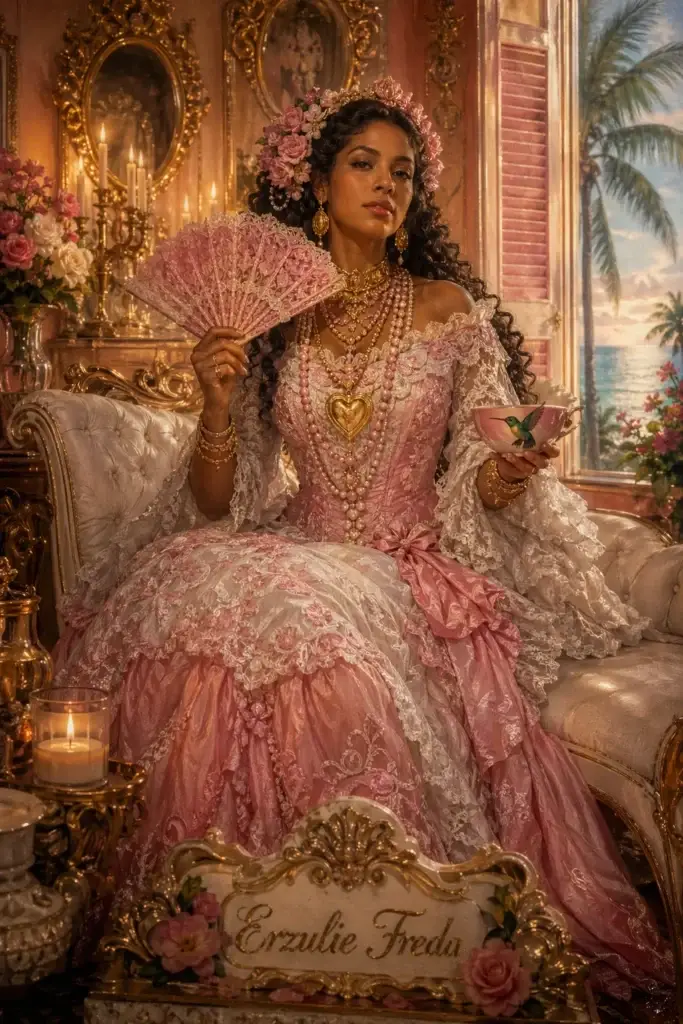
Goddess of love, beauty and desire, queen of grace. Erzulie Freda is the loa of feminine gentleness, luxury, eroticism and refined feelings. She appears in pink and light-blue cloths, surrounded by mirrors, perfume and roses.
Her tears are genuine, for she feels the suffering of humanity. But her laughter is divine and vivid. Those who honor Erzulie Freda experience love, beauty and the comfort of intimate closeness.
Quick Overview: Erzulie
Type: Vodou loa of love and beauty (Rada family)
Pantheon: Vodou (Haiti), Louisiana Vodou (Erzulie Freda Dahomey)
Function: Love, desire, beauty, wealth, vanity
Main attributes: Golden jewelry, sweets, perfume, three rings (marriage symbol)
Main cult sites: Hounfor temples, women’s shrines, private altars
Syncretism with Mary: Mater Dolorosa
Context
Period of the Texts
Erzulie (Creole: Ezili) developed from West African roots, particularly the Vodun goddess of love Aziri/Azili from the Dahomey tradition. In Haiti she splits into at least three manifestations: Erzulie Freda Dahomey (elegant, light-skinned, jealous), Erzulie Dantor (dark, warrior-empowering, mother), Erzulie Mapian (Petro aspect). Syncretically identified with the Catholic Mater Dolorosa.
Area of Diffusion
Venerated in nearly every Haitian hounfor temple; women’s household altars in her honor are widespread. Active in the Haitian diaspora in New Orleans, New York, Miami, Montreal, Paris.
Her feast day is Tuesday (day of love in many Creole traditions). Central identification in Haitian communities: every woman has a connection to Erzulie in one of her forms.
Source Situation
Key sources: Maya Deren’s Divine Horsemen (1953), McCarthy Brown’s Mama Lola (1991, detailed Erzulie observations), Métraux’s Le Vaudou haïtien (1958), Desmangles’ The Faces of the Gods (1992). Specialist studies: Joan Dayan’s Haiti, History, and the Gods (1995); Sharae Deckard’s studies on Erzulie symbolism in Haitian literature.
Name and Variants
Erzulie Freda is depicted as a beautiful, elegant woman in pink, light-blue or golden garments, often holding mirrors, surrounded by blossoms. She wears jewelry, bracelets, necklaces and earrings of precious materials.
Her gaze is gentle yet penetrating; her voice melodic. Her veve (loa symbol) shows hearts, rivers and ornaments. Incense, fresh blossoms, fine food (champagne, sweets) and perfume are her preferred offerings.
Characteristics
Erzulie Freda is invoked by men and women seeking romantic love, wishing for marital harmony, or wanting to deepen their own beauty and radiance.
Her rituals are feminine in character, often led by a mambo (priestess) and women’s groups. In possession, Erzulie Freda takes on a delicate, sometimes melancholic energy; she weeps, laughs and dances with grace.
She can, however, also become angry when her dignity is violated or when a lover is unfaithful. The veneration is less combative than that of other loa; it is about refinement, respect and emotional depth. Many Haitians carry small Erzulie amulets or pray to her at pilgrimage sites.
Appearance and Symbolism
Erzulie is depicted as a beautiful, elegant woman in red or pink clothing, often with jewelry and mirrors. She wears perfume and is regarded as coquettish and alluring. Her attributes are hearts, roses and mirrors. She is sometimes syncretized with the Virgin Mary. Pink is her characteristic color.
Profile: Erzulie
The most important aspects of Erzulie at a glance. The following fields summarize origin, function, appearance, veneration, symbols and parallels.
Erzulie emerged in West African Vodun from the goddess of love Aziri. In Haiti she has several husbands among the loa: Damballah (serpent god), Ogou (warrior), Agwé (god of the sea), which explains her jealousy and her changing moods.
Erzulie Freda is the refined, coquettish, impossible beloved; Erzulie Dantor is the dark mother, combative, holding the child Anaiz on her arm.
Patroness of love, beauty, desire, wealth, luxury, but also of disappointment, jealousy and tears. Erzulie Freda is invoked for love affairs and beautiful women seek her patronage. Erzulie Dantor protects mothers, single mothers and abused women; she is invoked for self-defense and empowerment. Both aspects are sexually empowering.
Erzulie Freda: elegantly dressed young woman in white-pink lace, with golden jewelry, three rings (married to three loa), perfume, lace handkerchief, sunglasses (sometimes). Light-skinned, almost white.
Erzulie Dantor: dark-skinned woman with two scars on her right cheek, holding the child Anaiz on her arm, capable only of bubbling sounds (tradition: her tongue was cut out in a war). Black or red headscarf, gold necklace with cross.
Domain of effect: Erzulie Freda is invoked for success in love, marriage intentions, beauty care and desire. Women maintain household altars with mirror, perfume, sweets and three rings.
Erzulie Dantor is sought in times of crisis: against abuse, for self-defense, for single mothers. In historical context: Erzulie Dantor was reportedly the loa who initiated the Haitian Revolution of 1791 at the Bois Caiman ritual; her invocation carries political weight.
Erzulie Freda: three gold rings, perfume, lace handkerchief, sweets, champagne, pink roses, mirror, doves, jewelry. Erzulie Dantor: child Anaiz, Black Madonna of Czestochowa (syncretism), rooster (sacrificial animal), knife, red or black candles, spicy food with pepper. Sacred plants: rose, violet, magnolia.
West African root: Aziri/Azili (Dahomey, Yoruba). Caribbean relatives: Oshun (Yoruba/Santeria, love orisha with similar complexity), Yemaya (mother orisha). Global love-goddess parallels: Aphrodite (Greece), Inanna/Ishtar (Mesopotamia, similarly volatile power of love), Hathor (Egypt), Freyja (Germanic), Lakshmi (Hinduism), Mary (Christian Mater Dolorosa tradition).
Protective Practice
Veneration Rituals
Erzulie Freda (Haitian Creole: Èzili Freda) is the loa of love, beauty, elegance and romantic longing in Haitian Vodou, syncretically identified with the Catholic Mater Dolorosa. Her festivals take place on 11 February (Mater Dolorosa Day) and on Mardi Gras (Carnival).
Devotees dress in pink-white, offer white jasmine blossoms, fresh strawberries, white champagne and pastries. The perfumed dressing table with mirror is a central cult element. Erzulie’s possession is characterized by refined behavior, outbursts of tears and yearning desire (cf. Deren, Divine Horsemen; Métraux).
Invocations
Houngan invoke Erzulie with the Yanvalou rhythm. Creole chants (chants Erzulie) praise her beauty and charm. Characteristic is her invocation song “M’pra mande Èzili” (I call upon Erzulie). The invocation is often made as a request for help with love and relationships.
Amulets and Protective Symbols
Veve diagram: stylized heart with arrow, drawn on the ground in cornmeal. Rose quartz pendants and mother-of-pearl as Erzulie stones. Perfume bottles with jasmine or rose essence as temple offerings.
Three golden wedding rings (symbol of Erzulie’s three mythic husbands Damballah, Agwe and Ogou) as a protective ring. Mater Dolorosa postcards or devotional images on the household altar.
Erzulie, Parallels in Other Cultures
Oshun (Yoruba/Candomblé), the African goddess of love and the river, who functionally represents a parallel to Erzulie. Aphrodite (Greece) as goddess of love and beauty.
Freyja (Germanic) as goddess of love and attraction. In the Christian tradition, the Mother of God and Mary Magdalene, both merged in Erzulie veneration into a feminine-sacred figure of grace.
A Lwa with Many Faces
In Haitian Vodou, Erzulie is not a single, clearly defined spirit, but a group of related female lwa, each embodying a different aspect of femininity, love and fate.
The two best-known are Erzulie Freda and Erzulie Dantor, yet scholarship and practice know further forms of manifestation. This multiplicity is not a lack of clarity but an expression of the way Vodou distributes the contradictory experiences of life across different figures.
Erzulie Freda is considered the lwa of refined love, beauty, luxury and longing. She belongs to the group of Rada lwa, the spirits regarded as cooler and gentler, whose roots lie in the traditions of Dahomey.
Erzulie Freda loves fine things: perfume, sweets, jewelry and the color pink. Characteristically, her manifestations often end in tears, for no love and no wealth ever suffice for her. She embodies unfulfillable desire.
Erzulie Dantor, by contrast, belongs to the Petwo lwa, the hotter, harder group whose origins are connected with the experience of slavery and resistance in the New World.
She is the lwa of protective, combative motherly love, of the working woman, of the single mother. She is regarded as fierce and relentless when her children are threatened.
These two main figures stand in a tension that in Vodou mythology is even narrated as conflict. Together they outline a wide field of female existence, from refined desire to fierce protective power. Those who wish to understand Erzulie must grasp this multiplicity as her core.
The Iconography and the Catholic Marian Images
Like most lwa, Erzulie too was connected with Catholic images under the pressure of forced Christianization, in her case with representations of the Virgin Mary. This overlay of images continues to shape the iconography of both principal forms of manifestation to this day.
Erzulie Freda is frequently represented through the image of the Mater Dolorosa, a richly adorned Marian figure marked by swords or wounds, often with jewelry, precious garments and an expression moved by tears.
This choice fits Erzulie Freda’s nature: her inclination toward beauty and, at the same time, her inconsolable sadness. On her altar one finds mirrors, combs, perfume, jewelry and white and pink cloth.
Erzulie Dantor, by contrast, is generally associated with a dark Marian figure, frequently an image showing a Black Madonna with child that enjoys great veneration in Haiti.
Characteristic in many depictions are the scars on the cheek of the figure, interpreted in the narratives as referring to her battle with her sister or to her role in the Haitian war of independence.
Erzulie Dantor is often depicted with a child, her daughter, and in many traditions is regarded as mute, since her tongue was reportedly cut out in the war.
The religious-studies reading of these images is the same as for other lwa: it is a matter of masking and correspondence, not of a merging of theologies.
The Marian image supplies a permitted, publicly displayable likeness, but the lwa retains her own nature, her own songs, foods, dances and character. The iconography is thus a document of adaptation under compulsion and at the same time of the tenacious preservation of the distinct tradition.
Erzulie Dantor and the Covenant of Bois Caiman
Erzulie Dantor holds a particular significance through her connection with the Haitian Revolution.
According to widespread tradition, a Vodou ceremony in August 1791 at a place called Bois Caiman was the opening of the great slave uprising that ultimately led to Haitian independence in 1804, the first founding of a state through a successful slave revolution.
In the commemorative culture of Haitian Vodou, Erzulie Dantor is closely linked with this ceremony. She is regarded by many as the lwa who was present at Bois Caiman and granted the insurgents strength and protection.
Her image as a combative, unyielding mother defending her children could be applied directly to the struggle for liberation.
Historians urge caution in reconstructing the events at Bois Caiman itself, since the source base is thin and partly overlaid by later interpretations. What can be stated with confidence, however, is that Vodou and with it Erzulie Dantor have become a central point of reference for Haitian national identity.
In this reading, the lwa embodies the resistance of the enslaved, the solidarity of the oppressed and the readiness to fight for one’s own children and for freedom.
This connection explains why Erzulie Dantor in Haiti is not only a religious but also a political and cultural figure. She stands for a history in which a community sustained by African religions cast off slavery.
The lwa regarded as mute and marked by scars thus became a symbol of the fact that the experience of violence and silencing need not have the last word.
Further Links
Sources and Literature
- Desmangles, Leslie G.: The Faces of the Gods. Vodou and Roman Catholicism in Haiti. Chapel Hill 1992.
- Dayan, Joan: Haiti, History, and the Gods. Berkeley 1995.
Further standard works in the literature index.
Frequently Asked Questions about Erzulie
Who is Erzulie in Vodou?
Erzulie (Creole: Ezili) is the loa of love, beauty and femininity in Haitian Vodou. She is not a single figure but an entire family of related spirits with different characteristics.
Erzulie embodies the ideal of feminine grace, but also longing, jealousy and deep pain. She is venerated with jewelry, perfume, sweets and the color pink, and is regarded as one of the most beloved loa in Vodou.
What distinguishes Erzulie Freda from Erzulie Dantor?
The two best-known forms of manifestation stand in tension-filled contrast. Erzulie Freda is the light, refined loa of romantic love and luxury, often associated with the Virgin Mary; she weeps frequently because no earthly love satisfies her longing.
Erzulie Dantor, by contrast, is the dark, combative mother loa, protector of women and children, often associated with a Madonna depiction bearing scars on her face. Freda represents the romantic, Dantor the protective and working side of femininity.