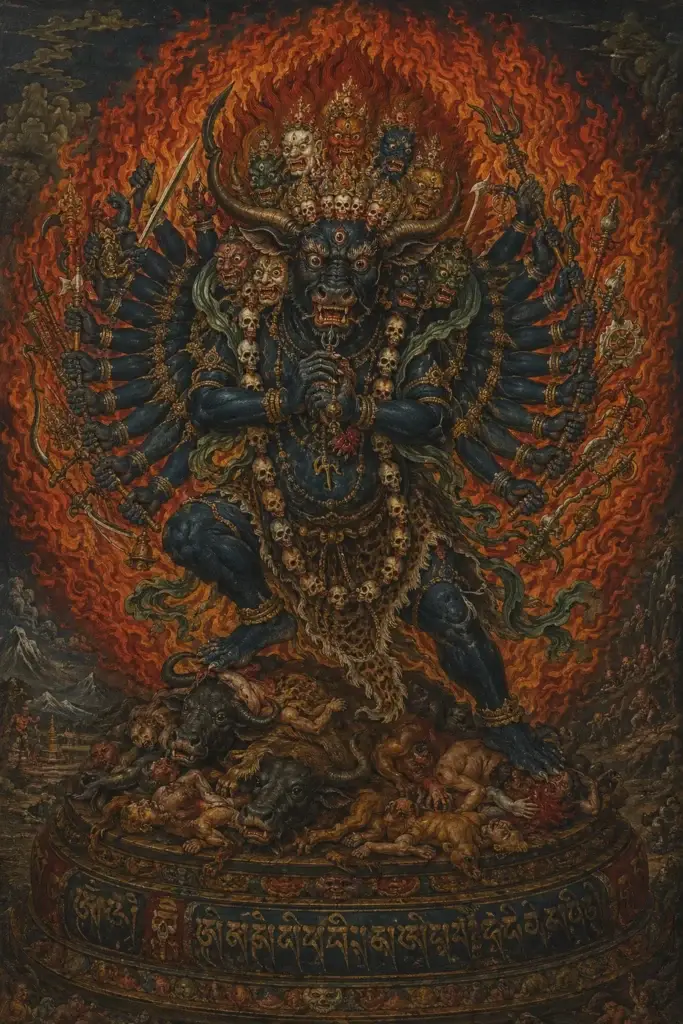
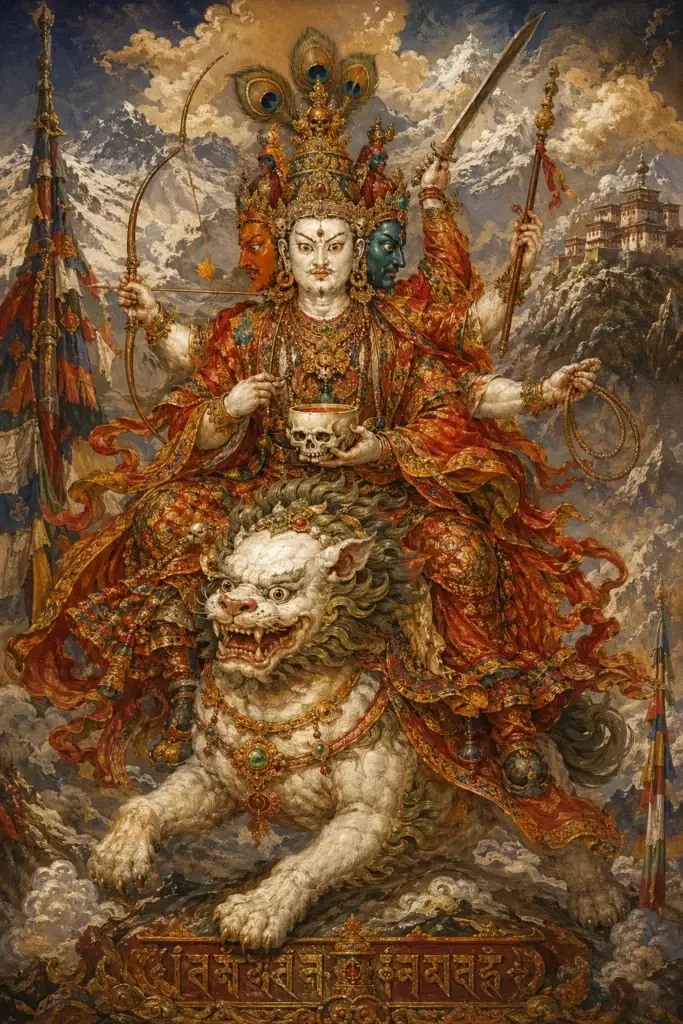
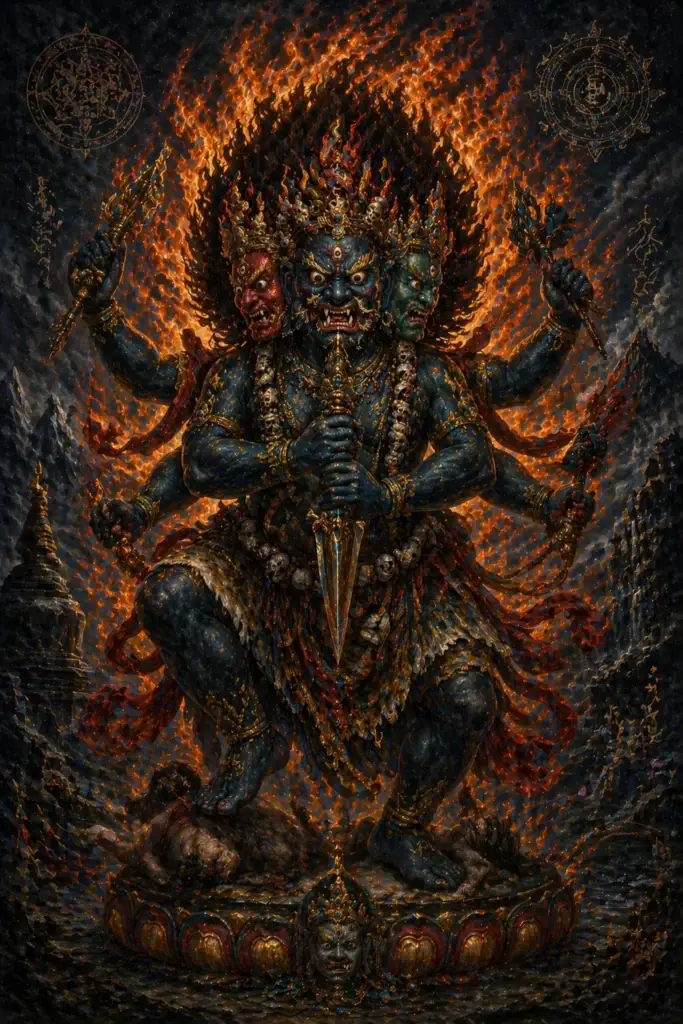
Yamantaka (the conqueror of death, also called Vajrabhairava) is one of the fiercest and most influential meditation deities of Tibetan Buddhism. With nine heads, 34 arms and 16 legs, this form of the bodhisattva Manjushri represents the ultimate destruction of ignorance and fear of death.
In the Gelug school, Yamantaka is practised as a yidam (personal deity form). The nine-headed, dark blue-black figure with animal heads symbolises the control of all the senses. The tantric practice requires several hundred hours of meditation and is considered extremely advanced. His presence is said to overcome fear of death and ego attachment.
Type: Vajrayana Buddhist wrathful main yidam, conqueror of Yama (death)
Pantheon: Tibetan Buddhism (especially the Gelug and Sakya traditions)
Function: conquest of the fear of mortality and of the law of karma, highest Vajrayana yidam
Main attributes: buffalo head, nine heads (main form), 34 arms, 16 legs, flaming aureole
Main place of worship: principal Gelug monasteries (Drepung, Sera, Gandän), principal Sakya monastery
Identity: wrathful form of Manjushri (Vajrabhairava aspect)
Yamantaka (Sanskrit, „destroyer of Yama“) develops in the tantric tradition of India (8th-10th century CE) as a wrathful form of Manjushri: the bodhisattva of wisdom takes on this terrifying figure in order to defeat death itself (Yama) and thereby save all beings from the cycle of karma.
The main flowering of the Yamantaka tradition: Atisha’s arrival in Tibet (11th century), then especially the Gelug tradition with Tsongkhapa (14th/15th century), where Yamantaka as Vajrabhairava becomes the main yidam of the Gelug school. He is also central in the Sakya and Nyingma systems, with different tantra texts.
Main places of worship: all Gelug monasteries have the Yamantaka sadhana as their main practice, especially Drepung, Sera, Gandän, Tashilhunpo. The principal Sakya monastery in Tibet (Vajrabhairava tradition). Central in Mongolia.
Present in many monastery complexes in Bhutan and Nepal. Found internationally in every Tibetan Buddhist centre with a Vajrayana tradition. Tantric initiations (wang) for Yamantaka are among the highest Vajrayana initiations.
Central sources: Vajrabhairava Tantra (main source), Krishnayamari Tantra, Raktayamari Tantra (three main forms). Commentary literature: Tsongkhapa’s Six Yogas of Yamantaka. Secondary literature: Linrothe, Ruthless Compassion. Wrathful Deities in Early Indo-Tibetan Esoteric Buddhist Art; Siklos, The Vajrabhairava Tantras; Lopez, Religions of Tibet in Practice.
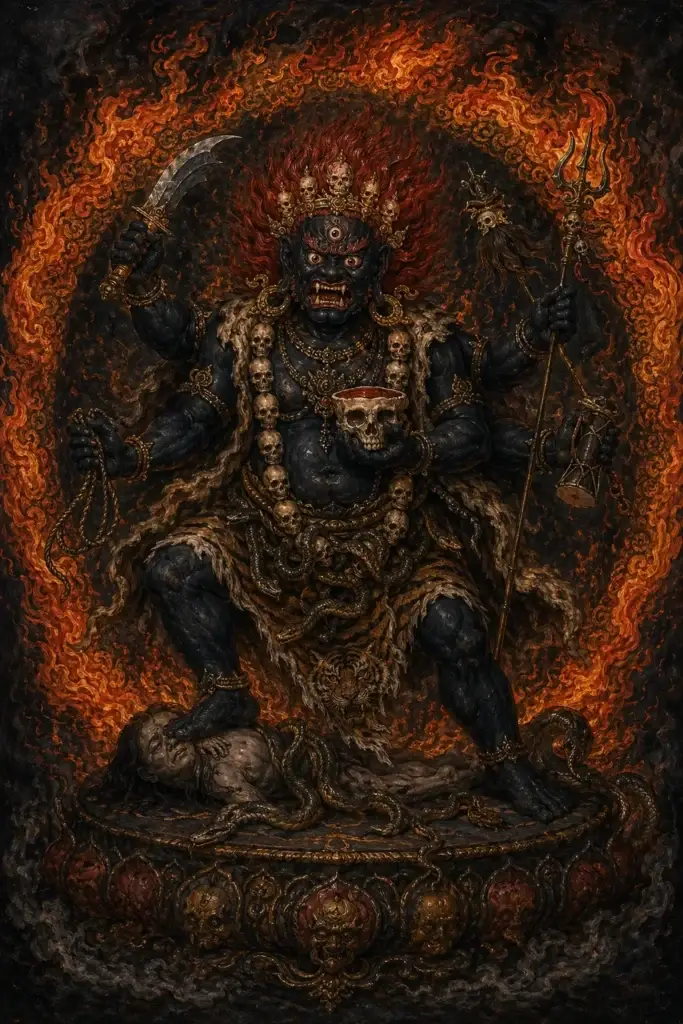
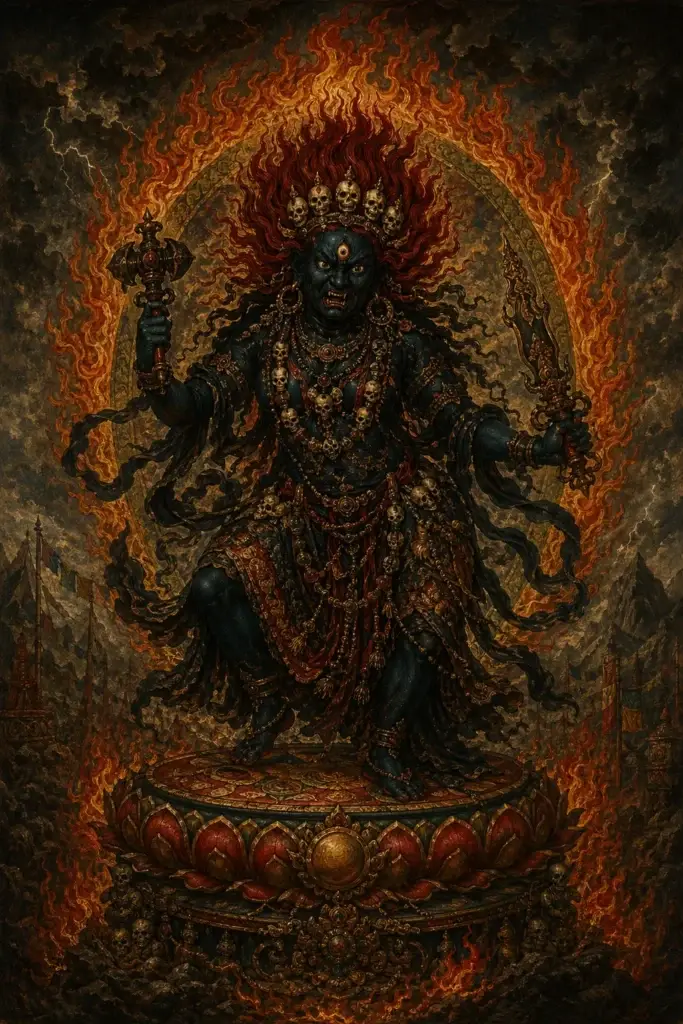
Yamantaka is typically depicted with several heads (often nine, one main head and eight subsidiary heads) and several arms (often sixteen). His main face is dark blue or black, fierce and terrifying to behold. His body is muscular and dreadful, with swollen veins and exaggerated anatomy.
He wears a crown of human heads and skulls, symbolising the destruction of the ego. His body is adorned with garlands of snakes and animal skins.
The symbols in his many hands are swords, lassos, a skull club, a bell and other insignia of tantric power. He often dances in fierce motion, sometimes embracing his shakti (female energy) in divine union.
Yamantaka is venerated not through external rituals but through intense internal meditations. Practitioners visualise themselves as Yamantaka; this process is a gradual transformation in which the ego is dissolved. The practice is advanced and presupposes initiations. A lama must initiate the student and give instructions.
The mantra “om bhrum sarva dushta mara ya dung drip soha” is recited, sometimes a thousand or ten thousand times. The mandala (cosmic diagram) is visualised. Despite his dreadfulness, the practice is profoundly calming: it destroys the foundation of all fear.
Appearance and Symbolism
Yamantaka is depicted as a black or dark blue god with wild hair and 34 arms (in various traditions), with bull heads and skulls. He wears a garland of heads and holds numerous weapons and ritual objects. Flames surround him. This iconography symbolises the overcoming of death through wisdom.
The most important aspects of Yamantaka at a glance. The following fields summarise origin, function, appearance, veneration, symbols and cultural parallels.
Yamantaka is the wrathful manifestation of Manjushri. The main myth: a holy yogi meditates for a long time in the caves of India and is threatened by Yama (death) and his demons; in his despair he calls upon Manjushri, who takes on the wrathful form Yamantaka, larger, more terrible and more powerful than Yama himself, and conquers Yama.
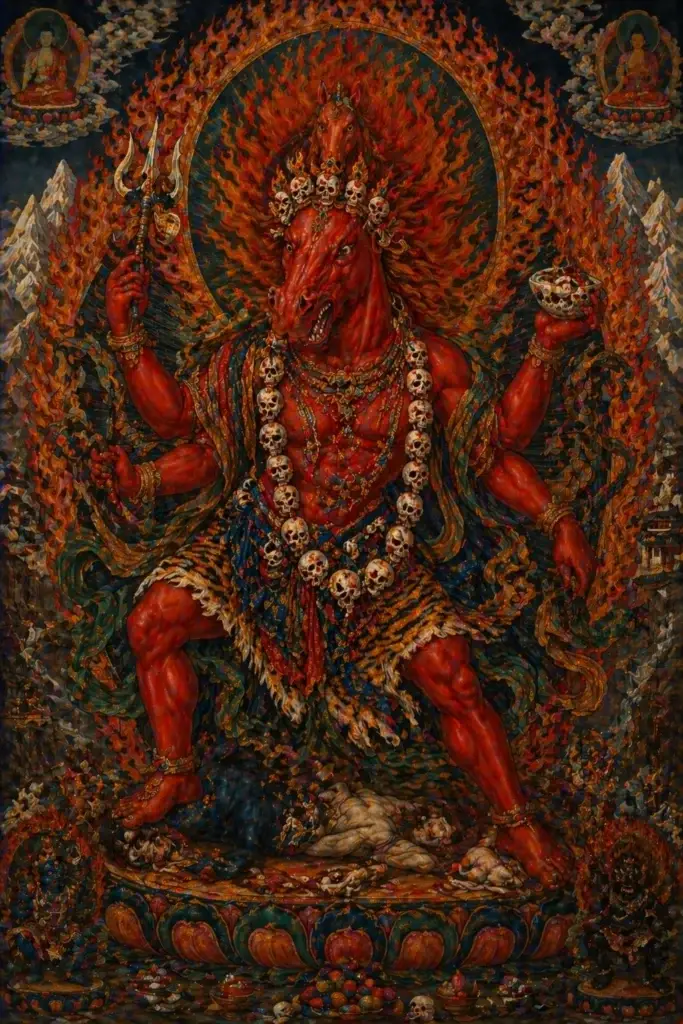
This destruction is not the end of Yama (he remains active as judge of the dead), but the demonstration that the Buddha nature transcends death itself. Three main forms: Vajrabhairava (most popular, buffalo-headed), Krishnayamari (the black one), Raktayamari (the red one).
Yidam (meditation deity) of the highest Vajrayana practice. Destroyer of the fear of mortality and of the law of karma.
In tantric practice the practitioner identifies with Yamantaka through long visualisations; the result is the experience of one’s own immortality as Buddha nature. Protection against all obstacles on the path. Patron of the highest Vajrayana initiations.
Vajrabhairava form (most popular): wrathful, dark blue (or black) muscular male body. Main head: buffalo head with enormous horns, three eyes, gaping mouth with fangs.
Eight further heads (nine in total) in two rows one above the other, plus the face of Manjushri at the top. 34 arms with various weapons and symbols (sword, skull cup, khatvanga, etc.). 16 legs: on the right treading on defeated gods and humans, on the left on animals.
Skull crown and ornaments, flaming aureole. Standing in a dynamic bow-step pose. In the tantric yab-yum form: in union with his consort Vajravetali.
Sphere of effect: In the Gelug tradition Yamantaka is meditated upon as the main yidam; practitioners pass through the generation and completion stage practices of his tantra over years, often decades. The Dalai Lama and Panchen Lama have Yamantaka as their main yidam.
There is a monthly Yamantaka puja in every Gelug monastery. Tantric initiation (wang) is reserved only for advanced practitioners. He is hardly ever invoked directly in personal cult; he is a yidam, not a folk protective god. In Cham dances he appears ritually as a masked figure.
Buffalo head, nine heads, 34 arms with weapons (sword, skull cup, khatvanga, damaru, trishula, etc.), 16 legs, skull crown, bone ornaments, flaming aureole. In yab-yum form: consort Vajravetali. Sacred animals: buffalo (main head). Sacred plants: none specific. Sacred mantra: Om Yamantaka Hum Phat.
Manjushri (Buddhism, his own peaceful main form), Vajrabhairava (designation of his own main form), Krishnayamari (his own black variant), Raktayamari (his own red variant), Mahakala (Buddhism, related wrathful form), Bhairava (Hinduism, shared root), Yama (Hinduism / Buddhism, the conquered antagonist).
Functionally: unique among the world’s religions as a „wrathful form of wisdom that conquers death“, a specifically tantric conception.
Yamantaka’s nine-headed form with animal symbolism shares structural similarities with syncretistic Western demonologies, where multi-form deities (for example Hecate with three bodies or Baal with several appearances) represent the complexity of cosmic forces. The practice of meditative veneration of an originally terrifying figure for purposes of liberation finds parallels in Gnostic traditions.
Jewish tradition: Moloch as a sacrificial god and Samael as an angel of wrath share with Yamantaka the demonic or wrathful aspect dimension, although without the possibility of integration into meditation.
Greco-Roman world: Hades as god of the dead and Ares as the wrathful god of war share with Yamantaka aspects of control over the forces of death and aggression. Hecate as a three-form goddess shares the multiplicity of forms.
Germanic tradition: Hel as goddess of the dead and Fenrir as a destructive animal being share with Yamantaka chthonic wild forces, though more as adversaries than as objects of integration.
Hinduism: Kali as the wrathful mother and Shiva as destroyer share with Yamantaka tantric forces of destruction and transformation. Bhairava, the wrathful form of Shiva, is a direct parallel.
The name Yamantaka (Sanskrit Yamantaka, Tibetan gShin rje gshed) literally means conqueror or ender of Yama, that is, of the god of death. Behind this name lies a well-known narrative that has been handed down in several versions.
In the widespread Tibetan version, a holy ascetic meditated for many years in a cave, shortly before enlightenment. On the decisive night, robbers broke into the cave, bringing with them a stolen bull, and beheaded the ascetic together with the animal.
The headless ascetic thereupon took on the bull’s head, transformed into a raging figure of the death power Yama and threatened to destroy all living beings of Tibet.
In order to tame this force that had spun out of control, the bodhisattva Manjushri, the embodiment of perfect wisdom, manifested in an even more terrifying form, many-armed and many-headed, in the shape of a bull: as Yamantaka, who overcomes Yama.
The logic of the narrative is tantric: the destructive power of death is not extinguished but surpassed by an even more powerful form, one guided by wisdom, and placed in the service of the teaching.
From the perspective of religious studies, the narrative is a key text for understanding the wrathful deities. Yamantaka is not the opposite of a benevolent Buddha but rather his wrathful aspect. The identity of Manjushri and Yamantaka is explicitly emphasised in the ritual texts.
The myth thus explains why a terrifying bull form can stand at the centre of one of the most important meditation practices of the Gelug school: it is wisdom itself in the form that is equal to death.

Yamantaka appears in the Tibetan sources in several closely related forms, the most important of which is Vajrabhairava (Tibetan rDo rje ‘jigs byed, the diamond-like terrible one).
Vajrabhairava is regarded as the wrathful yidam, that is, the meditation deity, of an entire tantra cycle. In the Gelug school the Vajrabhairava practice belongs, alongside Guhyasamaja and Chakrasamvara, to the three central highest yoga tantras on which advanced practice is built.
The transmission of this tantra to Tibet is traditionally connected with the translator Ra Lotsawa Dorje Drak in the 11th century, a historically tangible figure, though one surrounded by legends.
The reformer Tsongkhapa (1357 to 1419), the founder of the Gelug school, attached particular weight to the Vajrabhairava practice, which is why it became characteristic of this school.
Within the tantric system Yamantaka fulfils a dual function. As a yidam he is the object of identification meditation: the practitioner imagines taking on the form of the deity in order to overcome the separation between the ordinary self and the enlightened spirit.
At the same time, Yamantaka can be invoked as a dharmapala, a protector of the teaching.
This combination of meditation deity and protective deity is typical of the highest tantras. Research, such as the work of Bulcsu Siklós on the textual transmission of the Vajrabhairava Tantra, has worked out the complex layering of these traditions. Related wrathful deities are Palden Lhamo and Ekajati.
The main form of the Vajrabhairava Yamantaka follows a precisely fixed pictorial canon that is described down to the smallest detail in the ritual texts. The deity has nine heads, the central one being a wrathful buffalo head with two horns.
Above it appears, small and peaceful, the head of Manjushri, which indicates the true nature of the deity. The remaining heads are wrathful and rendered in various colours.
Yamantaka has 34 arms, each holding a particular attribute, as well as 16 legs. With his legs he treads on a series of animals, birds and deities of the older Indian religion, which symbolises the overcoming of worldly powers. His body is dark blue and surrounded by flames.
He is frequently depicted in union with his female companion. The number of arms and legs is not arbitrary: every number, every attribute and every colour is interpreted symbolically in the sadhana texts, so that the image is at the same time a meditation diagram.
Alongside this, the tradition knows simplified forms, for example a one-headed, two-armed Ekavira Yamantaka (the solitary hero), used for certain stages of practice. In material culture Yamantaka is represented by numerous bronzes, thangka paintings and above all by three-dimensional mandala models.
Significant examples are found in the collections of the Rubin Museum in New York and the Museum of Asian Art in Berlin. The strict fixing of the iconography has meant that Yamantaka depictions remain comparable with one another across centuries and across different regions, which makes them readily datable for art-historical research.
Yamantaka has become known in the 20th and 21st centuries beyond the narrower religious context. One factor in this was the public conferral of the Vajrabhairava initiation by senior Gelug teachers in the West.
The 14th Dalai Lama bestowed this initiation several times, by which a tantra previously kept strictly secret became accessible to a wider circle. From the perspective of religious studies, this opening is itself an object of study, since it raises questions about the relationship between secrecy and the dissemination of tantric practice.
Art history too has popularised Yamantaka. Major exhibitions of Tibetan art regularly showed Yamantaka thangkas and bronzes, whose visual force has a strong effect on the public. In collection catalogues and museum guides Yamantaka is among the most frequently explained wrathful deities, which in turn shapes his image in general perception.
In popular culture the name is occasionally taken up, usually in a superficial sense as a terrifying figure, without the tantric background. Such uses detach Yamantaka from his system and miss the central point, namely that this is wisdom in wrathful form.
Serious presentation, by contrast, emphasises that Yamantaka’s wrath is not directed against people but against the inner obstacles on the path to enlightenment, above all against attachment to a permanent self and against the fear of death.
Scholarly study, from Nebesky-Wojkowitz’s foundational work through Siklós’s textual studies to more recent iconographic work, provides the necessary corrective against simplifying interpretations.
Further standard works in the literature index.
Yamantaka (Sanskrit, the conqueror of Yama, that is, of the god of death) is a wrathful manifestation of the wisdom bodhisattva Manjushri. He is also called Vajrabhairava and is considered one of the most powerful meditation deities of the Gelug school.
Yamantaka is depicted with a bull head, several faces, numerous arms and legs, surrounded by flames. His task is to conquer death itself, that is, to overcome the ignorance that repeatedly forces beings into the cycle of birth and death.
In tantric Buddhism the principle holds that death can be met only by a force that is even more powerful than it. The peaceful wisdom bodhisattva Manjushri therefore takes on the terrible form of Yamantaka in order to overcome the god of death, Yama, with his own means.
The wrathful form is thus not an expression of anger in the ordinary sense but of compassionate resolve. Yamantaka is one of the three main deities in whose practice Tsongkhapa, the founder of the Gelug school, was initiated.
Against its influence, cross-cultural tradition names these protective means:
Compare in the Protection Compass →Recommended protective means
The simplest protective means in this collection: 41 layers of fine gold 999, platinum, silver and silicon, manufactured in Ruhla, Thuringia. It requires no activation, is bound to no person, and is effective within a radius of around 50 meters, even without being worn.
Related Beings

The Asrai, a delicate English water nymph who melts into water in sunlight. Origin, the disputed ...

Lada is the Slavic goddess of love, beauty and marriage. Mother of Lel and Polel, counterpart to ...

Kresnik, the Slovenian-Slavic fire and sun figure. Origin, the solstice connection and the religi...

Holla, also known as Frau Holle: Germanic mother goddess of weather, fertility and the otherworld...

Ryujin is the Japanese dragon god of the sea, ruler of the dragon palace Ryūgū-jō. Father of Toyo...

Jibril (Gabriel), the angel of revelation in Islam who transmitted the Quran to the Prophet Muham...