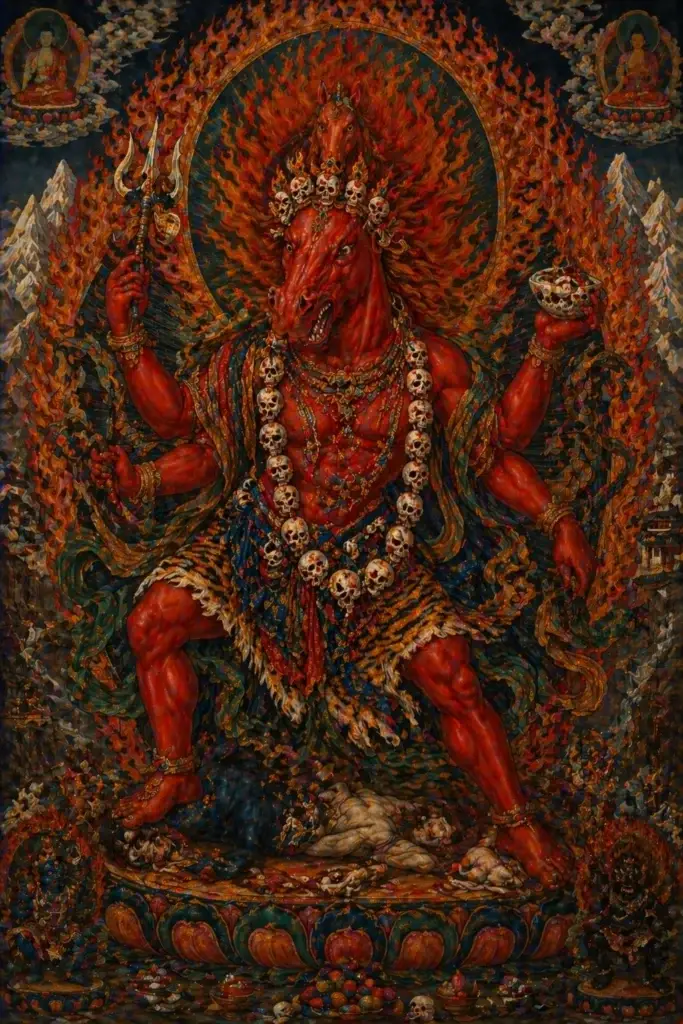
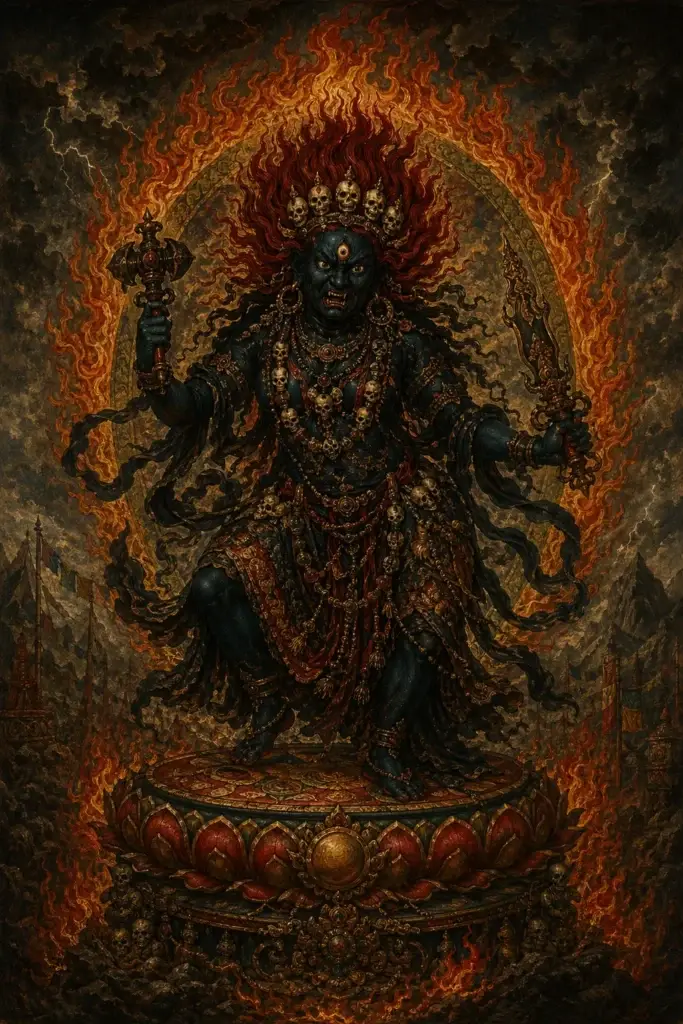
Mahakala, god of the Tibetan tradition
By Ralf Ittermann · last reviewed on
Mahākāla, Sanskrit for “Great Black One”, Tibetan Nagpo Chenpo, is a central Dharmapāla (protector god) of the Tibetan Buddhist tradition.
In the history of religion he combines Hindu Shiva aspects with tantric Buddhist soteriology and is established from the 8th century onward in India and, since the second spread in the 10th to 11th century, in Tibet as a protector of the teaching. In all four schools of Tibetan Buddhism he ranks among the most widely venerated protective deities.
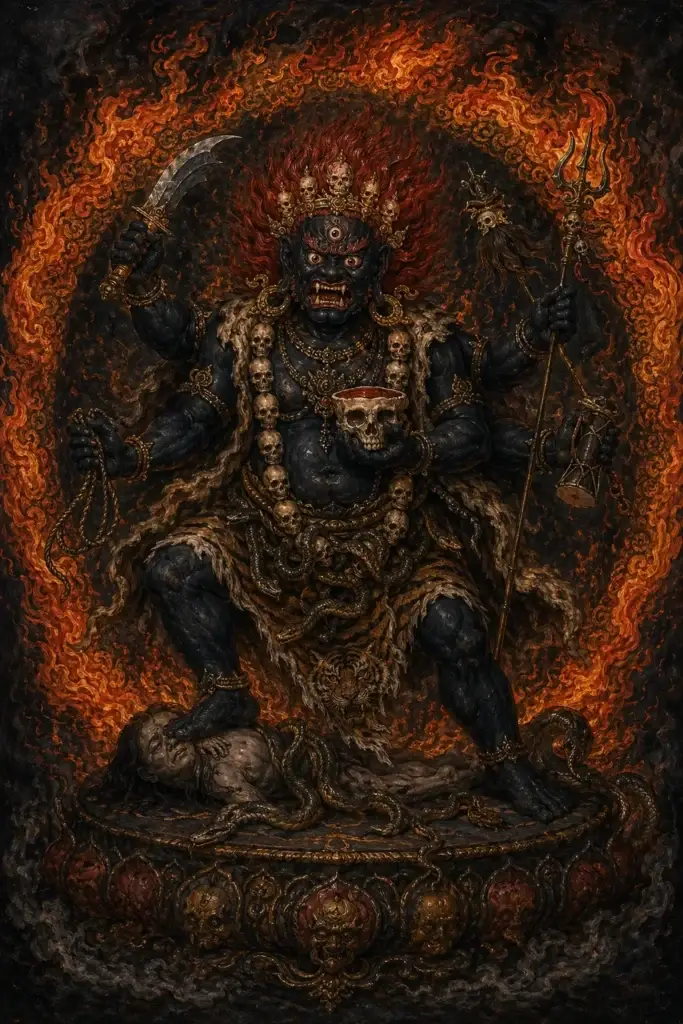
Mahakala
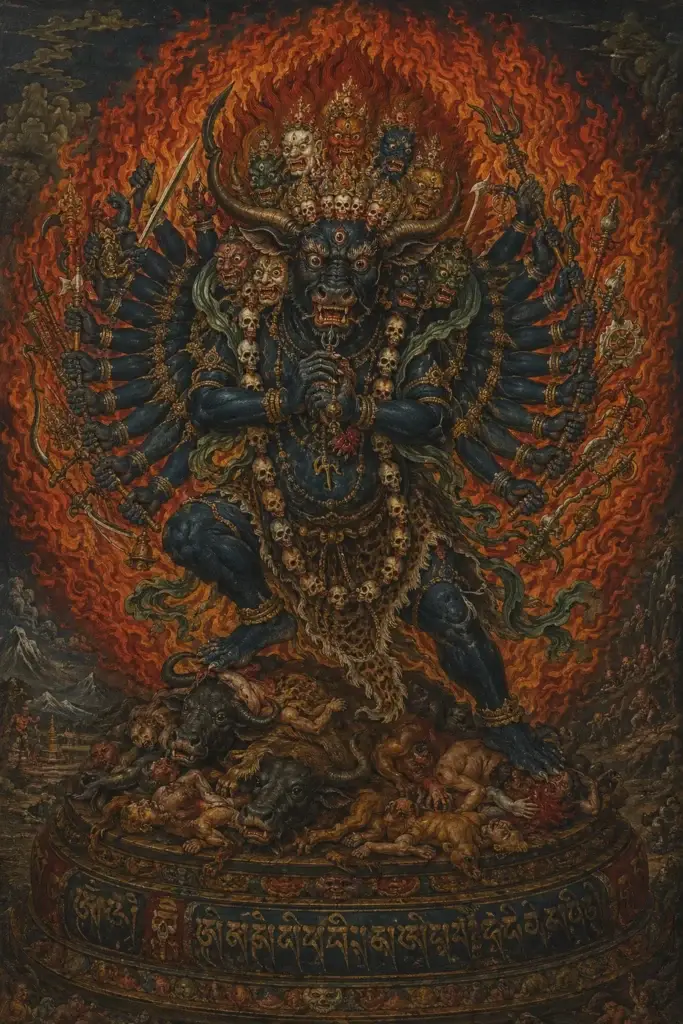
Mahākāla appears in numerous iconographic forms: two-, four- and six-armed, with a black or dark-blue body, wearing a skull crown, a garland of severed heads and an apron of tiger skin.
The two-armed Bernagchen form is regarded as the main protector of the Karma Kagyu school, the four-armed Caturbhuja form as protector of the Sakya and Gelug schools, the six-armed Shadbhuja form as protector in the Avalokiteśvara context. Functionally he protects practitioners, monasteries and the Dharma transmission itself, averts obstacles and supports enlightened activity.
At a glance: Mahakala
Type: Vajrayana Buddhist principal deity, wrathful protective Yidam
Pantheon: Tibetan Buddhism (all schools), adopted from the Hindu Bhairava/Shiva
Function: protection of the Dharma, destruction of obstacles and demonic powers, protector of the monastic lineages
Main attributes: six arms (six-armed form, most popular), skull crown, flaming aureole, tiger-skin apron, skull cup
Main places of cult: all Tibetan monasteries (in every protector main hall as central deity), Mt. Wutai (China)
Main forms: six-armed Mahakala, four-armed Mahakala, Brahmanrupa Mahakala, Pancanatha Mahakala (5-headed)
Context
Mahakala (Sanskrit, “great black one” or “great time”) arises in the Hindu tantric tradition as a wrathful aspect of Shiva (= Bhairava), is adopted by Indian Vajrayana Buddhism in the 8th-9th century and later advances in Tibet to become the main protector god.
The main heyday of Mahakala veneration in Tibet was the 11th-14th century with the second spread of Buddhism through Atisha. In modern Tibet he remains central in every monastery.
In Chinese Buddhism he appears as Daheitian (patron of the kitchens), in Japan as Daikokuten (one of the seven gods of fortune, ironically transformed into a mild prosperity deity).
Main places of cult: in every Tibetan monastery Mahakala has his own protector main hall (Gonkhang). Main monasteries with a particular Mahakala tradition: Tashilhunpo (seat of the Panchen Lama), Drepung, Sera, Ganden, Sakya.
Present in many monastic complexes in Bhutan and Nepal. Central in Mongolia (Bogd Khan tradition). In Japan in every temple as Daikokuten (with a characteristic mild appearance, a sack of rice instead of a skull cup), in Chinese temples as Daheitian.
Central sources: Mahakala Tantra (various versions for the different Mahakala forms), Sadhanamala, Nispannayogavali. Tibetan practice texts: the Mahakala Sadhana corpus of each school.
Secondary literature: Linrothe, Ruthless Compassion. Wrathful Deities in Early Indo-Tibetan Esoteric Buddhist Art (standard work); Stablein, The Mahâkâla Tantra. A Lectionary on Vajrayâna Buddhism; Kohn, Lord of the Dance. The Mani Rimdu Festival in Tibet and Nepal; Lopez, Religions of Tibet in Practice.
Name
Mahakala is depicted with certain iconographic elements that are symbolically coded and carry deep meaning. These elements convey above all the functions, sources of power, sphere of responsibility and cosmic role of this entity.
In depictions of Mahakala, every pictorial element is fixed by the Tibetan sadhana texts: the black or dark blue body color, the hooked knife (kartika) in the right hand and the skull cup (kapala) in the left, together with the skull crown and the aureole of flames. Painters in the monasteries have reproduced these specifications for centuries according to the same iconometric rules, so that this protective form of Avalokiteshvara remains clearly recognizable across all schools.
Characteristics
Mahakala was central to the religious practice and the everyday understanding of Tibet. People turned to this entity in critical situations or at certain ritual times of the year, with structured rituals, prayers or offerings.
The practice was precisely transmitted and often led by priests or specialists. The continuity of these practices over many generations shows that they were regarded as effective and necessary. Functions were manifold: preventive (warding off misfortune), healing (relieving suffering), transformative (accompaniment through transitions) and protective (continuous watching).
Appearance and symbolism
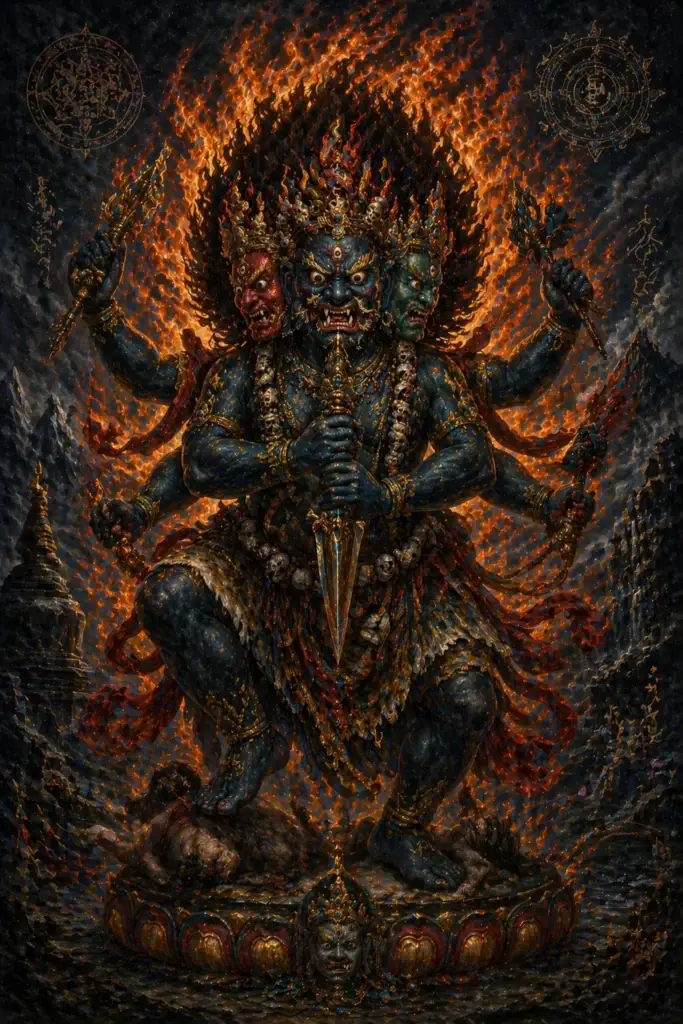
Mahakala is depicted as a black or dark-blue god with wild hair, often with four arms. He wears a skull diadem, a necklace of heads and holds a skull bowl and a curved blade. His third eye blazes. He stands on corpses or demons. This iconography symbolises the destruction of the ego and of attachment.
Profile: Mahakala
The most important aspects of Mahakala at a glance. The following fields summarise origin, function, appearance, veneration, symbols and cultural parallels.
Mahakala arises from the Hindu tantric tradition as a wrathful aspect of Shiva (Bhairava) or as an emanated form of Avalokitesvara in his wrathful aspect (one of the Buddhist reinterpretations).
In the Tibetan system there are various main forms: six-armed Mahakala (most popular, protection of the Karma teaching), four-armed Mahakala (Sakya tradition), Brahmanrupa Mahakala (in Brahmin form), Pancanatha Mahakala (5-headed). Each form has its own Tantra and its own Sadhana.
Protective Yidam (meditation protective deity) of the Buddhist teaching and of the practising Sangha. Destroys obstacles, demonic powers, malevolent spirits. In Tibetan monasteries the monthly Mahakala puja cycle keeps the teaching and the monastery protected.
Patron of the teacher-pupil transmission. In Cham dances a ritual confrontation with the negative powers. In Japan, as Daikokuten, a paradoxical transformation into a mild prosperity deity (kitchens and rice-sack seat).
Six-armed form (most popular): wrathful, coal-black (or dark-blue) male body, very muscular, three eyes (the third vertical on the forehead), gaping mouth with fangs, flaming wild hair with five skulls as a crown.
Six arms: in the hands a sword (Khadga), a skull cup (Kapala) with blood/amrita, a Khatvanga (skull staff), a Damaru (drum), a Pasha (lasso), a Trishula (trident).
Tiger-skin apron, snake necklace, bone ornaments. Stands or crouches on a powerless human body (symbol of vanquished egocentrism), surrounded by a flaming aureole. In Japan, as Daikokuten, paradoxically mild and peaceful, with a sheaf of rice and a staff.
Sphere of effect: Mahakala is venerated daily in every Tibetan monastery. The Mahakala puja (often on the 29th day of the Tibetan lunar calendar, the day of protection) is a principal rite. In tantric practice he is meditated upon as a Yidam.
In the personal illness cult he is the object of invocation for protection against demonic causers of illness. In Cham dances (especially the Mani Rimdu festival in Sherpa monasteries) he is central as a mask wearer.
In Japan, as Daikokuten, he stands in every house altar as a god of prosperity. In Mongolia and in China as Daheitian.
Sword (Khadga), skull cup (Kapala), Khatvanga (skull staff), Damaru (drum), Pasha (lasso), Trishula (trident). Skull crown (5 skulls), flaming hair, third eye, tiger-skin apron, snake ornaments, bone ornaments.
Mount (in some forms): a human beneath the feet. Sacred plants: the Bilva tree. Sacred colours: black, dark blue. Sacred days: the 29th day of the lunar calendar.
Bhairava (Hinduism, direct precursor), Shiva (Hinduism, tantric aspect), Yamantaka (Vajrayana, own page, related wrathful form), Daikokuten (Japan, its own paradoxical transformation), Daheitian (China, Chinese Buddhist form), Yamadaharaja (Tibet, related wrathful deity), Hayagriva (Buddhism). Global wrathful-deity parallels: Sekhmet (Egypt), Set (Egypt, chaos aspect), the Erinyes (Greece), Kali (Hinduism, female parallel).
Mahakala, parallels in other cultures
Wrathful protective deities that appear as aspects of a higher deity are a topos of the Indo-Tibetan forms of Buddhism, comparable to Bhairava, Yamantaka or the Heruka figures; the function as threshold guardian and Dharma keeper is constant.
Jewish tradition: No direct correspondence; distantly related are archangel-warriors such as Michael, whose protective function against cosmic adversaries stands structurally parallel to the Dharmapāla role (cf. Gershom Scholem: Ursprung und Anfänge der Kabbalah, Berlin 1962).
Greco-Roman world: Comparable are chthonic deities of terror such as Hecate-Brimo or Pluto in his wrathful aspect, who likewise function as guardians of ritual thresholds. Walter Burkert (Griechische Religion, Stuttgart 1977) points to the structural parallel between apotropaic black deities in Indo-European religions.
Mesopotamia: Nergal as god of the underworld and of warlike destruction carries comparable iconographic elements (skull, weapons, black colour).
India/Asia: Mahākāla goes back to the Hindu Shiva aspect Mahākāla (Linga Purāṇa, Skanda Purāṇa) and is venerated in the tantric Yogini cults as the principal Bhairava.
In Chinese Buddhism he appears as Daheitian (大黑天), in Japanese Shingon Buddhism as Daikokuten, where, however, he was strongly reinterpreted as a god of fortune (cf. Bernard Faure: Protectors and Predators, Honolulu 2016).
The transmission from India to Tibet
Mahākāla is not a genuinely Tibetan figure but was adopted from Indian tantric Buddhism and developed further in Tibet over centuries.
His Indian roots lie on the one hand in the Śiva milieu, where mahākāla (“the great time”, “the great black one”) is an epithet of the destroying aspect of Śiva, and on the other hand in the Buddhist appropriation that made him a protective deity (dharmapāla).
Buddhist Tantras such as the texts around Cakrasaṃvara and Hevajra give him his place in the mandala.
The Tibetan reception begins with the second spread of Buddhism from the tenth and eleventh centuries onward. Translators and teachers such as the figures around the early Sakya tradition brought Mahākāla Tantras to Tibet and established his cult.
Each of the great schools then developed its own emphases: the Sakya tradition cultivates in particular the two-armed Mahākāla in the form of Pañjaranātha, the “Lord of the Pavilion” or “Tent Mahākāla”, who is closely connected with the Hevajra cycle.
The Karma Kagyu school knows its own lineage in which Mahākāla plays a prominent role as protector of the Karmapas.
This history of transmission explains why there is not one Mahākāla but a whole family of forms that differ according to the number of arms, the accompanying figures and the ritual assignment.
The two-, four- and six-armed variants are not contradictions but different aspects, each bound to particular Tantra cycles and transmission lineages. Anyone who wishes to understand Mahākāla must read him as a historically grown bundle of traditions, not as a fixed single figure.
Iconography of the six-armed form
The depiction most widespread in the Tibetan sphere is the six-armed Mahākāla, in Tibetan often called mGon po phyag drug pa. This form is closely connected with the Gelug school but is also venerated in other traditions.
The iconography is strictly regulated and laid down in the Sādhana texts, so that a correctly executed depiction can serve as a basis for meditation.
The body is black or dark blue, stocky and powerful, with a wrathful face, three eyes and a crown of five skulls that symbolise the five transformed mental poisons.
The six arms each carry particular attributes: a flaying knife (kartṛkā), a skull bowl (kapāla), a rosary of bone, a small hand drum (ḍamaru), a trident and a lasso or noose.
These objects are not mere weapons but coded bearers of meaning: the flaying knife severs attachment, the skull bowl holds the emptied world of appearance, the lasso binds the disturbing forces.
Beneath the feet usually lies an elephant-headed being that embodies the obstacles to be cast down. Mahākāla stands in an aura of flames, surrounded by charnel-field attributes that show his connection to the charnel grounds, the places of burial of the dead, which in the Tantra are regarded as spaces of radical transformation.
Thangka painting and bronze casting have handed down this pictorial formula over centuries; well-datable examples are found in the great museum collections and in the treasuries of the monasteries. The apparent ferocity is iconographically precise: every detail points to an aspect of the path, not to mere menace.
Protective deity, not demon: the theological classification
A widespread misinterpretation outside the Tibetan context treats wrathful figures such as Mahākāla as evil spirits or demons. Within Tibetan Buddhism this classification is wrong. Mahākāla belongs to the class of the dharmapāla, the protectors of the teaching.
In the overarching systematics he counts as a wrathful emanation of an enlightened being, depending on the tradition of the Bodhisattva Avalokiteśvara or of one of the Buddhas. The wrathful form is not an expression of aggression but a particular modality of enlightened activity that removes obstacles without being entangled in hatred.
The Tibetan tradition here distinguishes between “worldly” protectors, who can be untamed local spirits, and “supramundane” protectors, who stand beyond the cycle of existence. Mahākāla clearly belongs to the second group.
His action is directed against the inner and outer forces that lead the practitioner away from the path: against attachment, hatred and delusion as well as against concrete threats to the monastic community.
This classification has practical consequences for the cult. The Mahākāla practice is preceded by an initiation (abhiṣeka) given by a qualified teacher; it is not intended for unprepared performance.
The regular protective ritual ceremonies in the monasteries, often held at the end of the month, are collective practices in which the monastic community renews its connection to the protector.
Anyone who confuses Mahākāla with the harmful spirits against which he himself is deployed misjudges the basic structure of the tantric pantheon. Comparably wrathful and yet clearly classified as protectors are figures such as Palden Lhamo and Yamantaka.
Mahākāla as imperial deity: the Mongolian and Chinese context
Beyond the monastery walls Mahākāla had a political history. With the spread of Tibetan Buddhism to the north he became a deity of dynastic importance.
Under the Mongol rulers of the Yuan period, when the Sakya hierarchs maintained close relations with the Mongol court, Mahākāla attained the status of a protective deity of the ruling house. Reports connect his cult with military success and with the legitimation of the dynasty.
This line continued in the Qing period. The Manchu emperors, who promoted Tibetan Buddhism as an instrument of imperial integration, had Mahākāla sanctuaries built; in Mukden, present-day Shenyang, there was an important Mahākāla temple linked to state power.
Here the god was not only protector of individual practice but guarantor of the order of the empire.
From the standpoint of religious studies this finding is important because it shows that the function of a deity depends on the circle of its bearers.
The same Mahākāla who casts down the inner obstacles of the meditator in the monastic ritual could appear at court as guarantor of fortune in battle and of the stability of rule.
Both interpretations can be justified from within the tradition, because the “removal of obstacles” can be filled in mentally or politically depending on the context.
Modern research, for instance on Tibetan-Mongolian religious history, has worked out this interweaving of cult and power in detail. At the same time it warns against reducing the protector to his political instrumentalisation: the monastic cult remained the actual bearer of the tradition.
Ritual practice and textual basis
The Mahākāla practice rests on an extensive textual basis. At the centre stand the Sādhanas, ritualised meditation instructions that prescribe, step by step, the visualisation of the deity, the recitation of the mantra and the offering of gifts.
Alongside these there are hymns of praise (stotra), historical texts on the transmission lineage and the detailed ritual handbooks for the monastic protective ceremonies.
The characteristic ritual object is the gtor ma, a shaped offering of barley flour and butter that takes on a particular form depending on the occasion and is presented to the deity.
In the great monasteries the Mahākāla ceremonies belong to the fixed annual cycle, especially in the days before the Tibetan New Year, when the time drawing to a close is to be cleansed of disturbing influences. Mask dances (‘cham), in which dancers embody the protectors, belong to this in some traditions.
Important for understanding is the role of the teacher. The serious Mahākāla practice is bound to initiation and to oral instruction; the texts alone are regarded as insufficient.
This binding to the lineage (brgyud) is not an institutional end in itself but follows the tantric view that the efficacy of the practice depends on the unbroken transmission of the empowerment.
Western collections possess numerous Mahākāla manuscripts and block prints, which are now partly digitised and make possible the study of the various lineages. The state of the sources is therefore comparatively good, but it requires familiarity with ritual Tibetan and with the inner logic of the Tantra.
Sources and literature
Further standard works in the literature index.
Frequently Asked Questions about Mahakala
Who is Mahakala in Tibetan Buddhism?
Mahakala (Sanskrit for the great blackness or the great time) is one of the most important dharmapalas, the wrathful protective deities of Tibetan Buddhism. Dharmapalas are not evil beings but enlightened forces that appear in a terrifying form in order to protect the Buddhist teaching and its practitioners from obstacles.
Mahakala is typically depicted in dark blue or black, with a crown of skulls, three eyes and a garland of severed heads. His wrathful expression is directed against the inner enemies of greed, hatred and delusion.
How is Mahakala connected to the Hindu Shiva?
Mahakala has roots in the Hindu god Shiva, whose epithet is Mahakala (lord of time, vanquisher of death). During the development of Tantric Buddhism this figure was adopted and reinterpreted as a Buddhist protector.
Mahakala exists in numerous forms with two, four or six arms, which are assigned to different transmission lineages. By way of Tibetan Buddhism he also reached Mongolia and Japan, where, as Daikokuten, he even became one of the seven deities of fortune and the protector of kitchen and prosperity.