Mano fico: the fig hand against the evil eye
By Ralf Ittermann · last reviewed on
The mano fico is a gesture and an amulet from the Mediterranean region. A fist thrusts the thumb out between the index and middle finger. As a fig hand it serves to ward off the evil eye and is regarded as an ancient protective sign.
Classification
The mano fico is a protective gesture and a protective amulet from the Mediterranean region. The name means fig hand. It belongs to the ancient protective symbols of this region.
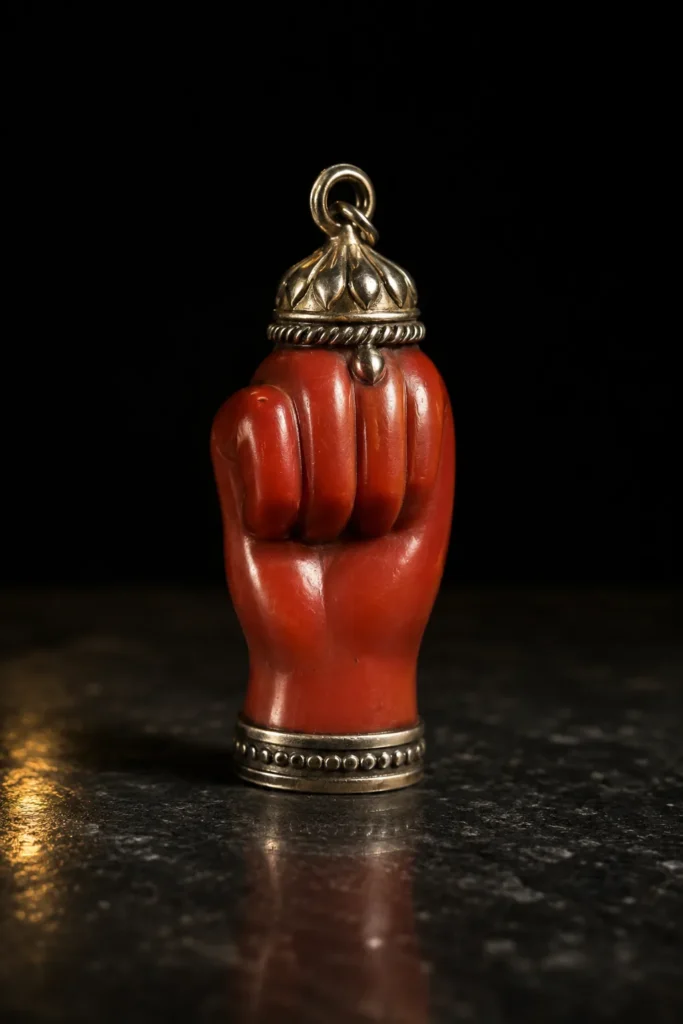
The gesture consists of a closed fist in which the thumb is thrust between the index finger and the middle finger. The tip of the thumb peeks out between the fingers.
This hand position is called the fig. The protruding thumb was likened to the fruit of the fig, and the name of the gesture is derived from this comparison.
The mano fico appears in two forms. It is a gesture made with the living hand, and it is an amulet that reproduces the fig hand in a solid material.
Its task is to ward off the evil eye and misfortune. In religious studies and in folklore studies, the mano fico is regarded as one of the oldest and most widespread hand amulets of the Mediterranean region.
This page presents the mano fico from the perspective of protection. It describes the gesture, the amulet, its origin, its principle of action, and its place alongside related hand signs.
The gesture of the fig hand
The mano fico is first of all a hand gesture. It can be made with either hand without any aids and is therefore available at all times.
In the gesture, the hand is closed into a fist. The thumb is not laid on the outside but pushed through between the index finger and the middle finger, so that its tip peeks out.
This protruding thumb tip is the hallmark of the gesture. It gave the hand position the name fig, because it recalled the shape of the fig fruit.
The gesture is unambiguous and memorable. It can be recognized from a distance and made quickly and inconspicuously, which made it suitable as a protective gesture for the moment.
As an amulet, this very hand position is reproduced. A small shaped fist with a protruding thumb is made from coral, bone, metal, amber, or another material.
The form of the mano fico is thus clearly defined. Whether as a living gesture or as a shaped amulet, the identifying feature is always the fist with the thumb emerging between the fingers.
Origin and age
The mano fico is an ancient sign. The gesture of the fig hand and the corresponding amulet are attested in the Mediterranean region since antiquity.
Amulets in the form of the fig hand have been found in archaeological investigations. They are among the evidence that this hand sign already served as a means of protection in antiquity.
The gesture was associated with fertility and with vital force. This association also explains its warding meaning, since vital force was considered suited to confront misfortune.
From antiquity, the mano fico passed into the later folk custom of the Mediterranean region. Especially in the Italian and Iberian areas it remained alive as a protective gesture and as an amulet.
To be honest, not all the steps of this long history can be documented without gaps. What is certain is the great age of the sign. The precise paths of its transmission over the centuries cannot be traced in every detail.
The mano fico is thus a sign with ancient roots and a long history. A factual account names both the secured great age and the gaps in its transmission.
Warding off the evil eye
The most important task of the mano fico is to ward off the evil eye. In the Italian area this is known as malocchio, which literally means evil eye.
According to this idea, a gaze can cause harm. The evil eye is often associated with envy. The belief in it is widespread throughout the Mediterranean region and is presented in detail on the page about the evil eye.
The mano fico opposes this belief as a means of warding. According to tradition, anyone who makes the gesture or wears the amulet is protected against the malocchio and against other misfortune.
As a gesture, the mano fico is made in a moment of danger. When someone encounters a person from whom they fear misfortune, they inconspicuously form the fig hand to ward it off.
As an amulet, the mano fico offers lasting protection. It was placed especially on children, who were considered vulnerable, and accompanied them through the fragile first years of life.
The mano fico is thus firmly embedded in the belief in the evil eye. It gives a widespread fear a simple warding sign that, as a gesture, was available at all times and, as an amulet, was lastingly effective.
The principle of action of the mano fico
The mano fico follows a principle of action of its own. It does not catch the evil eye like an eye amulet, but wards it off through what the gesture represents.
Research connects the fig hand with an ancient pictorial conception. The gesture was interpreted as a representation of the union of male and female and thus as a sign of fertility and vital force.
The warding meaning is derived from this connection. Vital force was considered the opposite, and thus the counter-remedy, to misfortune. A sign of fertility could ward off ruin.
To this is added the idea that a strong, coarse gesture draws attention to itself. The harmful gaze is directed at the conspicuous sign and leaves the person actually to be protected free.
The hand itself is also essential. The human hand is an ancient and powerful protective sign that stands for action, defense, and blessing, as represented in the hamsa.
The mano fico thus works through the combination of hand and fertility sign. It is neither a frightening image nor a mirror, but a sign that sets vital force against misfortune.
Mano fico and related signs
The mano fico belongs to a family of hand signs that serve in the Mediterranean region to ward off the evil eye. Within this family it does not stand alone.
Closely related is the horned hand, the mano cornuta, in which the index finger and the little finger are extended. Mano fico and mano cornuta form a pair of hand gestures that are often named together.
The two gestures differ in form. The mano cornuta rests on the horn motif, the mano fico on the fig and fertility motif. Both, however, serve the same purpose.
Related too is the horn-shaped amulet, the cornicello, which, like the mano cornuta, rests on the horn motif. Cornicello, mano cornuta, and mano fico together form the core of the Italian warding signs.
Beyond Italy, the mano fico can be compared with the hamsa, the hand amulet of the Mediterranean region. The hamsa too is a hand directed against the evil eye.
The mano fico is thus part of a rich stock of protective gestures and amulets. With mano cornuta, cornicello, and hamsa it shares the purpose, the warding off of the evil eye, and complements these signs in everyday life.
The gesture in gesture and language
The mano fico has a twofold history. It is an ancient protective gesture, and it has at the same time become a gesture with a second, insulting meaning.
In its ancient use, the fig hand was above all a warding sign. It was directed against the evil eye and against misfortune and stood in the service of protection.
Alongside this, a second use developed. The gesture could also be used as a crude, dismissive, or insulting gesture against a person. The two meanings lie close together.
This double meaning is understandable. A gesture that wards off and rejects misfortune can likewise be used to rebuff a person curtly. Warding and rejection are related.
The fig has also left traces in language. In several languages of the Mediterranean region there are expressions that can be traced back to the gesture of the fig hand.
The mano fico is thus a good example of how a sign can carry several meanings. A factual account names both, the ancient protective sense and the second, coarsely dismissive use.
Mano fico in folk custom
The mano fico was firmly anchored in the folk custom of the Mediterranean region. As a gesture and as an amulet it was integrated into daily life in many ways.
As an amulet, the fig hand was placed especially on children. The small amulet of coral, amber, or bone was meant to accompany the child through the fragile first years of life and to keep it safe from the evil eye.
The choice of material was significant here. Coral and amber were themselves considered protective. A mano fico made of such material combined the power of the gesture with the power of the material.
As a gesture, the mano fico was made in moments of danger. This was often done covertly, in the pocket or behind the back, so as not to insult the other person openly.
The mano fico was often used together with other means of protection. It could be combined with the cornicello, with the mano cornuta, and with further amulets, which reinforced one another.
The mano fico is thus not merely a single sign, but part of a living folk custom. Gesture, amulet, and choice of material interlocked and together formed a dense net of defense.
Present-day reception
The mano fico is still known in the Mediterranean region today, even though its use has declined compared with earlier times.
As an amulet, the fig hand continues to be made and worn, often of coral, silver, or amber. It can be found in jewelry and souvenir stalls of the Italian and Iberian areas.
As a gesture, the mano fico is still familiar to many people, but mostly in its second, coarsely dismissive meaning. The ancient protective sense has faded more strongly in everyday life than the insulting use.
For folklore studies and religious studies, the mano fico remains an illuminating subject. It is one of the oldest hand amulets of the Mediterranean region and is well documented in archaeological collections.
Especially illuminating is the double meaning of the mano fico. It shows how a protective sign and a crude gesture can come together in a single hand position.
The mano fico is thus a striking example of an ancient hand amulet. In it are combined the ancient fertility motif, the power of the hand sign, and the wish to ward off the evil eye and misfortune.
Literature (selection)
Related key terms: mano fico, fig hand, protective gesture, evil eye, malocchio, hand amulet, coral, cornicello, Mediterranean region, antiquity.
iWell Guard and protective traditions
iWell Guard stands in the cultural-historical line of portable protective objects to which the mano fico also belongs. A modern companion for people who live with protective symbols: made in Germany, 41 layers of solid gold, platinum, and silver, with a 30-day right of return.
Personal experiences may vary. Not a medical device. No promise of healing.