The Witch Bottle: A Buried Defensive Vessel of Early Modern Folk Magic
By Ralf Ittermann · last reviewed on
The witch bottle, known in the German-speaking world as the Hexenflasche, refers to a sealed and usually buried vessel that served in the early modern period to ward off supposed harmful magic. It was typically filled with pins, nails, hair and bodily fluids of the threatened person.
Archaeological research is aware of numerous finds of such vessels, especially from England and the Netherlands. They are regarded as material evidence of a defensive practice directed against witchcraft, which was felt to be dangerous. This article places the witch bottle within its folkloric and archaeological context.
The witch bottle is a buried defensive vessel of early modern folk magic.
Classification
The witch bottle is a piece of material evidence of early modern defensive magic. It is a vessel, usually of clay or glass, that was filled with certain substances, sealed and deposited in a hidden place.
Its purpose lay not in an active attack but in warding off harmful magic that was already suspected or feared. It therefore belongs among the means of protection of European folk magic, similar to the protective symbols placed on buildings, but acts as an active counter-charm.
The German term Hexenflasche is a comparatively recent word formation modelled on the English term witch bottle. In older German-language folklore studies there are also descriptions such as magic bottle or defensive pot. The thing itself, however, was widespread across large parts of Northern and Central Europe, even though the densest tradition comes from England.
Characteristic is the combination of vessel, contents and place of concealment. Only the interplay of these three elements turned an ordinary jug into an object of defensive magic. Here research speaks of a ritually charged deposit, whose meaning arises from the context and not from the vessel itself.
Witch bottles were deliberately removed from sight. Common find sites are the area beneath doorsteps, beneath hearths or within masonry. This place of concealment distinguishes the witch bottle from worn means of protection such as the amulet and talisman, which were carried on the body, either visibly or concealed.
In the folkloric classification, the witch bottle belongs to the group of building offerings and threshold deposits. It thus joins a broad tradition of objects deposited at critical points of a house in order to secure passages and openings by magical means.
It is important to state soberly that the witch bottle describes a historical phenomenon of belief. Its effect cannot be demonstrated scientifically and is presented here solely as a notion of its respective time, not as a real protective benefit.
Origin and History
The densest tradition of the witch bottle comes from seventeenth-century England. In that period the belief in harmful magic was widespread, and defence by counter-magic was regarded by many as legitimate self-defence. Contemporary writings describe the burying of filled vessels as a common means against supposed bewitchment.
The English scholar Joseph Glanvill and other authors of the seventeenth century mention the practice in their writings on witchcraft. Particularly informative is a description in a work on supposed apparitions of spirits, in which the heating of a bottle filled with urine and pins is portrayed as a remedy against bewitchment.
The roots of the practice probably reach further back. Already in medieval folk magic there are records of notions according to which illness or misfortune could be caused by harmful magic and redirected onto its originator by means of a counter-charm. The witch bottle is a concrete material expression of this notion.
In the German-speaking world similar customs have been handed down, though more sparsely documented in the sources. The Handwörterbuch des deutschen Aberglaubens names various forms of enclosing harmful substances in vessels that are close to the English witch bottle. There was, however, no uniform designation.
With the decline of judicially prosecuted witch belief in the eighteenth century, the witch bottle lost its significance. In rural regions, however, the practice remained locally alive into the nineteenth and, in isolated cases, into the twentieth century, as folkloric surveys show.
The history of the witch bottle is thus closely tied to the history of witch belief itself. It disappeared from everyday use to the extent that the notion of personal harmful magic lost its binding force in society.
Form, Material and Manufacture
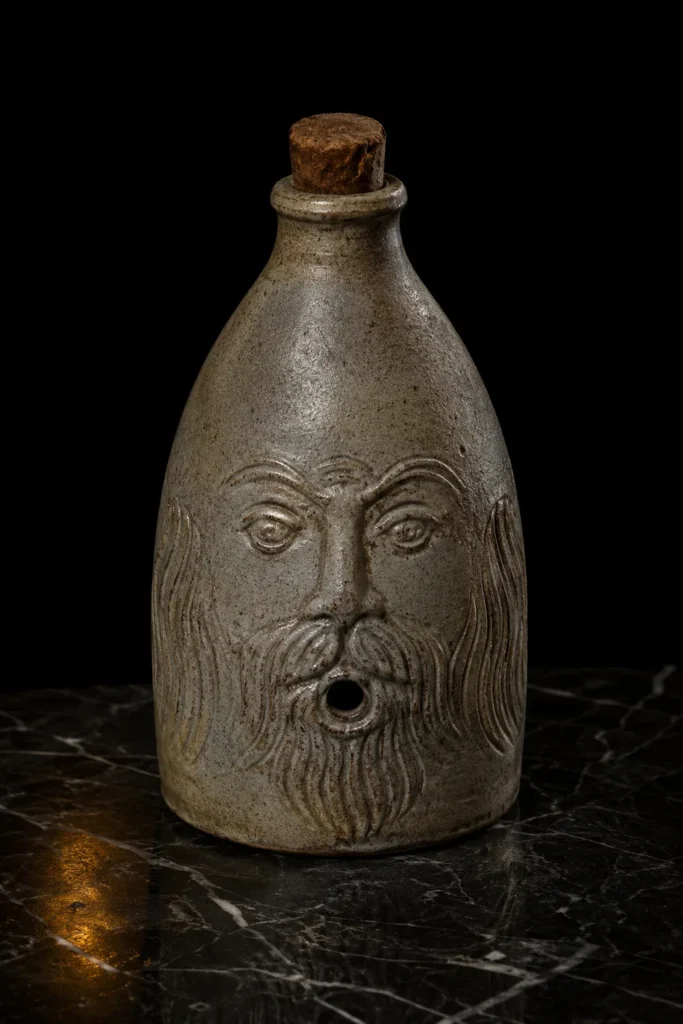
Whatever was available in the household served as the vessel. Especially common are salt-glazed stoneware jugs, in the English record the so-called Bartmann jugs with an applied face. Their stern, bearded mask head gave such finds the names Greybeard or Bellarmine in the older literature.
Alongside these, simple earthenware bottles, glass bottles and small pots were used. In the eighteenth and nineteenth centuries glass vessels increasingly appear. The material was secondary; what mattered was the ability to seal it, since the contents had to be securely enclosed.
The contents followed a recurring pattern. Sharp objects such as pins, nails and thorns form the core of almost all finds. To these were added hair, fingernail clippings and a piece of cloth or yarn belonging to the person to be protected.
A central ingredient was human urine, in some finds also detected through organic residues. Occasionally there were heart shapes of cloth or sheet metal into which pins had been stuck. This composition can be explained from the underlying notion, which is set out in the following section.
The manufacture was not a public act. It took place privately, often at night, and followed rules passed on by word of mouth. Some accounts prescribe silence during the work or particular accompanying formulas. A written set of instructions was unusual.
After filling, the vessel was tightly sealed, for example with a cork, a clay plug or wax. This was followed by burying or walling it in. In some accounts the bottle was instead heated over the fire, which was considered particularly effective.
Folkloric Background and Beliefs
The witch bottle is based on the notion of a magical connection between a person and the constituents of their body. Hair, nails and urine were regarded as carriers of personal substance. Whoever possessed them could, according to this belief, exert influence on the person concerned.
In the case of harmful magic it was assumed that the witch relied on precisely this substance of her victim. The witch bottle reversed this logic. By enclosing his own urine and hair in the vessel, the victim was meant to intercept the magical connection, as it were, and turn it back against the perpetrator.
The sharp pins and nails had a double function here. They were meant to cause the witch pain or to destroy her spell, and at the same time to prevent the harmful magic from reaching its actual target. The pain, according to the notion, struck not the victim but the originator.
Heating over the fire intensified this notion. It was believed that the witch felt the growing heat in her own body and was forced to lift the spell in order to end the torment. This interpretation explains why some accounts name heating as the most effective form.
Behind the custom stood a widespread explanatory model for misfortune. Illness, the death of livestock or persistent bad luck were interpreted not as chance but as caused. The witch bottle offered a possibility for action where medical or economic knowledge failed.
From a folkloric perspective, the witch bottle is thus an expression of a worldview in which personal suffering had an identifiable originator. It combined fear, the need for explanation and the desire for active action into a concrete object.
Application and Custom
The use of the witch bottle presupposed the suspicion that a particular person or power had caused harm. Only then did one reach for this means. It was not a preventive everyday object but a reaction to concrete misfortune.
After filling came the deposition. The most common place was the area beneath the doorstep or the hearth. Both spots were regarded as magical thresholds of the house at which harmful things could enter or be channelled. The witch bottle shares this logic with other building-protection customs.
A further form of application was the heating already mentioned. Here the bottle was placed on the fire until it burst or the cork sprang out. The bursting was regarded as a sign that the spell had been broken. Because of the risk of injury, however, this custom was not without danger.
The performance often lay with the affected person themselves or with a local healer, who in the English-speaking world was called a cunning man or cunning woman. These persons possessed the orally transmitted knowledge of the correct procedure.
Accompanying spells and prayers were spoken. In regions shaped by Christianity, magical and religious elements combined, for instance through the inclusion of words from the Bible. This blending is typical of the popular piety of the early modern period.
After the deposition had taken place, the bottle was, if possible, not to be touched or dug up again. A disturbance was regarded as dangerous, since it might release the enclosed spell again. This notion explains why many witch bottles were only found centuries later during construction work.
Regional Variants and Related Practices
The English witch bottle is the best known, but not the only form. In the Netherlands comparable finds are documented, which points to cultural exchange across the North Sea. Related customs are also found in Northern Germany and Scandinavia.
In the German-speaking world the witch bottle overlaps with the custom of enclosing harmful substances in pots or small containers. These were sometimes not buried but hung in the chimney or hidden in the stable in order to protect the livestock.
Related is the practice of deliberately placing objects into walls and foundations. These include hidden shoes, dried animal bodies and coins. These building offerings share with the witch bottle the idea of securing critical points of the house by magical means.
A further related form is the use of inscribed slips of paper placed into vessels. Here the witch bottle approaches the custom of the protective letter and other writing-based means of defence.
In North America the tradition lived on through European emigrants. There, too, buried bottles with pins and personal substances are archaeologically attested. They show how the custom travelled across the Atlantic with the settlers.
The regional variants differ in vessel form, contents and place of concealment, yet share the basic idea. This constancy alongside local diversity is a recurring feature of folk-magic customs in Europe.
Significance as a Means of Protection
The protective significance of the witch bottle rests on the idea of reversal. It was meant not simply to ward off the harmful magic but to redirect it back to its originator. It thus combined protection and counter-charm in a single object.
From the perspective of those affected, the value of the bottle lay in the fact that it enabled an action. Whoever felt bewitched was not helplessly exposed to the misfortune but could do something. This psychological function of agency has been emphasised several times by research.
The place of concealment reinforced the protective notion. By lying beneath the threshold, the bottle, according to the belief, secured the most dangerous passage of the house. Protection was thus spatially bound to the architecture.
The sharp contents were regarded as an active protective barrier. Pins and thorns were meant to impale the spell, as it were, and render it ineffective. This notion of the protective effect of sharp and pointed objects is frequently found in European folk magic.
Unlike many other means of protection, the witch bottle was person-specific. According to the belief, it worked only for the person whose substance it contained. It was thus an individual, not a general, protective object.
It should be emphasised that this protective significance describes a historical belief. A real defensive benefit against harm cannot be demonstrated. The value of the witch bottle for research lies in the fact that it vividly illustrates a past way of thinking.
State of the Sources and History of Research
The state of the sources on the witch bottle is twofold. On one side stand written testimonies of the early modern period, on the other the archaeological finds, whose number has grown steadily since the nineteenth century.
Among the most important written sources are works by English authors of the seventeenth century on witchcraft and apparitions of spirits. They provide the oldest detailed descriptions of the custom. To these are added court records and pastoral writings that document witch belief.
Archaeological research began when filled vessels regularly came to light during demolition and conversion work. For a long time they were not recognised and were misinterpreted as household goods. Only the folkloric classification made it possible to identify them as defensive deposits.
An important role for German-language research is played by the Handwörterbuch des deutschen Aberglaubens, which deals in detail with the custom of enclosing harmful substances. It places the witch bottle within the larger context of counter-magical means.
In more recent times scientific analyses have broadened the research. Examinations of vessel contents have been able to detect urine and organic substances and thus to confirm the written sources materially.
The history of research shows that the witch bottle long stood at the margins of attention. Only the combination of archaeology, folklore studies and natural science has established it as a serious object of study.
Contemporary Reception
In modern esotericism and in contemporary witch belief the witch bottle is once again present. Vendors and self-help literature describe instructions for making so-called protective bottles. This modern practice, however, differs markedly from the historical tradition.
Modern variants frequently use dried herbs, salt and colourful ribbons instead of urine and pins. The character has shifted from a counter-charm against a concrete enemy towards a general protection for house and home.
In museums and exhibitions original witch bottles are sought-after exhibits today. They illustrate everyday life in the early modern period and the extent of the witch belief of that time in a striking way.
The witch bottle also appears in literature, film and popular non-fiction. There it is often romanticised or used as a picturesque detail, which pushes the historical context of fear and persecution into the background.
Anyone interested in the historical practice will find reliable information in folkloric and archaeological accounts rather than in esoteric guides. The topic overview of the protective symbols offers an organised introduction to this.
It remains to be noted that contemporary reception reinterprets the witch bottle. From a means of self-defence against supposed harmful magic it has become a decorative and symbolic object, whose historical meaning should be considered separately from this.
Literature (Selection)
Related key terms: witch bottle, harmful magic, counter-charm, Bartmann jug, building offering, witchcraft, early modern period, doorstep, folk magic, defensive magic, Greybeard.
iWell Guard and Protective Traditions
iWell Guard stands within the cultural-historical line of portable protective objects to which the witch bottle also belongs. A modern companion for people who live with protective symbols: made in Germany, 41 layers of genuine gold, platinum and silver, with a 30-day right of return.
Personal experiences may vary. Not a medical device. No healing promise.