Protective Fire and Threshold Light
By Ralf Ittermann · last reviewed on
Among the means of light, fire is the oldest, the most penetrating and the most communal.
While a candle lights up a room and a bell sounds across a courtyard, a fire marks a boundary for all who can see it. This quality led cultures around the world to use fire not only for warmth and cooking, but as a ritual means of protection: at the threshold of the house, on the summit of the mountain, at the edge of the village, at the turning points of the year.
Protective fire and threshold light form the large-scale pole within the category Sound and Light. They complement the individual practices of the protective candle and the protective bells with collective, space-related means of protection that are not carried by the individual, but kindled and kept in a place.
Quick Overview
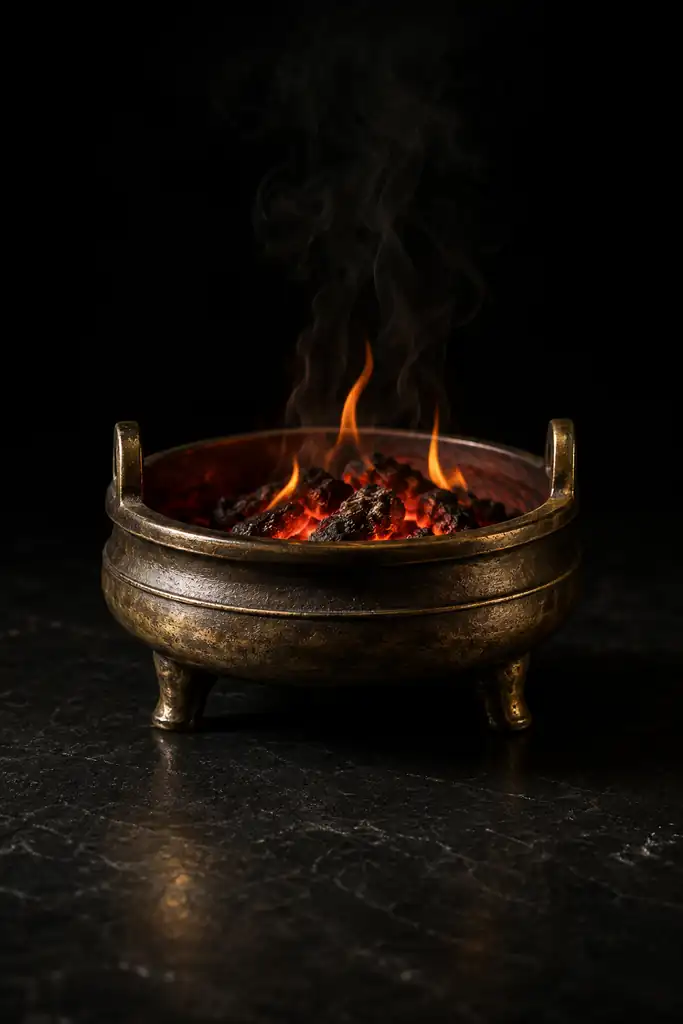
In tradition, fire at the threshold is regarded as protection against harmful beings that use darkness, cold and the open times of the year to enter. Need-fires were kindled collectively to avert cattle plagues and other misfortunes.
Solstice fires marked the boundaries of the year at which evil spirits were held to be especially active. Threshold light in the form of torches, oil lamps or braziers kept the transition between inside and outside secured. The effect is tied to the burning and ends when the fire goes out.
Origin and Tradition
The tradition of the protective fire reaches back further than any written testimony. Archaeological findings suggest that fire at entrances and graves had a ritual function in prehistoric times. The ethnological research of the 19th and early 20th centuries gathered an abundance of evidence for fire customs connected with protection and defense.
In Germanic and Celtic folk belief, fires at the nodal points of the year played a prominent role. Walpurgis Night, Midsummer (St. John’s) and the Twelve Nights were times at which the boundary between the world of humans and the world of spirits was held to be permeable.
In tradition, on these nights fires were kindled on hills, cattle were driven through smoke or fire, and gates and doors were marked with charcoal signs.
The need-fire, also called nodfire or friction fire, was a special form: it was kindled by rubbing two pieces of wood together, and every other fire in the village first had to be extinguished, in order to be rekindled from the new fire.
This custom was held to be especially effective against cattle plagues and other ills.
In ancient Greece and Rome, eternal fires burned in temples, especially in the Temple of Vesta in Rome, where priestesses maintained the flame of the city-protecting goddess. The extinguishing of this flame was regarded as a dire omen that interrupted the protective effect of the fire for the entire city.
In Iran and among the Zoroastrians the sacred fire is alive to this day. In Zoroastrian theology, fire is regarded as the embodiment of the pure creation of Ahura Mazda and at the same time as a means of defense against Ahriman and his daevas.
In fire temples, or Atash temples, the sacred fire burns without interruption. The domestic fire at the hearth enjoyed the same sacred status on a smaller scale.
In Slavic folk tradition, many regions knew the custom of kindling fires at the boundaries of the village at certain times of the year and walking around them.
This encirclement was meant to set apart the space of the community from everything that could do harm. Torches were also used at weddings and funerals, in order to mark the transition and to keep evil influences away.
In Japan, the bonfire practices of otaki-age, in which carried amulets from the old year are burned, and dondoyaki, in which New Year decorations are given to the fire, are expressions of the same conviction: the fire purifies, transforms and closes a cycle.
Working Principle According to Tradition
The tradition explains the protective effect of fire in several ways. The most direct is the quality of light: fire illuminates the area in which dark and light-shy beings seek to act, and thereby deprives them of the condition of their activity.
A second explanation emphasizes the purifying power of heat and smoke. What passes through fire or is surrounded by fire is regarded as cleansed of adhering harmful influences. This idea connects the protective fire with smudging rituals: there too it is less the light than the transformative power of burning and smoke that takes effect.
A third dimension is the marking of boundaries. A fire that burns at the threshold or around an area draws a visible line.
In tradition, this line is regarded as a physical barrier and beyond that as a boundary of meaning: here ends the protected area of the community or of the house. Beings that do not belong to this area cannot, according to folk description, cross this line as long as the fire burns.
Fourth, fire is regarded as a medium of communication with higher powers. The prayer at the fire, the offering thrown into the fire, the observation of the flame as a sign: these practices unite protective action and religious practice in one.
Cross-Cultural Spread
Germanic and Celtic area: need-fires, Midsummer fires, Walpurgis fires, Easter fires. Driving cattle through fire as protection against plague. Charcoal signs over door and window lintels.
Iran and Zoroastrianism: Atash Bahram as the highest form of the eternal fire, hearth fire as a daily protective practice, fire at Nowruz (New Year festival) for purification.
India: Agnihotra as a Vedic fire ritual, Yajna as a sacrificial fire, the fire of the hearth god Agni as threshold protection. Diwali, the festival of lights, links firelight with protection by Lakshmi and the driving away of misfortune.
Japan: otaki-age, dondoyaki, sakihare fires at Shinto shrines. The bonfire custom around the turn of the year is regarded as purification and preparation for the new year.
North America: In numerous indigenous traditions, fire plays a central role as a means of purification and protection. Sweat lodge ceremonies, vision quests and winter ceremonies use fire in order to cleanse the space and to call upon protective spirits.
Africa: Hearth fires and campfires as means of protection are described in many sub-Saharan cultures. Fire at the entrance of the homestead or at the grave is regarded as protection against wandering spirits.
What It Is Used Against
The tradition describes protective fire as especially effective against:
Spirits of the year and seasonal threats. Beings that, according to folk tradition, become active at certain times of the year, especially in the dark halves of the year and at the transitions of the seasons.
Midnight spirits that roam during the Twelve Nights, nightmares (Alps) and other nocturnal beings are regarded as shy of fire and light.
Collective threats to house and hearth. Cattle plagues, crop damage and other misfortunes that, according to folk tradition, are triggered or favored by harmful influences were meant to be banished by collectively kindled need-fire.
Boundary-crossing beings. Spirits, demons and harmful nature beings that try to cross the boundary between the protected space of the human community and the outside. The fire at the threshold marks and reinforces this boundary.
Adhering impurities. Beings are one part of this; conditions are the other: grief, illness, the remnants of the year that have accumulated in the body or in the place are regarded in many traditions as dissolvable by fire.
Which concrete beings from the lexicon are linked with protective fire is shown by the Protection Compass.
Application and Limits
The tradition knows various forms of protective fire that cover different contexts. The need-fire was a communal emergency measure that required collective action.
The threshold torch or the hearth fire was a daily or seasonal household practice. The turn-of-the-year fire on heights was a public ritual. Each form had its own rules, timings and performers.
The limits lie above all in the tie to the place. A fire protects the area that it illuminates or bounds, not the person who moves away from it. The protective fire is thus a place-bound means that differs fundamentally from carried means of protection such as amulets.
Furthermore, the protective effect ends when the fire goes out. According to many traditions, the fire must not be allowed to go out as long as the need for protection persists.
A fire that goes out on the night of protection is regarded as a bad sign. The quality of the fire also plays a role: need-fires kindled by friction were held to be purer and more effective than those kindled with already existing fire.
Literature (Selection)
Related key terms: protective fire need-fire threshold light fire defense.
iWell Guard and Protective Traditions
Protective fires bear witness to the fact that cultures everywhere have had the experience that light draws a boundary between the area one claims and what stays outside. From Iranian Atash temples to Germanic nodfires, the kindling of a fire was a communal act with a clear message.
The iWell Guard carries this principle into a form that the individual can keep on their person: as a synthesis of the protective traditions that cultures developed independently of one another, in order to assure themselves of support against the unknown.
Personal experiences may vary. Not a medical device. No promise of healing.