Maat: Egyptian Goddess of Order, Truth and Justice
By Ralf Ittermann · last reviewed on
In ancient Egypt, Maat was at once a goddess and a principle. She embodied the cosmic order, the truth and the justice on which the world rested. In the judgment of the dead, the heart of the deceased was weighed against her feather, and the actions of the king were likewise bound to her.
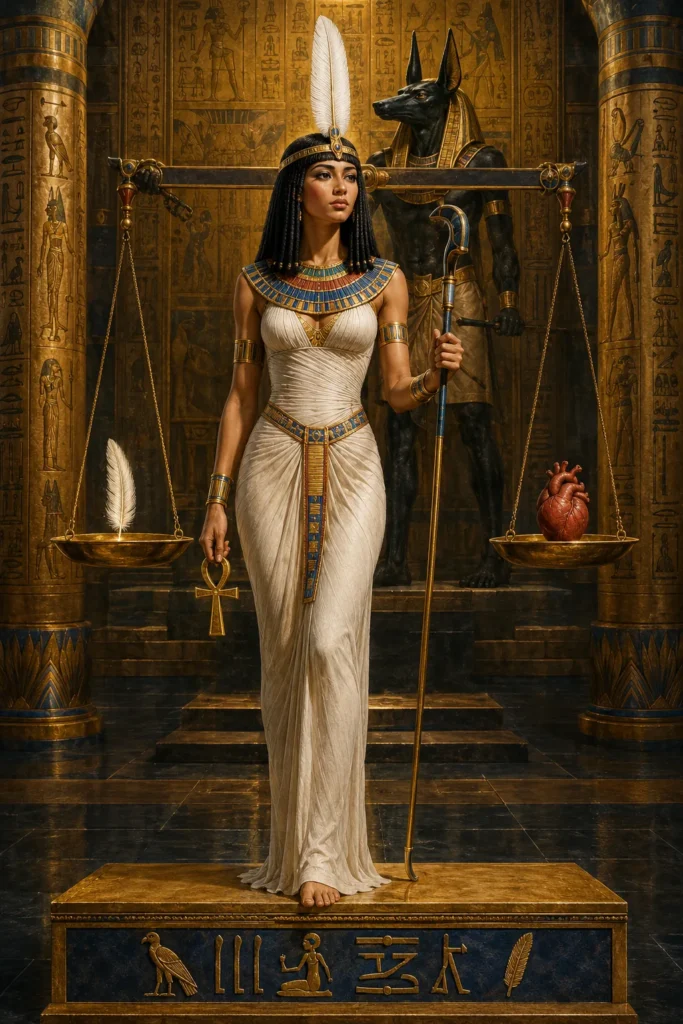
Classification
Maat belongs to the central concepts of ancient Egyptian religion and culture. She is a goddess and at the same time an abstract principle, which distinguishes her from many other figures of the Egyptian pantheon.
While gods such as Ra, Osiris or Isis appear above all as acting persons, Maat also stands for an idea, namely for the proper order of the world. This order encompasses the course of the stars, the changing of the seasons, the Nile flood, social coexistence and just judgment.
In the religious thought of Egypt, Maat was the opposite of chaos, falsehood and injustice. According to this view, the world was not stable on its own but had to be established and preserved again and again through the actions of gods and humans.
This task fell in a special way to the king, who was regarded as the guarantor of Maat. Each individual, too, was called to act in accordance with Maat in their life.
In the history of religion, Maat is a key concept, because the Egyptian understanding of world, law and ethics is concentrated in her. She combines cosmology, royal ideology, legal thought and personal conduct of life into a coherent worldview.
Name and Etymology
The name Maat goes back to an Egyptian root associated with terms such as straight, correct and true. From this root derive meanings that aptly describe the word.
Maat denotes truth, justice, proper order and the right measure at the same time. There is no single English equivalent, which is why scholarship often leaves the term untranslated.
The word could designate both the abstract principle and the personified goddess. In written Egyptian, Maat is rendered with a characteristic sign, most often interpreted in scholarship as a stylized base or pedestal, as well as with the feather, which became the established symbol of the goddess.
Noteworthy is the close connection between language and religion. When Egyptians spoke of a life or action in Maat, they did not mean mere rule-following but the agreement of one’s own conduct with the fundamental order of the world. The term runs through wisdom texts, legal documents, royal inscriptions and religious writings alike.
Description and Iconography
Maat is depicted in Egyptian art as a seated or standing woman. Her unmistakable characteristic, stable throughout the whole of Egyptian history, is the ostrich feather she wears on her head.
In some depictions the feather alone, without the human figure, already serves as a fully valid sign for the goddess and the principle she embodies.
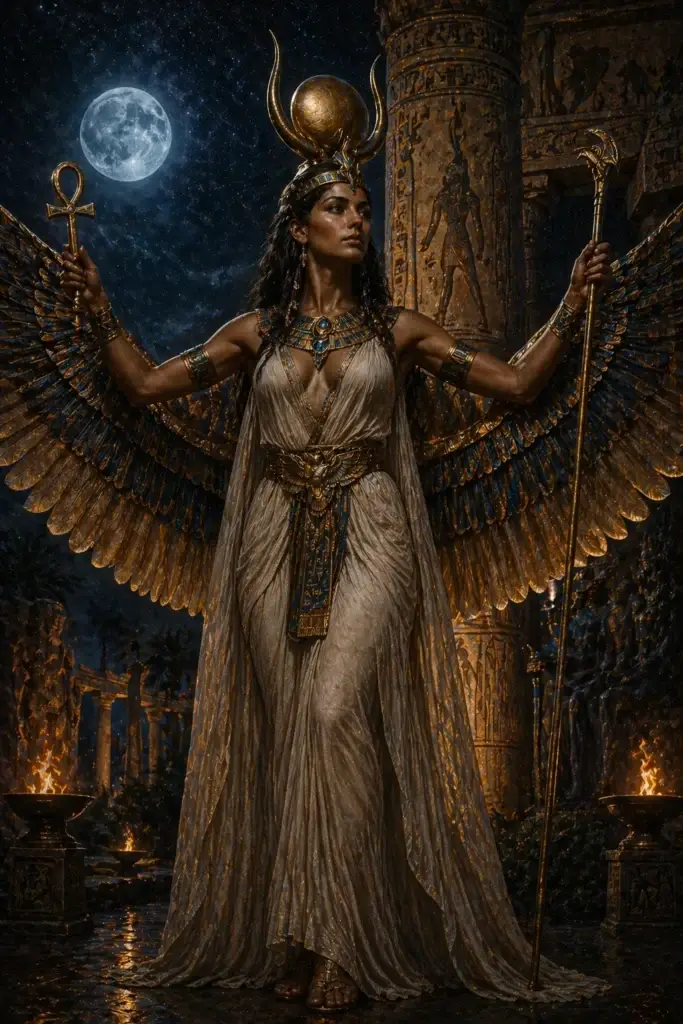
Maat is frequently shown with outstretched, winged arms, a gesture that suggests protection and the embracing of order. In her hands she may hold the sign of life. Her depictions are found on temple walls, on stelae, in tombs and on numerous small objects.
A particularly widespread pictorial formula is the scene in which a king offers a small figure of Maat to a deity. This gesture, the offering of Maat, is one of the most important motifs of Egyptian temple reliefs.
It shows that the king fulfils his foremost task, namely to return order to the gods and thereby to secure the continued existence of the world. Within the beliefs about the dead, the feather of Maat as a counterweight on the scales of judgment is the defining pictorial element.
Mythological Narratives
Maat stands less at the centre of narrative myths with an elaborated plot than at the centre of cosmological and theological statements. In the conceptions of the creator god, Maat is regarded as bound up with creation from the very beginning.
She is called the daughter of the sun god Ra. By this is meant that the proper order is given with the act of the world’s coming into being itself and is not added only afterwards.
Maat plays a central role in the course of the sun. The sun god traverses the sky by day and the underworld by night.
Texts describe that Ra lives on Maat and that the gods nourish themselves on Maat. In this conception, Maat is the foundation without which even the gods and the course of the sun could not exist.
The daily victory of the sun god over the forces of chaos, embodied by the serpent Apophis, is at the same time a victory of Maat over disorder.
In some depictions Maat stands at the prow of the solar barque and shows the way, so that the god’s journey itself appears as movement in proper order.
The best-known mythical scene involving Maat is the judgment of the dead, known above all from the so-called Book of the Dead, whose relevant chapter is counted in scholarship as spell one hundred and twenty-five.
The deceased steps before a tribunal of gods, led by Osiris and including numerous further judges. The heart is placed on a balance, on the other side of which lies the feather of Maat. The god Anubis supervises the weighing, the god Thoth records the result.
If the heart is in equilibrium with the feather, the deceased has led a life in Maat and is found just. If the verdict is negative, destruction threatens through a composite creature, referred to in the sources as the devourer and bearing features of crocodile, lion and hippopotamus.
Before the tribunal the deceased speaks declarations in which he enumerates what wrongs he has not committed. This so-called negative confession is addressed to a series of individually named judges and names offences against gods, against humans and against the social order.
Cult and Veneration
Maat was venerated in cult in ancient Egypt, although her veneration was arranged differently from that of the great state gods with their own large temples.
There were sanctuaries and chapels consecrated to Maat, among them a sanctuary in the area of Karnak, and she had a priesthood. Tellingly, persons concerned with the legal system stood in a particular relationship to Maat.
The highest judge or vizier could be designated as a priest of Maat, which underscores the close connection of goddess, justice and jurisdiction. From the New Kingdom it is recorded that the vizier wore an image of Maat during official acts, a visible sign that his judgment was bound to the goddess.
The most important cultic act in connection with Maat was the daily temple ritual, in which the king, represented by the priesthood, offered Maat to the gods. This ritual of offering Maat was performed in many temples and was regarded as one of the most effective offering acts of all.
The small figure of Maat that was presented symbolically comprised all other offerings, for whoever offered order itself gave the gods the most comprehensive gift. Scholarship has pointed out that this ritual at the same time contained a political statement, since it confirmed the king again and again as the legitimate guardian of order.
Beyond this, Maat was omnipresent in religious life without requiring a temple visit of its own. She was anchored in royal ideology, in legal practice, in the wisdom teachings with which officials were educated, and in beliefs about the dead.
Personal names that referred to Maat, as well as titles of officials, show how deeply the term was embedded in the self-understanding of the educated. The veneration of Maat is therefore shown less in a delimited cult than in the permeation of all areas of life by the principle she embodied.
Protective Practice and Apotropaic Aspects
In Egyptian thought, living in accordance with Maat was itself the most important form of protection. Whoever spoke truthfully, acted justly and observed the right measure stood in harmony with the order of the world and need not fear the judgment.
The wisdom teachings, a literary genre of their own, conveyed precisely this knowledge. They taught how, through conduct in accordance with Maat, one secured a successful life and a good standing in the afterlife.
In the beliefs about the dead, preparation for the judgment of Maat had an almost apotropaic character. The Book of the Dead contained spells with which the deceased was to pass the judgment, among them the confession before the judges and spells for securing the heart.
Heart scarabs, that is, amulets in beetle form, were placed with the deceased and were intended to prevent the heart from testifying against the dead person at the judgment.
Maat herself, however, was not a deity invoked like a protective deity against demons. Her protection acted indirectly, through the maintenance of order. A world in Maat was a world in which chaos and its harmful forces remained held back.
In this sense, striving for Maat was the fundamental precaution against calamity, both in this world and in the afterlife. No further efficacy in the modern sense is claimed by this.
Parallels in Other Cultures
The concept of a comprehensive world order that is at once cosmic, social and ethical is found in several ancient cultures.
In the discussion within religious studies, Maat is frequently compared with terms from other traditions, for instance with the concept of a cosmic order in ancient Indian thought. Such comparisons show that Maat belongs to a more widely distributed type of conceptions of order.
Within the ancient Near East, Maat can be related to Mesopotamian conceptions of divinely ordained law and truth, without a direct borrowing needing to be assumed. Greek thought, too, knows figures and terms that personify justice and proper order. These parallels are to be understood as typological kinship, not as historical dependence.
A particular feature of Maat lies in the close fusion of goddess and principle as well as in the central position she occupies in royal ideology and in beliefs about the dead.
While in other cultures the idea of world order often remains more strongly abstract, in Egypt it was formed into a clearly defined divine figure with its own iconography and its own cult. The comparative view of religions helps to recognize more clearly both the common ground and the specifically Egyptian.
Reception and Research Today
Maat is a much-discussed topic in modern Egyptology. The source situation is broad, since the term appears in nearly all text genres, from temple inscriptions through wisdom teachings and legal documents to the Book of the Dead.
On this basis, scholarship has worked out Maat as a key concept of the Egyptian worldview. An influential study has described Maat as a form of connective justice, that is, as a principle that links action and outcome with one another and holds society together through mutual obligation.
The change of the concept of Maat over the long course of Egyptian history is also discussed. In times of crisis, for instance in the so-called lamentations of the First Intermediate Period, Maat appears as an endangered or even overturned order whose restoration is longed for.
Such texts show that Maat was not regarded as a self-evident state but as something that could be lost and had to be won again and again.
Particular significance attaches to the discussion of how Maat is to be understood as a connection of cosmology, ethics and social law. Studies have shown that Maat was not only a religious but also a social and legal guiding concept.
Action in accordance with Maat connected the sphere of the gods with the everyday life of humans. Scholarship emphasizes that Egyptian law and the Egyptian conception of solidarity and mutual obligation are closely linked with this term.
In the wider public, Maat is known above all through the scene of the judgment of the dead and the weighing of the heart, which is among the most frequently reproduced images of Egyptian religion.
Popular depictions, however, often reduce the term to justice or truth alone. A sound engagement with Maat relies on the Egyptological scholarly literature and the edited sources, which make her many-layered nature as goddess and as principle visible.
Literature (Selection)
- Jan Assmann: Maʿat. Gerechtigkeit und Unsterblichkeit im Alten Ägypten (1990)
- Erik Hornung: Der Eine und die Vielen. Altägyptische Götterwelt (1971)
- Stephen Quirke: Ancient Egyptian Religion (1992)
- Maulana Karenga: Maat, the Moral Ideal in Ancient Egypt (2004)
- Emily Teeter: The Presentation of Maat. Ritual and Legitimacy in Ancient Egypt (1997)
Related key concepts: Maat Egyptian goddess judgment of the dead feather truth justice world order Book of the Dead weighing of the heart.
iWell Guard and Protective Traditions
iWell Guard ties in with the cultural-historical tradition of wearable protective objects, in the tradition of Egypt and many other cultures worldwide. 41 layers, solid gold, platinum, silver, made in Germany. 30-day right of return.
Personal experiences may vary. Not a medical device. No promise of healing.