Näkki, the terror beneath the beautiful facade
By Ralf Ittermann · last reviewed on
Näkki is a spirit of Finnish (Kalevala) tradition.
Draws children who seek their reflection into the water. The entry warns of the terror hidden beneath a beautiful facade that lures children toward the water. Näkki is a well-known water spirit of Finnish legend associated with the Kalevala tradition.
The Näkki is a water spirit of Finnish and Estonian folk tradition. He dwells in murky ponds and wells, as well as at jetties and under bridges, and is regarded as the lord or terror of the given body of water.
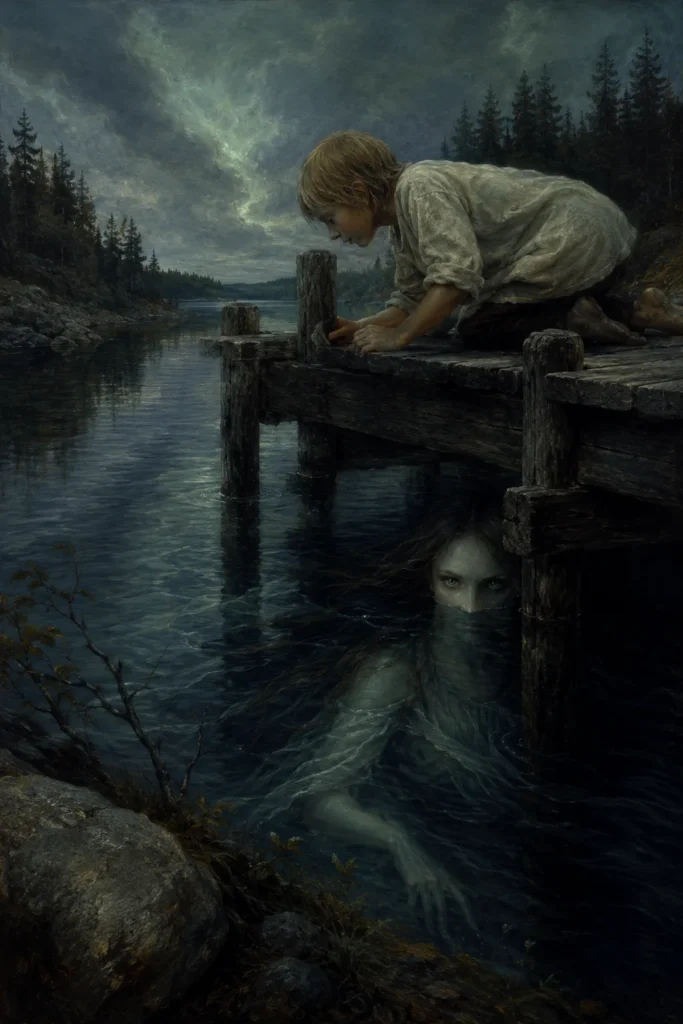
He became known chiefly as a bogeyman for children: whoever leans too far over a bridge railing or jetty to look at their own reflection is pulled into the depths by the Näkki. In this way, the tale deliberately kept children away from dangerous shoreline spots.
Type: Water spirit, warning figure for children
Origin: Finnish and Estonian folk tradition
Texts: well attested through clear etymology and traditional protective sayings
Period: alive to this day
Appearance: variable, often femininely seductive or as a fish-man
Traditional context
Period of the Texts
Alive to this day: the Näkki belongs to Finnish and Estonian folk tradition and is part of popular overviews of Finnish mythology.
Area of Diffusion
Finland, with the Estonian equivalent Näkk. He dwells in murky ponds and wells, as well as at jetties and under bridges.
Sources
Good: a clear etymology and traditional protective sayings attest to the figure, supported by the standard works of Harva, Siikala and Haavio.
Name and variants
Finnish: The Swedish word näck was adopted as a loanword into Finnish and Estonian, giving rise to Näkki and the Estonian form Näkk; this attests to the close connection to the Scandinavian Näcken. Traces appear in the everyday Finnish word näkinkenkä, literally ‘shoe of the Näkki’, the name for the shell of a mussel.
Appearance and behaviour
Appearance
Tradition follows a contradictory but recurring pattern: from the front the Näkki is strikingly beautiful, but his back is hairy and hideous. Other accounts turn him into an ugly fish-man who transforms at will into a beautiful woman or into a silvery fish, a horse or a dog. The Estonian Näkineiu, by contrast, always appears as a beautiful water maiden with a fish tail.
Effect
The Näkki mainly pulls small children into the depths when they lean over bridge railings, jetties or stretches of water to look at their reflection and touch the water. The Estonian Näkk likewise lies in wait for swimmers and lures them into his underwater realm with a voice resembling the murmuring of the river.
Profile: Näkki
The key aspects of the water spirit at a glance.
A water spirit of Finnish and Estonian folk tradition, classified among the Haltija, the local spirits of a natural area.
Children and adults at dangerous shoreline spots: bridges, jetties and wells are his preferred lurking places.
Beautiful from the front, his back hairy and hideous; shapeshifting as a fish-man, a beautiful woman, a fish, a horse or a dog.
A warning figure: his reputation kept children away from dangerous behaviour near water and served parents as a targeted aid in upbringing.
Traditional magic words spoken on entering and leaving the water, together with iron, an amulet and salt as protective means.
Between loanword and Haltija spirit
The Näkki, Estonian Näkk, is a water spirit of Finnish and Estonian folk tradition who dwells in murky pools, wells, and at jetties and under bridges. The Swedish word näck was borrowed into Finnish and Estonian, which attests to the close connection with the Scandinavian Näcken. Linguistic traces survive even in everyday words, for instance in the Finnish word for mussel shell, näkinkenkä, literally shoe of the Näkki.
The Näkki belongs to the Haltija spirits, the local spirits of a natural area, and is master or terror of the respective body of water. Unlike the great water deities Ahti and Vellamo, who rule over water as a whole, he appears as a concrete, place-bound danger: not a ruler, but a lurker.
A bogeyman for children to this day
The Näkki remains alive in Finland today as a bogeyman figure for children and is a fixture in popular overviews of Finnish mythology. The mermaid motif of the Estonian Näkineiu links him to the broader European tradition of mermaids and water nymphs.
In terms of religious studies, the Näkki belongs to the class of Haltija, the local spirits of a natural area, within the Balto-Finnic nature religion. His double function is characteristic: a personified natural hazard and a social figure of upbringing, a warning spirit for children. The Scandinavian origin of his name shows the cultural exchange across the Baltic Sea.
Magic words at the water
Specific magic words have been passed down. On entering the water, one would say in effect that the Näkki should go to land while one went into the water, and that he would not dare take anyone; on coming out, the saying was reversed, one going to land and the Näkki back into the water. These sayings form the source-attested core of the protective practice. In addition, iron, an amulet worn by children near water, and salt as an old cleansing agent were regarded as effective; fish offerings are less well attested for the Näkki himself than for the water mothers, to whom the first catch was offered.
Näcken, Vesihiisi and the Finnish water powers
The Näkki is directly related to the Scandinavian Näcken, whose name goes back to the same Germanic word family as the German Nix; despite the shared root, he remains an independent Finnish-Estonian figure. Closer still is his relationship to the Vesihiisi: some sources call the Näkki himself Vesihiisi or Vetehinen, though the Vesihiisi places greater emphasis on the demonic side and its classification within the Hiisi system. Above both stand the great water deities Ahti and Vellamo, while the monstrous Iku-Turso embodies the far more dangerous, chaotic side of Finnish waters, making the Näkki appear a comparatively small, place-bound danger.
Frequently asked questions about the Näkki
Is the Näkki male or female?
Both. The Näkki is a shapeshifter and appears as a fish-man, as a beautiful woman, or as an animal, such as a horse, dog or fish.
Why does the Näkki lurk at bridges and jetties?
Because that is where people, especially children, lean over the water. The tale served as a warning against precisely these hazardous spots.
How does one protect oneself from him?
Through the traditional magic words spoken on entering and leaving the water, and by avoiding dangerous shoreline spots.
Further links
Literature (selection)
Further standard works in the bibliography.
Näkki water spirit: this is how Finnish tradition aptly describes the figure who lurks at bridges, jetties and wells, meant to keep children away from dangerous shores. As a Finnish water spirit, he is thus far more than a mere bogeyman: his magic words hold centuries-old knowledge about the danger of open water.