Xtabay, the singing death-woman of the Ceiba
By Ralf Ittermann · last reviewed on
Xtabay is a spirit of Maya tradition.
She combs her hair at the world tree and lures men to their deaths.
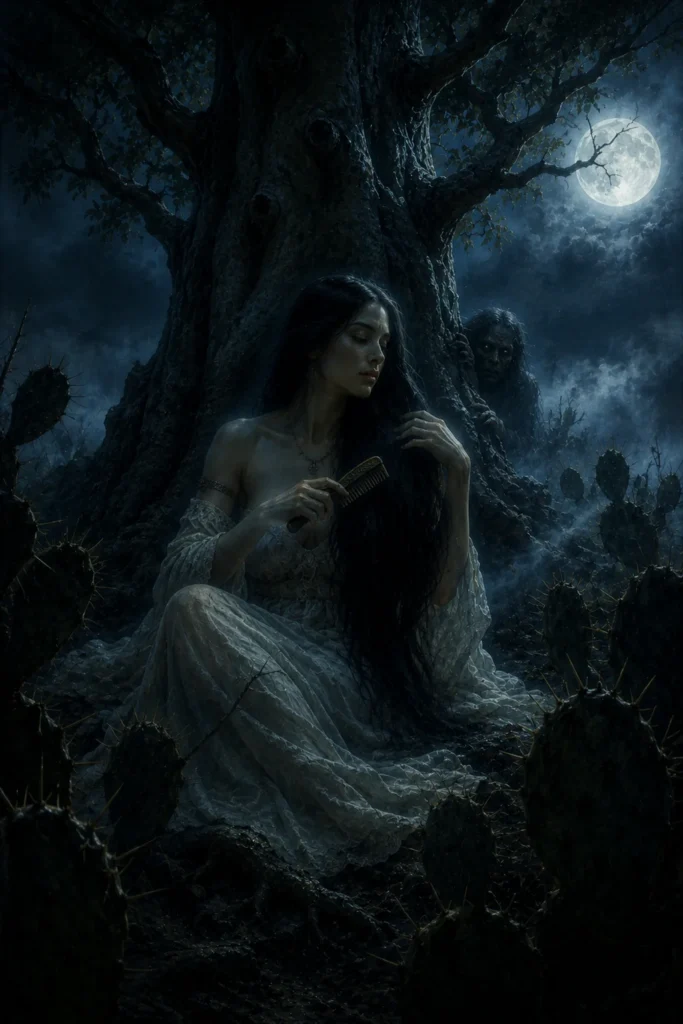
Xtabay is the deadly seductress of the Maya, found throughout the Yucatán Peninsula and the wider Maya cultural region. As a beautiful woman with long black hair, she combs herself at night beneath a sacred Ceiba and lures passing men, especially night-time travellers, with her singing.
Whoever follows her is killed or driven mad, and found dead at the foot of the tree the next morning. The well-known two-sisters version of the legend, recorded in the early 20th century from an older substrate, explains her origin.
Type: Deadly seductress, spirit of Maya tradition
Origin: Yucatec Maya, Yucatán Peninsula and Maya cultural region
Texts: well documented, including the academic study by Osborn (2022) and regional Maya folklore collections
Period: Yucatec Maya, the transmitted two-sisters version since the early 20th century from an older substrate
Appearance: a beautiful woman with long black hair, combing herself beneath a Ceiba
Textual history
Period of the Texts
The legend is Yucatec Maya; the well-known two-sisters version was recorded in the early 20th century from an older substrate.
Area of Diffusion
The Yucatán Peninsula and the wider Maya cultural region.
Sources
Well documented: including the academic study by Osborn as well as regional Maya folklore collections and overview accounts from Yucatán.
Name and variants
Yucatec Maya: The name Xtabay is linked to the Xtabentún vine and contains the element tab, meaning rope or noose, evoking the image of entanglement. Xtabay is the deadly spirit derived from Utz-Colel, whereas the harmless Xtabentún flower and the liqueur of the same name derive from Xkeban.
Appearance
Appearance
Xtabay appears as a beautiful woman with long black hair, which she combs with a spine of the Tzacam cactus while singing beneath the Ceiba. Beauty and sacred tree become a trap; the cactus spines found on the bodies of her victims point to the deadly embrace.
Effect
She appears at night beneath the Ceiba, singing and luring passing men. Whoever follows her succumbs to the deadly embrace or loses their mind. The legend is regarded as a classic warning against wandering at night and against men’s susceptibility to temptation.
Profile: Xtabay
The key aspects of the seductress at a glance.
Yucatec Maya legend of the Yucatán Peninsula and the Maya cultural region.
Men, especially night-time travellers, who follow her singing.
A beautiful woman with long black hair, combing herself beneath the Ceiba with a Tzacam cactus.
Seduction through singing, followed by a deadly embrace or madness for her victims.
Avoiding solitary Ceiba trees after nightfall, together with prayer and blessed objects.
The Siguanaba, the seductive death-woman by the water, and La Llorona as another cautionary female figure of Mexican legend.
Xkeban and Utz-Colel: the origin of Xtabay
The name Xtabay is Yucatec Maya and linked to the Xtabentún vine; it contains the element tab, meaning rope or noose, evoking the image of entanglement. The origin legend knows two contrasting women: the compassionate, socially despised Xkeban and the compulsively chaste, haughty Utz-Colel. After death, Xkeban becomes the fragrant Xtabentún flower, while Utz-Colel becomes the deadly Xtabay.
The Ceiba is the sacred world tree of the Maya. The Christian-colonial reinterpretation turned the sacred tree into a place of danger and the ambivalent forest guardian into a hungry demon: the guardian of the world tree thus became the deadly seductress of the legend.
From cautionary image to cultural icon
Xtabay is a firmly established Yucatec cultural icon. She features in travel and tourism culture, literature, painting and local narratives, and is also studied academically.
In religious studies, Xtabay serves as a textbook example of colonial syncretism and the revaluation of sacred symbols: the sacred Ceiba becomes a place of danger, and the ambivalent forest guardian is Christianised into a demon. As a seductive death-woman, she also functions as an instrument of moral control.
Prayer, avoidance and blessed objects
Documented practices include Christian prayer and making the sign of the cross, avoiding solitary Ceiba trees after nightfall, and carrying blessed objects such as an amulet, along with holy water. As with the Siguanaba, popular tradition also draws on the motif of iron and the machete. No dedicated Xtabay cult is documented; the Ceiba held sacred significance in Maya cult practice, but this is tree worship, not veneration of Xtabay.
Seductive death-women in comparison
Xtabay corresponds to the Greek Lamia, the seductive killer of men, and the Slavic Rusalka, the alluring nature spirit. Her closest regional relative is the Siguanaba, the seductive death-woman by the water.
Frequently asked questions about Xtabay
Why beneath the Ceiba?
The tree is the sacred world axis of the Maya; the legend, through colonial reinterpretation, turns it into a place of danger.
Xtabay or Xtabentún, what is the difference?
Xtabay is the deadly spirit derived from Utz-Colel, while Xtabentún is the harmless flower and liqueur derived from Xkeban.
What happens to the victims?
Death or madness; the dead lie at the foot of the Ceiba, scratched by the cactus spines.
Further links
Further reading:
- Siguanaba – the seductive death-woman by the water
- La Llorona, Cihuateteo – further cautionary female figures of Mexico
- Amulet, holy water, iron – traditional protective means
- Protection Compass – protective means at a glance
Literature (selection)
Further standard works in the bibliography.
As the seductress of the Maya, Xtabay remains unforgettable: the beautiful woman beneath the Ceiba, whose song becomes the final embrace for anyone who follows her by night.