Padfoot, harmless unless provoked
By Ralf Ittermann · last reviewed on
Padfoot is a spirit of English tradition.
A black dog that only becomes dangerous when provoked. The profile stresses that this spirit remains harmless unless someone provokes it.
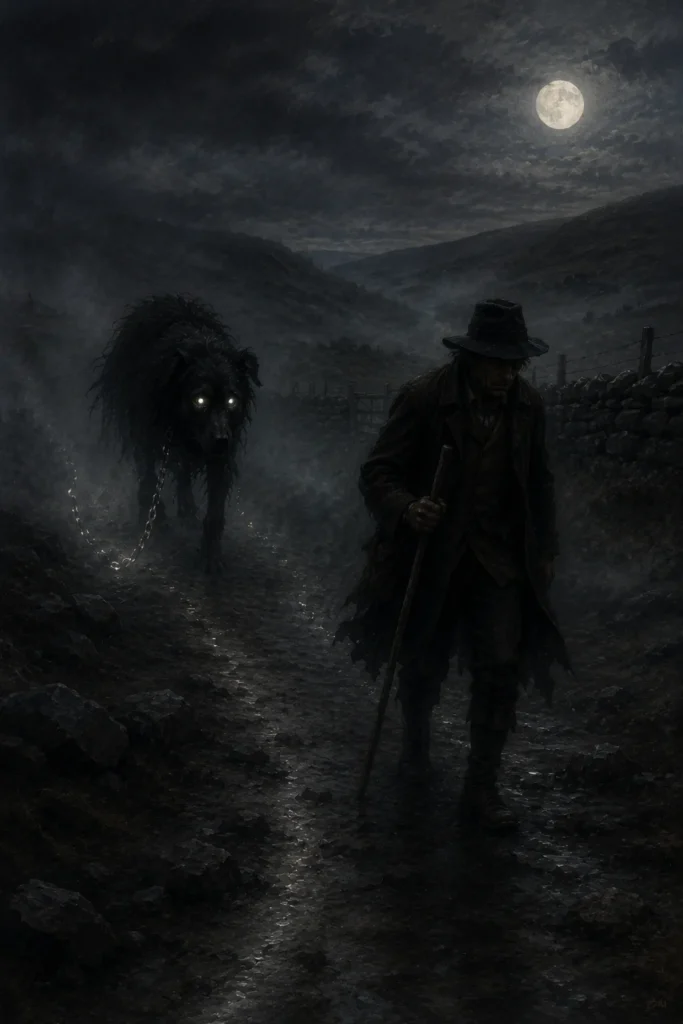
Padfoot is a black ghost dog from the West Riding of Yorkshire, named after the padding sound of its paws. It follows nocturnal travellers, appearing before or beside them, and is considered an omen of death. As long as it is not provoked, it remains uninvolved.
Padfoot is recorded by William Henderson and the clergyman J. C. Atkinson, who took it to be an omen of death; in Barnsley, by contrast, it was regarded as harmless as long as one did not disturb it.
Type: Black ghost dog, omen of death with a rule of non-interference
Origin: Northern English tradition of the West Riding of Yorkshire
Texts: Notes on the Folk-Lore of the Northern Counties (Henderson, 1866) and later studies
Period: recorded in the 19th century, still passed down today
Appearance: black, shaggy dog the size of a small donkey, with large eyes, visible or invisible
Evidence from the West Riding
Period of the Texts
The tradition comes from the West Riding of Yorkshire in the 19th century and was recorded by Henderson and the clergyman J. C. Atkinson.
Area of Diffusion
West Riding of Yorkshire, with focal points around Wakefield, Leeds and Pudsey.
Sources
Good: Henderson and Atkinson provide the core evidence, supplemented by Theo Brown’s study The Black Dog and the overviews by Briggs and by Westwood and Simpson.
Name and variants
English: Padfoot describes the quiet padding sound of paws, from to pad, to walk softly. The name thus directly names the acoustic trait by which the being is recognised, even before it is seen.
Form and appearance
Appearance
Padfoot appears as a black, shaggy dog the size of a small donkey, with large eyes as big as plates; occasionally it is described as white rather than black. It can be visible or invisible.
Effect
The acoustic character, the padding and at times a rattling chain, makes it an eerie companion on the road; the chain stands as a sign of damnation and restlessness. Padfoot follows people with a padding step and then reappears before or beside them.
Profile: Padfoot
The key aspects of the padding ghost dog at a glance.
Northern English folk tradition of the West Riding of Yorkshire, recorded by Henderson and the clergyman J. C. Atkinson.
Nocturnal travellers, whom Padfoot follows with a padding step and before or beside whom it reappears.
Black, shaggy dog the size of a small donkey, with eyes as big as plates, occasionally white instead of black, visible or invisible.
Whoever addresses or attacks Padfoot falls under its power; one account tells of a man who was dragged a long distance.
Leave it be, do not address it, do not kick it: the only recorded form of protection lies in one’s own behaviour.
The Welsh Cwn Annwn as a distant relative, along with Black Shuck and Barghest, which, unlike Padfoot, are also considered messengers of death even without provocation.
From padding to rattling chains
The name Padfoot describes the quiet padding sound of the paws, from to pad, to walk softly. The dog follows people with just such a padding step and then reappears before or beside them; at times this is accompanied by the sound of a dragging chain.
The interpretation was not equally strict everywhere: in Barnsley, Padfoot was regarded as harmless as long as one did not disturb it. This range from messenger of death to uninvolved companion is characteristic of the English black ghost dogs, yet a clear provocation clause sets Padfoot apart: whoever addresses or attacks it falls under its power. One account tells of a man who kicked at it and was consequently dragged through hedge and ditch right up to his own window.
The padding companion in gothic literature
Padfoot is a fixed entry in overviews of England’s black ghost dogs and a source of the motif of padding, invisible companions in gothic literature; the name itself is also, independently of this, widespread in modern fantasy.
From a religious-studies perspective, Padfoot is a regional variant of the death omen of the black dog type, with a pronounced auditory motif and the taboo of non-interference. The rattling chain refers to the restless, damned spirit; the provocation clause shows the widespread wariness of threshold beings.
Non-interference as the only protection
Comparatively well attested for this class of being is the rule of non-interference: leave the being be, do not address it, do not kick it, do not attack it. Any provocation turns against the person, as the account of the dragged man shows. No active banishing ritual is recorded; folklore additionally names iron as protection against ghostly beings, holy water as a Christian sign in dealing with the restless dog, and the sound of consecrated bells against misfortune. But the real protection lies in correct behaviour.
Barghest, Black Shuck and the family of black dogs
Padfoot belongs to the English family of black ghost dogs alongside Barghest and Black Shuck; further regional figures such as Grim, Gytrash and Hairy Jack bear similar traits. Related to it is the Welsh Cwn Annwn; thematically close to it stand chain-rattling apparitions in general.
As a black ghost dog of Yorkshire, Padfoot differs from the purely acoustic celestial pack of the Gabriel Hounds: it is a single, often visible animal on the ground, not an invisible swarm in the air, and its behaviour, unlike that of the Gabriel Hounds, depends directly on the behaviour of the person concerned.
Frequently asked questions about Padfoot
Why is he called Padfoot?
After the padding sound of his paws, which announces him.
Is he always deadly?
No. In Barnsley he was considered harmless as long as he was not disturbed, elsewhere a death omen.
What happens if he is provoked?
Whoever addresses or attacks him falls into his power; one tale tells of a man who kicked him and was dragged far away.
Further links
Further reading:
- Gabriel Hounds – the invisible airborne pack of northern England
- Barghest, Black Shuck, Cwn Annwn – related spectral hounds
- Iron, Holy Water, Bells – traditional protective means
- Protection Compass – protective means at a glance
Literature (selection)
Further standard works in the bibliography.
As a black spectral hound of Yorkshire, Padfoot remains a padding harbinger of death with one exception: whoever does not provoke him, he leaves unharmed, a restraint that sets him apart from most figures of his family.