iWell Guard

Waziya, the icy giant of the north

Waziya is a spirit of Lakota tradition.

The north-wind giant who brings cold, snow and hunger.

SpiritLakota

Table of Contents

Waziya, the North Wind Giant of the Lakota
Waziya

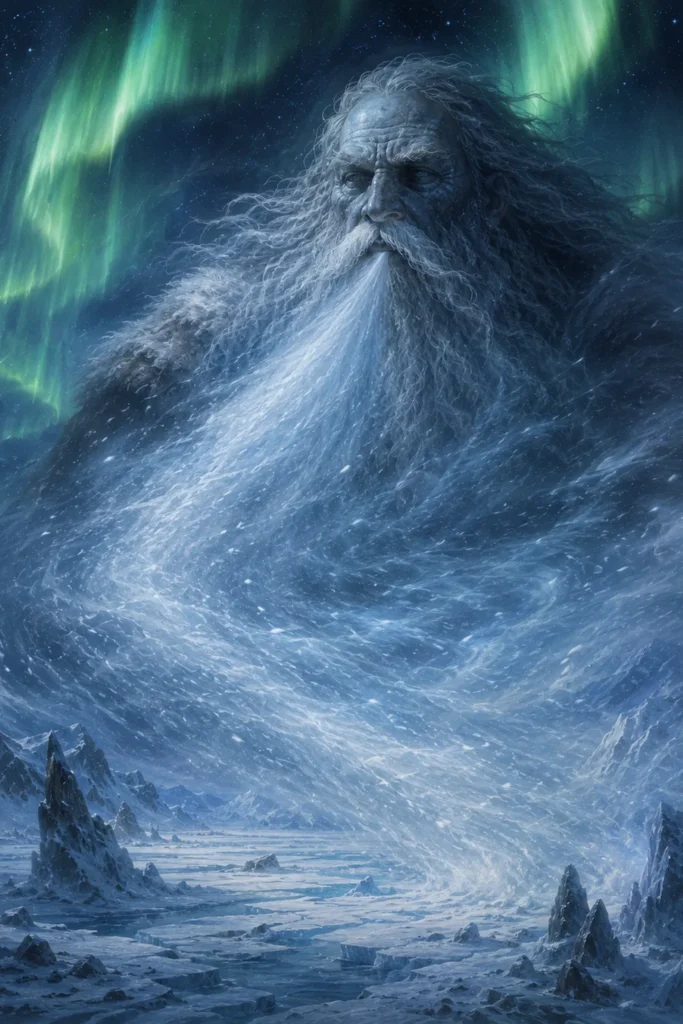
Among the Lakota, Waziya is the north-wind giant, the guardian of the northern lights. He brings cold, snow, ice and hunger and is a personification of north and winter.

Two levels must be distinguished: the concept of direction is old and independently documented, already found in 1852 in Riggs’s dictionary. The elaborated family story, which makes Waziya the father-in-law of the wind father Tate, is by contrast dependent on Walker’s cycle.

Overview: Waziya

Type: North Wind giant, personification of the north and winter
Origin: Lakota and Dakota, northern Plains
Texts: Riggs 1852, systematics in Walker
Period: linguistic attestation since 1852, mythical tradition
Appearance: gigantic, aged old man who blows cold

Historical Classification

Period of the Texts

The directional term is attested since 1852 in Riggs; the systematic genealogy stems from Walker’s records around 1900.

Area of Diffusion

Lakota and Dakota of the northern Plains; Waziya serves the mythical tradition as an explanatory figure for the harshness of winter.

Sources

Divided: the directional and North Wind term is old and independently attested, whereas the elaborated genealogy is Walker-dependent.

Name and variants

Lakota: Waziyata means north or towards the north and is already attested in Riggs 1852; Waziya is folk-etymologically linked to wazí, the pine.

Form and effect

Appearance

Waziya is gigantic and aged, blowing cold from his mouth. He embodies the north, winter, and the northern lights, the Aurora, which he guards.

Effect

Waziya brings north wind, snow, ice and winter; he fights against the south winds and sends hunger and disease. As guardian of the Aurora, he is connected to the northern lights.

Profile: Waziya

The most important aspects of the North Wind giant at a glance.

Tradition

Winter and north figure of the Lakota and Dakota: a linguistically old directional term, later incorporated by Walker into a genealogy.

Object of Influence

The winter of the northern Plains: Waziya explains the cold, snow and ice, and the hardship that the north wind brings upon people.

Depiction

A gigantic, aged old man who blows cold from his mouth; in the far north he guards the northern lights, the Aurora.

Sphere of Influence

North wind, snow, ice and winter; along with hunger and disease that he sends, and the fight against the south winds.

Practice

No established independent protective practice has been handed down; Waziya is above all an explanatory figure for the harshness of winter.

Parallels

As North Wind, he is typologically close to the Greek Boreas and the Seneca bear Ya-o-gah.

Two Waziyas: an old term and Walker's genealogy

Waziyata means north or towards the north and is already attested in Riggs 1852; Waziya is folk-etymologically linked to wazí, the pine. The older, primary Waziya is the North Wind giant: linguistically old and attested independently of Walker.

Alongside this stands the later Waziya, systematised by Walker, as the first man who, together with his wife Wakanka, was banished to earth because both had helped their daughter Anog Ite; this makes him the father-in-law of Tate and grandfather of the winds. This genealogy is Walker-dependent and must not be mixed with the older directional term.

Afterlife and Classification

Waziya lives on, among other things, in the place name Wayzata in Minnesota. In tradition, he is the classic figure of the harsh north winter.

From a religious-studies perspective, Waziya shows the personification of the north and winter as a threatening giant. An important clarification: the old directional and North Wind term waziyata must not be mixed with the elaborated banishment and family story; the latter is essentially Walker’s cycle, the former older and independently attested.

Explanatory Figure Rather Than Protective Ritual

No established independent protective practice against Waziya has been handed down; this should be honestly noted. Waziya is above all an explanatory figure for the harshness of winter: the giant, who blows cold from his mouth and sends hunger and disease, gives a face to the winter hardship of the northern Plains, without the sources naming a dedicated warding ritual.

Frost Giants and North Winds Compared

Waziya is a winter and North Wind old man of the frost giant or Old Man Winter type, a widespread motif without genetic derivation. As North Wind, he is typologically close to the Greek Boreas and the Seneca bear Ya-o-gah. Within Lakota tradition, he is to be distinguished from the wind father Tate and his sons: Waziya is not one of the four directional figures, but an independent winter giant.

Frequently Asked Questions About Waziya

Who is Waziya?

The North Wind giant of the Lakota, who brings cold, snow and winter and guards the northern lights.

Is the family story old?

No. The elaborated banishment and father-in-law story is essentially Walker’s cycle; the directional term waziyata is older and independently attested.

What does he guard?

The northern lights, the Aurora, in the far north.

Further links

Recommended internal links:

  • Tate – the wind father of the Lakota, in Walker’s cycle Waziya’s son-in-law
  • Boreas – the Greek North Wind as a typological counterpart
  • Ya-o-gah – the North Wind bear of the Seneca
  • Amulet, Sage, Protective candle – traditional protective means of the home

Literature (selection)

A selection of key sources and studies:
  • Riggs, Stephen Return: A Dictionary of the Dakota Language. Washington 1852.
  • Walker, James R.: Lakota Belief and Ritual. Lincoln 1980.
  • Walker, James R.: Lakota Myth. Lincoln 1983.

Further standard works in the bibliography.

The Lakota North Wind has taken shape in Waziya: he is regarded as the old man of the north who blows cold from his mouth and guards the northern lights, one of the most striking winter figures of the northern Plains.

Classification & Protection

IIILEVEL
The Protection Compass assigns this being to influence level III, Burdensome influence.

Against its influence, cross-cultural tradition names these protective means:

Compare in the Protection Compass →

Recommended protective means

iWell Guard

The simplest protective means in this collection: 41 layers of fine gold 999, platinum, silver and silicon, manufactured in Ruhla, Thuringia. It requires no activation, is bound to no person, and is effective within a radius of around 50 meters, even without being worn.

All protective means at a glance →