Toggeli, the nightmare spirit of the Central Swiss Alps
By Ralf Ittermann · last reviewed on
The Toggeli is a demon of the alpine tradition.
The nightmare spirit that takes the breath away from those asleep.
The Toggeli is a nightmare spirit of the Central Swiss Alps that sits on the chest of sleeping people until their breath catches. In some parts of the Lucerne region also called Schrättli, it belongs to the widespread family of alp and nightmare spirits found throughout the German-speaking world.
Related to the more general Alp, the Toggeli also plagues livestock in the stable and tangles manes into so-called wirrzöpfe (tangle braids). Its core area of distribution lies in the Lucerne region and around Mount Pilatus, with offshoots into other parts of central Switzerland.
Type: Nocturnal nightmare spirit, also plagues livestock in the stable
Origin: orally transmitted, documented by folklore studies since the 19th century
Texts: legend collections by Lütolf and Rochholz, Schweizerisches Idiotikon
Period: at night, particularly in bedrooms and stables
Appearance: invisible or shadowy pressure spirit, in some places also called Schrättli

Historical Classification
Period of the Texts
Folklore documentation took place in the 19th century, primarily through Alois Lütolf and Ernst Ludwig Rochholz; belief in alp and nightmare spirits itself is attested throughout the German-speaking world since the Middle Ages.
Area of Diffusion
The core area of distribution lies in Central Switzerland, particularly in the Lucerne region and around Mount Pilatus, with offshoots into other parts of central Switzerland.
Sources
The legend collections by Lütolf and Rochholz, as well as the Schweizerisches Idiotikon, document the term as a fixed part of the Central Swiss vocabulary, along with regional narrative research.
Name and variants
Name: Toggeli, also spelled Toggel and in some parts of the Lucerne region called Schrättli. The Schweizerisches Idiotikon records the term as a fixed part of the Central Swiss vocabulary.
Appearance
Appearance
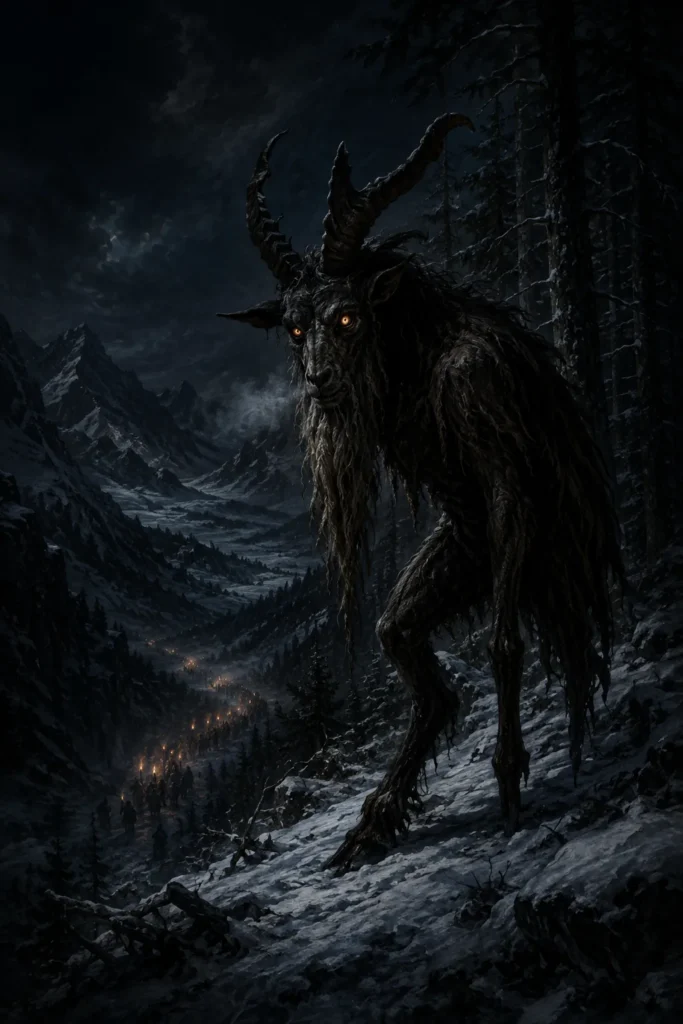
Unlike many other legendary figures, the Toggeli has hardly any fixed outward form in tradition; it acts mainly invisibly or only as a shadowy presence in the dark. Visible traces of its actions, by contrast, are precisely described: tangled horse manes twisted into so-called wirr- or alp-braids.
Effect
The Toggeli visits people in their sleep and sits on their chest until their breath catches. In the stable, it plagues animals and tangles their manes. Those affected reported a feeling of paralysis that can be linked to what is medically known today as sleep paralysis, although the legend itself does not know this explanation.
Profile: Toggeli
The most important aspects of the nightmare spirit at a glance.
Central Swiss variant of the widespread family of alp and nightmare spirits, documented since the 19th century by Lütolf and Rochholz.
Sleeping people whose breath it takes away, and livestock in the stable whose manes it tangles.
Invisible or shadowy, without a fixed outward form; recognisable only by the traces of its actions, such as tangled manes.
Nocturnal nightmare pressure on people and the plaguing of livestock in the stable, both expressions of the same pressure-spirit concept.
Shoes placed upside down before the bed, a knife positioned with an open blade, and a scythe leaned against the stable door with its sharpened side facing upwards.
Related to the more general Alp, from which it differs as a distinct variant rooted regionally in Central Switzerland.
From legend collection to Central Swiss nightmare figure
The Toggeli, also spelt Toggel and in many parts of Lucerne called Schrättli, belongs to the widespread family of alp and nightmare spirits of the German-speaking world. Its folkloric documentation took place in the 19th century, chiefly through Alois Lütolf, who collected legends from Lucerne, Uri, Schwyz, Unterwalden and Zug, and through Ernst Ludwig Rochholz, whose Swiss legends from Aargau document related nightmare figures.
In the recorded versions, the Toggeli usually appears as a spirit described as aggressive and malicious, whose origin remains unclear; occasionally it is linked to enchanted or deceased humans, though no single origin story has become established. The late written documentation, only beginning in the 19th century, does not mean that the belief itself is recent: belief in alp and nightmare spirits is attested throughout the German-speaking world since the Middle Ages.
Reception and classification
Today the Toggeli is known mainly on a regional level and was presented, among other things, in the Swiss television series Mysteriöse Schweiz as an example of Central Swiss nightmare legends. The Märchenstiftung Schweiz holds several recorded versions, including tales titled Mittel gegen das Toggeli. Outside Central Switzerland, the figure remained comparatively little known.
From a religious-studies perspective, the Toggeli can be understood as a folk interpretation of sleep paralysis and general nocturnal states of oppression. An important distinction applies: the Toggeli is regarded as a distinct figure rooted in the Central Swiss region, with its own name and its own narrative details, and it should not simply be equated with the more general Alp, even though both belong to the same basic family of nightmare spirits and share the same central effect, sitting on the chest of the sleeping. Likewise, it is to be distinguished from the Bavarian-Austrian Drud, an independent figure within the same broader nightmare tradition.
The sharp blade as a principle of defence
Tradition knew several practical countermeasures against the Toggeli. Shoes placed backwards in front of the bed were meant to confuse the spirit so that it could not find its way to the sleeper. A knife stuck into the wall or the bed with its blade exposed was considered an effective means of defence, as was a scythe leant against the stable door with its sharpened edge, the Dengel, facing upwards. What unites these means is the principle of the sharp edge, meant to block the invisible intruder’s access.
Alp, Drud and Pesanta: related pressing spirits
A close equivalent is found in the Catalan Pesanta, a huge black dog that likewise sits on the chest of the sleeping and takes their breath. While the Pesanta takes on a fixed animal form as a black dog, the Toggeli remains deliberately undefined in most Central Swiss versions. Within the German-speaking nightmare-spirit family, the Toggeli must also be distinguished from the more general Alp and from the Drud: all three share the central effect of nocturnal chest pressure, yet each figure remains a distinct, regionally shaped form with its own name.
Frequently asked questions about the Toggeli
Is the Toggeli the same as the Alp?
Both belong to the same basic family of nightmare spirits and share the central effect, sitting on the chest of the sleeping. However, the Toggeli is regarded as a distinct form rooted in a particular region, chiefly Central Switzerland, with its own name and its own narrative details.
What does tradition say helps against the Toggeli?
Common measures included shoes placed backwards in front of the bed, a knife positioned with its blade exposed, and a scythe leant against the stable door with its sharpened edge facing upwards. What all these measures have in common is the sharp edge, meant to block the spirit’s access.
Why is the Toggeli said to tangle horses’ manes?
Knotted manes found in the morning were seen as visible proof of a nocturnal visit by the Toggeli to the stable. The explanation assigned an inexplicable, everyday nuisance to a known cause.
Further links
Further reading:
- Alpine region – all beings of alpine legend
- Alp, Drud – related nightmare spirits for comparison
- Nachtkrapp, Butz – further nocturnal legendary figures of the region
- Iron, Home protection – traditional protective means
- Protection Compass – overview of protective means
Literature (selection)
Further standard works in the bibliography.
Also known as toggeli alpdruck and nachtmahr schweizer alpen, this figure represents the Central Swiss form of a Europe-wide pattern: the explanation of nocturnal oppression through a personified pressing spirit.