Philippine Mythology, Anito Belief and the Aswang Complex
By Ralf Ittermann · last reviewed on
Philippine mythology is thus a web of pre-Spanish spirit world, regional pantheons and centuries of overlay by Christianity.
The so-called Aswang complex and the Anito ancestor cult were reshaped by three centuries of colonial rule and Catholic popular piety, but remain alive in the oral tradition of the Visayas and Luzon to this day.
Island world, language families and the pre-Spanish belief world
The term Anito is documented across large parts of the archipelago and primarily denotes ancestor and place spirits. Diwata, derived from the Sanskrit word devata via Malay mediation, is more widespread in the Visayas and Mindanao, where it tends to denote nature and landscape deities such as Maria Makiling. A sharp distinction between the two terms cannot always be maintained from a religious-studies perspective, as regional sources sometimes use them with overlapping meanings.
Anito ancestor worship, Diwata veneration and the later Aswang complex together form the basic framework of Philippine mythology before, and alongside, the Catholic overlay.
Pantheon: Bathala, Bakunawa and the Diwata of Nature
In early Spanish accounts, such as the Relación by the Franciscan Juan de Plasencia from 1589, Bathala appears as a Tagalog sky and creator god, to whom Anito and Diwata are subordinate. This hierarchical interpretation, however, is strongly shaped by the Christian preconceptions of the missionaries and cannot be applied uncritically to the entire pre-Spanish religious landscape.
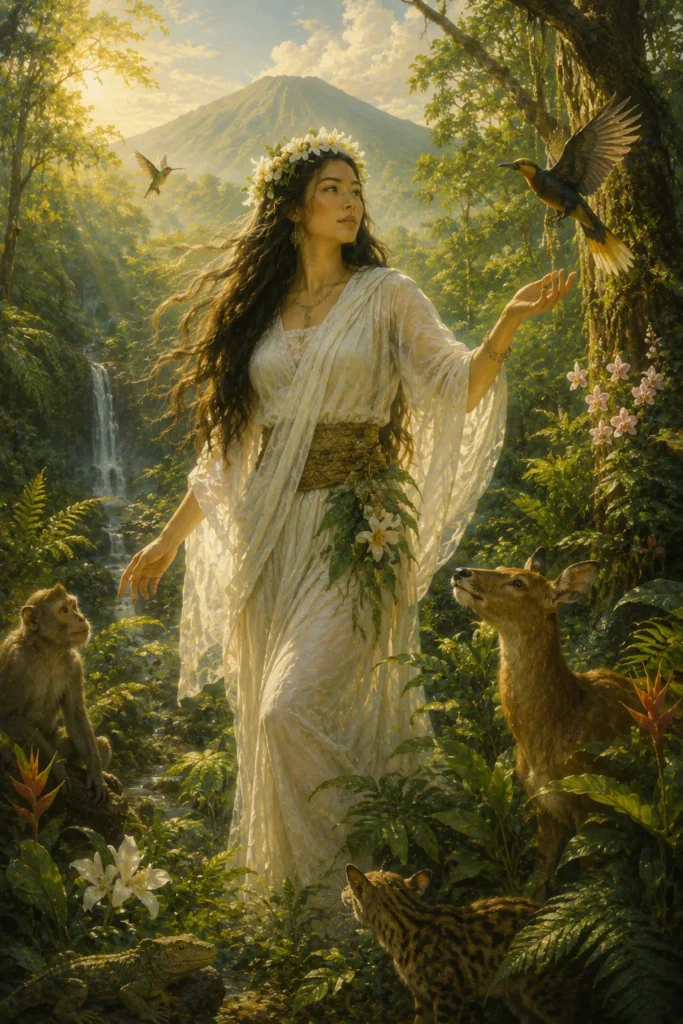
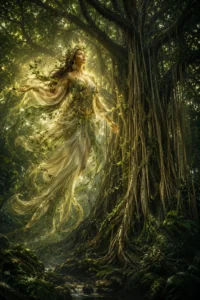
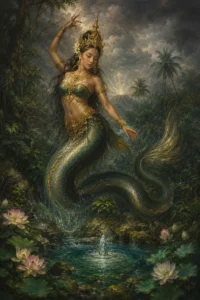
In Visayan and Bicol traditions, the serpent Bakunawa explains lunar eclipses by trying to swallow the moon, which is why noise and drumming were meant to drive it away. Among the Diwata are, for instance, Diwata as a collective term, the mermaid Sirena and the mountain goddess Maria Makiling, whose legend surrounding Mount Makiling in Laguna is still told today.
The Aswang Complex: Manananggal, Tiyanak, Aswang
The folklorist Maximo Ramos coined the term Aswang complex in his studies of the 1960s and 1970s for a cluster of related, shape-shifting beings recounted as threatening, which is most densely documented in the western Visayas, particularly the province of Capiz. The term Aswang itself is used differently by region, sometimes as an umbrella term, sometimes for a specific manifestation.
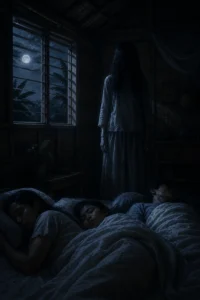
The complex includes the Manananggal, which according to tradition separates its upper body from its lower torso and flies with bat-like wings, as well as the Tiyanak, a being in the form of an infant that lures travellers. In village communities, these accounts served, among other things, to reinforce social control and to explain unexplained deaths or miscarriages.
Forest Beings and Colonial Hybrid Figures: Tikbalang, Kapre, Berberoka
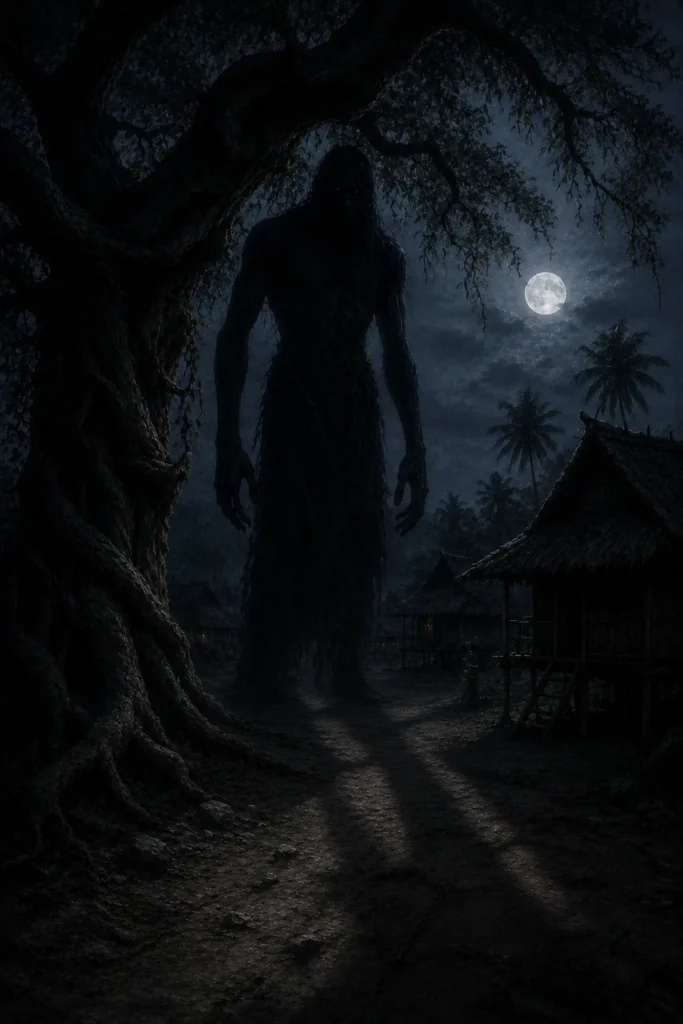
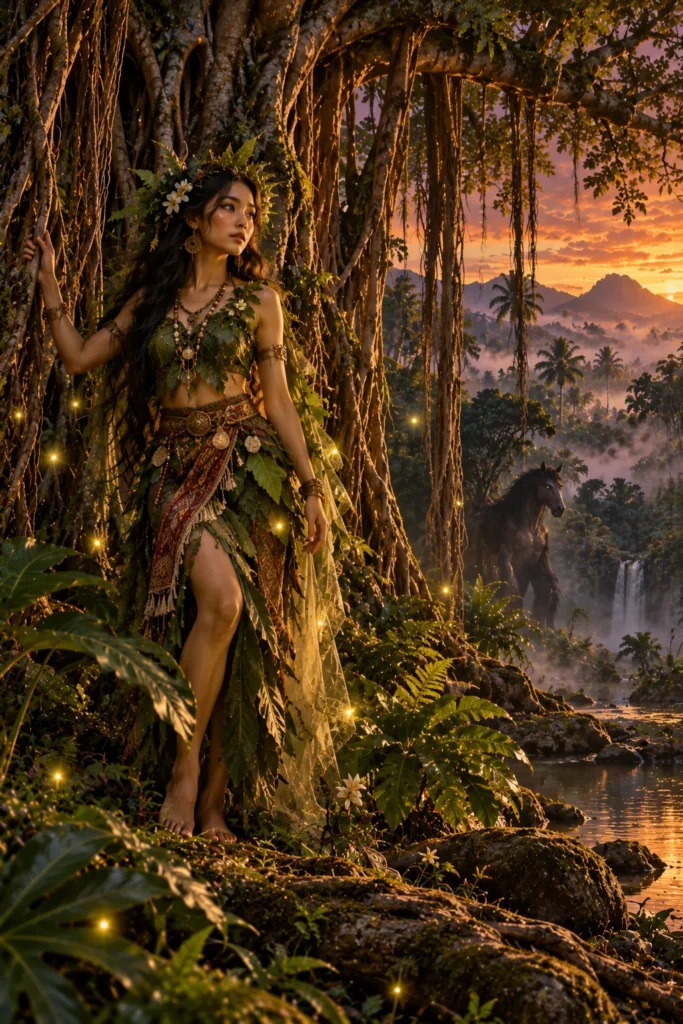
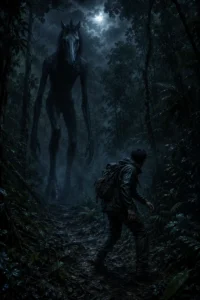
Alongside ancestor and nature spirits, Philippine tradition includes a number of landscape and hybrid beings, in which pre-Spanish ideas merged with later influences. The Tikbalang, a horse-headed being of the forests and mountains, is said by tradition to make travellers walk in circles until they lose their bearings. The Kapre, a giant, cigar-smoking tree being, bears a name that, via Spanish, probably traces back to an Arabic word for non-believers, a hint at the archipelago’s multilayered history of contact.
In northern Luzon, Ilocano and Isneg tradition tells of the Berberoka, a swamp monster that holds back water and floods the land to catch prey, documented among others by historian William Henry Scott. The headless Pugot and the Multo, understood as a general spirit, whose name derives from the Spanish word for the deceased, show how pre-Spanish spirit concepts blended with Spanish-Catholic terms.
Frequently Asked Questions about Philippine Mythology
What does Anito mean?
Anito refers, across much of the pre-Spanish Philippines, to ancestor and nature spirits to whom offerings were made. The term is documented across many language groups of the archipelago, although its exact meaning varies regionally.
What is the Aswang complex?
The Aswang complex is a collective term coined by folklorists such as Maximo Ramos for a group of related, shape-shifting beings described as man-eating, including Manananggal, Tiyanak and Aswang, which are especially densely documented in the western Visayas.
What distinguishes Anito from Diwata?
Anito tends to be used for ancestor and place spirits and is found throughout the archipelago, while Diwata, linguistically derived from the Sanskrit word devata, is more strongly associated with nature and landscape deities in the Visayas and Mindanao. However, the boundary between the two terms is not always clear-cut in the sources.
How did the Spanish colonial period change Philippine mythology?
From the 16th century onwards, Spanish missionaries predominantly interpreted Anito and Diwata as demons and opposed their veneration. Nevertheless, many elements survived in a folk form of Catholicism and in oral storytelling tradition, which continues to this day.
Bicolano pantheon: Gugurang, Kan-Laon and Lalahon
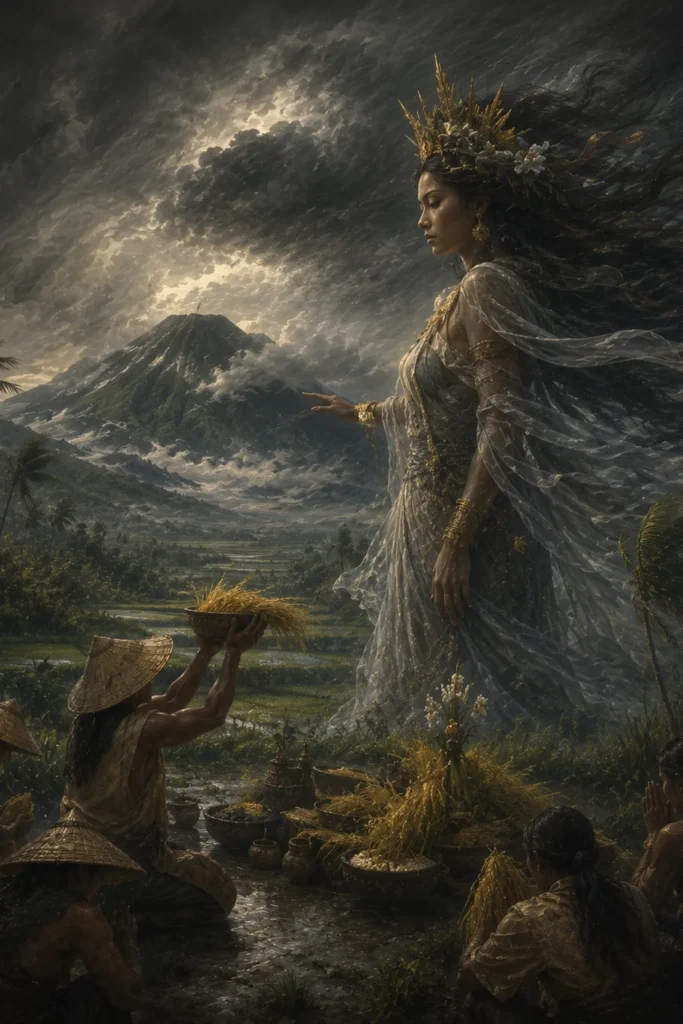
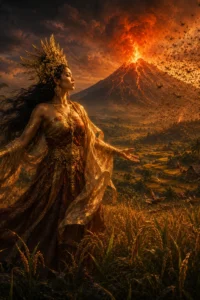
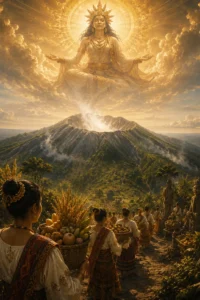
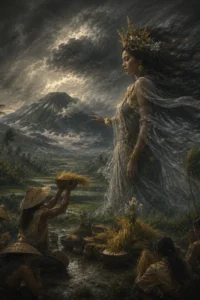
In the Ibalong epic of the Bicol region, first recorded by a Spanish missionary in the 16th century and reconstructed by Fray José Castaño in the 19th century, Gugurang is regarded as the supreme fire deity residing in Mount Mayon, challenged by a rival spirit. On the island of Negros, Kan-Laon is associated with Mount Kanlaon, while Lalahon is regarded as a harvest goddess who, according to tradition, sends locusts if disrespected. Both figures are described in different sources as sometimes overlapping and sometimes distinct, and the state of research remains inconsistent.
Alongside the major pantheon figures, Bicol tradition also includes regional serpent beings of the river basin, grouped under the collective term Naga-Bicol, a local expression of the Naga motif transmitted from South Asia.
Wind deities: Amihan, Habagat and the children of Lihangin
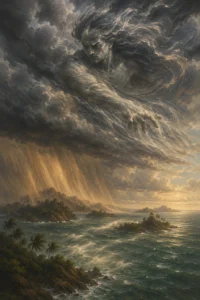
In Tagalog creation narratives, Lihangin is regarded as a wind god married to a sea goddess. Their children are the four winds, among them Amihan, the northeast monsoon, and Habagat, the southwest monsoon, both still used today as names for the Philippine seasons. Anitun Tabu appears in some versions as a capricious weather and lightning deity.
Other wind and storm beings include Apo-Angin, attested regionally in Kapampangan and Ilocano tradition, and Buhawi, the whirlwind, which appears personified in oral narratives.
Spanish colonial period, missionisation and folk religion today
During the Spanish colonial rule from 1565 to 1898, members of religious orders such as Ignacio Francisco Alcina, whose Historia de las Islas e Indios de Bisayas was written in 1668, documented native beliefs while simultaneously combating them as diabolical. Veneration of Anito and Diwata was consistently demonised in church sources, which continues to shape the tradition today: much survives only from the perspective of its opponents.
Despite centuries of missionisation, elements of the old spirit world survived in a folk form of Catholicism, in which saints sometimes took on functions of earlier Anito, as well as in oral storytelling tradition, in healing practices and in the Aswang belief still widespread in rural regions today. Folklorists such as Maximo Ramos and Damiana Eugenio, and later the social anthropologist Fenella Cannell, have documented these traditions scientifically.
An archipelago of more than a hundred ethnic groups and languages
The Philippines consists of over 7,000 islands and is home to more than 180 languages, which is why, strictly speaking, one cannot speak of a single ‘Philippine mythology’. What is summarised under this title today comprises numerous regional traditions that differ considerably between Luzon, the Visayas and Mindanao.
Before Spanish colonisation began in 1565, there was no central pantheon and no unified priesthood. Instead, local ritual specialists, the Babaylan or Catalonan, performed ceremonies for their respective communities. Their duties ranged from healing and death rituals to mediation between people and Anito.
The archipelago’s great linguistic and cultural diversity also explains why central terms such as Anito and Diwata are used differently from region to region, and why pantheon figures such as Gugurang or Kan-Laon are known only in certain regions rather than throughout the entire archipelago.
From a religious studies perspective, caution is therefore warranted towards depictions that suggest a unified Philippine pantheon. Closer to the source material is a description of a network of related but distinct regional traditions.
Anito, Diwata and the ancestors: basic structures of belief
At the centre of pre-Spanish religion was the belief that ancestors, natural places and certain animals were imbued with a distinct spirit-substance, a characteristic of what religious scholars term animism. Anito generally stood for the spirits of deceased ancestors, to whom offerings were made in cases of illness, at harvest time or during important life events.
Diwata, a term borrowed from Sanskrit via Malay mediation, tended to refer to beings bound to particular places, such as a mountain, an old tree or a spring. Venerating such place spirits required consideration for the landscape: trees were not to be felled without permission, and certain sites were not to be entered without ritual.
Contact with the spirit world was mediated by the Babaylan, ritual specialists who communicated with Anito or Diwata in trance, interpreted illnesses and led ceremonies. In many communities they enjoyed high standing, and their role was deliberately undermined during the Spanish colonial period.
The relationship between people and the spirit world was not abstract or theological but a matter of everyday practice: land use, illness, birth and death were consistently interpreted in relation to Anito and Diwata.
The sources: Spanish chronicles and oral epics
The written tradition concerning the pre-Spanish religion of the Philippines derives almost exclusively from Spanish clergy. Among the earliest and most important sources is the Franciscan Juan de Plasencia’s Relación de las Costumbres de los Tagalos of 1589, along with the slightly later Boxer Codex, a richly illustrated manuscript on the inhabitants of the archipelago.
For the Visayas, the Jesuit Ignacio Francisco Alcina’s Historia de las Islas e Indios de Bisayas of 1668 is a central, though missionary-authored, source. As with comparable colonial texts from other world regions, its aim was to suppress practices branded as pagan, not to describe them neutrally.
A second, more independent group of sources consists of orally transmitted epics that were only recorded in writing in the 19th and 20th centuries, including the Ibalong epic of the Bicol region and the Hinilawod epic of Panay. Despite due caution regarding later revisions, they preserve older narrative structures and pantheon figures such as Gugurang and Handyong.
In the 20th century, folklorists such as Maximo Ramos, who coined the term Aswang complex, and Damiana Eugenio, with her multi-volume collection of Philippine folk literature, systematised these scattered sources for the first time on a scholarly basis.
Colonisation, Christianisation and modern rediscovery
The Spanish colonial period, from 1565 to 1898, brought systematic Christianisation. Anito and Diwata were regularly depicted as demons in ecclesiastical writings, their veneration was persecuted as sin, and Babaylan were stripped of power or pressured towards conversion in many regions.
The old spirit world did not vanish entirely, however. It survived in a folk form of Catholicism, in which saints’ feasts merged with pre-Spanish harvest customs, as well as in an oral storytelling tradition around Aswang, Diwata and nature spirits that remains active to this day, particularly in rural areas of the Visayas.
In the 20th century, Philippine nationalism brought a renewed interest in pre-Spanish traditions, visible for instance in José Rizal’s literary engagement with Maria Makiling. From the 1960s onwards, folklorists such as Maximo Ramos and Damiana Eugenio systematically documented the remaining narrative traditions.
Today, film, television and popular culture significantly shape the public image of Aswang and Diwata, prompting the social anthropologist Fenella Cannell to distinguish between popular simplification and the more complex, regionally diverse sources. One cannot speak of a unified revival of the pre-Spanish religion as a lived practice: the great majority of Filipinos today are Catholic or, in parts of Mindanao, Muslim.
Beings of this tradition (21)











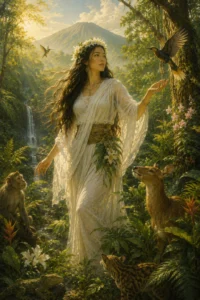
The Philippine Anito ancestor cult combines Babaylan, offerings and local spirits into a distinct protective practice, while the Aswang complex, as described by research, shows how communities dealt narratively with threat, for example through garlic, salt or blessed objects used against the feared beings of the night.
Related key terms: Anito Diwata Bathala Bakunawa Babaylan Aswang Ibalong Visayas Luzon Mindanao.
Protective objects in this cultural tradition
Philippine folk tradition includes the amulet known as Anting-Anting, bearing religious signs and prayer formulas, as well as the amulet, the Agimat as a related talisman, and garlic, salt and blessed oil, which appear in rural narratives as means used against the Aswang complex. Such objects are to be understood in cultural-historical terms as expressions of a need for protection, not as proven means of effect. An overview of protective forms across different cultures is offered by the Protection Compass.
iWell Guard fits into this cultural-historical line of portable protective objects, in a contemporary material architecture, crafted in Germany. 41 layers, real gold, platinum, silver. 30-day right of return.
Personal experiences may vary. Not a medical device. No promise of healing.