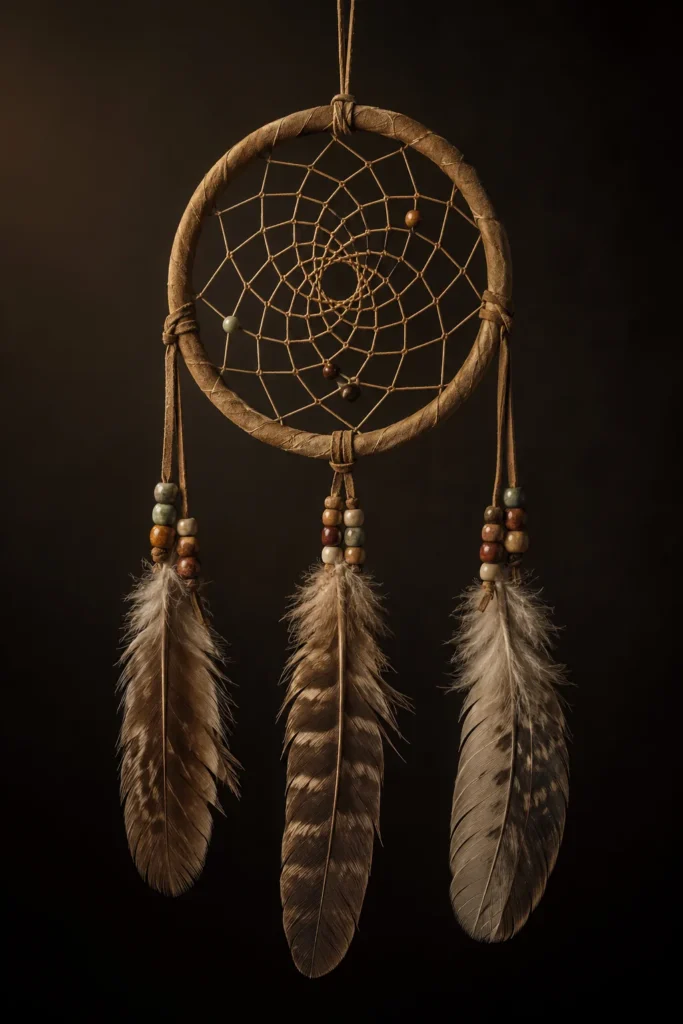
As a protective object, many Indigenous North Americans associate the dreamcatcher with the idea that it keeps bad dreams away from the sleeper. The dreamcatcher is a protective object of the Indigenous peoples of North America.
Its origin lies with the Ojibwe, where a delicate net within a hoop, hung over the cradle, was meant to catch bad dreams and let only the good ones pass through to the sleeping child.
The dreamcatcher is a protective object that comes from the world of the Indigenous peoples of North America. It consists of a round hoop into which a net-like mesh is woven, along with feathers and ornaments that hang down from it.
Its origin lies with the Ojibwe, who are also called Anishinaabe and live in the region of the Great Lakes. In their language, the object bears a name connected with the spider and its web.
The purpose of the dreamcatcher is closely tied to sleep. It was placed above the sleeping place, above all over a child’s cradle, and was meant to guard sleep against harmful influences.
Today the dreamcatcher is known worldwide. This wide distribution has made it familiar to many people, yet it has at the same time often obscured the view of its actual origin and meaning. A factual account therefore begins with the Ojibwe.
In the language of the Ojibwe, the dreamcatcher bears a name that refers to the spider and its web. This linguistic connection points directly to the model for the object.
As an object described and named in its own right, however, the dreamcatcher was documented in greater detail only comparatively late, which is why research relies heavily on oral tradition.

The dreamcatcher originally belongs to the culture of the Ojibwe. In this tradition it was made by hand and hung above the sleeping place, especially where children slept.
The early dreamcatchers were small objects. The hoop was bent from a pliable twig, usually of willow, and the net was knotted from plant fibers or sinew. The materials came directly from the surrounding natural world.
The Ojibwe understood the dreamcatcher as part of the care for sleep and for the well-being of the child. It was not a piece of jewelry but an object with a clear purpose within domestic life.
Because the early dreamcatchers were made of perishable natural materials, hardly any old pieces have survived. Knowledge about their original form therefore rests above all on oral tradition and on records that have been produced since the late nineteenth century.
The spider held a firm and friendly place in the world of Ojibwe ideas. It was regarded as a useful being in the house, met with goodwill. This positive image of the spider explains why its web in particular could become the model for a protective object meant to watch over the sleep of children.
A narrative about a caring Spider Woman is connected with the dreamcatcher. In the tradition of the Ojibwe she is a figure who cares for people, especially for children, and who watches over their sleep.
The narrative tells that the Spider Woman wove a net over every cradle to protect the sleeping children. As long as the people lived closely together, she could reach every child.
When the people spread out over an ever larger territory, however, the Spider Woman could no longer reach all the children. Thereupon, so the narrative goes, the mothers and grandmothers began to knot nets themselves and to hang them over the cradles.
This narrative connects the form of the dreamcatcher, the woven net, with the idea of care. The dreamcatcher knotted by human hands takes the place of the Spider Woman’s net and continues her protection.
The narrative of the Spider Woman is passed on in different versions. Oral tradition is not rigid, and individual families and communities told the story with their own emphases.
This flexibility is not a flaw but belongs to the nature of a living tradition that lives on not in a single fixed text but in the telling itself.
The traditional dreamcatcher follows a clear construction. The frame is formed by a round hoop made from a pliable twig. Into this hoop a net is stretched that runs from the outside inward and leaves an opening in the center.
The net was knotted with a continuous cord fastened to the hoop at regular intervals. This produced the characteristic pattern that recalls a spider’s web. Small ornaments could be worked into the mesh.
Feathers and sometimes beads or leather strips were hung from the lower part of the hoop. These components were not only decoration but had their own role in the interpretation of the dreamcatcher.
The materials came from the immediate surroundings. Willow wood, plant fibers, sinew and feathers were available and could be worked. The dreamcatcher was thus an object that arose from simple means present on the spot.
The points at which the net is fastened to the hoop carry their own meaning in some interpretations. In some places a particular number of fastening points is named, which is related to the legs of the spider or to the course of the moon.
Here too it becomes clear that there is no single binding form but various forms handed down by tradition.
The idea behind the dreamcatcher refers to the dreams of the sleeper. According to this interpretation, the net within the hoop distinguishes between the dreams and does not let them all pass through in the same way.
According to the widespread interpretation, the net catches the bad dreams. They become entangled in the meshes and cannot reach the sleeper. The good dreams, by contrast, find their way through the opening in the center and reach the sleeper.
A complementary idea brings in the light of morning. The bad dreams caught in the net accordingly pass away with the first daylight, so that the net is free again for the next night.
There are also divergent interpretations in which the net holds the good dreams fast and lets the bad ones slip through. These differences show that the dreamcatcher is not a rigid doctrine but a living tradition with several readings.
The opening in the center of the net is given a special role in the interpretation. Through it the good dreams are meant to find their way to the sleeper.
Some narratives connect this image with the morning light, in which the bad dreams caught in the net pass away. Light and opening thus belong to the core of the interpretation handed down.
In its original use, the dreamcatcher was closely connected with the child. It was placed above the cradle or the sleeping place of the child and thus belonged to the sphere of care for the youngest.
This orientation toward the child is no accident. Small children were regarded in many cultures as especially vulnerable, and sleep was a state in which they were felt to be in need of protection. The dreamcatcher answered precisely this feeling.
The narrative of the Spider Woman who watches over the cradles underscores this connection. The dreamcatcher continues her care and makes it visible in the house, there where the child rests.
In this way the dreamcatcher fits into a worldwide pattern. In very many cultures, protective objects concentrate on the child, on birth and on sleep, because the wish for preservation is especially strong there.
The protection of the child took many forms among the Ojibwe. Infants were sheltered in elaborately crafted carriers, and small objects meant to keep the child safe were often fastened to these. The dreamcatcher above the sleeping place fit into this web of protective customs and was part of the comprehensive care for the youngest.
Originally the dreamcatcher was an object of the Ojibwe. In the course of the twentieth century, however, it spread across many further Indigenous nations of North America.
This spread was connected with a development in which members of different Indigenous peoples came to understand themselves more strongly as a shared group. During this time individual cultural forms were adopted across the borders of single nations.
In this process the dreamcatcher became a sign that many Indigenous people shared with one another. It increasingly stood not only for the Ojibwe but generally for Indigenous identity and for the connection to one’s own roots.
This development is important for understanding the dreamcatcher. It explains why it is associated today with the Indigenous peoples of North America as a whole, even though its origin lies in a particular culture.
The spread of the dreamcatcher across many nations fell in a time when Indigenous communities were reorganizing themselves and showing their cultures with confidence.
At large gatherings and festivals, members of different peoples met one another, and cultural forms were exchanged. The dreamcatcher was among the objects that became known beyond their culture of origin in this way.
With its growing fame, the dreamcatcher was produced and sold in great numbers. Today it is available worldwide as a mass-produced article, often machine-made and far removed from its original form and meaning.
This development has led to a critical discussion. Many Indigenous voices point out that an object with a particular cultural meaning has become an arbitrary decorative item.
At the center of this stands the question of cultural appropriation. What is meant is the adoption of a cultural element without reference to its origin and without the participation of the community from which it comes.
A factual account should name this question. The dreamcatcher is not merely a decorative object but a piece of living Indigenous culture. Knowledge of its origin belongs to a respectful handling of it.
The question of commercialization also involves an important distinction. Indigenous artisans make dreamcatchers according to traditional methods and sell them, and this is a recognized and respected source of income. To be distinguished from this is the anonymous mass-produced article. Those who acquire a dreamcatcher from Indigenous makers support the tradition rather than diluting it.
The dreamcatcher is today among the most widely known objects associated with Indigenous culture. It appears as wall decoration, as a pendant and as a motif in design.
In this broad reception the original meaning has often faded. For many people the dreamcatcher is a general sign of protection, of pleasant dreams or of a nature-connected way of life.
Within the Indigenous communities themselves the dreamcatcher continues to be made, and there the knowledge of its origin and its interpretation is alive. For them it is a part of their own tradition and not an arbitrary souvenir.
The dreamcatcher is thus an example of a protective object that has traveled from a particular culture into the whole world. Its path shows how much such an object can gain, but also lose, on this journey.
In present-day culture the dreamcatcher appears in many places, from interior decoration to memorial sites where it commemorates deceased people.
At the same time, the voices calling for the origin of the object to be known and respected are increasing. Knowledge about the origin has thus itself become part of an appropriate way of handling it.
Related pages in the lexicon: an overview of the protective symbols at a glance as well as the page on the amulet, talisman and protective sign.
Related key terms: dreamcatcher Ojibwe Anishinaabe Spider Woman cradle net protective object Indigenous North America.
iWell Guard stands in the cultural-historical line of wearable protective objects, to which the dreamcatcher also belongs. A modern companion for people who live with protective symbols: made in Germany, 41 layers of genuine gold, platinum and silver, with a 30-day return policy.
Personal experiences may vary. Not a medical device. No healing promise.