iWell Guard

Wendigo, cannibal spirit and cold demon of the North American forest peoples

Wendigo (Algonquian Wiindigoo, also spelled Witiko, Wetiko, or Windigo in various languages) is the cannibal spirit and cold demon of the North American forest peoples, particularly the Anishinabe (Ojibwe, Algonquin, Cree). It ranks among the most intensely feared malevolent spirits in the religious history of the Americas.

Malevolent SpiritNative AmericanCannibal Demon

Table of Contents

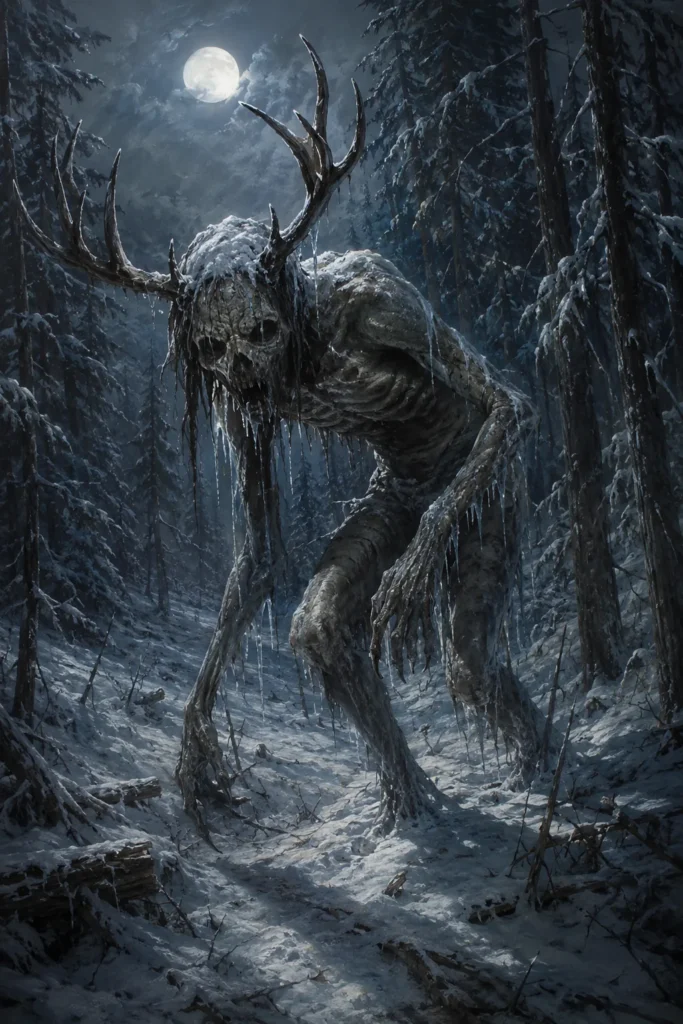
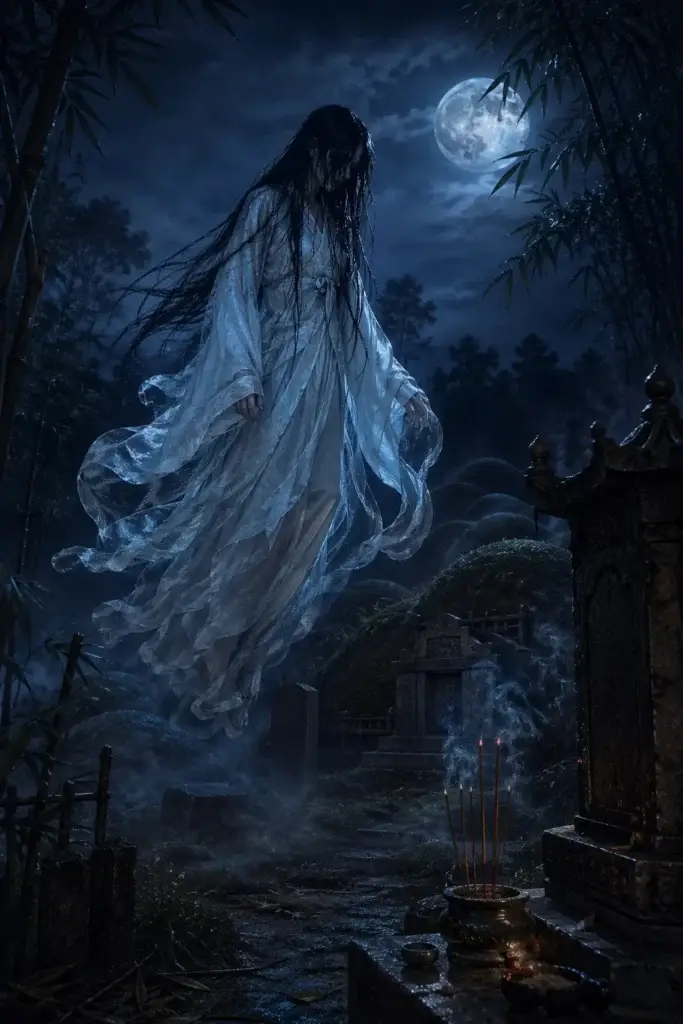
Wendigo - spirits from the Native American tradition, historical-illustrative

The Wendigo, as the Algonquian cannibal spirit, is the central embodiment of hunger, the compulsion of winter, and cultural taboo in the narratives of North American Algonquian-speaking peoples.

Classification within Algonquian Religion

The Wendigo belongs to the malevolent-spirit pantheon of the Algonquian-speaking peoples of the North American woodlands: the Anishinabe (Ojibwe, Chippewa, Algonquin), Cree, Innu, and Naskapi.

Geographically, the distribution of Wendigo narratives extends from the Great Lakes in the south to the Labrador Peninsula in the north, and from the Atlantic coast in the east to the Rocky Mountains in the west. The Wendigo thus represents a pan-Algonquian tradition that is spread with remarkable consistency across linguistic and tribal boundaries.

From a religious-studies perspective, the Wendigo belongs to the class of cannibal spirits, beings that arise through the consumption of human flesh or that themselves consume humans. Structurally comparable beings include the Australian Aboriginal Kurdaitcha, the Slavic and southeastern European vampire, the Japanese Onibaba, and, with significant cultural differences, the Caribbean Soucouyant.

The specific Algonquian Wendigo concept, however, uniquely combines the cannibal motif with the cold motif: the Wendigo is not merely a man-eater but also the personification of cold and hunger.

The earliest European records of the Wendigo come from the reports of French Jesuit missionaries in the first half of the 17th century. Paul LeJeune mentions the being in his Relations of 1636; later Jesuits provided more detailed descriptions.

Modern ethnographic scholarship has been shaped above all by the work of Diamond Jenness (The Ojibwa Indians, 1935), Ruth Landes (Ojibwa Religion and the Midewiwin, 1968), and Basil Johnston (The Manitous, 1995).

One notable observation is that the Wendigo tradition, despite its wide geographic spread, displays considerable regional variation in its details. Among the more northerly Cree and Innu, the ice component is especially pronounced, reflecting the harshest winters in those regions.

Among the more southerly Anishinabe of the Great Lakes area, the social component is more prominent: here the Wendigo is less the personification of cold and more the personification of community-destroying greed.

This regional differentiation has been described by the Canadian anthropologist Heather Howard in Aboriginal Peoples in Canadian Cities (2011) as an example of the cultural-historical diversity of indigenous religion within an apparently unified tradition.

Name and Etymology

The Algonquian name varies by language. In Ojibwe the being is called Wiindigoo or Windigo; in Cree, Witiko or Wetiko; in Innu, Atshen; and in the French-Canadian voyageur tradition (a notable appropriation of indigenous tradition by non-indigenous fur traders), Wendigo.

The standard English spelling Wendigo only became widespread in the 19th century.

The etymology has not been definitively established. Canadian linguist Rand Valentine proposes deriving wiindigoo from a root wiind- (evil, harmful) and a being-suffix -igoo, which would make Wiindigoo literally the evil one. An alternative etymology links the root to the meaning to consume, yielding the consuming one.

Noteworthy is the grammatical function of the word wiindigoo in the Ojibwe language: it is used not only as a noun (the being Wendigo) but also as a verb (wiindigowin, to transform into a Wendigo) and as an adjective (Wendigo-like behavior).

This flexible grammatical use reflects the central place the concept holds in the Algonquian worldview.

Description and Iconography

In traditional Algonquian narratives, the Wendigo is described as a tall, gaunt, emaciated figure. Its body is wasted, the skin stretched tightly over protruding bones; its mouth is lined with long, sharp teeth, its breath is ice-cold and smells of decay.

It is sometimes depicted as a larger-than-human form, several meters tall; at other times as a distorted, dehydrated figure with a skin of ice.

The ice connotation is characteristic: the Wendigo is often described as made of ice or permeated by ice. Its breath is said to produce freezing mist; wherever it goes, the air turns to frost.

This ice component links it to the harsh Canadian winter tradition and makes it the personified perception of the danger that winter brings.

In modern popular iconography, particularly through the spread of the Wendigo motif in horror films and fantasy literature since the 1980s, a distinct visual tradition has emerged that depicts the Wendigo with deer antlers, an animal head, and supernatural proportions.

This visual tradition is not, however, an Algonquian tradition; it is a contemporary popular-cultural appropriation that is frequently criticized in indigenous discourse.

Mythological Narratives

The mythological tradition surrounding the Wendigo is extensive, preserved in numerous versions. One central narrative class describes how a human becomes a Wendigo through the consumption of human flesh.

According to Algonquian belief, this process is irreversible: anyone who has once eaten human flesh, perhaps in a desperate survival situation during a harsh North Canadian winter, develops an insatiable hunger for more and becomes a cannibal spirit.

A second narrative class describes the Wendigo dream: a young man or woman repeatedly dreams of becoming a Wendigo. This dream phenomenon is understood as a serious spiritual crisis requiring ritual intervention.

If the dreams are not addressed, the dreamer may actually slide into Wendigo-being, a mental illness that has been described in the ethnopsychiatric literature as Wendigo Psychosis or Wiindigoo Syndrome.

A third narrative class concerns Wendigo encounters in the wilderness. Young hunters who venture too far from the main group may encounter a Wendigo, usually after dark and often during the snow-heavy winter months.

Such an encounter is almost always fatal; only a few survive to tell of it, and in those cases the person must immediately undergo an elaborate purification ceremony to avoid becoming a Wendigo themselves.

A fourth important narrative class concerns the Wendigo family: in some traditions the Wendigo appears within a Wendigo family unit, with a Wendigo spouse, Wendigo children, and an extended Wendigo household.

This social form of the Wendigo shows that it is not merely a solitary figure of terror but an entire anti-world of its own, said to exist in a parallel existence deep in the remote wilderness of northern Canada and the Great Lakes region.

This Wendigo social world appears in the narratives as a grotesque mirror of human society, with similar structures but entirely cannibal and harmful in nature.

Wendigo Psychosis and the Ethnopsychiatric Discussion

In the ethnopsychiatric literature, the so-called Wendigo Psychosis or Wiindigoo Syndrome is a widely debated concept. It describes a clinical picture in which a person believes they are transforming into a Wendigo, with insatiable craving for human flesh, predictions of their future cannibalistic acts, and in some cases actual cannibalistic behavior.

The psychiatric status of Wendigo Psychosis is contested. Earlier ethnopsychiatric literature (Morton Teicher, Windigo Psychosis, 1960) categorized the diagnosis as a culture-specific psychiatric syndrome.

More recent critical studies, particularly the work of Lou Marano (Windigo Psychosis: The Anatomy of an Emic-Etic Confusion, 1982), have rejected the diagnosis as an ethnographic construct that obscures the actual socioeconomic realities of North Canadian winter hunger.

The religious-studies perspective holds that the Wendigo tradition is primarily a cultural processing of the existential hardship of the North Canadian winter.

In the extreme conditions under which isolated hunter-gatherer families had to survive for weeks or months without resupply, cannibalism was a real threat understood not only as a physical but also as a religious-spiritual problem. The Wendigo is the personified embodiment of this threat and, simultaneously, the ritual-practical form for warding it off.

Protective Practices and Apotropaic Action

Protective practices against the Wendigo form an important domain of Algonquian religion. They center on four areas: avoiding cannibalism even under extreme hardship, purification after possible Wendigo contamination, recognizing signs of Wendigo transformation in oneself or others, and the ritual killing of a confirmed Wendigo.

Concrete protective practices include burning tobacco in the Four Directions before any extended wilderness expedition, spreading buffalo sage and sweetgrass around the camp area, the ritual drinking of fat to strengthen inner warmth (a concrete anti-cannibalistic practice), and wearing small protective amulets made of bone or stone that had been given in a vision.

One particularly striking protective practice is the ritual killing of a confirmed Wendigo. When a person has finally transformed into a Wendigo, usually recognized through their behavior, their predictions, or their cannibalistic acts, Algonquian tradition required that they be killed ritually.

This killing was decided upon and carried out collectively by the community; the body then had to be burned with fire and the heart pierced with iron or stone to prevent return. This practice is documented in several historical cases in Canadian official records, which led to complex colonial-legal confrontations.

Within the Anishinabe Mide religion (Midewiwin, the institutionalized sacred society of the Ojibwe), there are specific ritual procedures for addressing the Wendigo threat. The Mide healer, a high-degree initiate of the Mide society, commands healing procedures against the first signs of Wendigo transformation.

These include drinking rich lard, fumigation with fir resin, the ritual singing of special Mide songs, and in extreme cases the expulsion of the Wendigo spirit through a collective drumming session. Ruth Landes has systematically described this Mide-Wendigo healing practice in her ethnographic works.

Parallels in Other Cultures

The Wendigo has been regularly compared to other cannibal-spirit concepts in comparative religious studies. Structurally comparable beings include: the southeastern European vampire (particularly in the Serbian Vrykolakas tradition), the West African were-hyena, the Mexican Tlazolteotl in her cannibal aspects, the Japanese Onibaba, and the Polynesian Atua-Kasai.

Within North America, the Wendigo tradition is closely related to the Skadegamutc of the Wabanaki and to the cannibal spirits of the Northwest Coast peoples (such as the Hamatsa cannibal dance of the Kwakwaka’wakw).

The latter is of particular interest in the religious ethnology of religion because it transfers a Wendigo-like tradition into ritualized form as a youth initiation ritual.

The psychoanalytic discussion since Jung has interpreted the Wendigo as a symbolic expression of the unconscious shadow aspect. The American psychiatrist John Mack described the Wendigo as a culture-specific embodiment of oral aggression.

These psychoanalytic readings are contested in religious studies because they sacrifice the cultural-historical specificity of the Algonquian tradition in favor of a universalist depth psychology.

An additional parallel can be found in the northern European Troll and Draugr tradition, in which the destructive force of winter and of the unburied dead are likewise combined in a single type of being.

This convergence between widely separated subarctic cultures is of interest in religious ethnology and suggests that the existential experience of the long, dark, hungry winter steers religious imagination in a particular direction. The historical connection between Algonquian Wendigo traditions and Norse Draugr traditions is, however, ruled out; these are convergent developments under similar ecological conditions.

Contemporary Reception and Research

The Wendigo is today one of the best-known indigenous religious figures in Western popular culture. Stephen King’s novel Pet Sematary (1983), Larry Fessenden’s film Wendigo (2001), and numerous other novels, films, and comics have spread the Wendigo motif widely.

This popular-cultural diffusion has, however, frequently distorted the specifically Algonquian religious tradition, reducing it to a free-floating horror figure.

In indigenous academic discourse, the Anishinabe theologian Basil Johnston (The Manitous, 1995) has defended the genuine Wendigo tradition against popular-cultural appropriation.

Johnston interprets the Wendigo as a cultural-critical symbolic figure: it represents the community-destroying force of greed, insatiable consumption, and selfishness. From this perspective, the modern capitalist economy can be seen as a form of collective Wendigo tendency in society.

From a religious-studies perspective, the Wendigo is an important reminder that indigenous malevolent spirits cannot simply be fitted into European demon categories. The specific intertwining of cannibalism, cold, madness, and social crisis in the Wendigo concept is a genuine Algonquian theological construction that deserves its own attention in comparative religious history.

The iWell Guard treatment of the Wendigo tradition presents these findings from a religious-historical perspective, without making any claims about effects or spiritual recommendations. Within the pan-indigenous lexicon context, the Wendigo belongs among the Native American beings of the highest religious-historical interest.

An important recent line of research connects the Wendigo with ecological discourses. The contemporary Anishinabe author Louise Erdrich in her novel The Sentence (2021) and the indigenous activist Winona LaDuke in The Winona LaDuke Reader (2002) have interpreted the Wendigo as a symbol of industrial resource extraction.

This reading connects the traditional Wendigo concept with the modern indigenous climate discussion, turning the cannibal spirit into a cautionary figure against the destructive economics of the fossil age. The Wendigo thereby shifts from an exclusively negative malevolent-spirit figure to a critical reflective figure on the destructive tendencies of human societies.

Literature and Sources

The following selection lists key works on Algonquian religion and ethnopsychiatric research on the Wendigo tradition.

The Ethnographic Documentation among Algonquian Groups

The concept of the Wendigo is found among the Algonquian-speaking groups of the northeastern woodlands and the subarctic region, including the Ojibwe, Cree, and Innu.

The spelling varies considerably because it derives from different languages and recording systems; common forms include wiindigoo in Ojibwe and witiko in a Cree-based rendering. This variety alone shows that the Wendigo is not a single unified figure but a complex of regionally distinct conceptions.

Early references appear in the reports of 17th-century Jesuit missionaries and in the records of fur traders. More systematic documentation was produced in the 20th century, notably by A. Irving Hallowell, who worked among the Ojibwe of the Berens River region, and through studies of the Cree and Innu.

In these sources, the Wendigo appears as a being associated with winter, hunger, and cannibalism. It may be an independent spirit being or a human who has transformed into such a being through the consumption of human flesh.

Scholarship emphasizes that in its original context the Wendigo was no mere horror figure. It stood for a real danger in an environment where winter starvation was a known fate, and at the same time for a moral prohibition.

The consumption of human beings was regarded as the ultimate transgression, and the Wendigo embodied both the temptation and the consequence of that transgression. Any depiction that reduces it to a monster misses this social and moral dimension.

The Debate around the So-Called Windigo Psychosis Concept

A separate strand of research concerns the question of whether there was a distinct mental disorder that older literature referred to as Windigo Psychosis.

Anthropologists of the early 20th century used this term to describe cases in which individuals allegedly developed a compulsive craving for human flesh and believed themselves to be Wendigos. For a long time this concept was treated as an example of a culture-bound syndrome.

Since the 1980s this interpretation has been fundamentally challenged. Lou Marano demonstrated in an influential study that hardly a single documented case can be found to support the diagnosis.

On careful examination, the surviving accounts frequently turned out to be second- or third-hand narratives, killings justified by the accusation of being a Wendigo, or material that had been interpreted from the outside. Marano spoke of a construct of anthropology itself.

Current research regards Windigo Psychosis above all as a case study in the formation of scientific myths. Indigenous authors have added that the fixation on an exotic mental illness obscured the actual understanding of the Wendigo.

In Cree and Ojibwe perspectives the Wendigo has increasingly been interpreted as an image of greed, exploitation, and reckless growth.

Authors such as Basil Johnston, an Ojibwe scholar, have explicitly linked the Wendigo to the destruction of land and community by unrestrained consumption.

This reading is not a purely modern transposition but connects with the original association of the Wendigo with boundless selfishness. The scholarly debate thus reveals two things: the fragility of older ethnographic findings and the vitality of the figure in contemporary indigenous reflection.

Literature (Selection)

  • Basil Johnston: The Manitous (1995)
  • Morton Teicher: Windigo Psychosis (1960)
  • Lou Marano: Windigo Psychosis: The Anatomy of an Emic-Etic Confusion (1982)
  • Diamond Jenness: The Ojibwa Indians (1935)
  • Ruth Landes: Ojibwa Religion and the Midewiwin (1968)
  • Paul LeJeune: Relations (1636)

Related key terms: Wendigo Wiindigoo Witiko Wetiko Algonquian Ojibwe Cree Wendigo Psychosis Hamatsa.

iWell Guard and Protective Traditions

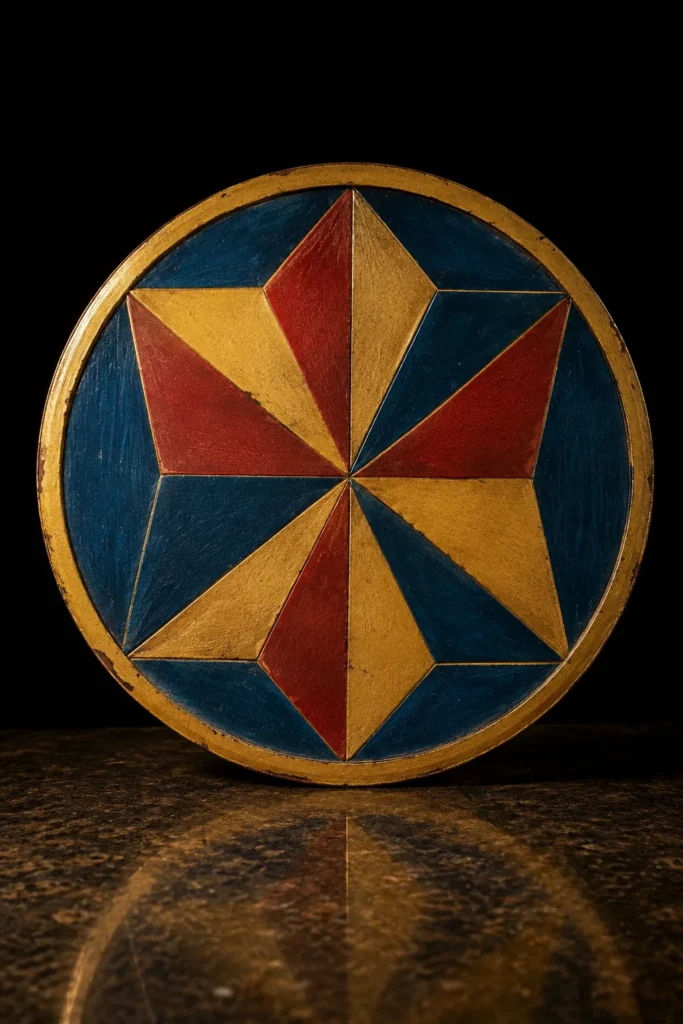
iWell Guard draws on the cultural-historical tradition of wearable protective objects, in the tradition of Native American and many other cultures worldwide. 41 levels, real gold, platinum, silver, crafted in Germany. 30-day return policy.

Individual experiences may vary. Not a medical device. No healing promises.

Classification & Protection

VLEVEL
The Protection Compass assigns this being to influence level V, Profound influence.

Against its influence, cross-cultural tradition names these protective means:

Compare in the Protection Compass →

Recommended protective means

iWell Guard

The simplest protective means in this collection: 41 layers of fine gold 999, platinum, silver and silicon, manufactured in Ruhla, Thuringia. It requires no activation, is bound to no person, and is effective within a radius of around 50 meters, even without being worn.

All protective means at a glance →