Dangun, God of the Korean Tradition
By Ralf Ittermann · last reviewed on
Dangun is the god of the Korean foundation mythology and is regarded as the legendary founder of the first Korean state, Gojoseon. His veneration is closely interwoven with the formation of the state and the collective memory of Korea, and he remains a symbol of national identity and legitimacy.
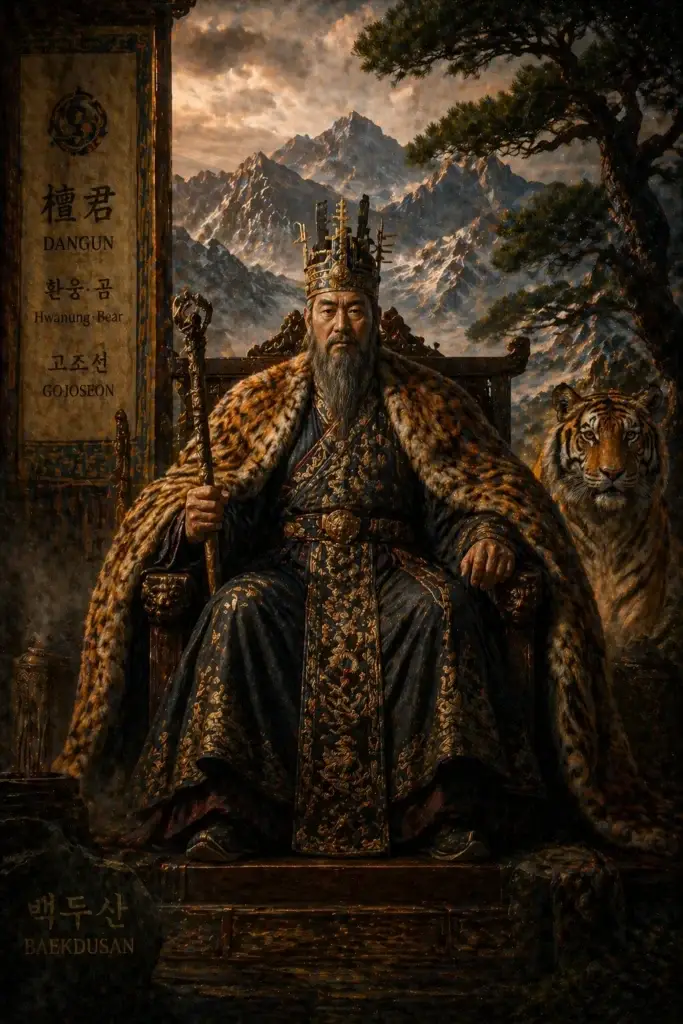
Dangun
In the Samguk yusa, Dangun is portrayed as the son of the sky god Hwanung and a human woman. He founded Gojoseon in the year 2333 BCE and ruled from his capital Asadal.
His foundation narrative joins divine and human lineages: the mortal Dangun mediates between the celestial and the earthly realm. Unlike purely divine figures, Dangun occupied, as king, a historical-mythological role that grounded the legitimation of rule in divine descent.
At a Glance: Dangun
The central source is the Samguk yusa (Memorabilia of the Three Kingdoms) by the monk Iryon from the 13th century. The Dangun legend is transmitted regionally throughout Korea and forms one foundation of modern national historiography.
In the 20th century his feast day (3 October, Gaecheonjeol) was incorporated into the national festival calendar. James H. Grayson and other scholars of religion treat Dangun as an interface between shamanic-mythological and Confucian-legitimizing tradition.
Context
Period of the Texts
The continuity of the tradition over these long spans of time is remarkable and shows a deep, stable cultural rootedness. Even in modern times the memory and sometimes also the active veneration remain alive, sometimes transformed, yet still recognizable in their basic features.
Mythological Classification
Dangun (단군, “sandalwood lord”) is a legendary historical figure, founder of the ancient Korean kingdom of Gojoseon (2333 BCE according to legend). He is venerated as the son of the heavenly prince Hwanung and a she-bear. His genealogy joins human and celestial lineages, a classic feature in East Asian mythologies.
Area of Distribution
Dangun was not confined to a particular region or to specific locations, but was universally known and venerated, or respectfully feared, throughout the Korean world.
This clearly points to a central role in the self-understanding of the whole people. Trade, migration and cultural exchange contributed to its geographical spread and to the stable uniformity of its veneration.
Source Situation
The Dangun tradition is documented in the Samguk yusa, which was composed around 1281 by Iryon. The oldest references probably derive from proto-Korean traditions, but become tangible in literary form only with this source. Further mentions are found in later chronicles such as the Dongguk yeoji seungnam (Geographical Survey of the Eastern Country).
In his study “Korea, A Religious History”, James H. Grayson identifies Dangun as a synthesis of sky worship and ancestor veneration. Yi Sang-ok and other Korean scholars of religion examine his role in the transition from mythology to historical narrative.
Name and Variants
In the various sources and artistic traditions, Dangun is depicted with certain recurring iconographic elements that remain relatively constant across decades and across different geographical regions. These elements are not purely decorative or chosen at random, but are deeply coded symbolically and carry great meaning.
They centrally convey the functions, sources of power, area of responsibility and cosmic role of the being.
The overall system is like a sacred script or a coded image; it allows the initiated or the culturally educated to grasp and correctly understand the essential deeper meaning. Colors, sacred objects or weapons, bodily attributes, specific accessories, everything is significant and traditionally transmitted.
Characteristics
Dangun was less an object of popular cult than of state and elite religion and was regarded as the founder of the realm. People turned to this entity in critical or particular life situations or at certain ritual times of year, with structured, often elaborate rituals, prayers or offerings.
The memory of Dangun was cultivated in ordered forms: the monk Iryeon recorded the founding narrative in the thirteenth century in the Samguk Yusa, drawing on older sources, and later Korean dynasties held state rites in honor of the founder of the realm. In the twentieth century, the Daejonggyo religion incorporated the veneration of Dangun into a fixed doctrinal form. The handling of the figure thus lay with scholars, officials, and religious communities with regulated practice.
The continuity of these practices over many generations clearly shows that the practice was regarded as effective and necessary. The functions were varied: some were preventive (warding off potential misfortune), some healing (relieving illness or suffering), some transformative (accompaniment through transitions between life stages).
Appearance and Symbolism
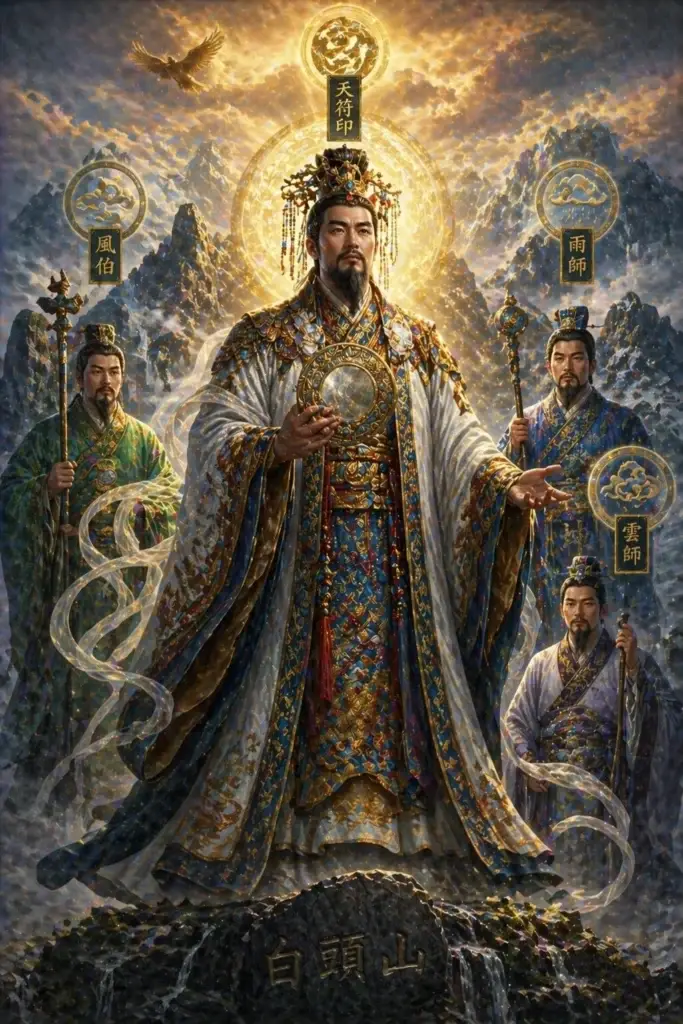
Dangun is depicted as a young, powerful leader in traditional Korean clothing, often with a scepter or sword. He is sometimes shown with mythological attributes (a celestial aura, mountains, eagles). His color is often gold or red, royal colors. He often sits on a throne or on a mountain.
Profile: Dangun
The Profile presents Dangun under six aspects: the origin and dating of his legendary foundation, the social groups that venerated him, his iconographic depiction, references to protection and the state cult, as well as cultural parallels in neighboring traditions. Together these dimensions yield a picture of his function within the Korean religious framework.
Dangun is depicted as the son of the sky god Hwanung and the she-bear goddess Ungnyeo. The legendary foundation of Gojoseon took place in 2333 BCE at Asadal (presumed location: Manchuria or the northern peninsula).
Archaeologically a dating is difficult; in terms of the history of religion the legend is understood as a mythological construct of the formation of the state. The literary fixing occurs only with the Samguk yusa of the 13th century, by which a locally orally transmitted foundation myth was canonized in writing.
Dangun was venerated by kings, state officials and the educated elite as the embodiment of legitimate rule. In the early 20th century his cult became part of modern Korean nationalism, especially under Japanese colonial rule, where Dangun served as a symbol of independence and cultural continuity.
His veneration was less a folk cult than a religion of the state and the elite, and later also a national ideology. To this day, state ceremonies are held on the day of his foundation (3 October).
In modern depictions Dangun is shown as a young king with crowns and insignia of rule, sometimes with a divine halo. In older images he wears the robes of the Three Kingdoms period. Typical attributes are the royal staff or scepter, the seal of Gojoseon and the banner.
He is often depicted in scenes of the founding of the state: at the foundation ceremony at Asadal or being venerated by his subjects. The iconography blends features of a divine being (radiance, aura) with those of an earthly ruler.
Dangun is not a harmful being, but a cultural figure of protection. Veneration takes place through state rituals and national feast days (Gaecheonjeol on 3 October). Traditionalist schools offer commemorative ceremonies in which Dangun is invoked with respect as the forefather of Korea.
In traditional shamanism he is venerated less centrally; his veneration is primarily Confucian and national in character. Reverence is shown through commemorative observances and written acts of veneration, not through protective rituals against harm.
Comparable are mythological founders of states in other cultures: Yu the Great in China (the saga of taming the flood and founding a dynasty), Aeneas in the Roman foundation legend (mediator between the divine and the human) and Ragnar Lothbrok in the Scandinavian tradition (mythical founder of dynastic lines).
Common to all is the linking of divine descent with the historical founding of a realm and the legitimation of ruling orders through mythical genealogy.
Dangun, Parallels in Other Cultures
Rituals and Veneration
Dangun Day (3 October according to the Gregorian calendar, the 3rd day of the 10th month according to the traditional lunar calendar) is a national holiday. At the Dangun shrine, ceremonies were carried out with offerings, grain offerings, libations and later, after Confucianization, incense sticks. Military ceremonies honored him as the guardian of the concord of the state.
Invocations and Appeals
Classical invocations emphasized warrior strength and royal legitimation: “Dangun, founder of our people, preserve our unity.” In Confucian ceremonials, rituals were performed for the state and the court. Modern nationalist symbolism refers to him as the embodiment of Korean independence.
Amulets and Protective Symbols
The Taegeuk symbol (red-and-blue yin-yang) on the flag represents his cosmology. The “Dangun talisman” with three crowns was a symbol of the three kingdoms (Goguryeo, Baekje, Silla). Historical scroll seals showed his ruler iconography.
Jewish tradition: In Judaism there is no direct equivalent to Dangun as a state-founding god. The Jewish tradition knows the legitimation of kingship through prophecy (King David), not through divine descent.
Abraham as patriarch represents a functional similarity: both mediate between a divine promise and human descendants, but Abraham is not a state founder in the political sense.
Greco-Roman world: Romulus and Remus in the Roman foundation legend correspond to Dangun in their role as founders of the state. Both are portrayed as sons of a god (Mars) and a mortal woman.
The founding of Rome (753 BCE according to the traditional chronology) resembles the legendary founding of Gojoseon in its mythological transfiguration. Romulus and Dangun function as national symbols and as sources of legitimation for rule.
Mesopotamia: The Sumerian king Gilgamesh is described as two-thirds god and one-third human, similar to Dangun as the son of Hwanung. Both embody the boundary between the realm of gods and that of humans.
However, Gilgamesh was a transmitted king with legendary additions, while Dangun is purely mythological. The veneration differs: Gilgamesh was venerated in a heroic, commemorative manner, Dangun in a national-cultic manner.
India/Asia: In the Indian tradition, the role of Krishna as an incarnation and founder of states (the establishment of Dwaraka) is similar.
In China too, Yu the Great is venerated as a god-man who founds the new order through cosmic taming of the flood. Common to all these figures is the blending of a divine origin with a historical or quasi-historical founding of a realm.
Dangun as Founder of Gojoseon
Dangun, by his full name Dangun Wanggeom, is in the Korean tradition the founder of the first Korean state, Gojoseon, the “Old Joseon”.
According to the account of the Samguk Yusa from the 13th century, he is the son of the son of heaven Hwanung and the bear-woman Ungnyeo. He thus unites celestial and earthly descent within himself and is, as such, destined to rule over humankind.
The text gives a concrete, if mythical, chronology. Dangun is said to have ascended the throne and established his capital in the year traditionally equated with 2333 before our era; Asadal is named as his residence, a place associated with the region of present-day Pyongyang.
Dangun is said to have ruled and lived for an extraordinarily long time; the text gives figures in the range of one to two thousand years, which underscores the mythical nature of the account.
At the end of his rule, according to the tradition, Dangun withdrew and became a Sansin, a mountain god. His story thus ends not with an ordinary death, but with a deification.
This construction is significant in the history of religion: Dangun is at once a mythical forefather, the first king and a deity.
He stands at the beginning of Korean political history and connects it with the celestial sphere. Scholarship sees in the Dangun account a foundation and legitimation myth that traces the existence of a Korean commonwealth back to a divine origin.
The Question of Dating and the Korean Foundation Myth
The traditional foundation date of 2333 before our era requires a careful, source-critical classification. This figure derives from the statement in the Samguk Yusa that the founding by Dangun took place during the reign of a legendary Chinese ruler, and from later chronological calculations by Korean scholars.
It is therefore a result of medieval and early modern historical construction, not a historically secured date.
Archaeological and historical research cannot demonstrate a state organization in the North Korean and Manchurian region for the third millennium, but only for a considerably later time; on the precise beginnings of Gojoseon as a real political entity there is no complete agreement in scholarship, yet no one places them as early as the myth does.
It is methodologically decisive to distinguish between the mythical foundation date and the actual early history. The Dangun account is a mythical narrative about origins, not a historical record.
Nevertheless the traditional date has unfolded a considerable practical effect. The Korean era reckoning Dangi counts the years from this mythical year of foundation and was for a time in official use in South Korea.
The presumed day of foundation is observed as Gaecheonjeol, the “Day of the Opening of Heaven”, as a legal holiday.
Here it becomes apparent how a mythical date can become a firm point of reference for a national identity.
For a scholarly account the rule is: the date 2333 is to be presented as a traditional setting of religious and national significance, not as a historical fact. This distinction takes nothing away from the cultural significance of the myth, but classifies it correctly.
From Myth to National Symbol: The Modern Veneration of Dangun
Dangun has passed through several phases of differing significance in Korean history, and his present-day role is essentially a product of the modern era. In the Joseon period Dangun was indeed recognized as a forefather and received state veneration alongside the Chinese-shaped Confucian cult.
He gained an entirely new significance, however, in the late 19th and early 20th century, in the period of threat from foreign powers and Japanese colonial rule.
In this phase Dangun became the central symbol of an independent Korean identity. He offered an origin that was older than and independent of China and Japan, and that grounded the Korean people as a unified community descended from a common forefather.
With Daejonggyo there even arose a religion of its own that placed Dangun as a divine ancestor at its center and that played a role in anticolonial resistance. The Japanese colonial administration accordingly regarded the veneration of Dangun critically.
After liberation and division the Dangun myth continued to have effect in both Korean states, though accentuated differently. In South Korea he remained present as a cultural point of reference and through the holiday Gaecheonjeol.
In North Korea the discovery of an alleged tomb of Dangun was announced in the 1990s and used for propaganda, a process that international scholarship regards with great skepticism.
This modern history shows that Dangun is by no means only a figure from the medieval collection of myths, but a figure on which national self-assertion, religious renewal and political instrumentalization have fastened. A serious account must take this history of reception into consideration without adopting the respective political interpretations.
Further Links
Sources and Literature
Further standard works in the literature index.