St. John's Wort: Protective Plant of the Solstice
By Ralf Ittermann · last reviewed on
In Latin botany, St. John’s wort bears one of the most expressive popular bynames a medicinal plant has ever received: Fuga daemonum, the flight of the demons.
This name, attested since the Middle Ages in botanical and theological texts, sums up the core of the folkloric tradition: the herb, which stands in full bloom around St. John’s Day on 24 June, is said to keep demons, night-mares and harmful spirit beings away from the house.
St. John’s wort is part of the protective substances and protective plants and holds a special position among the protective plants, because it bears a Latin protective name that is attested in botanical and theological texts: the designation Fuga daemonum indicates that this protective attribution was known in medieval scholarship and was documented in botanical and theological texts. Important: this page deals exclusively with the folkloric protective tradition.
Medical or pharmacological statements about the herb are not the subject of this article.
Quick overview
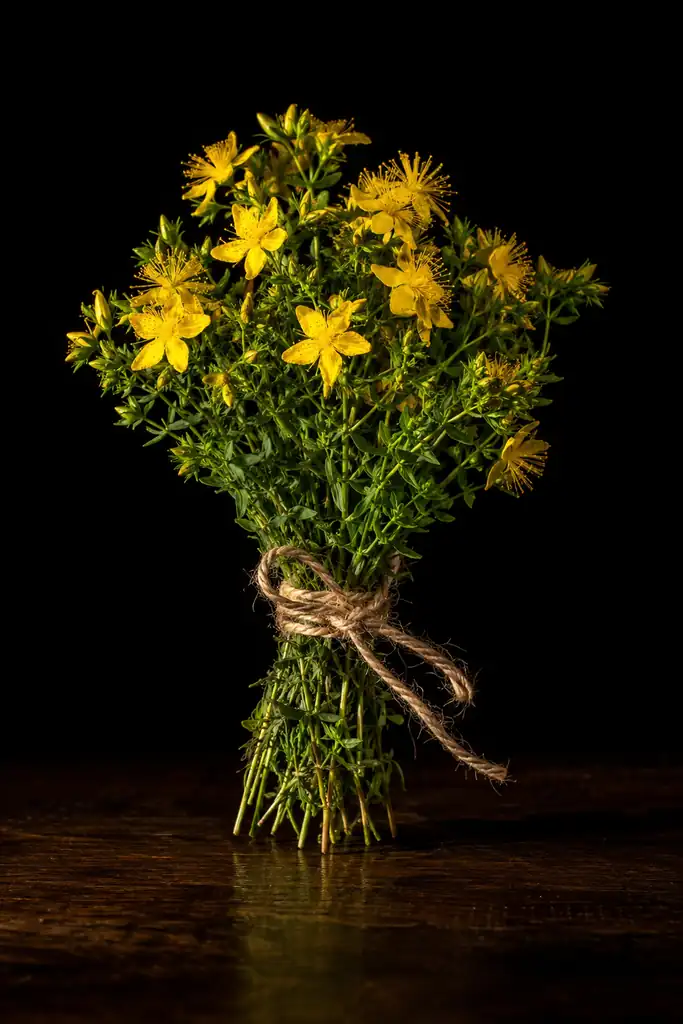
In tradition, St. John’s wort is regarded as a protective plant against demons, night-mares and general nocturnal influence. The herb is dried and hung in bunches above entrances, in window frames and beside beds.
Herb gathered on St. John’s Day is considered especially potent. The golden-yellow flowers and the red dye of the crushed leaves are interpreted in tradition as a sign of the power of light that pushes back the darkness.
Origin and tradition
The name St. John’s wort refers to John the Baptist, whose feast day is celebrated on 24 June. The summer solstice falls shortly before this date, and in folk tradition the bonfire customs of pre-Christian usage merged with the Christian veneration of saints.
Plants harvested at this time were considered especially potent, because they had absorbed the maximum of the sun’s power within them.
Hypericum perforatum, the botanical name of the plant, contains a clue in its species name: when held up to the light, the leaves show fine perforations, which in folk tradition were interpreted as puncture marks or wounds. This connection with the suffering of the Baptist reinforced the religious charge of the herb.
In the medieval botany of Konrad von Megenberg (Buch der Natur, 14th century), St. John’s wort is mentioned in the context of warding off demons and night-mares. Paracelsus, the physician and natural philosopher of the early 16th century, describes the herb in the contexts of light, purification and the warding off of spirits.
In German folk tradition, documented in detail in the Handwörterbuch des deutschen Aberglaubens, the hanging up of bunches of St. John’s wort at Midsummer is among the most widespread domestic practices.
Anyone who forgot to cut fresh herb on St. John’s Day and hang it above the door was, in some regions, considered unprotected for the coming year.
Working principle according to tradition
Tradition grounds the protective effect of St. John’s wort on several levels.
The attribution to light is the strongest. The herb blooms an intense yellow at the time of the year’s longest hours of daylight, and the red dye hypericin, which seeps from the crushed flowers, was interpreted as congealed sunlight or as the symbolic blood of the solar saint.
According to this logic of tradition, beings that seek the dark cannot withstand this concentrated power of light.
Added to this is the timing: plants harvested at Midsummer stand, in folk belief, at the peak of their natural power.
In this view, the boundary between the ordinary strength of a plant and its protective effect lies not in chemistry but in the moment of the harvest and the cosmic constellation of energy associated with it.
Finally, the designation Fuga daemonum contributes to the depth of the tradition: when even the Latin learned botany of the Middle Ages named this herb in connection with warding off demons, folkloric practice found a backing in written culture.
Cross-cultural distribution
St. John’s wort as a protective plant is primarily a Central European phenomenon, but it has also left traces in neighbouring cultures.
In Central and Western Europe, the Midsummer protective practice is documented comprehensively. From Bavaria across Austria, Switzerland and France to Poland and the Baltic countries, the hanging up of St. John’s wort at St. John’s Day appears as a uniform protective custom.
In Scandinavia, similar solstice-herb practices are known. The herb itself is rarer, but the logic of the solstice herb as a protective plant finds equivalents in local herbs such as valerian.
In Southern Europe and the Mediterranean region, St. John’s Day is likewise widespread as a harvest date for magical herbs, and in some regions of Italy and Greece St. John’s wort plays a role similar to that in the German-speaking area.
In North Africa and the Near East, the plant is less present as a means of protection, but in some Berber and Arabic folk-medicine sources it is associated with the warding off of spirits.
What it is used against
According to tradition, St. John’s wort is regarded as protection especially against:
Against demons and demonic influence: the name Fuga daemonum states this directly. The herb is said to keep demons out of rooms and to compel them to leave a household in which it is hung up.
Against night-mares and incubi: in Central European folk tradition the Alp, a night spirit that sits on sleeping people and torments them in nightmares, is a principal target of the St. John’s wort protective practice. Bunches on bedsteads and above bedroom doors are meant to keep the Alp away.
Against witches and harmful magic: St. John’s wort hung at doors and windows is also regarded as protection against the intrusion of witches or the effect of harmful magic directed at the house.
Against general evil influence in the solstice period: in folkloric practice, Midsummer marks the beginning of the “more dangerous half of the year”, in which supernatural forces are said to be more active. The fresh herb is regarded as seasonal protective equipment for this time.
Application and limits
Dried bunches are hung above entrances, in window frames and in bedrooms. According to tradition, the optimum lies at St. John’s Day itself or shortly before: the herb cut then carries the full power of the sun.
Herb harvested outside this time is considered, in a strict reading of tradition, to be less effective.
Some traditions require that the herb be harvested without iron tools, that is, with bare hands or with a wooden knife, so as not to disturb the natural power. Others see no such restriction.
The protective effect is bound to the place where the herb hangs: it protects the room, not the person who leaves the room. For personal protection while travelling, the herb was sewn into a protective pouch in other traditions.
No medical claims of effect are associated with this tradition.
Literature (selection)
Related key terms: st johns wort protection fuga daemonum demon herb folk belief.
iWell Guard and protective traditions
The tradition of St. John’s wort shows how light and nature together shaped a protective notion that remained alive over centuries.
The idea that certain plants and substances, gathered at the right time and in the right place, unfold a protective effect connects with the concept of the iWell Guard, an object that unites within itself the strands of tradition of protective thinking from many cultures.
Personal experiences may vary. Not a medical device. No promise of healing.